Dissertation Writing Help After an External Examiner’s Report
By Writing Gram • Sep 23, 2026
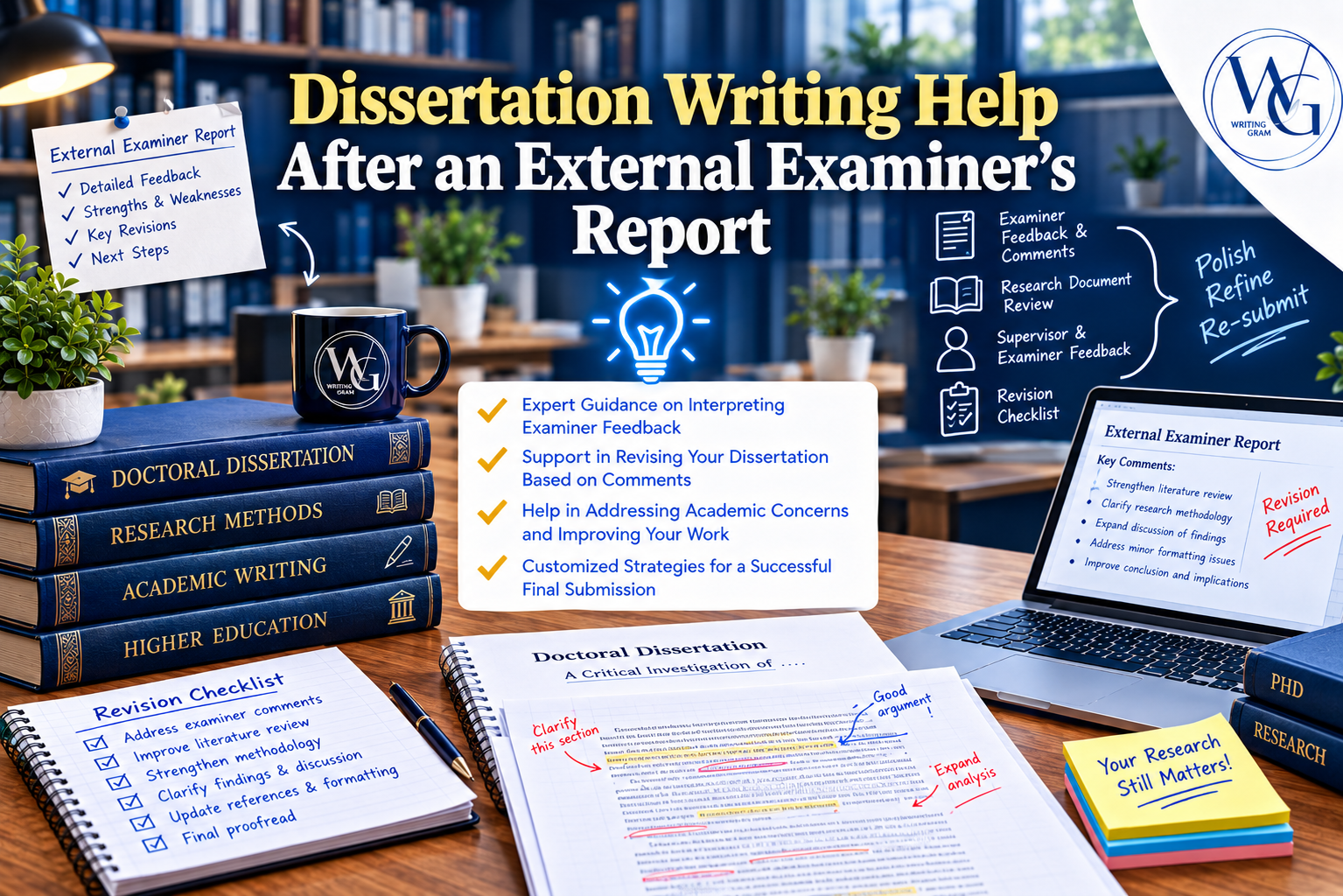
Need dissertation help after an examiner's report? Get expert revision support to address examiner feedback, strengthen chapters, and prepare your dissertation for resubmission.
An external examiner’s report can require more than correcting individual sentences or responding to isolated comments. Dissertation writing help can assist doctoral students in translating examiner feedback into a structured revision plan, identifying which chapters need changes, strengthening affected sections, and checking that revisions remain consistent across the dissertation before resubmission.
What an External Examiner’s Report Can Require You to Change
An external examiner’s report should be treated as a set of connected dissertation requirements rather than a list of individual edits. A comment about your research questions, methodology, findings, or conclusions may require changes in several chapters to keep the dissertation consistent.
The first step is to determine what each supervisor comment actually requires. Some comments may involve minor corrections, while others may require additional explanation, restructuring, stronger justification, or substantial rewriting.
The University of Michigan Rackham Graduate School identifies several levels of dissertation revision. Some dissertations are accepted as submitted, while others need minor corrections, minor substantive changes, or substantial revisions. Knowing which level applies to your dissertation helps you understand the amount of work required before you begin making changes throughout the document.
A comment should therefore be read in context. If an examiner questions the relationship between your research questions and findings, changing one paragraph in the introduction may not be enough. You may also need to review the methodology, results, discussion, and conclusions to make sure they continue to address the revised research questions.
✍️ Turn Examiner Feedback Into a Stronger Dissertation With Writing Gram
Writing Gram provides dissertation writing help for doctoral students who need to turn examiner feedback into meaningful revisions in their dissertations. Instead of simply correcting individual comments, Writing Gram helps you revise the sections affected by the examiner’s feedback as a whole. This helps strengthen your explanations, connect your chapters, align your analysis with your research questions, and ensure your Discussion and conclusions accurately reflect your revised findings.
When an examiner’s report requires changes across multiple chapters, Writing Gram helps you revise those sections while keeping your research questions, evidence, analysis, interpretation, and conclusions consistent throughout the dissertation. This helps strengthen the links between chapters, ensure your conclusions are supported by your revised findings, and make sure the changes you submit directly address the examiner’s comments.
👉 Place your order now for dissertation revision help with examiner-required changes and get support revising affected chapters, strengthening your dissertation’s argument, improving connections between your research questions, analysis, and conclusions, and ensuring your revised dissertation addresses the examiner’s feedback.
How to Turn Examiner Feedback Into a Dissertation Revision Plan
Instead of opening your dissertation and responding to comments in the order they appear, create a revision plan that shows where each examiner comment affects the document.
You can follow these steps to help you revise your dissertation and ensure that you address all the feedback and comments effectively:
i. Group examiner comments by dissertation chapter
Start by placing every comment alongside the chapter or section it affects. A comment about the literature review may primarily concern one chapter, while a methodological concern may require changes to the methodology and later interpretation of the findings.
This gives you a working map of the revision. It also reduces the risk of making the same change several times because you did not initially identify every place where an examiner's point applies.
ii. Identify comments that affect multiple chapters
Some revisions should not be treated as isolated edits.
For example, if an examiner questions the wording or scope of a research question, check whether that wording appears in your objectives, methodology, results, discussion, and conclusions.
Likewise, if an examiner asks you to clarify how a method supports your research objectives, you may need to revise the methodology and then check whether the interpretation of the resulting evidence still flows logically.
iii. Separate required revisions from supporting improvements
Identify the underlying problem before deciding how much writing needs to change.
If an examiner says that a claim is insufficiently supported, the appropriate response might involve adding evidence, qualifying the claim, improving the explanation, or restructuring the discussion. Rewriting several pages without addressing the actual problem can create additional work without resolving the examiner's concern.
iv. Create a revision-tracking document
Your revision-tracking document should contain:
Affected chapter or section
Required change
Evidence or source needed
Revision completed
Once every comment has been mapped, you can work through the dissertation systematically rather than repeatedly switching between the examiner's report and different chapters.
Which Dissertation Chapters May Need Revision After an Examiner’s Report?
The required changes depend on the examiner's report, but feedback that affects the substance of your dissertation may require revisions in several connected chapters. The areas below are among the most likely to require revision, depending on the issues raised in your examiner’s report.
i. Research Questions and Objectives
An examiner may identify a weak connection between the research questions, objectives, methods, and findings.
If an examiner asks you to change a research question, you should also check the other chapters that depend on that question. The methodology should explain how you investigated the revised question, the Results should present evidence that addresses it, and the Discussion and conclusions should explain what those findings mean and provide an answer to the question. This helps ensure that changing the research question does not create inconsistencies between your methodology, findings, interpretation, and conclusions.
ii. Literature Review
A request for additional literature does not necessarily mean adding citations at random. You may need to explain how the relevant studies affect the theoretical framework, research gap, interpretation of your findings, or justification for the study.
The important question is not simply “Where can I add another source?” but “What part of my argument does this literature change or strengthen?”
iii. Methodology
An examiner may ask you to clarify your research design, sampling, data collection, analytical procedures, methodology, or study limitations.
Address the specific concern rather than adding technical terms that do not explain your research decisions. If the examiner's concern affects how the evidence should be interpreted, check the results and discussion as well.
iv. Results and Interpretation
A request for clearer results does not automatically mean that you need to conduct new analysis.
Sometimes the problem is that the dissertation reports the findings without sufficiently explaining what they mean in relation to the research questions. Revision may therefore involve improving the explanation of the results, correcting inconsistencies, or making the relationship between the evidence and interpretation more explicit. This may also include explaining the effect size to show how large an observed relationship or difference is and discussing its practical significance to explain what that finding means in the context of the study. These revisions help readers understand not only whether a finding is statistically significant, but also how large it is and whether it has meaningful implications for the research question.
v. Discussion and Conclusions
The discussion may require significant attention when examiner feedback concerns unexpected findings, rejected hypotheses, or the interpretation of your results.
The revised discussion should explain unexpected findings and rejected hypotheses in relation to the evidence, research questions, and relevant literature without claiming more than the results support. The conclusions should then reflect these findings rather than simply repeating the original expectations or an earlier version of the dissertation.
How to Check That Examiner Revisions Are Consistent Across Your Dissertation
Completing every individual correction does not necessarily mean that the dissertation has been fully revised. After making the requested changes, perform a separate consistency review.
Start with terminology. Check that variables, concepts, participant groups, research methods, and key findings are described consistently throughout the dissertation.
Next, check research-question alignment. If an examiner's comment resulted in a change to a research question or objective, confirm that the methodology explains how it was investigated and that the Results, Discussion, and conclusions address the revised wording.
Then review tables and figures. Changes to sample sizes, statistical values, categories, labels, or findings can make references elsewhere in the dissertation inaccurate.
You should also review cross-references. If a revised section refers to another chapter, table, figure, appendix, or finding, confirm that the reference still points to the correct material.
The University of California, Berkeley Graduate Division states that changes are normally not allowed after a dissertation manuscript has been filed and places responsibility on the student to ensure that the manuscript is in its final form before submission.
After making the required revisions, review the entire dissertation to check that the changes are consistent throughout the document. If you revise your Results but fail to update the Discussion, conclusions, abstract, tables, or cross-references, the dissertation may contain contradictions even though you have addressed each examiner comment individually.
Finally, review the abstract. If examiner-required revisions substantially change your findings, interpretation, or conclusions, the abstract may need to be updated as well.
What to Do If You Disagree With an Examiner’s Dissertation Comment
You do not necessarily need to change your dissertation blindly whenever an examiner raises a concern. First determine what the examiner is asking you to address.
The comment may be requesting additional evidence, a clearer explanation, a stronger justification, a qualification of a claim, or a different organization of the discussion.
Understanding the underlying concern helps you make a revision that addresses the issue without changing conclusions that are supported by your research.
If you believe a requested change conflicts with your research design or evidence, follow your university's procedures and discuss the matter with the appropriate academic authority. Do not introduce unsupported findings simply to make the dissertation appear to satisfy a comment.
The University of Texas at Austin Office of Graduate and Postdoctoral Studies explains that when revisions are required after a doctoral defense, the revisions must be completed to the satisfaction of the committee before the dissertation is finalized. Your own institution's procedures should take precedence because examination and revision requirements differ between universities.
📝 Get Dissertation Revision Help to Address Examiner Feedback
Writing Gram helps doctoral students turn examiner feedback into coordinated revisions across their dissertations. If you understand what your examiner wants you to change but are struggling to apply those changes across multiple chapters, Writing Gram can help you revise the affected sections while keeping your research questions, findings, analysis, discussion, and conclusions consistent and connected.
This is particularly relevant when:
one examiner comment affects several chapters;
revisions to the results require corresponding changes to the discussion;
you have made individual corrections but the dissertation now contains inconsistencies;
your pilot study failed to produce the expected results and you need to revise the dissertation around what the pilot revealed;
your dissertation proposal was rejected and you need to revise the research questions, literature review, methodology, or study design before proceeding;
sections need substantial rewriting to explain your argument more effectively;
you need help connecting revised findings to your research questions;
you need another review of the revised dissertation before submission; or
you have a short revision deadline and a large amount of writing to complete.
We work from your existing research, evidence, examiner feedback, and dissertation requirements to make the required revisions without changing what your research actually established. We can help you identify which sections need to change, revise the affected chapters, strengthen explanations, improve connections between your research questions and findings, and ensure that changes made in one chapter are reflected consistently throughout the dissertation.
The University of Pennsylvania states that during its dissertation examination, the committee discusses needed revisions or changes with the student and that members provide written advice concerning those revisions or changes.
For complex examiner feedback, we can also review how the revisions affect your results, analysis, discussion, conclusions, tables, and other related sections. This helps you submit a dissertation in which the required changes have been addressed while the argument, evidence, interpretation, and conclusions remain consistent across the document.
👉 Place your order now for dissertation revision help after receiving examiner feedback. We help you strengthen the explanations in your dissertation, connect your results and discussion to your research questions, align your conclusions with your evidence, and make sure the required revisions remain consistent throughout the document before resubmission.
What to Provide for Dissertation Revision After Examiner Feedback
To revise your dissertation effectively after examiner feedback, we need to see the documents and information that explain the required changes and the university’s requirements for resubmission. To help us understand your examiner’s requirements and revise the right parts of your dissertation, please provide the following documents and information:
1. External examiner’s report
Provide the complete report rather than selected comments whenever possible. The complete report helps us understand what the examiner expects you to change and identify the sections of your dissertation that need revision.
2. Current dissertation
Provide the latest version of the dissertation so the requested revisions can be connected to the existing chapters, arguments, tables, figures, references, and conclusions.
3. University revision instructions
Include any formal instructions concerning examination revisions, resubmission, formatting, response documents, or approval procedures.
4. Response-to-examiners document
If your university requires a response or revision matrix, include it with the examiner's report. It can show how each comment is expected to be addressed.
5. Submission deadline
State the deadline clearly. This helps establish the amount of revision work that needs to be completed within the available time.
6. Priority chapters or sections
Identify areas where you already know substantial revision is required. This is particularly useful when the examiner's report covers several chapters.
7. Our Dissertation Revision Checklist
Before placing your order, use this checklist to make sure you have provided the information we need to understand the required revisions:
☐ Complete external examiner’s report
☐ Latest version of your dissertation
☐ University instructions for dissertation revisions and resubmission
☐ Response-to-examiners document or revision matrix, if required
☐ Dissertation submission deadline
☐ Chapters or sections that require the most revision
☐ Any specific instructions from your supervisor or graduate school
☐ Tables, figures, appendices, or other supporting files that need to be revised
☐ Any previous revision notes that explain changes already made
Providing these documents and information helps us understand what the examiner has requested, which parts of your dissertation need to change, and what your university requires for resubmission. This makes it easier to plan the revisions, update connected sections, and ensure that your dissertation is coherent throughout before you submit it again.
The University of Wisconsin–Madison provides official doctoral-degree guidance covering dissertation defense and committee information, including the final oral examination and dissertation approval process.
Once you have the examiner's report, dissertation, university requirements, and deadline ready, you have what you need to plan the revisions effectively. You can identify the required changes, map them to the relevant chapters, complete the revisions, and perform a final consistency check before resubmission.
Get Your Dissertation Revised to Address Examiner Comments, Strengthen Key Chapters, and Prepare for Resubmission
Writing Gram provides dissertation writing help for doctoral students who need to revise their dissertation after receiving an examiner's report. This may involve strengthening weak explanations, expanding areas that need more support, correcting problems in the interpretation of your findings, and revising the discussion and conclusions so they accurately reflect the evidence in your dissertation.
If your examiner's comments affect several chapters, Writing Gram can help you address each required change, correct inconsistencies created by the revisions, strengthen sections that need more explanation, and ensure the revised dissertation reflects the examiner's requirements before resubmission.
👉 Place your order now for dissertation writing help after an external examiner’s report and get your dissertation revised to address examiner comments, strengthen affected chapters, correct inconsistencies, align your findings with the discussion and conclusions, and prepare the complete dissertation for resubmission.