Dissertation Help: How to Write a Dissertation Abstract That Gets Positive Examiner Attention (Expert PhD Guide)
By Writing Gram • May 20, 2026
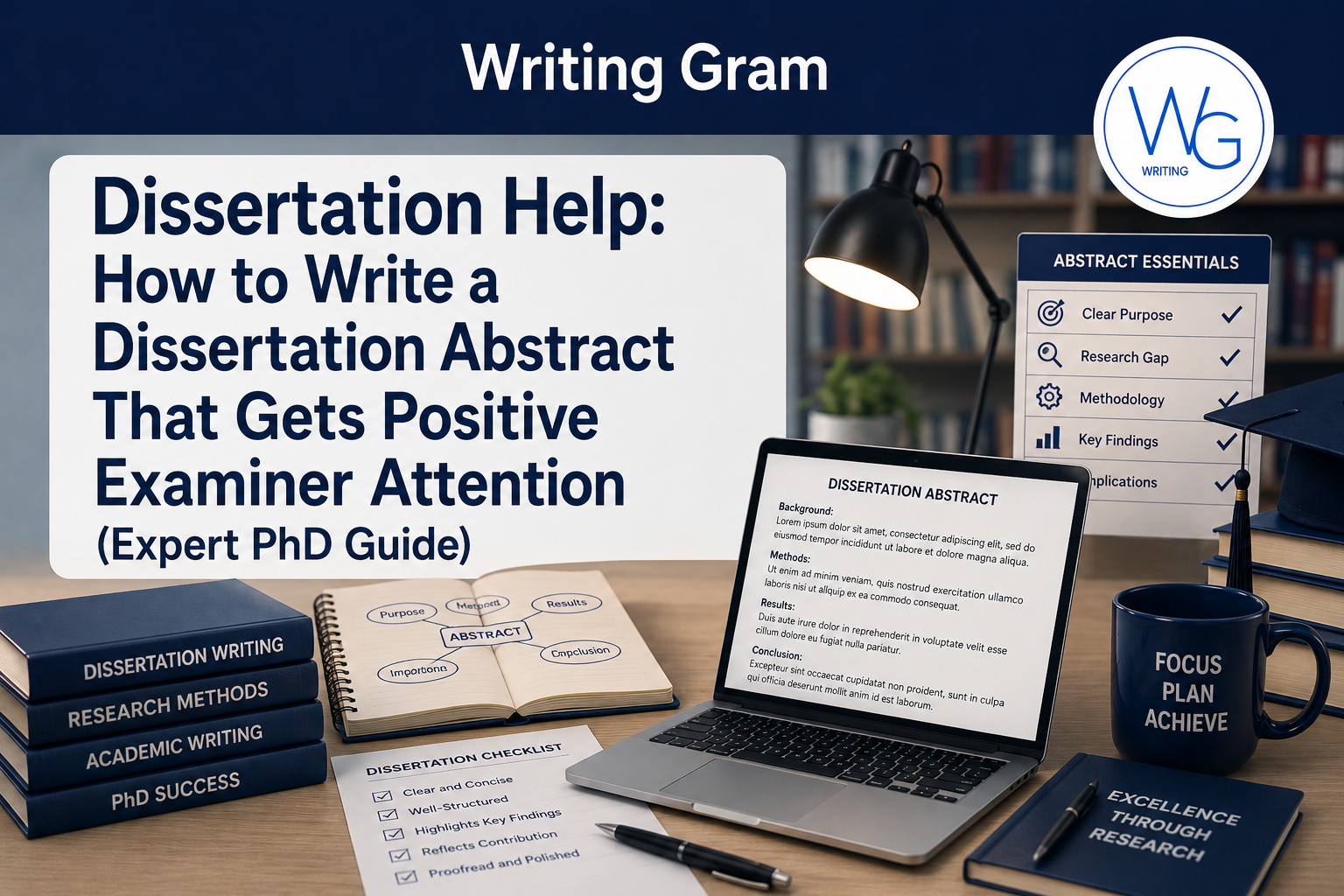
Get expert dissertation help to write a strong PhD abstract that clearly presents your research problem, methods, and results. Improve clarity, structure, and academic quality with professional support.
A dissertation abstract is a concise summary of your entire research project that helps examiners quickly understand your study, methodology, findings, and academic contribution. Although it appears at the beginning of a dissertation, the abstract is usually written last because it reflects the completed research as a whole. For many PhD and master’s students, this section is one of the most important parts of the dissertation because it creates the first impression examiners will have of their work.
Many students mistakenly treat the abstract as a simple introduction or a long summary. In reality, a strong abstract functions as a concise research snapshot that clearly and systematically highlights the purpose of the study, the methods used, the key findings, and the significance of the results. A weak abstract can make even strong research appear disorganized or unclear, while a well-written abstract immediately signals strong critical thinking, clear research direction, and high academic standards.
Students often seek dissertation abstract writing help or custom PhD dissertation writing services when they struggle to summarize complex research clearly while meeting strict academic guidelines. In this guide, you will learn the ideal academic abstract structure, common mistakes to avoid, dissertation abstract examples, and practical strategies that help attract positive examiner attention.
Need Professional Dissertation Help?
At Writing Gram, we help PhD and master’s students develop clear, well-written dissertation abstracts that align with university expectations and examiner standards. When you place an order, you benefit from:
Professionally structured dissertation support
Clear and concise academic writing
Research-aligned abstract development
Improved clarity, flow, and academic tone
Timely delivery and confidential assistance
Expert guidance tailored to your dissertation topic
If you want your dissertation abstract to create a strong first impression and reflect the quality of your research, professional support from Writing Gram can help you submit with greater confidence. Just place your order now and relax as our expert academic writers craft the dissertation and ensure that all its sections, including the abstract, align with doctoral-level standards
Dissertation Abstract Writing Guidelines You Must Follow
Writing a dissertation abstract requires more than simply summarizing your research. A strong abstract must communicate your study clearly, professionally, and concisely while following accepted academic standards. Because examiners often read the abstract before the main dissertation, this section can significantly influence their first impression of your work.
According to Purdue University’s Online Writing Lab (Purdue OWL), an effective abstract should briefly explain:
The research problem or objective
The significance of the study
The research methodology used
The key findings or conclusions
The implications of the research
These elements form the foundation of a clear and credible dissertation abstract.
Key Dissertation Abstract Guidelines
Keep the Abstract Concise and Focused
Most universities require dissertation abstracts to stay within a strict word limit, typically between 150 and 300 words. Every sentence should provide meaningful information about your research.
A concise abstract should:
Eliminate unnecessary background details
Avoid repetition
Focus only on the most important research points
Present information in a logical flow
Examiners value clarity and precision more than overly complex language.
Make the Abstract Self-Contained
A dissertation abstract should make sense even if someone does not read the full dissertation. Readers should understand:
What the study investigated
Why the research matters
How the study was conducted
What the findings revealed
Avoid references, citations, tables, or abbreviations that require additional explanation.
Follow a Clear Academic Abstract Structure
A well-organized abstract is easier for examiners to evaluate quickly. Most successful dissertation abstracts follow this structure:
Background or research context
Research problem or objective
Methodology
Key findings
Conclusion and implications
This structure improves readability and aligns with common academic expectations in US universities.
Use Clear Academic Language
Strong dissertation summary writing does not depend on difficult vocabulary. Instead, focus on:
Clear sentence construction
Direct explanations
Formal academic tone
Logical transitions between ideas
Overly technical or complicated writing can reduce clarity and weaken the impact of your abstract.
Write the Abstract After Completing the Dissertation
One of the most common mistakes students make is writing the abstract too early. Since the abstract summarizes the final research outcomes, it should usually be written after completing the:
Findings
Discussion
Conclusion
This ensures consistency between the abstract and the full dissertation.
Highlight Specific Findings
Examiners look for concrete research outcomes, not vague statements. Instead of writing:
“The study produced important findings”
Write:
“The study found that remote work improved employee productivity but reduced team collaboration in hybrid organizations.”
Specific findings demonstrate research depth and academic confidence.
According to Purdue University Abstract Guidelines, effective abstracts should prioritize clarity, organization, and accurate presentation of the research project. This is especially important in PhD-level dissertations where examiners expect precise academic communication.
Dissertation Abstract Writing Guidelines You Must Follow
Writing a strong dissertation abstract requires precision, clarity, and adherence to academic standards and formatting requirements. Universities in the United States consistently emphasize that an abstract should act as a complete but compact representation of your research, allowing examiners to quickly understand the purpose, methods, and findings of your study.
According to the University of North Carolina at Chapel Hill Writing Center, an effective abstract should clearly summarize the research problem, methods, results, and conclusions in a brief and structured format, without unnecessary detail or added explanation. To meet these academic expectations and improve examiner perception, your dissertation abstract should follow these key guidelines:
Keep it concise and focused
A dissertation abstract is not a detailed explanation of your research but a condensed academic summary. Most institutions expect it to remain within a limited word count, usually 150–300 words. The abstract should
Include only essential research information
Avoid repetition or extended explanations
Prioritize clarity over descriptive depth
Ensure every sentence adds academic value
Make it self-contained
Your abstract should be understandable without reading the full dissertation.
Do not rely on citations or external references
Avoid unexplained abbreviations or terminology
Ensure the reader understands the full research.
Present a complete academic snapshot of your work
Use the past tense for completed research
Since the dissertation reflects completed work, the abstract should be written in the past tense.
Describe what was studied and what was found
Avoid future-oriented language such as “will examine.”
Maintain consistency with final research outcomes
Avoid unnecessary background detail
A common mistake is including too much introductory information.
Only include context that directly supports the research problem
Remove broad literature review content
Focus on the specific gap your study addresses
Focus on clarity over complexity
Examiners value clear academic communication more than complex wording.
Use simple, direct academic sentences
Avoid overly technical language where possible
Ensure logical flow between ideas
Ensure alignment with research content
Your abstract must accurately reflect the final dissertation.
Match findings exactly with your results chapter
Avoid introducing new information not present in the dissertation
Ensure consistency in methodology and conclusions
Apply correct academic structure
A well-structured abstract improves readability and examiner understanding:
Research background and problem
Aim or objective of the study
Methodology used
Key findings
Conclusion and implications
Use strategic keyword integration
When writing your abstract, it is important to use keywords naturally.
Avoid keyword repetition or forced placement
Maintain academic tone and readability
Following these dissertation abstract writing principles ensures that your work aligns with US university expectations, improves clarity for examiners, and strengthens the academic impact of your research summary.
The Ideal Academic Abstract Structure (Step-by-Step Breakdown)
A well-written dissertation abstract follows a clear academic structure that allows examiners to quickly understand your research without having to read the full document. Most American universities emphasize that abstracts should present a complete overview of the study in a logical, concise format, ensuring clarity, coherence, and accurate representation of the research.
The University of Wisconsin–Madison Writing Center highlights that effective abstracts should clearly and concisely present the purpose, methods, and results of a study in a structured format, enabling readers to quickly understand the essence of the work.
The abstract for your dissertation should have the following
1. Background (1–2 sentences)
The background section introduces the research context without overwhelming detail. It should quickly establish what area of study the dissertation focuses on.
Provide a brief academic context
Introduce the general topic area
Avoid extended literature review discussion
Keep it tightly focused and relevant
This section sets the foundation for understanding why the research matters.
2. Research Problem
This section clearly defines the gap, issue, or challenge your dissertation addresses.
State the specific research problem clearly
Identify the gap in existing knowledge or practice
Explain why this problem is significant
Keep it precise and direct
A strong problem statement helps examiners immediately understand the purpose of your study.
3. Methodology
Here, you briefly explain how the research was conducted.
Mention the research design (qualitative, quantitative, or mixed methods)
Include data collection methods (e.g., surveys, interviews, experiments)
Avoid including excessive methodological or statistical detail that belongs in the main body of the dissertation.
Focus on clarity rather than complexity
This section demonstrates the thoroughness and soundness of your research process.
4. Key Findings
This is one of the most important parts of the abstract because it highlights what your research discovered.
Present only the most significant results
Avoid interpretation or long explanations
Focus on direct outcomes of the research
Ensure alignment with your dissertation results chapter
Clear findings demonstrate the value of your research to examiners.
5. Conclusion and Implications
This section explains what your research contributes to the field.
Summarize the overall conclusion of your study
Explain academic or practical implications
Show how your research addresses the problem identified earlier
Keep it concise and impact-focused
This is where your research significance becomes clear to the reader.
Important Tip when Writing Your Abstract
To make your abstract easy to understand and highly structured, you can follow this simple model:
Problem → Method → Findings → Conclusion
This formula ensures your dissertation abstract remains logically organized, examiner-friendly, and aligned with doctoral expectations.
How to Write a Strong Dissertation Abstract (Step-by-Step Process)
A strong dissertation abstract is not written in a rushed way; it is carefully crafted after the full research has been completed. In academia, abstract writing is considered a high-level skill because it requires the ability to compress an entire dissertation into a clear, structured, and meaningful summary without losing accuracy or depth.
According to the Massachusetts Institute of Technology (MIT) Writing and Communication Center, an abstract should clearly and concisely summarize the research problem, the methods used, and the key findings or conclusions so that readers can understand the essence of the work without reading the full paper.
Below is a clear, step-by-step approach to effective dissertation abstract writing that helps improve clarity, structure, and how examiners perceive your work.
Step 1: Write your full dissertation first
A dissertation abstract should always be written after completing the full research project.
Finalize your introduction, methodology, results, and conclusion
Ensure your arguments and findings are fully developed
Avoid writing the abstract during the early stages of research
Use the completed dissertation as the reference for accuracy and consistency.
This ensures accuracy and prevents inconsistencies between the abstract and final document.
Step 2: Extract key findings only
The abstract should focus on the most important outcomes.
Identify your core research findings
Remove minor or supporting details
Focus only on results that answer your research question
Highlight contributions to your field of study
This step ensures your abstract remains focused and impactful.
Step 3: Remove unnecessary words
Concise writing is essential in academic abstract writing.
Eliminate repetitive phrases
Avoid overly descriptive language
Remove background information that does not support the research goal
Use direct and clear academic sentences
This improves readability and ensures compliance with word limits.
Step 4: Ensure logical flow
A strong abstract must follow a structured and logical order.
Start with the research problem or purpose
Briefly describe the methodology used
Present key findings clearly
End with conclusions and implications
This structure improves clarity and helps examiners quickly interpret your work.
Step 5: Check clarity and word count
Final refinement is essential for academic quality.
Ensure your abstract is within 150–300 words (or your institution’s requirement)
Check grammar, tone, and consistency
Make sure it accurately reflects your dissertation
Read it from an examiner’s perspective
A well-polished abstract improves academic credibility and first impression quality.
When students struggle to structure or refine their abstracts, many turn to custom PhD dissertation writing services to ensure their work meets strict academic standards and clearly communicates their research.
Need Expert Support for Your Dissertation Abstract?
At Writing Gram, we specialize in helping students create clear, well-structured dissertation abstracts that accurately reflect the quality of their research and meet examiner expectations.
When you place an order, you get:
Professionally structured dissertation abstract writing support
Clear alignment with your full research study
Improved academic tone and clarity
Plagiarism-free, high-quality writing
Fast turnaround with strict confidentiality
Expert-level refinement for PhD and master’s standards
If you want your dissertation abstract to stand out, impress examiners, and accurately represent your research, Writing Gram is here to help. Place your order today and get professional support that strengthens the quality and impact of your dissertation.
Dissertation Abstract Examples (Good vs Weak Comparison)
Understanding the difference between a weak and a strong abstract is one of the fastest ways to improve your dissertation abstract writing. Many students lose marks not because their research is weak, but because their abstract doesn’t clearly communicate the value of their study. Clear dissertation abstract examples help you see what examiners expect in terms of structure, clarity, and academic focus.
Weak Abstract (Common Student’s Mistake)
A weak abstract often looks like a general summary of the topic rather than a focused academic snapshot of the research. It typically includes unnecessary detail or lacks clear findings.
Common characteristics include:
Too vague and broad, with no clear research focus
Overly long sentences that reduce clarity
Missing or unclear research problem
Methodology not explained or too detailed
Findings not clearly stated or completely absent
Reads more like an introduction than a summary
This type of abstract makes it difficult for examiners to quickly understand what the study actually achieved, which can negatively affect first impressions.
Strong Abstract
A strong abstract is focused, structured, and directly communicates the most important parts of the research.
Key characteristics include:
Clear identification of the research problem or objective
Concise explanation of the methodology used
Direct presentation of key findings without unnecessary detail
Logical flow from problem to conclusion
Precise academic language with no repetition
Alignment with the actual dissertation content
A strong abstract ensures that the reader immediately understands what the research is about, how it was conducted, and what it found.
Why the Strong Version Gets Better Examiner Attention
Examiners often assess clarity and academic control within the abstract before engaging with the full dissertation. A strong abstract performs better because it:
Demonstrates a clear understanding of the research topic
Shows that the researcher can summarise complex work effectively
Reflects strong academic writing and organization skills
Makes it easy to identify the value and contribution of the study
Builds confidence in the quality of the full dissertation
In contrast, a weak abstract creates uncertainty, forcing the examiner to work harder to understand the research, which can reduce overall academic impression even if the dissertation itself is strong.
Example of a Weak Abstract
This study looks at employee performance in organizations. It discusses different factors that may affect productivity and explores general ideas around workplace efficiency. Several methods were used to collect information, and the results show that performance can be influenced by many factors. The study concludes that organizations should consider improving their management strategies.
Why this is weak:
No clear research problem or objective
Vague language (e.g., “many factors,” “general ideas”)
Methodology is not specified
Findings are unclear and non-specific
Feels like a general introduction, not a summary of research
Lacks academic precision and structure
Example of Strong Abstract
This study examined the impact of remote working on employee productivity in mid-sized organizations. A quantitative research design was used, with data collected through structured surveys from 200 employees. The findings revealed that remote work improved individual productivity due to flexible scheduling but reduced collaboration efficiency among teams. The study concludes that hybrid work models may balance productivity and communication challenges in modern organizations.
Why this is strong:
A clear research problem and objective are stated early
Specific methodology provided (quantitative, surveys, sample size)
Concrete and measurable findings included
Logical flow from problem → method → results → conclusion
Clear academic tone with no unnecessary detail
Directly reflects what examiners expect in a dissertation abstract
A strong abstract is effective because it gives a complete but concise snapshot of the research, allowing examiners to understand the study quickly without reading the full dissertation.
Common Dissertation Abstract Mistakes That Cost You Marks
A dissertation abstract is often the first section examiners read, which means even small writing issues can negatively affect how they perceive the quality of your research. In effective abstract writing, clarity, precision, and focus are essential. Many students lose marks not because their research is weak, but because their abstract does not communicate it properly.
The University of Southern California (USC) Writing Center emphasizes that strong abstracts should be concise, focused, and free from unnecessary detail so that the reader can quickly understand the core research contribution.
Below are the most common mistakes that cost you marks when writing the abstract:
Writing too much background
Students often include long introductions instead of a focused summary
Excess background reduces space for findings and methodology
The abstract should only include background information that is directly relevant to the research problem.
Including citations
Abstracts should stand alone without referencing external sources
Citations interrupt readability and are not standard in dissertation abstracts
Examiners expect original summary writing, not a literature overview
Using the future tense
Abstracts should describe completed work, not planned research
Using “will study” or “will examine” weakens academic credibility
Past tense should be used for methods, findings, and conclusions
Lack of clear findings
One of the most serious mistakes is failing to state results clearly
Vague phrases like “results were significant” do not communicate value
Examiners expect specific outcomes tied to the research question
Copying the introduction content
Rewriting the introduction as an abstract is a common error
The abstract must summarize the entire dissertation, not repeat one section
It should include methods, findings, and conclusions—not just context
Avoiding these mistakes ensures your dissertation abstract is clear, professional, and aligned with doctoral level standards, improving how examiners interpret the quality of your research.
What Examiners Look for in a Dissertation Abstract
Your dissertation abstract plays a major role in shaping how examiners perceive your entire research project. Because it is usually the first (and sometimes the only) section read in detail before grading begins, it strongly influences first impressions of your academic work. The clarity and structure of your abstract directly affect how your research is evaluated.
Academic writing guidance from the University of Illinois Chicago (UIC) Writing Center emphasizes that strong abstracts should present the core purpose and results of research in a clear, concise, and organized way so readers can quickly understand the work’s value.
First impression bias in grading
Examiners are human, and the abstract often sets the tone for how they interpret the rest of your dissertation.
A clear abstract creates a positive first impression
A confusing abstract can lead to assumptions about a weak research structure
Early clarity often makes the full dissertation easier to evaluate positively
Poorly written abstracts may cause unnecessary skepticism about the study
Signals of research quality
The abstract acts as a quick indicator of how well the research was conducted and presented.
A clear problem statement suggests a strong research focus
Well-defined methodology demonstrates a clear, systematic approach to the research process.
Specific findings indicate meaningful data analysis
Logical structure reflects organized thinking and planning
Clarity = perceived academic competence
How clearly you communicate your research often affects how your competence is judged.
Simple and precise language signals a strong understanding
Structured flow shows control over complex academic material
Avoiding vague statements improves credibility
Clear summaries make research appear more professional and reliable
Alignment with rubric expectations
Examiners often assess dissertations using strict marking rubrics, and the abstract must align with these criteria and expectations. The abstract:
Must reflect the research objectives stated in the dissertation
Should match methodology and findings accurately
Needs to demonstrate relevance to the research question
Should follow academic formatting and summary standards
When these elements align properly, the abstract strengthens the overall presentation of the dissertation and contributes to a more favorable examiner evaluation.
When Students Should Consider Dissertation Abstract Writing Help
Writing a dissertation abstract can be challenging even for strong researchers because it requires compressing an entire study into a short, precise, and highly structured academic summary. In many cases, students do not struggle with the research quality itself, but with how to clearly communicate it within strict academic limits.
Seeking dissertation abstract writing help is a practical form of academic support when used appropriately, and it is legal and ethical since it focuses on guidance, editing and proofreading, structuring, and improving clarity. The goal is to strengthen the student’s own work, not replace it.
Situations where support becomes helpful
Struggling to clearly structure the abstract into a logical flow
Finding it difficult to condense a large dissertation into a short summary
Having strong research but weak academic expression or clarity
Needing help refining tone, grammar, and academic language
Working under tight submission deadlines and needing efficiency
International and non-native academic writing challenges
Many international students face additional difficulties when writing abstracts in English, even when they fully understand their research.
Translating complex ideas into clear academic English can be difficult
Sentence structure and academic tone may not come naturally
Risk of being too vague or overly detailed due to language barriers
Difficulty matching the expected US or UK academic writing style
These challenges are normal and widely recognized in higher education institutions, and seeking structured support in such cases is a legitimate way to improve academic communication skills.
When professional guidance becomes useful
In some cases, students choose professional academic assistance such as custom PhD dissertation writing services to refine their abstracts and ensure they meet doctoral-level standards.
This type of support is most helpful when it focuses on:
Improving clarity and readability
Strengthening structure and flow
Ensuring alignment with dissertation content
Enhancing academic tone without changing the student’s ideas
The key principle is that the research must remain the student’s own work, while support helps improve presentation quality.
When used correctly, this kind of assistance acts as a refinement tool that helps students communicate their research more effectively and confidently, especially when writing high-stakes dissertations.
Final Checklist Before Submitting Your Dissertation Abstract
Before submitting your dissertation abstract, it is important to carefully review it to ensure it meets academic expectations and accurately represents your research. An effective dissertation abstract writing process is not complete without a final quality check, as this is often the section examiners read first.
Use the following checklist to evaluate your abstract:
Is it within the required word limit?
Ensure your abstract meets your institution’s guidelines, typically 150–300 words, without exceeding or falling significantly below the range.Does it clearly state the problem, method, and findings?
A complete abstract should briefly answer:What problem was studied?
How was the research conducted?
What were the key findings?
Is it free from citations and references?
The abstract should stand alone as a summary of your work without relying on external sources or referencing other authors. This means the abstract should not have in-text citations.Can someone understand your research in 30 seconds?
A well-written abstract should allow a reader to quickly grasp the essence of your dissertation without needing to read the full document.Does it match your dissertation content exactly?
Ensure consistency between the abstract and your final chapters:Findings must not contradict your results section
Methodology should accurately reflect what you actually did
Conclusions should align with your discussion and analysis
A carefully reviewed abstract improves clarity, strengthens academic credibility, and ensures your research is presented in a professional and examiner-friendly way.
Get a Clear, Examiner-Ready Dissertation Abstract That Reflects Your Research Quality
A strong dissertation abstract is more than a summary—it is a reflection of how well your research is structured, understood, and communicated. Examiners often form an early judgment of your work based on this section, which is why clarity, accuracy, and structure are far more important than complex wording or lengthy explanations.
A well-written abstract improves your academic presentation by:
Clearly showing what your research is about
Demonstrating how well your study is structured
Making your findings easy to understand at a glance
Strengthening the overall impression of your dissertation
On the other hand, a poorly written abstract can make even strong research appear unclear or underdeveloped. This is why many students focus heavily on refining this section to ensure it aligns with academic expectations.
When done correctly, abstract writing should prioritize:
Precision over complexity
Structure over unnecessary detail
Clarity over technical overload
Direct communication of research value
For students who find it difficult to achieve this level of clarity, professional support can make a significant difference. Custom PhD dissertation writing services help refine structure, improve academic tone, and ensure your abstract accurately represents your research without losing meaning or focus.
Need a Perfect Dissertation Abstract That Impresses Examiners?
At Writing Gram, we help students transform complex research into clear, structured, and high-impact dissertation abstracts that meet doctoral-level standards and improve the overall presentation quality.
When you place an order, you get:
A professionally written and well-structured dissertation abstract
Clear alignment with your full dissertation findings
Improved academic clarity, tone, and flow
Plagiarism-free and high-quality academic writing
Fast delivery with complete confidentiality
Support tailored for PhD-level expectations
If you want your dissertation abstract to stand out, communicate your research effectively, and leave a strong impression on examiners, Writing Gram is ready to help you achieve that. Place your order today and get expert support that turns your research into a polished and well-written dissertation.