Dissertation Analysis Help for Non-Significant Results and Unexpected Statistical Findings
By Writing Gram • Sep 16, 2026
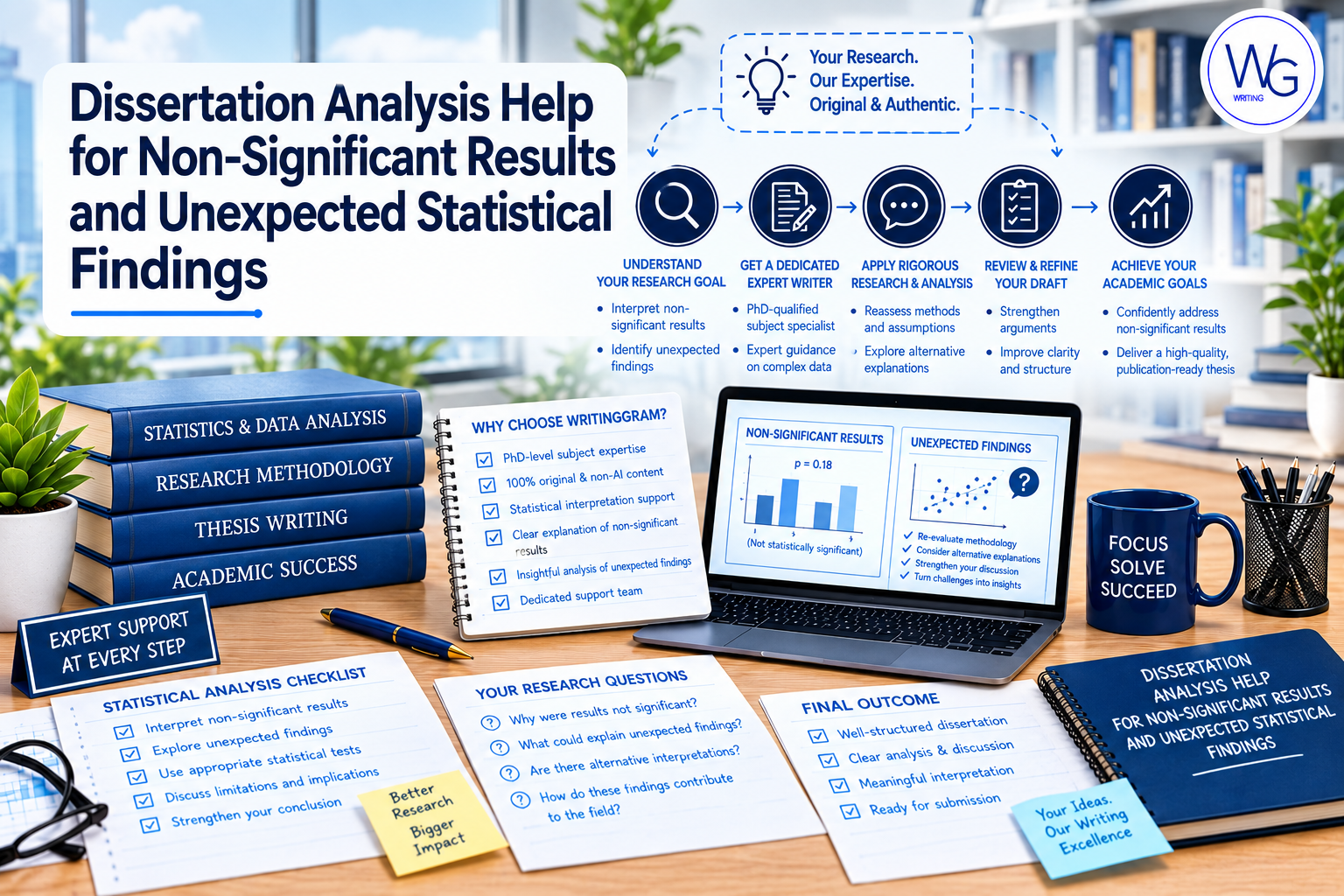
Need help interpreting non-significant or unexpected dissertation results? Get expert dissertation analysis help with statistical interpretation and discussion.
Non-significant dissertation results do not mean that a study has failed. They mean the statistical analysis did not provide sufficient evidence for the expected relationship, difference, or effect under the conditions tested. You still need to interpret the result accurately, explain whether the hypothesis was supported, and show what the finding means for your research questions and overall study.
What Does a Non-Significant Result Mean in a Dissertation?
A non-significant result means that the statistical evidence from your analysis was not strong enough to reject the null hypothesis at the significance level you specified. For example, if your study uses a 0.05 significance level and produces a p-value above 0.05, the result would commonly be described as not statistically significant.
However, this does not mean that you have proved there is no relationship, difference, or effect. A non-significant result indicates that your data did not provide sufficient statistical evidence for the alternative hypothesis under the test you conducted.
Stanford University explains that a small p-value provides evidence against the null hypothesis, while a larger p-value does not provide evidence against it. Therefore, the p-value needs to be interpreted in relation to the hypothesis and the analysis rather than treated as a simple measure of whether your dissertation succeeded or failed.
This distinction matters when writing your dissertation. Saying that “the analysis found no statistically significant relationship” is different from claiming that “the analysis proved that no relationship exists.” Your interpretation should remain within what the statistical evidence can support.
Hence, the problem for many students is not obtaining a p-value from SPSS, R, Stata, or another statistical program. The difficult part is deciding what the result means for the hypothesis, research question, findings chapter, and discussion.
📊Get Expert Help Interpreting Non-Significant Results and Strengthening Your Dissertation Analysis
Writing Gram can help you explain what your non-significant statistical results mean, relate them to your hypothesis and research questions, and present the findings clearly in your dissertation. If you already have your statistical output but are unsure how to connect a non-significant finding to your hypothesis and research questions, professional dissertation analysis help can help you determine what the result means for your study and how to discuss it appropriately.
👉 Place your order now to get help determining why your results were non-significant, explaining what each result means, identifying whether your hypotheses were supported or not supported, showing how the findings answer your research questions, interpreting statistical tables and outputs, identifying findings that need further explanation, and developing a clear discussion that accurately reflects your actual results.
What Should You Do When a Dissertation Hypothesis Is Not Supported?
When your statistical results do not support a hypothesis, do not rewrite the hypothesis or alter the data to produce the expected outcome. Instead, work systematically through the result and explain what the analysis actually found.
Start by returning to the original hypothesis and identifying exactly what relationship, difference, or effect you expected to observe. Then review the statistical test used to examine that hypothesis.
Your interpretation should normally consider:
The statistical test used and whether it corresponds to the research question and variables being examined.
The test statistic and p-value, rather than relying only on whether software labels the result significant.
The estimated effect or relationship, where applicable.
The confidence interval, when one is available, because it can show the range of values compatible with the analysis.
The original hypothesis, including whether the predicted direction or difference was observed.
The corresponding research question, so the finding is connected to the wider purpose of the study.
Relevant previous research, particularly where your finding differs from earlier studies.
Reasonable explanations for the unexpected result, based on your research design, sample, measures, and study context.
The University of Michigan Statistics Guidance also cautions against treating statistical terminology as a simple binary judgment. Its statistics guidance recommends using “statistically significant” when referring to the technical meaning of significance and avoiding vague language that can make statistical findings appear more definite than they are.
The goal is not to make an unsupported result look positive. The goal is to explain the result accurately and show what it contributes to your study.
How Should Non-Significant Results Be Discussed in a Dissertation?
A discussion of a non-significant result should do more than state that the p-value exceeded the chosen significance level. The reader needs to understand what was tested, what the analysis found, and what the result means within the context of the study.
When discussing a non-significant result, make sure you:
State what was tested. Identify the relationship, group difference, association, or effect examined.
Report what the analysis found. Include the relevant statistical evidence using the reporting style required by your discipline.
Address the hypothesis. State clearly whether the result supported the predicted relationship or difference.
Return to the research question. Explain what the finding tells you about the question your study was designed to answer.
Compare the finding with previous research. Identify whether your result is consistent with or different from relevant studies.
Discuss reasonable explanations. Consider the study population, research setting, measurement approach, sample, and other factors that could help explain the finding.
Explain the implications. Describe what the result contributes to the study without making claims that extend beyond the evidence.
Example of a Weak Discussion
The results showed that there was no significant relationship between supervisor support and dissertation completion time because the p-value was greater than .05. Therefore, the hypothesis was rejected. This means that supervisor support did not affect dissertation completion time. The result may have been caused by different factors, and more research is needed to understand the relationship.
Why this discussion is weak
It stops at statistical significance. It tells the reader that the result was not significant but does not explain what the observed relationship actually looked like.
It overstates the finding. Saying that supervisor support “did not affect” completion time implies that no relationship exists, which cannot be concluded simply from a non-significant result.
It does not answer the research question. The discussion does not explain what the finding means for the specific question the study investigated.
It gives no meaningful explanation. “Different factors” is too vague to help the reader understand why the finding may have differed from the expectation.
It does not engage with previous research. There is no comparison with studies that found similar or different results.
It provides little interpretation. The reader is left with a p-value and a rejected hypothesis but little understanding of what the finding contributes to the study.
Example of a Strong Discussion
The analysis examined whether perceived supervisor support was associated with the time required for doctoral students to complete their dissertations. The relationship was negative but not statistically significant, r = −.12, p = .28. Although students who reported greater supervisor support tended to have slightly shorter completion times in this sample, the result did not provide sufficient statistical evidence to support the hypothesis that greater supervisor support was associated with shorter dissertation completion times.
In relation to the research question, the findings indicate that supervisor support, as measured in this study, was not significantly associated with dissertation completion time among the participants. This finding differs from previous research that has reported significant associations between supervisory support and doctoral progress. Differences in the characteristics of the participants, the measurement of supervisor support, or the academic settings represented in the studies may help explain these differences. The finding therefore does not establish that supervisor support has no relationship with dissertation completion time. Instead, it indicates that this study did not detect a statistically significant association within the population and conditions examined.
Why this discussion is strong
It identifies exactly what was tested. The reader knows that the analysis examined the association between supervisor support and dissertation completion time.
It reports the actual statistical finding. The direction, correlation coefficient, and p-value are provided rather than simply saying “the result was not significant.”
It addresses the hypothesis. The discussion explains what the non-significant result means for the predicted relationship.
It answers the research question. The finding is explicitly connected back to what the study was designed to investigate.
It compares the result with previous research. The discussion identifies that the finding differs from earlier research instead of treating the result in isolation.
It considers plausible explanations. Participant characteristics, measurement, and academic setting are identified as possible reasons for differences without presenting speculation as fact.
It avoids an unsupported conclusion. Rather than claiming that supervisor support has no effect, it correctly limits the conclusion to what the study's evidence supports.
A strong discussion would explain that the analysis did not provide sufficient evidence for the predicted relationship, identify the direction and estimated size of the relationship where appropriate, connect the finding to the research question, and consider why the observed result differed from the original expectation.
The Pennsylvania State University Department of Statistics notes that p-values depend on both the magnitude of an association and sample size and emphasizes interpreting statistical results in context rather than reducing them to a simple significant/non-significant distinction.
This approach makes the discussion clearer because the reader can see not only whether the expected finding was observed but also how the result relates to the hypothesis, research question, and other findings from the study.
Why Can Dissertation Results Be Non-Significant When You Expected a Significant Finding?
There is no single explanation for a non-significant result. Several features of a study can affect the statistical evidence obtained, and the appropriate explanation depends on the research design and data.
Sample size and statistical power
A study with a relatively small sample may have limited ability to detect an effect, particularly when the expected effect is modest or the data are highly variable. This does not automatically mean that the study is inadequate, but it can be relevant when interpreting an unexpected result.
Measurement and variables
The variables may not have been measured with enough precision to detect the expected relationship. Restricted variation in a variable can also make relationships more difficult to identify.
Research context
A relationship observed in previous research may not appear in the same way in a different population, institution, location, or time period. Differences in participants or research settings can therefore be relevant when discussing unexpected findings.
Analysis and model considerations
The statistical model may also require careful examination. For example, relationships between predictors can affect individual regression coefficients, while assumptions associated with particular statistical procedures can influence interpretation.
The important point is that these possibilities should be investigated and supported by evidence from your study. They should not simply be listed as explanations because the result was unexpected.
When Does a Non-Significant Result Require Further Analysis?
A non-significant result does not automatically mean that you should perform another statistical test. Additional analysis should have a clear methodological or research justification.
Further analysis may be appropriate when:
An important condition or assumption of the original analysis needs to be examined.
The original test does not adequately address the research question.
The research design included a planned secondary or complementary analysis.
A confidence interval or effect estimate raises an important question that the original test alone does not answer.
A justified model comparison or robustness analysis is needed.
The statistical output reveals a methodological issue that needs to be investigated.
Multiple studies or research phases. Further analysis may be appropriate when the dissertation includes data from multiple studies, research phases, groups, or time points and the non-significant result needs to be examined across those parts of the research. For example, you may need to determine whether the same pattern appears in a second study or whether the finding changes between research phases.
ABD students with incomplete dissertation research. For an ABD student returning to unfinished dissertation work, further analysis may be necessary when an earlier non-significant finding leaves an important research question unanswered or when additional analysis was already planned in the original research design. The student should first determine whether the existing data can answer the question through a justified analysis rather than simply running additional tests to obtain a significant result.
Clarifying the study's contribution. Further analysis can be useful when a non-significant result raises an important question about what the study contributes. Examining effect sizes, confidence intervals, subgroup patterns, or other pre-planned analyses may help show whether the finding provides useful evidence even though the original test was not statistically significant.
For example, University of California, Berkeley explains that a non-significant result does not establish that the null hypothesis is true and that statistical significance should not be confused with practical importance. It also notes that an effect can be important but difficult to detect when data are limited or imprecise.
What you should avoid is repeatedly changing the statistical analysis simply to obtain a significant p-value. Doing so can shift the analysis away from the research question and toward finding a result that matches the expected outcome.
How Should Unexpected Dissertation Findings Be Interpreted?
Unexpected findings can be examined systematically by explaining what the analysis showed, considering why the result may have occurred, and discussing how it relates to the research question and previous research.
An unexpected result might involve:
A predicted positive relationship that was not observed.
A predicted negative relationship that was not observed.
A relationship that appeared in the opposite direction.
An effect that was weaker than expected.
A group difference that was not predicted.
A finding that differs from earlier research.
You can interpret an unexpected finding by working through these steps:
Expected finding → Actual finding → Statistical evidence → Possible explanation → Research implications → Limitations
For example, suppose a researcher expected higher training participation to be associated with higher employee performance. The analysis finds a positive relationship, but the result is not statistically significant. The discussion should not simply state that training “does not affect” performance.
Instead, the researcher could explain that the observed relationship was positive but did not reach the study's specified threshold for statistical significance. The discussion could then examine the size and uncertainty of the estimate, compare the finding with relevant studies, and consider whether the sample, measurement approach, or research setting provides a plausible explanation.
This produces a more informative discussion than treating statistical significance as the only feature that matters. Research on statistical reporting has also emphasized the value of considering effect estimates and measures of uncertainty alongside p-values.
What Should You Avoid Claiming From a Non-Significant Result?
The wording used in your findings and discussion matters because a non-significant result can easily be overstated.
Avoid claims such as:
“The study proved that there is no relationship.”
“The independent variable has no effect whatsoever.”
“The hypothesis was completely wrong.”
“The research failed because the result was not significant.”
“The null hypothesis was proven.”
“The data should be changed because the expected result was not found.”
“The relationship is unimportant simply because it was not statistically significant.”
Instead, use wording that accurately reflects what the analysis showed. For example:
When the predicted relationship was not statistically significant: “The analysis did not provide sufficient statistical evidence to support the hypothesized relationship between X and Y.”
When an effect was observed but was not statistically significant: “The analysis showed a small positive association between X and Y, but the association was not statistically significant at the specified significance level.”
When the result does not support the hypothesis: “The findings did not support the hypothesis that X would be significantly associated with Y.”
When interpreting what the finding means: “The results indicate that the study did not detect a statistically significant relationship between X and Y in the sample examined.”
When discussing the possibility of a relationship: “Although the observed results suggest a possible relationship between X and Y, the statistical evidence was insufficient to conclude that the relationship was present in the population represented by the study.”
When comparing the finding with previous research: “The non-significant finding differs from previous studies that reported a statistically significant relationship between X and Y.”
This distinction is important because a p-value alone does not tell you the size or practical importance of an effect. The American Statistical Association's guidance emphasizes that statistical significance does not measure effect size or practical importance and that a p-value should be interpreted in context.
Therefore, the purpose of your dissertation discussion is not to make an unexpected finding appear significant. It is to explain what the evidence shows, what it does not show, and how the finding relates to the research problem.
📈 Need Help Interpreting Your Dissertation Results?
Writing Gram provides dissertation analysis help for students who already have their data or statistical output but need help understanding and presenting the findings correctly. If your results are non-significant, contradict your hypothesis, or differ from what previous research suggested, the challenge may be explaining what the findings mean and presenting them clearly in your findings and discussion chapters.
👉 Place your order now to get help interpreting your statistical output, connecting your findings to your hypotheses and research questions, explaining unexpected results, and turning your completed analysis into clear findings and discussion sections that accurately explain what your results mean.
What Does a Non-Significant Result Mean in a Dissertation?
A non-significant dissertation result means that the statistical test did not provide sufficient evidence for the relationship, difference, or effect proposed by your hypothesis at the selected significance level. It does not automatically mean that there is no relationship or that your study has failed. The result needs to be interpreted in relation to the test used, the p-value, the estimated effect, the research question, and the study design.
For example, if your dissertation hypothesis predicts that X has a significant positive relationship with Y, but your regression analysis produces a p-value above your chosen significance level, you would normally report that the hypothesis was not supported by the analysis. You should not rewrite the result to make the hypothesis appear supported.
The statistical interpretation also needs to be precise. A non-significant result does not prove that the null hypothesis is true. It means that the evidence from the analysis was not sufficient to reject it. The University of California, Los Angeles notes in its statistics materials that a non-significant result does not necessarily mean the null hypothesis is true.
When interpreting your dissertation results, look beyond the word “significant.” Consider:
The exact p-value
The test statistic
The direction of the observed relationship or difference
The estimated effect or difference, where applicable
The confidence interval, where available
The sample size
Whether the analysis directly addresses the research question
Whether the assumptions required by the test were satisfied
This gives you a more accurate basis for explaining what your results actually show.
What Should You Do When a Dissertation Hypothesis Is Not Supported?
When a hypothesis is not supported, the first step is to return to the exact hypothesis and identify what your statistical analysis tested. For example, a hypothesis may predict a positive relationship, a difference between two groups, or an effect of one variable on another.
You can then work through the result systematically:
Restate the hypothesis clearly. Identify the relationship, difference, or effect you expected to find.
Identify the statistical test used. Make sure the test actually corresponds to the type of research question and data you have.
Report the relevant statistical evidence. This may include the test statistic, degrees of freedom, p-value, effect estimate, and confidence interval.
State whether the hypothesis was supported. If the result is non-significant, say that the analysis did not provide sufficient evidence to support the hypothesis.
Connect the result to the research question. Do not stop after reporting the p-value. Explain what the finding means for the question your dissertation was designed to answer.
Compare the finding with previous research. If earlier studies reported a significant relationship but your study did not, identify the difference instead of trying to make the results agree.
Consider plausible explanations. Differences in sample characteristics, measurement, research setting, statistical power, or study design may help explain why the expected result was not observed.
Statistical interpretation should also avoid treating significance as a simple yes-or-no judgment about whether a finding matters. The University of Washington explains that hypothesis testing involves possible outcomes such as rejecting or not rejecting the null hypothesis, and that not rejecting the null hypothesis does not establish that it is true.
The key is to explain the evidence you obtained without changing the data simply because the outcome differs from your prediction.
How Should Non-Significant Results Be Discussed in a Dissertation?
A weak discussion might simply state that the result was “not statistically significant.” That tells the reader what happened statistically, but it does not explain what the finding means for the study.
A strong discussion should connect the result to the broader purpose of the research. Depending on your study, you may need to explain:
What relationship, difference, or effect was tested
What the analysis found
Whether the hypothesis was supported
How the finding answers the relevant research question
How the finding compares with previous studies
Why your result may differ from earlier findings
What the finding means for the study
What limitations may affect interpretation
For example, instead of writing:
“There was no significant relationship between employee training and productivity.”
You could explain that the analysis did not provide sufficient statistical evidence of the hypothesized relationship within the study sample, then discuss the observed direction and size of the relationship where appropriate, compare the finding with previous research, and identify study-specific factors that may help explain the result.
That distinction matters because a non-significant result can still provide useful information about the research question.
Why Can Dissertation Results Be Non-Significant When You Expected a Significant Finding?
There are several possible reasons why an expected relationship or difference may not reach statistical significance. These possibilities should be considered in relation to your actual study rather than inserted simply to explain an inconvenient result.
Sample size and statistical power
A study with a small sample may have limited ability to detect an effect, particularly when the effect is modest. A non-significant result can therefore occur even when the estimated relationship points in the expected direction.
However, you should not automatically write that your result was non-significant “because the sample was too small.” That explanation requires support from your study design, power considerations, or other evidence.
Measurement issues
The variables may not have been measured with enough precision to detect the relationship you expected. Weak measurement, restricted variation, or unreliable instruments can affect the ability of a statistical test to identify an association.
Differences in the research context
Your participants, location, industry, institution, time period, or other study conditions may differ from those in previous research. A relationship reported elsewhere may not appear in exactly the same way in your sample.
Analysis and model considerations
The statistical model may not adequately represent the research question, or important variables may influence the relationship being examined. In regression analysis, for example, relationships between predictors can affect the precision of individual coefficient estimates.
Therefore, the explanation should come after examining the evidence. It should not be used as an excuse for a result that contradicts the hypothesis.
When Does a Non-Significant Result Require Further Analysis?
A non-significant result does not automatically mean that you should run another statistical test. Additional analysis should have a clear methodological or research purpose.
Further analysis may be appropriate when:
The original test did not adequately address the research question.
An important assumption of the statistical procedure needs to be examined.
Your research design supports a justified complementary analysis.
You need to examine an effect estimate or confidence interval to understand the result more fully.
Your research questions explicitly require another form of analysis.
Your supervisor has identified a specific statistical issue that needs to be addressed.
What you should avoid is repeatedly testing different variables, groups, or statistical procedures in the hope that one will produce a significant p-value. If additional analyses are conducted because the original result was unexpected, the reason for conducting them should be clearly explained and supported by the research question, study design, or appropriate statistical reasoning.
How Should Unexpected Dissertation Findings Be Interpreted?
Unexpected findings can occur in several ways. Your results may show:
No significant relationship where you expected one
A relationship in the opposite direction
A weaker relationship than previous studies reported
A difference between groups that you did not predict
No meaningful difference where your hypothesis predicted one
A finding that conflicts with the theoretical framework or earlier research
You can interpret an unexpected finding by working through the evidence in a logical sequence:
Expected finding → Actual finding → Statistical evidence → Possible explanation → Relationship to previous research → Implication for the research question
For example, suppose you expected job satisfaction to increase with employee autonomy, but your regression analysis produces a small negative coefficient that is not statistically significant. Your discussion should distinguish between the direction of the estimated relationship and the statistical evidence supporting that relationship.
You should not describe the result as proof that autonomy reduces job satisfaction. You should explain what the estimate shows, whether the evidence is sufficient to support the proposed relationship, and what factors might explain the unexpected pattern.
This distinction becomes especially important when writing the discussion chapter because the discussion should interpret the findings without going beyond what the analysis can support.
What Should You Avoid Claiming From a Non-Significant Result?
The biggest problem with non-significant results is often not the statistical output itself but what the researcher claims from it.
Avoid statements such as:
“The study proved that there is no relationship.”
“The null hypothesis was proven true.”
“The independent variable has no effect whatsoever.”
“The hypothesis was completely wrong.”
“The research failed because the result was not significant.”
“The data should be changed because the expected result was not obtained.”
Instead, you can use statements such as:
“The analysis did not provide sufficient statistical evidence to support the hypothesized relationship between X and Y.”
“The results showed a small positive association between X and Y, but the association was not statistically significant at the specified significance level.”
“The findings did not support the hypothesis that X would be significantly associated with Y.”
“The analysis did not detect a statistically significant difference between the two groups.”
“Although the estimated effect was in the predicted direction, the statistical evidence was insufficient to conclude that the effect was present in the population studied.”
“The confidence interval includes values that are consistent with both a small effect and no effect, indicating uncertainty around the estimated relationship.”
“The non-significant result differs from previous research that reported a statistically significant relationship between X and Y.”
“The findings indicate that this study did not detect a statistically significant relationship between X and Y under the conditions examined.”
A non-significant p-value by itself does not establish that an effect is absent or that the null hypothesis is true. Statistical significance and practical importance are also different concepts, so p-values should be interpreted alongside the estimated effect, confidence interval, study design, and other relevant evidence.
Therefore, your conclusion should match the strength of the evidence. If the analysis did not provide sufficient evidence for the predicted relationship, report that clearly. If the estimated effect points in a particular direction, report that where appropriate. If the confidence interval is wide, acknowledge the uncertainty. If methodological limitations affect interpretation, explain them.
The goal is not to make an unexpected result look positive or negative. The goal is to accurately explain what your data can and cannot support.
How Dissertation Analysis Help Can Make Unexpected Results Easier to Interpret
When the statistical output is already available, the difficult part may be understanding what the numbers mean for the dissertation. This is where specialized dissertation analysis help can help you interpret the results, connect them to your research questions and hypotheses, and explain what they mean in your findings and discussion chapters.
Professional dissertation analysis assistance can address the specific result that is difficult to interpret, without requiring you to redo your entire dissertation analysis. For example, you may need help with:
Reviewing your existing statistical output and identifying what each relevant result shows
Checking whether your interpretation matches the statistical test you used
Connecting non-significant findings to the correct research questions and hypotheses
Examining whether an unexpected finding requires additional analysis that has a clear methodological reason
Developing a supported explanation for why your findings differ from your expectations
Organizing the findings and discussion around the actual evidence
Checking whether your conclusions make claims that go beyond the statistical results
Revising an interpretation after supervisor feedback identifies a problem with your statistical reasoning
The important distinction is that this type of assistance works from your existing research, data, statistical output, and dissertation requirements. The objective is to help you understand and present the results accurately, not to change the data to produce a preferred outcome.
When Should You Get Dissertation Help With Non-Significant Results?
You may benefit from professional assistance if you have already completed your analysis but are struggling to explain the results in your dissertation.
Professional assistance may be particularly helpful when:
You have statistical output but are unsure what the individual results mean.
Your hypothesis was not supported and you do not know how to discuss it.
Your supervisor has said that your interpretation of the results is incorrect.
Your output contains several statistical tests and you are unsure which results answer each research question.
Your findings contradict previous studies and you need to explain the difference carefully.
You are unsure whether an additional analysis is justified.
You have written your findings but cannot connect them clearly to your research questions.
You are unsure whether your conclusion makes a stronger claim than your evidence supports.
Get Professional Help Interpreting Your Dissertation Results
Writing Gram provides dissertation analysis help for working through non-significant results, unexpected findings, statistical output, hypothesis interpretation, and research-question alignment using the analysis and materials from your dissertation.
👉 Place your order now to get help reviewing your statistical results, explaining non-significant and unexpected findings, connecting your analysis to each research question and hypothesis, and turning your statistical output into clear, well-developed findings and discussion sections ready for submission. 📊