Dissertation Editing vs Rewriting: What Students Actually Need Before Submission
By Writing Gram • May 23, 2026
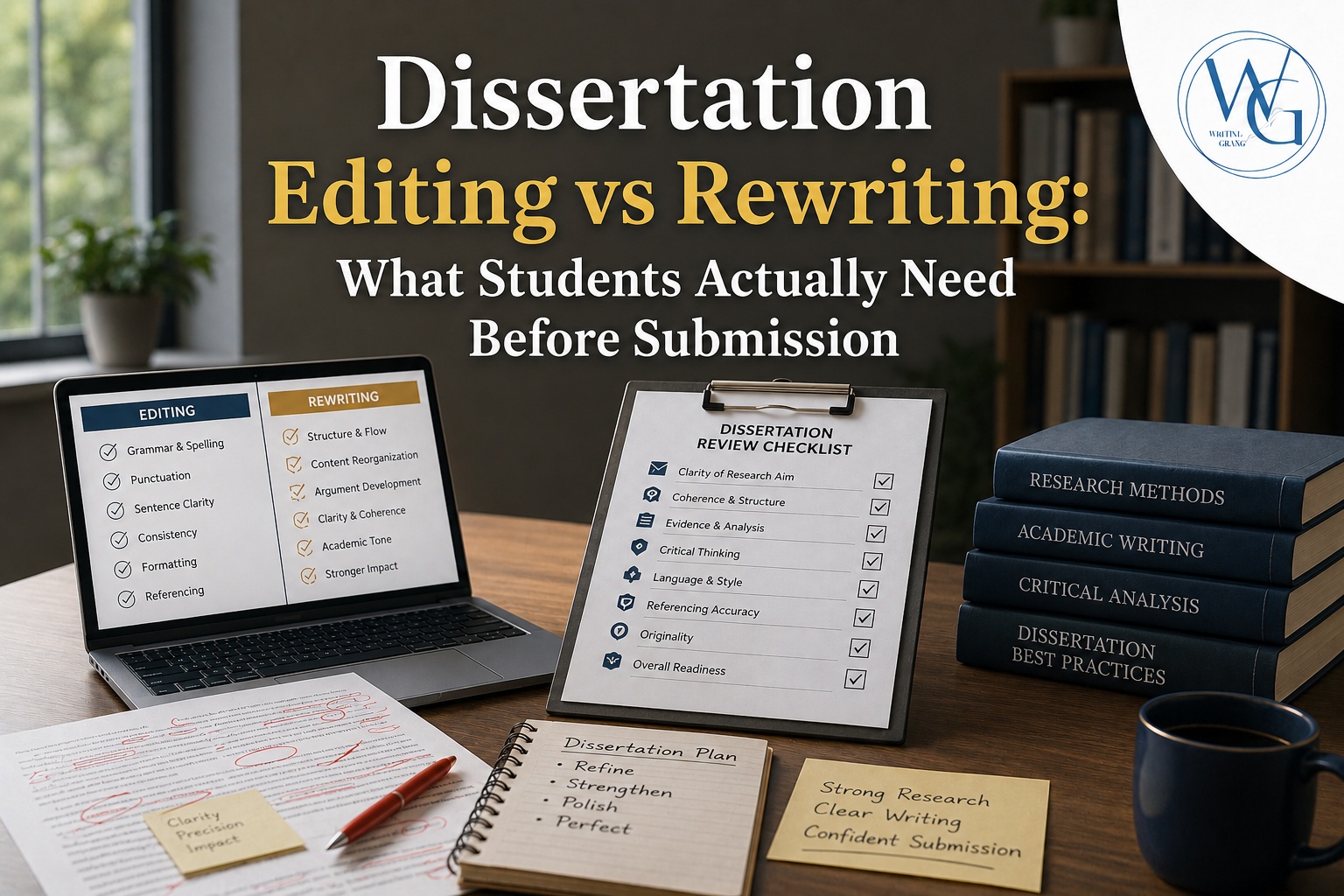
Dissertation Editing vs Rewriting explained clearly—learn what your dissertation actually needs before submission and avoid costly mistakes. Improve clarity, structure, and quality with expert help from Writing Gram.
Many students reach the final stages of their dissertations assuming that editing, proofreading, and rewriting all mean the same thing. In reality, they solve very different academic problems and can produce completely different outcomes. Choosing the wrong type of support at this stage can result in unnecessary revisions, poorly structured arguments, and lower grades, even after spending months writing and researching.
A dissertation that only needs grammar correction and formatting refinement should not undergo a complete rewrite. At the same time, a dissertation with weak structure, unclear arguments, or disconnected analysis may require more than basic editing. This is why understanding the difference between editing and rewriting is essential before submission.
Students often search for dissertation editing vs rewriting help when they are unsure whether their work needs minor language corrections or substantial changes to argument structure, clarity, and academic quality. The right decision depends on the condition of the draft, the level of supervisor feedback, and how close the dissertation is to final submission.
Before you submit one of the most important academic projects in your life, make sure your dissertation is fully polished, professionally refined, and ready for evaluation. Whether your work needs expert editing to improve clarity and academic flow or complete rewriting to strengthen weak sections and arguments, Writing Gram can help you submit a dissertation that meets doctoral-level standards.
Place your dissertation editing or rewriting order today and get professional academic support focused on improving the quality, readability, and overall presentation of your final submission.
Dissertation Editing vs Rewriting: Key Differences
Understanding the difference between dissertation editing and rewriting is essential before making final improvements to your dissertation. Many students assume the two services are interchangeable, but they actually address different issues within a dissertation. The distinction becomes especially important close to submission, where choosing the wrong type of support can affect clarity, structure, and the overall quality of the dissertation.
What Dissertation Editing Actually Involves
Dissertation editing focuses on improving the presentation and readability of an already completed draft without changing the original research methodology or core arguments. The goal is refinement rather than reconstruction.
Editing commonly includes:
Correcting grammar, punctuation, and sentence structure
Improving academic tone and clarity
Enhancing paragraph flow and transitions
Fixing formatting inconsistencies
Reviewing citation and referencing accuracy
According to the University of North Carolina at Chapel Hill Writing Center, editing and proofreading are important final-stage steps that help improve clarity, organization, and readability before submission.
What Dissertation Rewriting Actually Involves
Dissertation rewriting is a comprehensive revision process used when a dissertation has significant structural or analytical weaknesses. Instead of polishing the existing text, rewriting focuses on rebuilding sections to improve coherence and the strength of the argument throughout the dissertation.
Rewriting may involve:
Restructuring unclear arguments
Revising methodology explanations
Reorganizing literature review sections
Improving weak analytical discussion and data analysis.
Clarifying research objectives and findings
This type of support is usually necessary when supervisor feedback identifies major issues with structure, argument development, or alignment with doctoral-level expectations.
Editing vs Rewriting: The Main Difference
The difference between editing and rewriting depends on how extensive the changes need to be within the dissertation.
Editing improves what is already working
Rewriting fixes sections that are fundamentally weak or unclear
Editing focuses on refinement
Rewriting focuses on reconstruction
In simple terms, editing helps polish a dissertation, while rewriting helps rebuild problematic sections so the work communicates ideas more effectively and meets higher academic standards.
How to Know What You Actually Need (Decision Framework)
Choosing between editing and rewriting becomes much easier when you assess your dissertation against clear academic criteria, such as the grading rubric, rather than relying on assumptions. At the final stage, students often overestimate the severity of issues in their work, which leads to unnecessary rewriting or, in some cases, insufficient editing. A structured decision approach helps ensure your dissertation receives the right level of improvement.
Key Questions to Assess Your Dissertation
Use the following diagnostic questions to determine what your work actually needs:
Are your ideas solid but poorly expressed?
→ This typically indicates a need for editing rather than rewriting. Your research is strong, but clarity and language need refinement.Are your arguments unclear or not logically connected?
→ This often signals the need for rewriting, especially in sections like the literature review or discussion.Has your supervisor requested major structural changes?
→ This is a strong indicator that rewriting is required, not just surface-level corrections.Do you only need grammar, formatting, or citation fixes?
→ This falls under editing and proofreading rather than content restructuring.
Understanding the Level of Change Required
The dissertation revision process is not always about fixing everything; it is about applying the appropriate level of improvement. Minor issues in language or flow can often be resolved through careful editing, while deeper problems in argument structure require more substantial rewriting.
According to the University of Minnesota Crookston Writing Center, revision involves improving the structure, ideas, and overall clarity of a draft, while editing focuses on correcting grammar, style, and sentence-level issues.
Clarity Insight
Most students underestimate how small edits can significantly improve the clarity of their dissertations without rewriting entire chapters. In many cases, a strong draft only requires targeted refinement to achieve meaningful final improvements, rather than a complete structural overhaul.
When Dissertation Editing Is the Right Choice
Dissertation editing is most effective when your research is already complete and well-developed, but the presentation still needs refinement before submission. At this stage, the goal is not to change your ideas, but to improve how clearly and professionally they are expressed.
When editing is appropriate
Editing is the right choice if your dissertation needs polishing and not restructuring. Editing involves:
Grammar, spelling, and punctuation corrections
Improving academic tone and sentence clarity
Ensuring consistent citation and referencing style
Enhancing paragraph flow and readability
Removing repetition or awkward phrasing
These improvements help ensure your work reads smoothly and meets PhD-level presentation standards without altering your core arguments.
What universities emphasize about editing
Universities consistently emphasize that editing is a final-stage process focused on surface-level improvements, not changes to content. For example, the University of Wisconsin–Madison Writing Center explains that editing focuses on improving sentence-level clarity, grammar, and style once the main ideas and overall structure have already been established.
Practical insight for dissertation students
Editing is useful when:
Your supervisor has approved your structure
Your arguments are strong, but the wording is unclear.
You need final polishing before submission deadlines
In these cases, many students only require dissertation proofreading help rather than a full rewrite, since the core research and argumentation are already in place.
When Rewriting Is Necessary
Rewriting becomes necessary when the issues in a dissertation go beyond surface-level language problems and affect the overall structure, argument flow, and logic. In these cases, simple editing is not enough because the foundation of the work itself needs refinement to meet doctoral standards.
Signs that rewriting is required
Rewriting is typically needed when a dissertation shows deeper structural or conceptual problems, such as:
Weak or unclear argument structure that makes the research difficult to follow
Misaligned research objectives that do not consistently match the findings or discussion
Poor or incomplete explanation of the methodology section
Lack of coherence between chapters, where ideas feel disconnected or repetitive
Sections that do not clearly support the central research question
In such cases, the goal is not to correct sentences but to rebuild sections of the dissertation so that ideas progress logically and the central argument remains strong and consistent throughout the chapters.
Clarifying rewriting vs surface-level services
Many students searching for dissertation editing services often actually need rewriting support instead, because their challenges relate more to structure and argument development than to grammar or style.
According to the University of Michigan Sweetland Center for Writing, revision involves reworking ideas, reorganizing content, and improving clarity at the structural level rather than just correcting language issues.
🎓 Writing Gram helps turn your dissertation into a well-developed document by improving clarity, consistency, and how precisely each sentence expresses your ideas, while keeping your research direction intact—so your work reads more smoothly, follows the required academic expectations more closely, and is easier for examiners to follow and assess.
Place your dissertation editing or rewriting order today to strengthen your final submission, reduce avoidable revision requests, and submit a document that meets doctoral-level requirements on the first review.
Editing vs Rewriting: Cost, Time, and Academic Impact
Choosing between editing and rewriting often comes down to how much change your dissertation actually needs, and this directly affects time, cost, and the overall quality of the final submission.
Editing = faster, more affordable, final-stage polish
Usually takes less time because it focuses on refining existing content
Best for dissertations that are already well-structured
Improves readability, grammar, and academic tone without changing core ideas
Lower effort because no major restructuring is required
Rewriting = slower, more intensive, higher academic impact
Requires deeper work across entire sections or chapters
Involves restructuring arguments, improving logic, and rebuilding weak areas
Takes more time because it affects content at a structural level
Higher impact because it strengthens the overall academic argument
In practical terms, editing improves how your dissertation reads, while rewriting improves how your dissertation thinks. This distinction is why choosing the right level of dissertation editing vs rewriting support can significantly impact both your submission process and the quality of your assessed work.
Final Recommendation: What Most Students Actually Need
In most cases, students are surprised to discover that their dissertation does not require a full rewrite and only needs careful editing to improve clarity, flow, and academic presentation. If the research is already well-developed and the structure is approved, editing is usually enough to prepare the work for submission without altering the core ideas.
However, students who notice unclear arguments, weak structure, or disconnected chapters should not ignore those issues, as they often indicate the need for rewriting rather than surface-level corrections. The most effective approach is to first evaluate the condition of the dissertation objectively, then decide the level of support required based on its actual strengths and weaknesses.
Taking the right step at this stage ensures a smoother submission process and contributes to a stronger final dissertation improvement overall.
👉 At Writing Gram, we offer dissertation editing, proofreading, and rewriting services. You don’t need to worry—we help you choose the right service based on your specific needs. Simply place your order now and let our expert dissertation writers take care of the work, ensuring your dissertation meets the required academic standards.
Make the Right Choice Before Submission: Editing or Rewriting?
In most cases, students only realize at the final stage that the quality of their dissertation depends heavily on choosing the right type of improvement. A well-structured dissertation with clear arguments often only needs editing to refine language, improve flow, and ensure consistency in tone and presentation across sections. On the other hand, dissertations with unclear logic, weak structure, or misaligned arguments require rewriting to properly strengthen the foundation of the work.
Understanding this difference is important because it directly affects your final grade, submission confidence, and overall academic presentation. Making the wrong choice can either lead to unnecessary revisions or leave critical issues unresolved.
🎓 If you want expert help to get this right the first time, Writing Gram is where your draft is refined into a confident, submission-ready dissertation that aligns with doctorate and PhD standards. Simply place your order now and let our expert dissertation writers handle the work, ensuring your dissertation is carefully refined and meets the required academic standards at submission.