What Makes a Dissertation Methodology Chapter Strong: Advanced Evaluation Criteria Explained
By Writing Gram • May 22, 2026
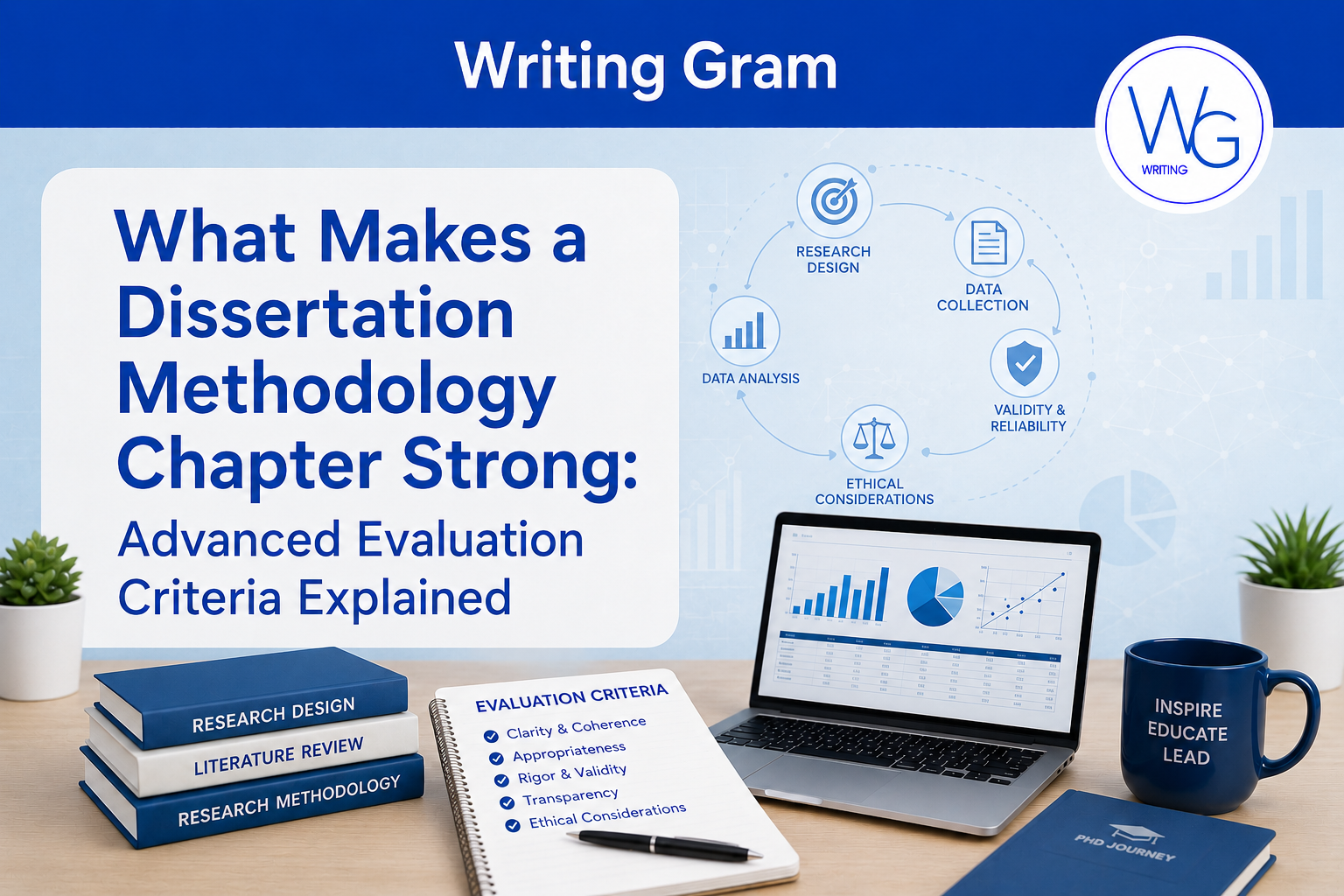
Discover what makes a strong dissertation methodology chapter using advanced examiner evaluation criteria. Learn how research design, data analysis, validity, and methodological justification affect grades—and get expert doctoral dissertation help from Writing Gram to improve your dissertation quality and academic success.
Introduction: Why Dissertation Methodology Is More Than a Description
A dissertation methodology chapter is not simply a section where researchers describe the methods they used—it is where they demonstrate the academic reasoning behind every major research decision. Examiners evaluate whether the selected research design, data collection techniques, and analytical approaches are logically connected to the study’s objectives and capable of producing credible findings. This is why a strong dissertation methodology is often viewed as a direct indicator of the overall quality and reliability of a dissertation.
At the doctoral level, methodology chapters are assessed using advanced criteria that go beyond technical explanation. Universities expect clear justification of methodological choices, transparency in research procedures, and evidence that the researcher understands the strengths and limitations of their approach. Many students seek doctoral dissertation help not because they lack research ideas, but because translating research decisions into academically defensible arguments can be challenging.
🎓 At Writing Gram, our expert dissertation writers help students develop well-structured methodology chapters that meet academic expectations while improving clarity, precision, and research credibility. Place your order now to receive professional dissertation support, timely delivery, plagiarism-free work, and expert guidance designed to strengthen your dissertation quality and final submission.
What Examiners Actually Look For in a Methodology Chapter
The San Jose University Writing Center notes that the methodology chapter is evaluated on far more than just the writing quality; examiners assess the logic, justification, and academic defensibility behind every methodological approach. In most cases, they are not asking what you did, but why you chose that approach and whether it genuinely supports your research objectives. This is where the PhD methodology chapter criteria become critical, as it reflects the underlying framework used to judge academic quality at the doctoral level.
Examiners typically focus on the following evaluation dimensions:
Justification of methods: Clear reasoning for choosing specific research designs, tools, or approaches over alternatives
Alignment with research questions: Strong connection between the methodology and the study’s aims and hypotheses
Transparency and replicability: Sufficient detail that allows another researcher to reproduce or evaluate the study
Methodological appropriateness: evidence that the methods are appropriate, systematic, and grounded in established research practice.
Research Design Justification: The Core of a High-Scoring Methodology
A well-developed methodology chapter is judged primarily on how it justifies the chosen research design, not simply on how clearly it describes it. In a doctoral dissertation, examiners expect researchers to demonstrate a clear, logical connection between the research problem and the methodological choices made. Without this justification, even technically correct methods can appear weak or unconvincing.
Strong justification typically includes:
Fit with the research problem: Explaining why a specific design (qualitative, quantitative, or mixed methods) best addresses the research questions
Rejection of alternatives: Showing awareness of other possible approaches and why they were not suitable for the study
Philosophical alignment: Briefly linking the design to underlying assumptions such as epistemology or ontology, without overloading theory
Practical feasibility: Demonstrating that the chosen method is realistic in terms of time, data access, and resources
According to Purdue University’s Online Writing Lab, research writing requires clear methodological reasoning and transparent decision-making, ensuring that research choices are well justified and meet doctoral-level standards.
This is where the concept of research design justification dissertation becomes essential, as it distinguishes a merely descriptive methodology from one that demonstrates critical academic reasoning. Weak justification often lists methods without explanation, while strong justification clearly shows why those methods are the most appropriate choice for answering the research question.
Data Collection & Analysis: Depth, Transparency, and Logic
A high-quality methodology chapter is not defined by listing tools or procedures, but by how clearly it demonstrates the logic connecting research design, data collection, and data analysis. Examiners look for a coherent system where each step naturally supports the research questions and overall study objectives. This is central to understanding what makes a good methodology chapter at the doctoral level.
Strong methodology writing typically demonstrates:
Clear sampling strategy reasoning: Why specific data analysis tools, participants, cases, or datasets were selected, and how they align with the research purpose.
Consistency in data collection: Ensuring procedures are applied uniformly to maintain reliability and reduce bias
Alignment of analytical framework: Showing how the chosen analysis method directly answers the research questions
Transparent decision-making: Clearly explaining each step so the research process can be evaluated or replicated
The University of North Carolina at Chapel Hill emphasizes that effective academic research writing requires clarity, logical structure, and sufficient explanation of methods so that readers can understand and evaluate how conclusions are reached.
Similarly, the University of Southern California research guides highlight the importance of aligning data collection and analysis methods with the overall research design to ensure validity and coherence.
When students struggle to translate the methodology into clear and well-justified explanations, many turn to doctoral dissertation help to strengthen clarity, structure, and argumentation.
🎓At Writing Gram, we specialize in transforming complex research processes into clear, examiner-focused methodology chapters that improve coherence and quality. Place your order today to receive expertly written support, faster turnaround, and a polished dissertation that meets doctoral-level standards.
Methodological Evaluation: Validity, Reliability, and Trustworthiness
A key part of a strong methodology chapter is demonstrating how the study’s findings can be trusted and meaningfully interpreted. Examiners assess this through core evaluation lenses that shape dissertation methodology evaluation, especially in relation to how data is collected, analyzed, and interpreted.
A strong methodology chapter clearly addresses the following elements:
Validity: Whether the research truly measures what it intends to measure. For example, ensuring that survey questions, interview prompts, or instruments directly reflect the research objectives rather than measuring irrelevant or off-topic variables.
Reliability: The consistency of the research process and whether similar results could be produced under similar conditions
Trustworthiness (qualitative focus): The credibility, transferability, and dependability of findings, especially when working with interviews, observations, or thematic analysis
The University of California, Berkeley, emphasizes that research methods should be clearly defined and structured so others can understand how conclusions are drawn from data, reinforcing the importance of transparent research design and reasoning. Together, these elements ensure that the methodological framework is not only clearly presented but also defensible when evaluated at the doctoral level.
Common Weaknesses That Lower Methodology Grades
Many methodology chapters lose marks not because the research idea is weak, but because the methodology lacks clarity, a strong justification, and a clear logical connection between the different sections of the dissertation.
Examiners are particularly sensitive to patterns that suggest surface-level understanding rather than thoughtful research design decisions. Understanding these weaknesses is essential for improving dissertation methodology evaluation outcomes.
Common issues include:
Copy-paste methodology structures
Many students rely on generic templates without adapting them to their specific research questions or context, which makes the methodology appear disconnected from the actual study.Lack of justification for choices
Methods are often stated but not explained. Examiners expect clear reasoning for why specific approaches were selected over others.Weak connection between methods and research questions
A common issue arises when data collection and analysis procedures do not clearly align with the study’s research questions.Over-description of procedures
Some dissertations focus too heavily on explaining basic steps rather than explaining why those steps matter for the research design.
The MIT Writing and Communication Center highlights that effective academic writing requires clear structure, purposeful explanation, and careful attention to how ideas are logically developed and supported MIT Writing and Communication Center.
At Writing Gram, these weaknesses are actively addressed by ensuring every methodology chapter is structured with clear justification, strong alignment to research objectives, and examiner-focused clarity. Our expert doctoral dissertation help ensures your work avoids common pitfalls and presents a well-structured, defensible methodology.
Place your order today to receive professional dissertation support that improves clarity, strengthens your arguments, and ensures your dissertation meets doctoral-level standards.
Advanced Examiner Evaluation Criteria in Dissertation Methodology
At the doctoral level, examiners apply a more detailed and multi-dimensional set of criteria when assessing methodology chapters
The focus is not only on whether appropriate methods were selected, but on how well the entire methodology demonstrates logical coherence, clear justification, and thoughtful reflection. This is where PhD methodology grading criteria become important in distinguishing average work from top-tier dissertations.
Examiners typically evaluate the methodology through the following advanced criteria:
Coherence between philosophy, design, and methods
The research philosophy (such as interpretivism or positivism) must align logically with the chosen research design and data collection methods. Any mismatch weakens the overall structure.Transparency of decision-making
Researchers are expected to clearly explain why each methodology choice was made, including sampling strategies, tools, and analytical approaches.Depth of academic justification
It is not enough to state what was done; strong dissertations explain why each decision is the most suitable option for addressing the research problem.Critical reflection on limitations
High-quality methodology sections acknowledge constraints such as sample size, data access, or methodological trade-offs, and explain how these limitations may influence findings.
The University of Michigan’s research guidance emphasizes that strong research design requires careful alignment between questions, methods, and interpretation to ensure clarity and meaningful analysis.
Together, these criteria show how examiners distinguish between descriptive methodology writing and work that demonstrates deeper analytical thinking and critical reasoning.
Where Expert Dissertation Writing Support Becomes Relevant
Methodology chapters often become challenging when students are required to clearly justify complex research decisions. At the doctoral level, even strong research ideas can lose marks if the methodology lacks structure, coherence, or a clear explanation of the methodological choices. This is why many students turn to professional doctoral dissertation help services for guidance when writing the methodology chapter.
Expert support is commonly used to help with:
Structuring methodology chapters in a logical and examiner-friendly format
Strengthening justification for research design and analytical approaches
Improving clarity in data collection and analysis explanations
Refining the methodology language to meet doctoral-level expectations
Identifying weaknesses or inconsistencies before final submission
Effective methodology writing requires more than technical description; it requires the ability to explain research decisions in a way that demonstrates critical thinking, transparency, and alignment with the study’s objectives.
Why Students Seek Doctoral Dissertation Help for Methodology Chapters
A methodology chapter becomes effective when every research decision is clearly justified and logically connected to the research objectives. Examiners are not impressed by excessive technical language or unnecessary complexity; they look for coherence, transparency, and the ability to demonstrate why the chosen methods are appropriate for the study. This is what separates an average methodology chapter from a strong dissertation methodology that supports credible and persuasive research findings.
Many doctoral students seek professional guidance because methodology writing requires more than describing procedures. It demands critical explanation, alignment between research questions and methods, and careful handling of issues such as sampling, validity, reliability, and analytical strategy.
🎓At Writing Gram, we help students develop methodology chapters that are clear, well-structured, and aligned with examiner expectations. Our expert dissertation writers provide personalized support, detailed research guidance, plagiarism-free work, and timely delivery that strengthen the quality of your dissertation. Place your order now and get professional dissertation assistance designed to improve clarity, organization, and overall academic performance.