How to Critically Analyze Sources in a Dissertation Literature Review
By Writing Gram • May 27, 2026
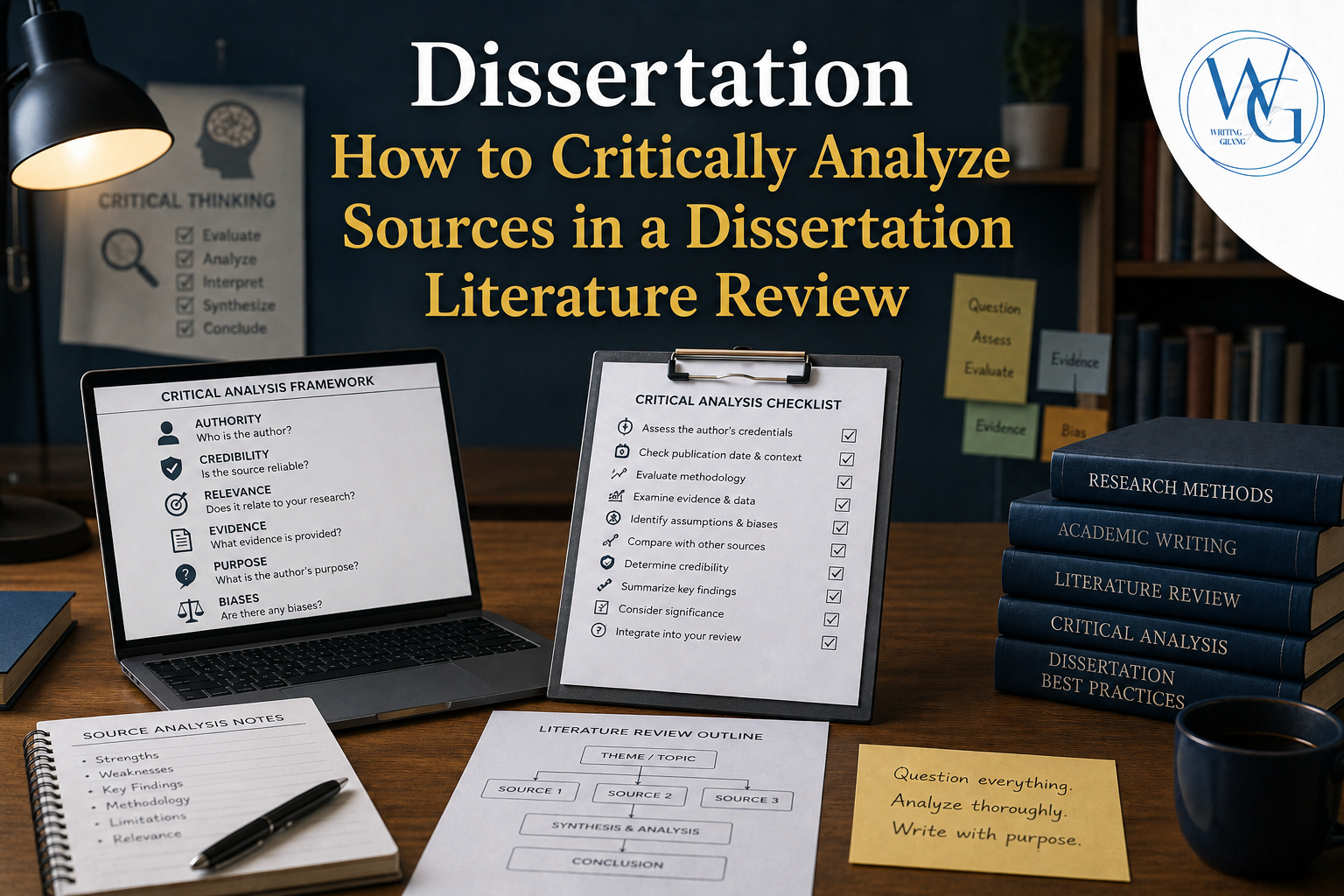
Learn how to critically analyze sources in a dissertation literature review using clear evaluation techniques that improve your grades and academic clarity. Get practical steps for source evaluation, avoid common mistakes, and strengthen your dissertation with expert-level guidance and support.
Critical analysis in literature review writing is one of the most important skills examiners expect at the postgraduate and doctoral levels. A strong dissertation literature review does more than summarize journal articles because it evaluates evidence, compares scholarly arguments, identifies methodological weaknesses, and explains how existing research shapes the direction of the study. Without this level of analysis, a dissertation can appear descriptive, fragmented, and unconvincing even when substantial research has been conducted.
Many students struggle with this process because critically reviewing literature requires more than just collecting sources. Researchers must determine:
whether evidence is reliable,
how studies relate to one another,
where research gaps exist,
and which findings are most relevant to the dissertation question.
This is why universities place strong emphasis on analytical discussion in the literature review instead of simple description. Examiners expect students to demonstrate independent evaluation, research awareness, and academic judgment throughout the literature review.
🎓At Writing Gram, our experts provide custom and non-AI PhD dissertation writing help that focuses on strengthening source evaluation, analytical discussion, and evidence synthesis to ensure your literature review meets doctoral standards. Simply place your order now to receive expert support that helps transform weak summaries into a well-structured critical literature review that strengthens the credibility, clarity, and overall quality of your dissertation.
What Does Critical Analysis Mean in a Dissertation Literature Review?
Critical analysis in literature review writing involves evaluating academic sources instead of simply describing them. In a dissertation, examiners expect students to interpret evidence, compare scholarly perspectives, and assess the reliability and relevance of research findings. A strong literature review demonstrates analytical thinking by explaining how different studies contribute to the overall research problem and not just describing information from multiple sources.
According to The University of Southern California Libraries, a critical literature review involves analyzing and synthesizing existing research to evaluate strengths, weaknesses, and gaps within the literature. This approach helps researchers build a stronger academic argument and justify the direction of their study.
Key Elements of Dissertation Source Evaluation
Effective dissertation source evaluation typically involves:
assessing the credibility of authors and journals,
comparing arguments across multiple studies,
identifying methodological strengths and weaknesses,
evaluating the quality and reliability of evidence,
recognizing bias, assumptions, and research limitations,
determining how relevant a source is to the dissertation topic.
Why Critical Evaluation Matters
When evaluating academic sources for a dissertation, students should focus on interpretation rather than summary. For example, two studies may reach different conclusions because they used different sample sizes, research methods, or theoretical frameworks. Identifying these differences demonstrates critical engagement with scholarly evidence and strengthens the overall quality of the literature review.
A well-developed analytical discussion also helps establish research gaps, highlight unresolved debates, and position the dissertation within existing academic literature.
Why Source Evaluation Matters in Dissertation Research
Source evaluation is a core part of producing a high-quality dissertation literature review because it directly shapes how a researcher builds arguments and justifies their study.. Examiners do not assess dissertations based on the number of sources included, but on how effectively those sources are analyzed, compared, and applied to the research problem. This is where how to analyze sources for a dissertation becomes a critical academic skill rather than a technical step.
At the doctoral level, source critique in PhD research reflects a student’s ability to demonstrate depth of understanding, research maturity, and independent analytical thinking. When sources are not properly evaluated, the literature review often becomes descriptive, weakening the overall academic contribution of the dissertation.
Strong evaluation improves dissertation quality in several key ways:
Stronger argument development by ensuring only credible and relevant evidence supports claims
Clear identification of research gaps, which helps justify the need for the study
Better theoretical positioning, allowing the research to align with or challenge existing frameworks
Improved research credibility, since well-critiqued sources signal good research and critical thinking.
Enhanced synthesis of evidence, where findings are meaningfully compared rather than listed
As explained by the University of North Carolina at Chapel Hill Writing Center, evaluating sources involves assessing their credibility, relevance, and context within the broader field of research, not just summarizing their content.
Ultimately, effective source evaluation ensures that a dissertation literature review demonstrates analytical depth and sound academic judgment, both of which are required at the postgraduate level.
How to Critically Analyze Sources for a Dissertation Literature Review
A strong dissertation literature review is built on evaluation rather than description. This means examining each source for credibility, methodology, relevance, and contribution to the research problem. At the doctoral level, this is central to critical analysis in literature review because it shows depth of understanding and academic judgment.
1. Evaluate the Author’s Credibility
A key part of evaluating academic sources for a dissertation is assessing whether the author is qualified and recognized in their field. Strong academic sources usually come from established scholars or researchers.
Important indicators include:
Academic qualifications such as a PhD or research specialization
Affiliation with reputable universities or research institutions
Publication in peer-reviewed journals
Recognition through citations and academic influence
Sources with strong credibility strengthen the reliability of your dissertation argument, while weak or unknown sources reduce academic trustworthiness.
2. Examine the Research Methodology
Understanding methodology is essential in understanding how to analyze sources for dissertation writing because it determines how valid and applicable the findings are.
Key aspects to assess:
Research design (qualitative, quantitative, or mixed methods)
Sample size and how representative it is
Data collection methods such as surveys, interviews, or experiments
Data analysis tools such as SPSS, NVivo, amongst others.
Clearly stated limitations and potential weaknesses
A study using a narrow, highly specific sample might involve 25 postgraduate engineering students from a single university department in one country, which is not appropriate for drawing general conclusions about engineering students globally because the limited size and context restrict representativeness. In contrast, a study using a large, heterogeneous (or broadly representative) sample might include 5,000 university students drawn from multiple institutions across different countries and disciplines, which is more appropriate when the goal is to produce generalizable findings about student behavior or experiences across diverse educational settings.
3. Compare Findings with Other Studies
A core part of critical thinking in literature review is comparing studies rather than reviewing them individually. This allows you to identify patterns, contradictions, and research trends.
You should:
Identify findings that support similar conclusions
Highlight conflicting results between studies
Observe how research evolves over time
Combine multiple perspectives into a structured argument
The University of Texas Libraries explains that synthesis involves connecting ideas across multiple sources rather than summarizing them separately.
This approach helps build a more analytical and coherent literature review.
4. Identify Biases and Limitations
A strong source critique in PhD research requires recognizing that all studies have limitations or potential bias.
Common reasons that cause bias in research include:
Funding influences that may affect outcomes
Limited geographic or cultural scope
Small or non-representative samples
Outdated data that may no longer be relevant
Researcher assumptions influencing interpretation
Acknowledging these limitations strengthens your academic integrity and shows deeper engagement with the literature.
5. Analyze Relevance to Your Dissertation Topic
A credible source is not always a relevant one. Effective dissertation source evaluation requires filtering studies based on their direct contribution to your research question.
Ask the following:
Does the study directly address my research problem?
Does it support or challenge my theoretical framework?
Does it help identify a research gap?
Is it applicable to my context or population?
Prioritizing relevance ensures that your literature review remains focused, structured, and meaningful.
Common Mistakes Students Make When Evaluating Sources
A strong dissertation literature review depends on how well students evaluate and interpret academic sources. However, many postgraduate students unintentionally weaken their work by treating literature review writing as a summary exercise rather than a critical process. Avoiding these mistakes is essential for producing critical analysis in literature review work that meets doctoral-level expectations. The most common mistakes that most students make when writing the literature review include:
1. Summarizing Instead of Analyzing
One of the most common errors in evaluating academic sources for a dissertation is describing what a study says without explaining its meaning, relevance, or limitations.
This becomes a problem when students:
Repeat findings without interpretation
Fail to compare studies
Do not explain the significance of their research question
For example:
A student writes: “Smith (2020) found that online learning improves student engagement.”
This is only a summary. A stronger approach would be:
“Smith (2020) found improved engagement in online learning, but the study focused only on first-year students in one institution, limiting its generalizability to broader university populations.”
2. Relying on Outdated Studies
Using outdated research can weaken academic arguments, especially in rapidly changing fields where newer evidence may have replaced earlier findings.
This is problematic because:
Methods and technologies may have evolved
Newer studies may contradict earlier conclusions
Data may no longer reflect current realities
According to Harvard University’s Writing Program, strong academic writing requires careful selection of relevant and credible sources that support up-to-date arguments.
Example:
A dissertation on digital learning relies heavily on studies from 2005–2010 that do not account for AI-based learning platforms or modern hybrid education models. This weakens relevance compared to using recent post-2020 research.
3. Using Too Many Weak Secondary Sources
A common issue in source critique in PhD research is relying on non-academic or secondary sources instead of peer-reviewed research.
Weak sources include:
Opinion blogs without data
News articles used as evidence
Literature reviews without primary research
General websites without academic review
Example:
A student cites a blog post claiming “remote learning reduces productivity” instead of using peer-reviewed journal studies that measure productivity through controlled experiments. This reduces academic credibility.
4. Ignoring Contradictory Evidence
A major weakness in critical thinking literature review writing is focusing only on studies that support a preferred argument while ignoring conflicting findings.
This leads to:
One-sided analysis
Weak academic discussion
Missed opportunities to identify research gaps
Example:
A dissertation on social media and academic performance only cites studies showing negative effects, while ignoring research that finds neutral or positive impacts depending on usage patterns and student demographics.
5. Focusing Only on Agreement Between Studies
Many students believe that showing agreement between studies is enough for a strong analysis, but this does not demonstrate critical analysis.
Instead, students should explain:
Why studies agree or differ
How methodology influences results
Whether context affects findings
Example:
Two studies report that physical activity improves student performance. One uses controlled lab experiments, while the other uses self-reported surveys. Treating both results as equally strong without evaluating the methodology ignores important differences in the quality of the evidence
🎓Avoiding these mistakes helps ensure a literature review demonstrates genuine analytical depth instead of simple description. Writing Gram helps PhD and doctoral students strengthen source evaluation, sharpen critical analysis, and remove common errors to produce a well-structured, high-quality dissertation that meets examiner expectations. Place your order now to get expert support that improves clarity, sharpens argumentation, and elevates your dissertation to meet doctoral standards.
How Strong Critical Analysis Improves Dissertation Quality
Strong critical analysis plays a central role in shaping a high-quality dissertation because it determines how effectively a student engages with existing research instead of simply repeating it. When sources are properly evaluated, the literature review becomes a structured academic argument instead of a descriptive summary of studies.
Effective source evaluation helps to:
build stronger and more logically supported arguments
demonstrate doctoral-level thinking through interpretation and judgment
improve originality by identifying gaps and underexplored areas in the literature
strengthen academic credibility through careful use of reliable evidence
Students who struggle with source evaluation often produce descriptive literature reviews that lack analytical depth and fail to meet examiner expectations. In such cases, professional dissertation support can help transform weak summaries into coherent, critical discussions that align with postgraduate standards and improve the overall research quality.
Why Strong Source Evaluation Directly Shapes Dissertation Success
Critical analysis is about evaluating ideas and evidence, not just describing them. In a dissertation literature review, this means moving beyond simply reporting what previous studies say and instead explaining how, why, and with what level of reliability those findings contribute to your research argument. Examiners consistently look for this shift from summary to interpretation as evidence of advanced academic thinking.
At the doctoral level, success depends on the ability to demonstrate analytical thinking through:
clear evaluation of the strengths and weaknesses of academic sources
meaningful comparison of differing research findings
identification of gaps, contradictions, and limitations in existing literature
logical integration of evidence to support a focused research argument
When source critique is done well, the entire dissertation becomes stronger, more coherent, and more credible because each claim is backed by carefully assessed evidence.
For students who find it difficult to consistently apply this level of evaluation, expert PhD dissertation writing help can make a significant difference.
Writing Gram helps PhD and master’s students refine their literature reviews by strengthening source analysis, improving critical engagement with research, and ensuring every section meets examiner expectations. If you want a focused, analytical, and high-quality dissertation, place your order now to get expert support that sharpens your argument, improves structure, and strengthens the overall quality of your work from the start to submission.