Help With Dissertation Writing After Unexpected Findings and Rejected Hypotheses
By Writing Gram • Sep 21, 2026
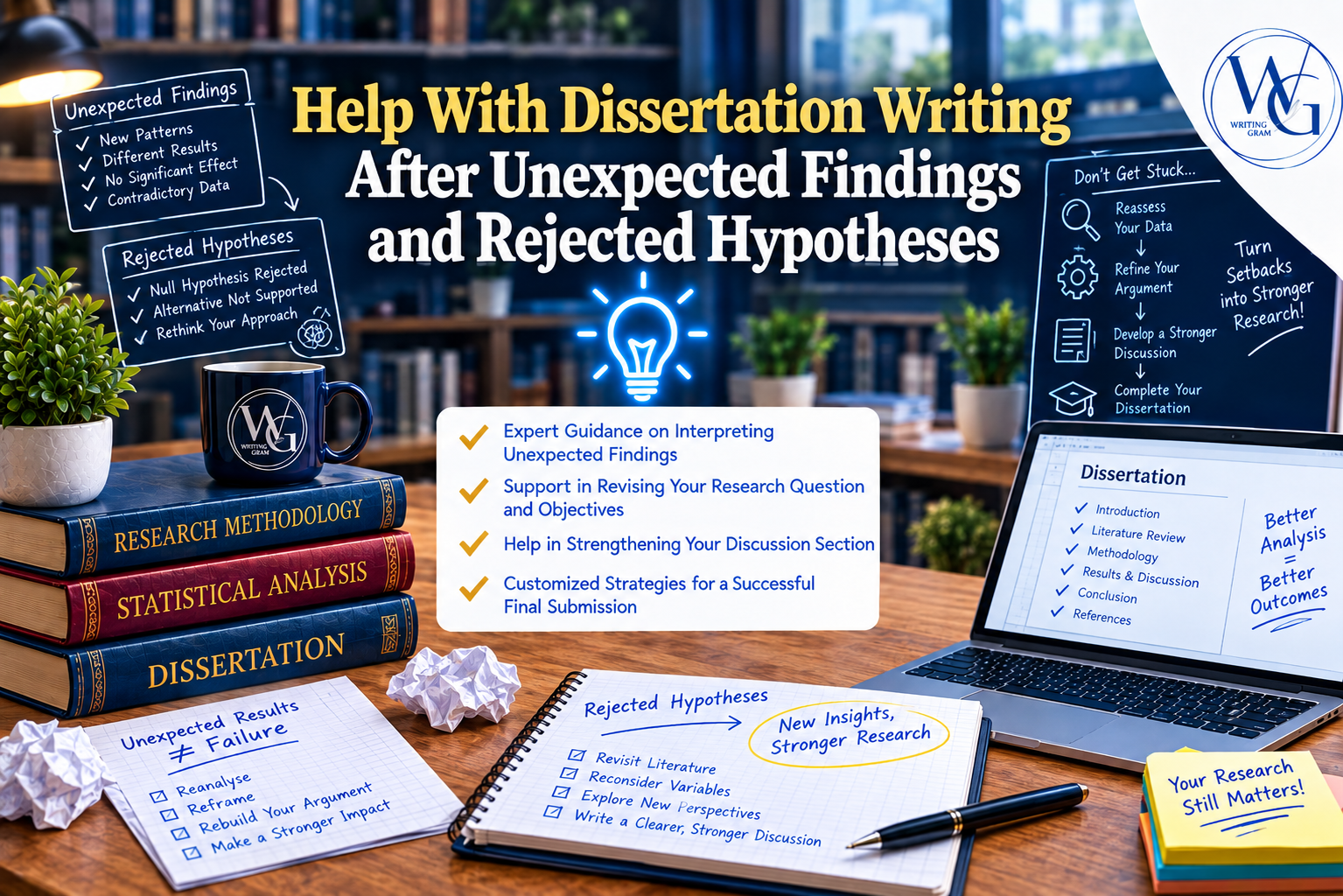
Need help with dissertation writing after unexpected findings? Get help interpreting rejected hypotheses, explaining results, and strengthening your discussion.
If your dissertation findings do not support your original hypothesis, do not change the data simply to produce the result you expected. Instead, report what the research actually found, explain whether the hypothesis was supported, interpret the unexpected result, compare it with previous research, and discuss possible explanations, limitations, and implications. The goal is to make the finding understandable and defensible.
1. What does it mean when dissertation findings do not support the hypothesis?
When your dissertation findings do not support your hypothesis, it means that the evidence you obtained did not confirm the prediction you made before conducting the study. That can happen in several ways. A statistical test may show no significant relationship, a predicted effect may not appear, or the results may point in the opposite direction from what you expected.
These outcomes are not necessarily evidence that your dissertation is unsuccessful. What matters is how accurately you report and interpret them. Research is designed to test questions and expectations, and the outcome does not always have to confirm the original prediction.
For example, you might have hypothesized that employee training would significantly improve job performance, but your analysis finds no statistically significant relationship. Your task is not to make the result look positive. Your task is to explain what the finding means in relation to your research question and the evidence available.
George Mason University distinguishes between reporting findings in the Results section and interpreting what those findings mean in the discussion chapter. Its guidance also recognizes surprising and contradictory results as part of research reporting.
If you are struggling to turn an unexpected result into a clear dissertation discussion, Writing Gram’s dissertation writing help can assist you in reviewing your findings, interpreting what the results mean, connecting them with relevant research, and revising the affected sections of your dissertation based on the evidence you actually obtained.
Place your order now for dissertation writing help that can help you explain rejected hypotheses, strengthen your Discussion chapter, and present your findings clearly without changing the underlying research.
2. Should you change your dissertation when the results do not support your hypothesis?
You may need to revise parts of your dissertation, but you should not change the underlying findings simply because they conflict with your original expectation.
There is an important difference between revising your interpretation and changing your research outcome.
You may need to revise:
what the hypothesis actually predicted
any statement that overstates what the results demonstrate
your explanation of why a predicted relationship was not observed
how unexpected findings connect with previous research
your discussion of the study's limitations
the implications of the findings for theory or practice
questions that future research could investigate
your research instruments, data collection procedures, or study design after a failed pilot study
your research questions, methodology, theoretical framework, or study design after a dissertation proposal is rejected
how you explain and interpret mediation and moderation results when the findings differ from your original expectations
earlier dissertation sections as an ABD student when your current findings, committee feedback, or research direction require changes to the work you have already completed
What should not happen is changing, omitting, or selectively presenting evidence simply to make a rejected hypothesis appear supported.
Your dissertation should represent what your research found, including results that were different from your expectations. Cornell University describes the Results section as a central part of the thesis and notes that the Discussion addresses the interpretation of those results.
An unexpected outcome can therefore require revising how you explain and discuss the evidence, rather than changing the evidence itself.
An unexpected outcome can therefore require revising how you explain and discuss the evidence, rather than changing the evidence itself.
What should not happen is changing, omitting, or selectively presenting evidence simply to make a rejected hypothesis appear supported.
Your dissertation should represent what your research found, including results that were different from your expectations. Cornell University describes the Results section as a central part of the thesis and notes that the Discussion addresses the interpretation of those results.
This means an unexpected outcome can require better explanation, not a different outcome.
3. How do you interpret unexpected hypothesis results in a dissertation?
The first step is to separate what the analysis showed from why you think it happened. Do not begin by trying to justify the result before clearly stating it.
Work through the result in this order:
Start with what the data showed
State the finding accurately and identify the analysis that produced it. For example:
“The analysis did not identify a statistically significant relationship between X and Y.”
Avoid immediately claiming that you know why the relationship was absent.
State whether the hypothesis was supported
Use language that accurately reflects your evidence. Depending on your research design, you might write:
“The findings did not support H1.”
“The results did not provide sufficient evidence to support H1.”
“The predicted relationship was not statistically significant.”
“The findings differed from the direction predicted by H1.”
The appropriate wording depends on your methodology and statistical framework. A non-significant result, for example, should not automatically be described as proof that no relationship exists.
Consider plausible explanations
Once the finding is established, examine explanations that are consistent with your research design and evidence. These might include:
characteristics of the sample
the research setting
measurement or instrument limitations
sample size and statistical power
differences between your study population and earlier studies
theoretical assumptions
contextual factors
unexpected relationships within the data
Do not present speculation as an established fact. If an explanation cannot be demonstrated from your study, describe it as a possible explanation rather than a definite cause.
Compare the result with previous research
Your unexpected finding becomes more meaningful when you place it within the existing literature. Ask whether your result agrees with previous research, differs from it, or provides evidence from a population or context that has received less attention.
Harvard Library explains that literature reviews do more than summarize research: they evaluate and contextualize existing scholarship and identify unanswered questions and areas for further research.
FAQ: Questions students often have about unexpected dissertation findings
Can a dissertation be accepted if the hypothesis is rejected?
An unsupported hypothesis does not automatically make a dissertation unacceptable. The significance of the outcome depends on the research question, methodology, quality of the analysis, interpretation of the evidence, and requirements of the student's program.
What should I do if my dissertation results contradict my hypothesis?
First verify that the analysis was conducted appropriately. Then report the result accurately, state whether the hypothesis was supported, interpret the finding, compare it with previous research, and discuss relevant explanations and limitations.
Should I say my hypothesis was rejected or not supported?
The appropriate terminology depends on your discipline and research design. In many contexts, “not supported” is useful when the evidence does not provide the expected result without implying more than the analysis demonstrates.
Should I change my hypothesis after seeing my results?
You should not rewrite the original hypothesis simply to make it appear that the study predicted the result. If your findings generate a new explanation or research question, you can discuss that possibility and identify it as something that could be examined in future research.
What if several hypotheses are not supported?
Discuss each hypothesis in relation to the corresponding research question and analysis. Look for patterns across the findings rather than treating every unsupported hypothesis as an isolated problem.
4. How to write the dissertation discussion when a hypothesis is rejected
The Discussion chapter is where an unexpected result becomes part of the larger argument of your dissertation.
Do not simply repeat the statistics from the Results chapter. Instead, move from the finding to its meaning.
You can structure this part of the Discussion as follows:
Finding → hypothesis decision → comparison with literature → possible explanation → implication → limitation
For example:
Finding: The analysis found no significant relationship between X and Y.
Hypothesis: Therefore, H1 was not supported.
Comparison: This differs from studies that reported a significant relationship in similar research.
Explanation: One possible explanation is the different characteristics of the present sample.
Implication: The finding suggests that the relationship may not operate in the same way within this particular context.
Limitation: The sample size and study setting may limit how broadly the result can be interpreted.
This approach prevents the Discussion from becoming either a repetition of Chapter 4 or a collection of unsupported explanations.
Purdue University explains that research reports commonly use the Results section to present what was found and the Discussion section to address what those findings mean.
The same approach applies when writing about unexpected results in a dissertation discussion: state what the findings show, explain what they mean, relate them to previous research, and clarify what they mean for your research question.
5. What if the unexpected finding is caused by a problem with the analysis?
An unexpected result should not automatically be treated as an important finding. Before building your Discussion around it, make sure the result has been produced correctly and interpreted accurately.
Depending on your methodology, check whether:
the appropriate statistical or analytical method was used
variables were coded correctly
relevant assumptions were assessed
missing data were handled appropriately
the sample size is adequate for the analysis
the statistical output has been interpreted correctly
the analysis actually addresses the stated research question
the measures used in the study adequately represent the variables being investigated
There is a major difference between “my hypothesis was not supported” and “there may be a problem with my analysis.”
The first can be a legitimate research finding. The second requires investigation before you can confidently interpret the result.
Resources from the University of Southern California include research-methods resources and information about evaluating testing instruments, including issues such as validity and reliability.
If you are unsure whether an unexpected result reflects the evidence or an analytical problem, getting specialist dissertation analysis help can help you identify what needs to be checked before you rewrite your interpretation.
6. How to discuss findings that contradict previous research
A finding that differs from previous studies needs more than a statement that “the results were different.”
Instead, examine why the studies may have produced different outcomes.
Relevant differences can include:
the characteristics of the participants
sample size or sampling approach
geographical or institutional setting
measurement instruments
time period
analytical techniques
differences in how variables were defined
For example, suppose earlier studies found a significant relationship between two variables, while your dissertation did not. Your discussion could examine whether your participants, setting, measurement approach, or methodology differed from those studies.
Avoid claiming that your result proves previous research wrong. Instead, consider whether your findings suggest that the relationship may differ under certain conditions or in a different research context.
The University of California, Berkeley writing guidance emphasizes connecting evidence to interpretation rather than simply repeating what the evidence shows. This is especially important when your findings differ from those reported in earlier studies.
7. When should you get dissertation writing help with unexpected findings?
You may benefit from dissertation writing help if you understand your results but are struggling to explain what they mean and how they fit into your dissertation.
Professional dissertation assistance can be particularly useful if:
you are unsure how to explain a rejected hypothesis
several hypotheses were not supported
your findings contradict previous research
you do not know how to connect the results with the literature
your Discussion chapter feels repetitive
you are unsure whether an unexpected result reflects an analytical problem
your supervisor has asked you to provide a deeper interpretation
you need to revise Chapters 4 or 5 after obtaining unexpected results
you understand the statistics but struggle to communicate their meaning clearly
Professional dissertation assistance should work from your actual research, findings, analysis, and existing dissertation material. The goal is to help you understand and clearly communicate the evidence, not to create a result that fits your original hypothesis.
8. How Writing Gram can help with unexpected dissertation findings
When your dissertation results do not support your original hypothesis, the challenge is often explaining and defending those findings clearly during your dissertation defense or viva voce.
Writing Gram can help you work through your existing research by reviewing the findings, examining how they relate to your hypotheses and research questions, identifying areas that need clearer interpretation, connecting the findings with relevant literature, and strengthening the sections affected by unexpected results.
You can get help with:
interpreting unexpected or non-significant findings
explaining unsupported or rejected hypotheses
developing the Discussion chapter
connecting findings with previous research
addressing contradictions between your findings and earlier studies
identifying where limitations affect interpretation
revising relevant dissertation sections around your actual evidence
If your findings did not turn out as expected, you do not need to force your dissertation to support your original hypothesis. Instead, our dissertation writing help can help you develop a clear, well-supported explanation of what your research actually found and why those findings matter.
Place your order now for dissertation writing help to turn unexpected findings into a stronger dissertation by developing your discussion, clearly explaining rejected hypotheses, connecting your results with relevant research, and revising the affected sections so your dissertation accurately reflects the evidence from your study.