How Dissertation Assistance Helps Students Manage Research Scope Without Weakening Their Study
By Writing Gram • Aug 11, 2026
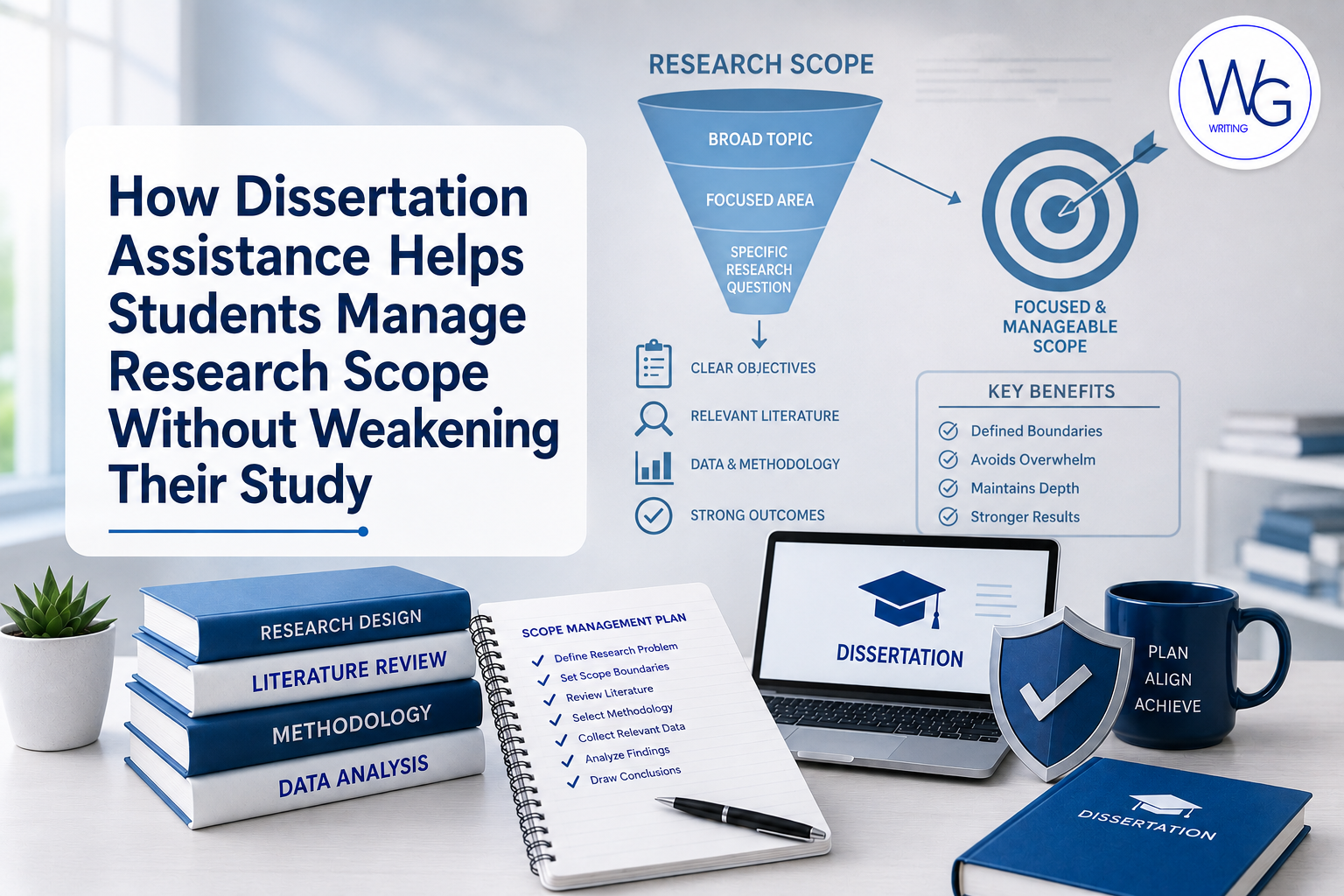
Get dissertation assistance to control scope expansion, narrow your research focus, and strengthen your dissertation while keeping your study focused and manageable.
Why Dissertation Scope Expansion Becomes a Serious Problem
A dissertation can begin with one clear research question and gradually expand beyond its original scope as new ideas, sources, and research needs emerge. A student may add another population, geographic setting, variable, comparison, theory, data source, or related research question because each seems relevant to the original topic. However, adding an element simply because it relates to the topic can expand the study beyond what the original research question requires. Maintaining alignment between the research question, study objectives, and the evidence collected helps keep every part of the dissertation focused on answering the same central problem.
Research questions are supposed to establish what a study will actually investigate. Oklahoma State University notes that research questions define the specific aspects of a topic that the study will examine, compare, measure, or explore. As a dissertation takes on additional questions and research areas, its original purpose can become harder to recognize.
Scope expansion also increases the amount of evidence a student must evaluate and can leave chapters addressing issues that do not directly advance the central question. Vanderbilt University requires dissertation proposals to demonstrate that the proposed inquiry is restricted enough to be manageable while remaining significant.
📚 Get Dissertation Assistance That Takes the Pressure Out of Your Research and Writing
Writing Gram dissertation assistance can help you identify unnecessary research elements that have pushed your dissertation beyond its original research question and objectives.
🎓Place your order now for focused dissertation assistance that helps you determine which research elements belong in your study, keep your work centered on its main question, and remove unnecessary additions that expand your scope.
What Is Dissertation Scope Management?
Dissertation scope management is the process of establishing clear boundaries around what a study will investigate and maintaining those boundaries as the research develops. It determines which questions, participants, cases, locations, variables, evidence, and comparisons belong in the project and which related elements should be left out.
Scope is not simply the size of a dissertation. A smaller study can still have an unclear scope if its research question, evidence, and objectives point in different directions. Conversely, a substantial study can maintain a clear focus when every major research element serves the same purpose.
Vanderbilt University explains that a dissertation proposal should show both the significance of a project and that its scope is restricted enough to be manageable. That distinction matters when students decide whether a new research idea strengthens the existing study or creates a second project inside the first one.
What Defines the Scope of a Dissertation?
Your dissertation scope establishes the specific limits of your study, including:
Research question: What exactly does the study need to answer?
Population or cases: Who or what will the research examine?
Location: Where does the study apply?
Time period: Which period is relevant to the research problem?
Variables or concepts: Which factors actually need investigation?
Evidence: What information is necessary to answer the research question?
Comparisons: Which comparisons contribute directly to the study?
The University of Rhode Island's Ph.D. dissertation proposal guidelines recommend defining limitations through factors such as time period, geographic location, social group, or other clearly identified boundaries.
How Scope Expansion Can Weaken a Dissertation
Adding more material can make a dissertation less coherent when new research questions, variables, comparisons, or sources do not clearly support the central research question. The challenge is not simply that the dissertation becomes longer because of the increased number of pages required when you add additional information. Each additional research question, variable, comparison, or source can require more analysis and explanation across the study.
Scope expansion weakens your dissertation in the following ways:
Research questions multiply: One central question can turn into several questions that are only loosely connected.
Evidence requirements increase: Adding a population, variable, or comparison can require additional sources or data.
Chapter boundaries become unclear: A chapter may begin addressing an issue that the original research question never required.
The central contribution becomes harder to see: Important findings can compete with secondary issues that receive substantial attention.
The project becomes harder to explain: Students may struggle to justify why every added element belongs in the same dissertation.
Columbia University's Dissertation Prospectus emphasizes the need to identify the argument, explain why it matters, and specify the evidence that will support it. Those elements become harder to connect when the project continually absorbs new research directions.
Narrowing the dissertation scope does not mean removing every interesting idea from the study. It means keeping the questions, evidence, and analysis that directly support the study’s central purpose while leaving secondary questions outside the project.
How Dissertation Assistance Helps Students Decide What Belongs in the Study
Dissertation assistance can help students review an expanding project, determine what belongs in the study, and avoid adding research that increases the workload without supporting the central question. Instead of simply deleting material, the process should examine how each major element connects to the research question, objectives, evidence, and planned chapters.
Dissertation assistance helps to manage large doctoral dissertations and projects in the following ways:
1. Tracing Every Research Element Back to the Main Question
The first step is to examine whether the research questions actually support the purpose of the study. If an objective introduces an issue that does not help answer the main research question, it may be better to remove it than expand the dissertation around it.
The same test can be applied to proposed data and chapters. Columbia University explains that a dissertation prospectus should identify the argument and the body of evidence that will support it. Each proposed research element should therefore have a clear connection to that argument and the evidence needed to support it.
2. Identifying Scope That Has Expanded Without a Clear Purpose
Consider a student researching employee retention. The original study may focus on why employees leave a particular type of organization. During the literature review, the student may become interested in job satisfaction, organizational culture, leadership style, remote work, compensation, workplace technology, and employee engagement.
Each subject may be relevant to employee retention. That does not mean all of them need to become separate parts of the dissertation.
Dissertation writing help can be useful when a student needs to distinguish between information that explains the central problem and information that simply introduces another research direction.
3. Separating Essential Research From Interesting Research
A simple way of separating essential research from interesting but unnecessary additions is by asking yourself
If the dissertation needs a particular research component to answer its central question, that component belongs in the study. If you can answer the central question without it, reconsider whether it needs to remain in the dissertation.
This does not mean you should automatically remove anything that does not appear essential. Instead, the goal is to understand how adding or removing each research component would affect the study before the project expands further.
How to Narrow the Dissertation Without Weakening the Study
Narrowing a dissertation does not require removing evidence that is necessary to answer the research question. Instead, students can establish more precise boundaries around the study so that every remaining research component has a clear purpose. You can use the following strategies to narrow your dissertation without weakening your research:
Narrow the Population
A study about employee retention, for example, may not need to examine every employee in every industry. A defined population can make the research question more precise while still allowing the study to address a meaningful problem.
Example 2: A DNP capstone project or PhD in nursing study examining the effects of telemedicine on patient satisfaction, may not need to include patients of every age and with every type of medical condition. Focusing on a defined patient population can make the research question more precise while still allowing the study to address a meaningful problem.
Narrow the Setting
A geographic, organizational, or institutional boundary can prevent the project from becoming a comparison of several settings when one setting is sufficient for answering the research question.
Example
A study examining employee adoption of artificial intelligence may not need to compare organizations across multiple industries and countries. Limiting the research to a specific industry or type of organization can provide a clear setting in which the research question can be answered without creating unnecessary comparisons.
Narrow the Time Period
A specific period can prevent students from collecting evidence across decades when only a particular period is relevant to the problem being investigated.
Example
A study examining changes in consumer purchasing behavior, for example, may not need to analyze trends across twenty years. Limiting the study to the period surrounding a specific market change can provide enough evidence to address the research problem without requiring decades of additional data.
Narrow the Variables
Students do not need to examine every factor connected to their subject. The stronger choice may be to focus on the variables that directly address the research question.
Example
A study investigating factors associated with college student retention may identify numerous possible factors, including financial aid, academic performance, campus involvement, family support, transportation, and housing. If the research question focuses on the relationship between financial aid and student retention, keeping the study centered on those two variables can prevent other factors from unnecessarily expanding its scope.
Narrow the Comparison
Adding more cases or groups does not automatically produce a stronger dissertation. If a smaller comparison can answer the research question, additional comparisons may add complexity without providing evidence needed to answer it.
Example
A study comparing remote and in-person work may not need to examine employees across five different industries. If the research question concerns productivity among software developers, limiting the comparison to remote and in-person software developers may provide the evidence needed to answer the question without adding unrelated industries.
The University of Rhode Island specifically recommends defining dissertation boundaries by factors such as the time period, geographic location, and social group covered by the study. The aim is not to narrow the study unnecessarily, but to establish clear limits that keep the research question, evidence, and conclusions focused on the same purpose.
How Dissertation Assistance Helps You Plan Your Dissertation and Define Your Research Scope
Dissertation writing help can become particularly useful when scope problems appear during doctoral research planning rather than at the beginning of the project. A student may recognize the problem while preparing a proposal, responding to supervisor feedback, reviewing literature, examining and analyzing new data, or realizing that different chapters are no longer focused on the same research question.
A dissertation can also change as the student's understanding of the subject develops. The Open University notes that a doctoral research question may change as understanding of the subject develops while remaining the central focus of the study.The important issue is whether those changes still support one coherent study or cause the dissertation to drift away from its central research question.
Dissertation assistance should therefore help students examine:
whether new research questions belong in the existing project
whether additional evidence is necessary
whether the population or setting has become too broad
whether chapters still contribute to the same research purpose
whether proposed additions strengthen the study or simply increase its size
🎓Get Your Dissertation Back on Track Before Scope Expansion Creates More Revisions
Has your dissertation started taking on more questions, evidence, or research areas than you originally planned?
Writing Gram offers focused dissertation writing help to keep your research question, objectives, evidence, and chapters aligned throughout your dissertation, helping you avoid unnecessary revisions and save valuable time.
🎓 Place your order now and we will help you identify unnecessary additions, clarify what belongs in your study, and keep your research question, evidence, and chapters aligned—so you can reduce unnecessary revisions, avoid spending time on research your dissertation does not need, and focus your effort on completing the research that supports your study.
Signs Your Dissertation Needs Scope Management
Your dissertation may need scope management if the boundaries of your study keep changing as the research develops. The issue is not simply having a large amount of material; it is whether the additional material still serves the research question. The University of Nevada, Reno recommends narrowing a broad research topic while keeping the narrower focus connected to the subject being investigated.
Your dissertation may need scope management if:
Your research questions keep increasing as new ideas emerge.
Every new source leads you toward another topic you feel you should investigate.
Your literature review has become much broader than your research question.
Your proposed sample keeps expanding.
You have added multiple populations, locations, or groups.
Your chapters appear to answer different questions.
You cannot explain your dissertation's focus in one or two clear sentences.
You are collecting evidence that does not directly help answer your stated research questions.
Get Dissertation Help to Narrow an Overly Broad Research Scope, Clarify Your Research Questions, and Strengthen Your Study
When your dissertation keeps expanding, deciding what to remove without affecting the study can be difficult. Writing Gram provides professional dissertation assistance to help you assess an overly broad research scope, determine which research elements are essential, and refine the study around its research question/s.
🎓 Place your order now for dissertation writing help that helps you determine which research questions, participants, variables, and evidence belong in your study, so you can keep essential research, avoid unnecessary additions, and reduce revisions caused by an expanding dissertation. We will help you determine which research questions, participants, variables, and evidence your dissertation actually needs. We will also help you identify research that falls outside your central research question and decide what should be left out before it creates more revisions. This can save you time, reduce unnecessary revisions, and keep your dissertation focused on answering the central research question you set out to investigate.