Dissertation Analysis Help for Effect Size and Practical Significance
By Writing Gram • Sep 22, 2026
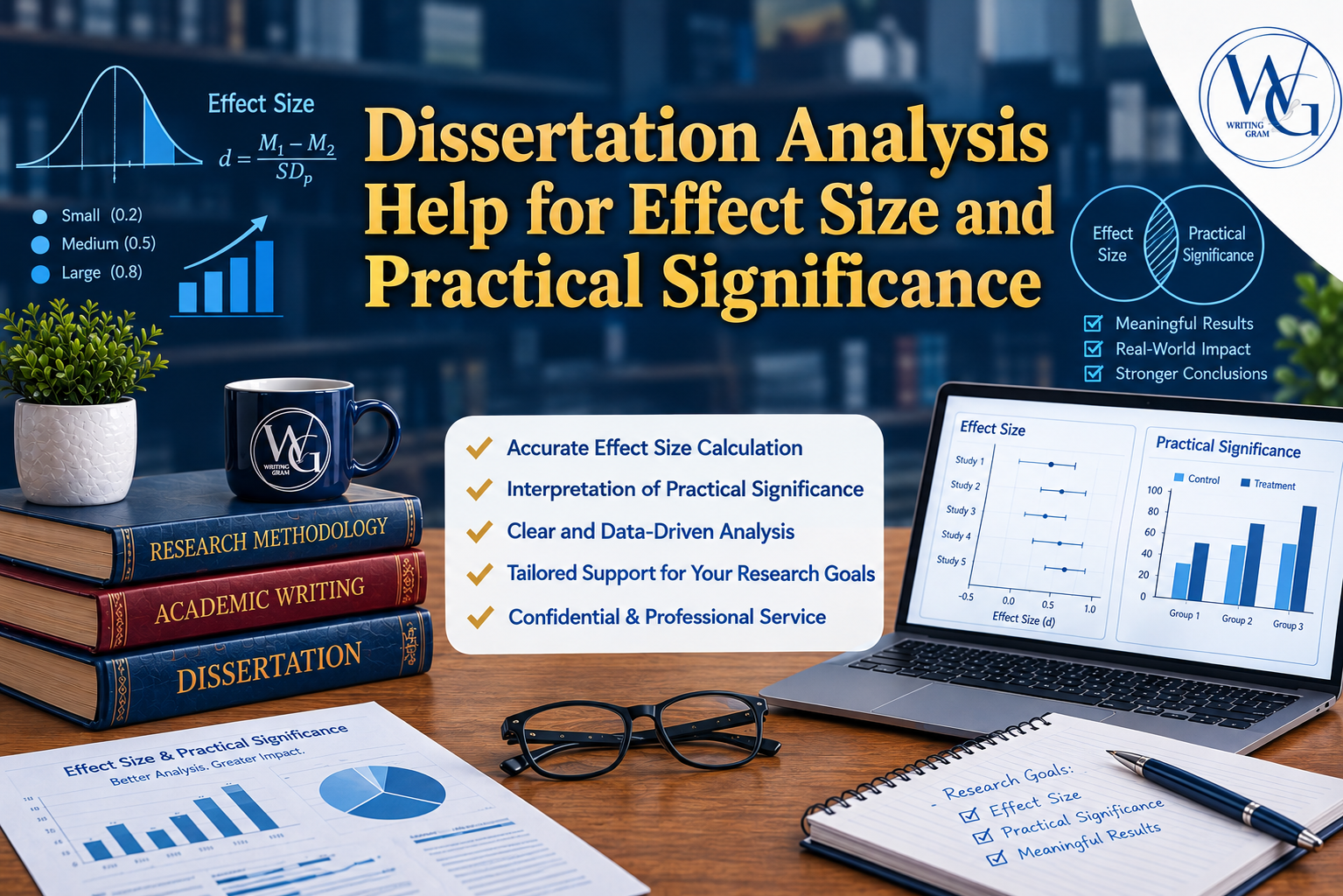
Get dissertation analysis help with effect size interpretation, practical significance, and results. Strengthen your dissertation findings with expert support from Writing Gram.
Effect size and practical significance help you explain what your dissertation findings actually mean, beyond simply determining whether your results are statistically significant.. Statistical significance provides evidence about the result under a statistical test, while effect size describes the magnitude of a finding. Practical significance asks whether that magnitude is meaningful in the context of your research question, variables, population, and study.
Why Statistical Significance Does Not Show How Important Your Dissertation Findings Are
A statistically significant result does not automatically tell you whether the finding is large or meaningful. Statistical significance addresses whether the observed result provides sufficient evidence against the null hypothesis under the statistical test you used. It does not, by itself, describe the magnitude of the difference or relationship.
This distinction matters in dissertation analysis because sample size can affect statistical significance. With a sufficiently large sample, even a relatively small difference can become statistically significant. That means a dissertation results chapter that reports only p-values may leave the reader without an important part of the finding, which is how large the observed effect actually is.
Penn State Eberly College of Science explains that practical significance concerns the magnitude of a difference and that statistical significance is directly affected by sample size. Its example shows that a result can be statistically significant while the actual difference is too small to have much practical importance. For your dissertation, this means that a statistically significant finding does not necessarily mean the difference is large or meaningful.
📊🎓Need Dissertation Analysis Help to Explain What Your Significant Results Actually Mean?
If your statistical output contains significant findings but you are unsure how to explain their magnitude or meaning, Writing Gram helps you interpret the results and strengthen the relevant parts of your dissertation. Our dissertation analysis help connects your statistical findings to your research questions, clarifies the meaning of effect sizes, and improves how your Results and Discussion chapters explain your findings.
📝 Place your order now for focused dissertation analysis assistance and get help turning statistical output into a clearer, better-supported interpretation that strengthens your dissertation.
What Effect Size Tells You About Your Dissertation Findings
Effect size provides information about the magnitude of a difference, relationship, or other statistical effect. The appropriate measure depends on the analysis you conducted and the research question your dissertation is addressing.
For example, Cohen's d can describe a standardized difference between two means. A correlation coefficient can describe the strength and direction of a relationship between variables. R² can indicate the proportion of variance explained by a regression model, while an odds ratio can describe the relative odds associated with a predictor in logistic regression.
The important point is that an effect-size value should not simply be copied from statistical software and left unexplained. Its meaning depends on the direction and magnitude of the effect, the uncertainty around the estimate, the variables involved, and the research question.
The University of Michigan explains that a statistically significant difference does not necessarily mean that the difference is big, important, or helpful for decision-making. It describes effect size as a way of examining whether a statistically significant difference is also meaningful.
For dissertation writing, this means moving from “What number did my analysis produce?” to “What does this number mean for my research?”
How to Determine Whether an Effect Is Practically Significant
Practical significance is not simply another name for statistical significance. It asks whether the magnitude of an observed finding is meaningful in the context of the study.
For example, a very large sample may produce a statistically significant difference that is too small to have meaningful consequences in the setting being studied. Conversely, a result that does not meet a conventional significance threshold should not automatically be described as proving that there is no meaningful effect without considering the estimated magnitude and uncertainty.
Penn State Eberly College of Science explains that statistical significance and effect size address different questions: a p-value provides evidence against a null hypothesis, while effect size describes the direction and magnitude of an association or difference.
When interpreting practical significance in your dissertation, consider questions such as: Does the magnitude meaningfully address the research question? Would the observed difference matter to the population being studied? Does the effect have substantive implications for the phenomenon you investigated? These questions help prevent a mechanical interpretation based only on labels such as “small,” “medium,” or “large.”
📊📝Have Your Statistical Results but Need Help Interpreting Them?
📊📝If you already have your statistical output but are struggling to explain what the effect sizes mean, Writing Gram can help you interpret the findings in relation to your research questions, distinguish statistical significance from practical meaning, and strengthen the interpretation in your dissertation. You can get dissertation analysis assistance with your existing analysis rather than trying to rewrite your entire results chapter yourself.
👉 Place your order now for dissertation analysis help with interpreting effect sizes, explaining practical significance, strengthening the accuracy and clarity of your results and discussion chapters, and presenting your findings in a way that clearly supports your research questions. 📊📝
How to Report and Discuss Effect Sizes in a Dissertation
When you report an effect size in your dissertation, do more than give the number. Your reader needs to understand what the effect size represents, how large the observed effect is, and what that magnitude means for your research question.
In the Results chapter, report the effect size alongside the statistical test used to produce the finding. Depending on your analysis, this may include the test statistic, p-value, effect-size estimate, confidence interval, and direction of the effect. For example, instead of reporting only that a result was statistically significant, you can state that the analysis produced a statistically significant difference and then report the corresponding effect size to show the magnitude of that difference.
The Discussion chapter is where you explain what that effect size means for your study.If the effect is small, moderate, or large according to an appropriate interpretation framework, explain what that magnitude means in the context of your variables, research question, theoretical framework, and conceptual framework rather than simply attaching a label to the number. You can also compare the magnitude of your finding with previous research and discuss whether the observed effect has meaningful implications for your study.
The University of Virginia explains statistical testing in terms of evidence against a null hypothesis, which is separate from determining the magnitude and practical meaning of an observed effect.
A strong dissertation therefore connects the reported effect size to its interpretation. The Results chapter shows the effect you found; the Discussion explains what that effect means for your research problem. This helps your reader understand not only whether your finding was statistically significant, but also how large the finding was and why that magnitude matters.
Statistical Significance vs Practical Significance: Common Dissertation Situations
The difference between statistical significance and practical significance becomes easier to understand when you apply it to situations that commonly occur during dissertation research. Your statistical results may not always give you a simple “significant = important” conclusion. The key is to consider the size of the effect, the uncertainty around the estimate, and how the finding relates to your research question and theoretical or conceptual framework.
The following situations show how these considerations can change the way you interpret and discuss your dissertation findings.
i. A Statistically Significant Result With a Small Effect
Your analysis may show that a difference or relationship is statistically significant, but the effect size may be small. In this situation, your dissertation should report both findings rather than treating statistical significance as evidence that the effect is important.
For example, a large sample can make a relatively small difference statistically significant. Your discussion chapter should therefore explain how large the effect actually is and whether that magnitude has meaningful implications for your study.
ii. A Statistically Nonsignificant Result With a Potentially Meaningful Effect
A nonsignificant result does not necessarily mean that there is no effect at all. Your estimated effect may still be meaningful, but the available data may not provide enough statistical evidence to draw a strong conclusion.
In this situation, examine the effect-size estimate and its confidence interval rather than simply writing that your hypothesis was “not supported.” Your Discussion can explain what the estimated effect suggests while being clear about the uncertainty surrounding the finding.
iii. A Large Effect Size With a Wide Confidence Interval
A large estimated effect can initially appear impressive, but you should consider how precisely that effect was estimated. If the confidence interval is wide, there may be considerable uncertainty about the actual size of the effect.
Your dissertation should therefore avoid presenting the estimate as more certain than the data allow. Explain the estimated magnitude, report the uncertainty, and discuss what the finding means within the limitations of your study.
iv. A Statistically Significant Result That Does Not Address the Main Research Question
A result can be statistically significant without directly answering the substantive question your dissertation was designed to investigate. Statistical significance tells you about the evidence provided by the statistical test; it does not automatically establish that the finding is important to your research problem.
Stanford Graduate School of Business discusses why p-values and statistical significance do not always answer the primary research question and why estimates and measures of uncertainty can provide important additional information.
iv. When a Pilot Study Fails
A failed pilot study can make it difficult to decide whether your main dissertation study should continue as planned. For example, your pilot may reveal problems with recruitment, survey items, data collection procedures, measurement instruments, or the planned statistical analysis.
The effect-size and practical-significance perspective can help you determine what the pilot results actually show and what needs to change. Rather than treating a failed pilot as the end of the research, examine whether the problem affects the research questions, methodology, measures, sample, or analysis plan. Your dissertation should clearly explain what was learned from the pilot and how those findings affected the subsequent study.
v. When Your Dissertation Findings Are Unexpected
Your findings may differ from what you expected based on previous research, your theoretical framework, or your hypotheses. An unexpected effect size does not mean that you should change your interpretation simply to make the results fit your original expectations.
Instead, explain what the data actually showed, consider possible reasons for the unexpected magnitude or direction, and compare the finding with previous research. If the result changes how you understand the relationship between your variables, explain that change in the discussion chapter.
vi. When Your Hypotheses Are Rejected
A rejected hypothesis does not mean that your dissertation has failed. It means that the analysis did not provide sufficient statistical evidence to support the predicted relationship or difference under the conditions of your study.
Your interpretation should go beyond saying that the hypothesis was rejected. Explain the direction and magnitude of the observed effect, consider the uncertainty around the estimate, and discuss what the result means for your theoretical or conceptual framework. If the finding differs from previous research, explain the possible reasons without claiming that the data support a conclusion they cannot establish.
vii. When Your Dissertation Proposal Is Rejected
A rejected dissertation proposal is different from a rejected statistical hypothesis. At the proposal stage, a committee may identify problems with the research question, theoretical framework, methodology, literature review, feasibility, or proposed analysis.
If you revise and resubmit your dissertation proposal, focus on identifying what needs to change in your proposed study and how each change affects the rest of your research plan. For example, changing your research questions may also require you to revise your conceptual framework, variables, hypotheses, data collection methods, or planned statistical analysis. This helps ensure that all parts of your proposed study remain consistent with the new research questions.
This is also important when interpreting later findings because your final analysis should remain connected to the research questions and framework approved for the study.
viii. When Mediation Results Are Significant or Nonsignificant
Mediation analysis examines whether the relationship between one variable and another can be statistically explained through an intervening variable. Your interpretation should therefore consider the indirect effect, its uncertainty, and the relationships represented in your mediation model.
A statistically significant indirect effect does not simply mean that “mediation exists.” Your discussion should explain the size and direction of the indirect effect and what it means for the proposed mechanism in your theoretical or conceptual framework. If the indirect effect is not statistically significant, explain what that finding means for the proposed pathway rather than simply stating that the mediation hypothesis was rejected.
ix. When Moderation Results Are Significant or Nonsignificant
Moderation analysis examines whether the relationship between two variables changes depending on the level of another variable. The important question is therefore not simply whether the moderator itself is statistically significant, but whether and how the relationship between the variables changes across levels of the moderator.
When interpreting moderation results, explain the interaction effect, its magnitude and uncertainty, and what the pattern means for your research question. If the interaction is statistically significant, describe how the relationship changes. If it is not significant, explain what the result means for your proposed moderating relationship without overstating the conclusion.
These examples highlight why dissertation analysis should go beyond reporting p-values or simply labeling results as significant or nonsignificant. Your interpretation should connect the statistical evidence, effect size, uncertainty, research question, and theoretical or conceptual framework so the examiner can understand what your findings actually mean.
Mistakes to Avoid When Interpreting Effect Sizes in Your Dissertation
a. Treating p < .05 as Proof That a Finding Is Important
Statistical significance and substantive importance answer different questions. A p-value helps you determine whether your results provide evidence against the null hypothesis, while the effect size shows the magnitude of the observed relationship or difference.
For example, suppose your dissertation examines whether a new teaching method improves students' test scores. Your analysis shows a statistically significant difference between students who used the new method and those who did not, with p = .03. If the effect size shows that the average improvement was only 1 point on a 100-point test, the finding may have limited importance despite being statistically significant.
b. Automatically Calling an Effect Meaningful Because It Crosses a Conventional Threshold
Common effect-size cutoffs can help you describe whether an effect is small, moderate, or large, but they do not tell you whether the effect is important to your study. A small effect may still matter if it has a meaningful impact on the outcome you are studying, while a larger effect may have limited importance depending on your research question.
For example, imagine your dissertation examines whether a workplace training program reduces employee turnover and finds a small effect size. If even a small reduction in turnover results in meaningful savings in recruitment and training costs, the finding may still be important. Your interpretation should therefore explain what the size of the effect means for your specific research question rather than simply labeling it as "small" or "medium."
c. Reporting an Effect Size Without Explaining What It Means
Reporting an effect size without explaining its meaning leaves the significance of the finding unclear. Your interpretation should explain the direction and magnitude of the relationship or difference and connect it to your research question.
For example, suppose your dissertation examines the relationship between sleep duration and academic performance and reports a correlation of r = .35. Simply reporting r = .35 in your results chapter does not explain the finding. You could state that the analysis found a positive relationship between sleep duration and academic performance, meaning that students who reported more sleep tended to have higher academic performance, and then explain what the size of the relationship means for your research question.
d. Ignoring Uncertainty Around the Effect Size
An effect size is an estimate based on your sample, so you should also consider how precisely it has been estimated. Confidence intervals help show the range of values that are reasonably consistent with your data.
For example, suppose your dissertation finds that a counseling intervention has an effect size of 0.40, with a 95% confidence interval ranging from 0.05 to 0.75. The estimated effect is 0.40, but the wide interval shows considerable uncertainty about the exact size of the effect. Your interpretation should acknowledge this uncertainty instead of presenting 0.40 as though it were the precise effect in the wider population.
e. Assuming That a Larger Effect Is Always Better
A larger effect is not automatically a better finding. The meaning of an effect depends on what you are measuring, the direction of the relationship, and why the finding matters to your research question.
For example, suppose your dissertation examines whether a workplace intervention reduces employee stress. A larger negative effect would indicate a greater reduction in stress, which may support the intended outcome of the intervention. However, if you are examining the effect of a risk factor on stress, a larger positive effect could instead indicate a more serious problem. The interpretation depends on what the effect represents in your study.
f. Changing Your Analysis Because the Effect Was Smaller Than Expected
If your results show a smaller effect than you expected, the appropriate response is to investigate and interpret the finding honestly rather than changing your analysis simply to produce a stronger result.
For example, suppose you expected a new study program to have a large effect on students' exam performance, but your analysis produces only a small effect. You should consider possible explanations, such as the length of the intervention, characteristics of the sample, measurement limitations, or other factors that may have influenced the outcome. You should not remove participants, change variables, or select a different analysis simply because the original effect was smaller than expected.
Harvard University provides research material discussing the relationship between statistical significance, effect size, and study size, reinforcing why the magnitude of an observed effect should be considered alongside statistical significance.
Frequently Asked Questions About Dissertation Effect Size and Practical Significance
Where should I discuss effect size in my dissertation?
Effect sizes can be reported with the relevant statistical results in the Results chapter, while their substantive meaning can be developed further in the Discussion. The exact presentation depends on your research design, statistical method, discipline, and dissertation requirements.
Can a result be statistically significant but have little practical significance?
Yes. A result can be statistically significant while representing a relatively small effect. A large sample can make small differences easier to detect statistically, so the magnitude and context of the finding should also be considered.
Does a large effect size automatically mean a finding is practically significant?
No. A large numerical effect does not automatically establish that the finding has important real-world consequences. Its practical meaning depends on the outcome, population, research question, and context of the study.
Should I report effect size when my result is not statistically significant?
The appropriate reporting depends on your statistical method and research design. Statistical significance should not be treated as the only information relevant to interpreting an estimated effect. Where appropriate, reporting the effect estimate and its uncertainty can provide a more complete account of the finding.
What if my effect size is smaller than I expected?
Do not change your interpretation simply to make the finding appear stronger. Examine the estimate, uncertainty, research design, relevant literature, and research question, then explain what the evidence supports.
How do I explain effect size to my dissertation committee?
Explain the magnitude in relation to the variables and research question rather than simply attaching a label such as “small” or “large.” You should also explain the direction of the finding and acknowledge relevant uncertainty.
Can dissertation analysis help include effect-size interpretation?
Yes. Dissertation analysis assistance can focus on interpreting your statistical output, explaining effect magnitude and practical significance, and strengthening how the findings are presented in the Results and Discussion chapters.
Can someone help me interpret statistical results I have already analyzed?
Yes. If you already have your statistical output, dissertation analysis help can focus on interpreting the results you have obtained, identifying what the statistics show, and developing clearer explanations that remain consistent with your research questions and evidence.
📊🎓Need Dissertation Analysis Help to Strengthen Your Findings, Argument, and Overall Dissertation?
If you have completed your statistical analysis but are struggling to interpret your findings, expert dissertation analysis help gives you the support needed to understand what your results mean and apply those findings effectively throughout your dissertation.
Writing Gram provides dissertation analysis help to interpret your statistical results, explain effect sizes and practical significance, connect your findings to your research questions, and strengthen the argument developed throughout your dissertation. This expert support helps you turn complex statistical output into clearer interpretations of your findings, strengthen the connection between your evidence and conclusions, identify unsupported claims, and show how your findings address the research problem and fit within your theoretical and conceptual frameworks.
👉 Place your order now for dissertation analysis help with effect size interpretation, practical significance, statistical results, and dissertation findings to strengthen your interpretation of the findings, connect your evidence to your argument and research questions, improve your discussion and conclusions, and ensure your final conclusions are supported by your results.