The Most Common Weaknesses Examiners Find in PhD Dissertations
By Writing Gram • May 30, 2026
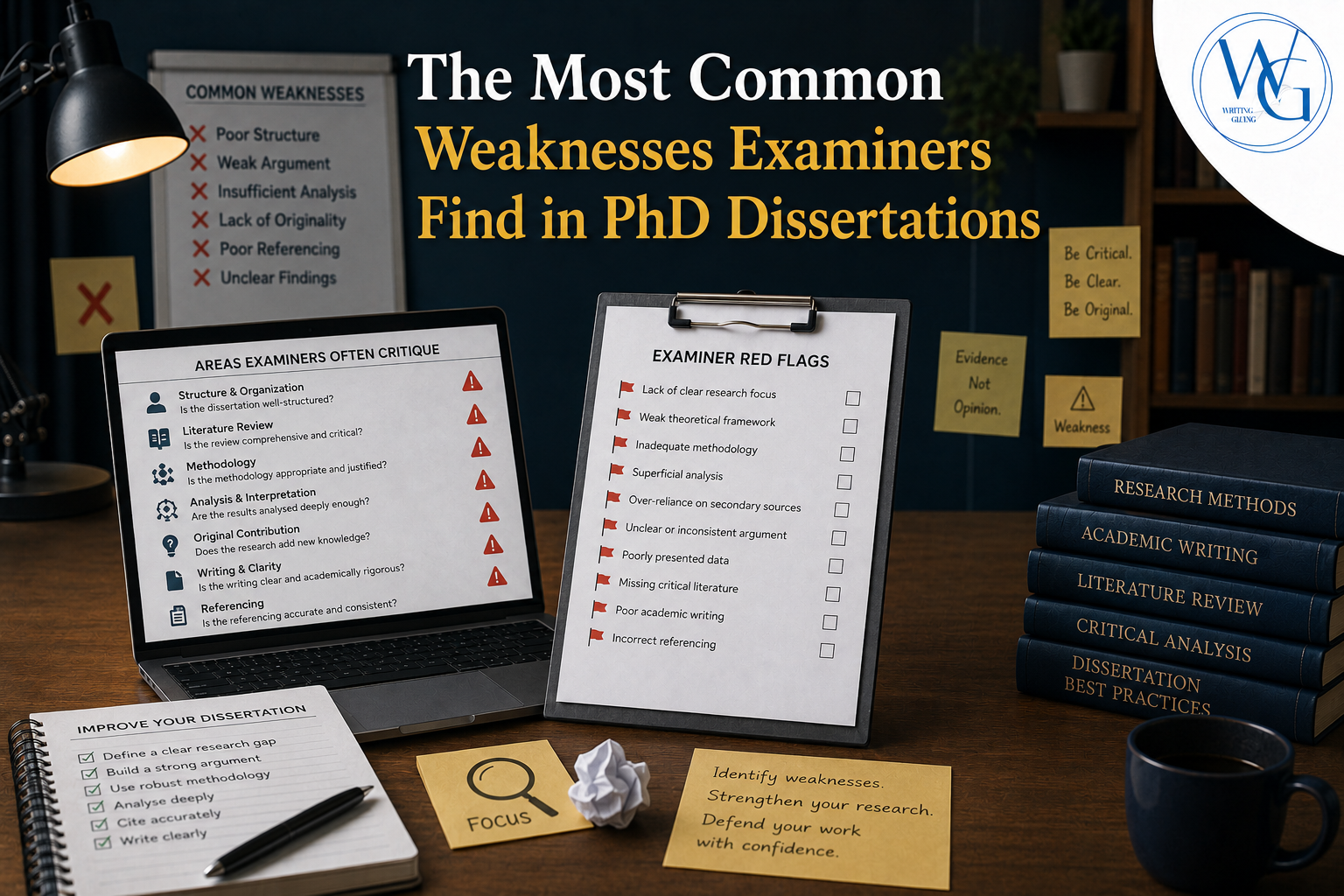
Learn how to fix supervisor feedback and criticism and improve dissertation quality with expert guidance and professional dissertation consultation services to boost approval chances.
What Examiners Actually Look For in a PhD Dissertation
Many doctoral students assume that examiners focus primarily on whether a dissertation contains enough information or research findings. While content is important, PhD examiners evaluate much more than the amount of information presented. Their role is to determine whether the dissertation demonstrates the level of independent research, critical thinking, and academic competence expected at the doctoral level.
When assessing a dissertation, examiners typically look for:
A clear, logical, and well-supported argument throughout the study
Strong methodological justification and research design
A meaningful contribution to existing knowledge within the field
Critical engagement with relevant literature and theories
Accurate interpretation of findings and their implications
Consistency between research questions, methods, results, and conclusions
Most dissertation problems are not unusual. Many of the issues identified in examiner feedback are common and occur repeatedly across different academic disciplines and universities. Examiners frequently identify similar weaknesses related to structure, analysis, critical thinking, and methodological quality. Recognizing these recurring patterns can help doctoral students address issues such as weak analysis, unclear arguments, poor chapter organization, and methodological inconsistencies before submitting their dissertations for examination.
Writing a PhD dissertation requires more than presenting research findings. It demands clear argumentation, critical analysis, methodological precision, and a demonstrable contribution to knowledge.
Writing Gram provides professional dissertation consultation services to help doctoral students strengthen every stage of their dissertation, from developing a strong literature review and methodology chapter to refining the findings and discussion, and preparing final revisions. Our experienced academic writers and editors help ensure your dissertation aligns with doctoral standards, addresses examiner expectations, improves academic clarity, and presents your research professionally.
🎓 Place your order today and get expert dissertation support to strengthen your research, improve the quality of your writing, and ensure your dissertation meets doctoral examination expectations.
This article examines the key quality gaps that examiners regularly identify and explains how addressing them can strengthen a dissertation, improve the quality of its analysis and argumentation, and better demonstrate the level of independent research expected at the doctoral level. The following are the most common weaknesses that examiners find in PhD dissertations
Weakness #1: Unclear Research Problem and Weak Theoretical Framing
One of the most frequently identified issues in doctoral research is an unclear or poorly defined research problem. Examiners often note that a study lacks clear direction when the problem statement is too broad or is not adequately grounded in theory.
This creates a disconnect between what the research aims to investigate and how the study is actually structured.
Common issues include:
A vague or overly broad problem statement that does not clearly define the research scope
Lack of a strong theoretical foundation to support the study’s argument
Weak alignment between research questions, objectives, and the literature review
When these elements are not well connected, it leads to what is often described as problems in PhD thesis writing, where the dissertation appears fragmented rather than cohesive. These gaps are also closely linked to broader dissertation quality issues, especially in the early chapters where conceptual clarity is essential.
As highlighted in guidance from the University of Michigan Rackham Graduate School on doctoral dissertation expectations, strong research is built on a clearly defined question and a coherent conceptual framework that guides the entire study.
Example: Weak vs Strong Research Problem (Healthcare Access in Rural USA)
❌Example of a Weak Research Problem
This study looks at healthcare access in rural areas and how it affects patients. It will explore challenges people face when trying to get medical services in rural communities and suggest possible improvements.
Why this is weak:
Too broad (no specific state, population, or health condition)
Does not define a clear research gap
No measurable variables or framework
Lacks academic precision needed for doctoral research
Hard to design a focused methodology from it
✅ Example of a Strong Research Problem
Rural communities in the United States continue to experience disparities in healthcare access, particularly in preventive care services. While previous studies have examined general access barriers, limited research has focused on how distance to primary care facilities influences preventive care utilization among Medicare beneficiaries in rural Appalachia. This study examines the relationship between geographic accessibility and preventive healthcare uptake in this population.
Why this is strong:
Clearly defined geographic and demographic focus (rural Appalachia, Medicare beneficiaries)
Identifies a specific research gap
Introduces measurable variables (distance, preventive care utilization)
Directly supports research design and data collection
Strong alignment with US PhD-level expectations
Weakness #2: Poor Literature Review Structure and Critical Depth
A common issue highlighted in examiner feedback is a literature review that summarizes studies without critically engaging with them or developing clear analytical depth. Instead of critically engaging with existing research, many dissertations end up summarizing studies one after another without showing how they connect, contradict, or build upon each other. This weakens the overall argument and reduces the academic depth of the work.
Typical literature review weaknesses include:
Simply describing previous studies instead of critically analyzing them
Failing to synthesize sources into clear themes or debates
Over-reliance on outdated or non-current research
Lack of a clear connection between the literature and the research problem
In weak dissertation examples, literature reviews often read like annotated summaries rather than structured academic discussions. Examiners expect the student to demonstrate critical thinking by comparing perspectives, identifying gaps, and showing how the study contributes to existing knowledge.
The University of Texas at Austin Graduate School Writing Center emphasizes that a literature review should not only summarize sources but also organize and evaluate them to show relationships and research gaps. This approach helps establish a stronger foundation for the study and improves overall dissertation quality issues related to academic coherence and argument development.
Example of a Weak vs Strong Literature Review
❌Example of a Weak Literature Review
Recent studies have looked at employee motivation. Smith (2019) says motivation improves productivity. Jones (2020) also found that motivation is important. Brown (2021) studied motivation in different companies and agreed that it affects performance.
Why this is weak:
Only describes studies without analysis
No connection between the studies
No clear themes or argument development
Reads like a summary list rather than a critical discussion
✅ Example of a Strong Literature Review
Research on employee motivation shows differing perspectives on what drives productivity. While Smith (2019) emphasizes intrinsic motivation as the key driver of performance, Jones (2020) argues that external rewards play a more significant role in organizational settings. However, Brown (2021) suggests that both intrinsic and extrinsic factors interact depending on workplace culture. This indicates a gap in understanding how context influences motivational strategies, which this study aims to address.
Why this is strong:
Compares and contrasts different studies
Identifies patterns and disagreements in research
Builds a clear academic argument
Highlights a research gap linked to the current study
Weakness #3: Methodological Inconsistencies
Methodology is one of the most closely examined parts of a PhD dissertation because it determines whether the research is credible and defensible. A common dissertation weakness occurs when the selected methods do not clearly align with the research questions or when key design choices are not sufficiently justified.
Typical problems include:
Mismatch between research approach and research questions
Weak justification for sample size or sampling strategy
Vague or incomplete explanation of data collection procedures
Lack of clarity on how the data will actually answer the research problem
Limited transparency, reducing replicability
❌ Example of Weak Methodology
A study aiming to analyze the relationship between standardized test scores and student performance uses only 10 interview participants from one school, without explaining why this sample was chosen or how interviews can measure statistical relationships.
Why this is weak:
The qualitative method does not match a quantitative research aim
The sample size is too small and unjustified
No clear link between data collection and research questions
Cannot produce measurable or generalizable results
Weak replicability and low methodological credibility
✅ Example of a Strong Methodology
A study examining the relationship between standardized test scores and student performance uses a quantitative correlational design. It collects test score data and GPA records from a stratified random sample of 500 high school students across three public school districts. The sampling method and dataset selection are clearly justified to ensure representativeness and statistical validity.
Why this is strong:
Clear alignment between the research question and the quantitative design
Appropriate use of measurable variables
Well-justified sampling strategy and sample size
Supports statistical analysis and generalizability
Transparent and replicable approach
In the peer- reviewed journal, The Journal of Research Initiatives, Bernard Dianala, a researcher at the University of the People, notes that a strong dissertation methodology must clearly explain research design choices so that the study can be evaluated, validated, and replicated with academic transparency.
Weakness #4: Weak Data Analysis and Interpretation
A recurring issue in doctoral research is weak data analysis and interpretation. Examiners often note that students may present data clearly but fail to explain its meaning in relation to the research questions. This is one of the most common dissertation weaknesses, as interpretation is the stage where raw findings are developed into a clear and meaningful contribution to the study’s research objectives.
Typical problems include:
Describing results without interpreting their significance
Failing to connect findings back to research objectives or hypotheses
Overgeneralizing results beyond what the data actually supports
Treating the analysis section as a summary rather than an explanation
For example, a student may report that “60% of respondents preferred a certain policy” but fail to explain why this matters, how it relates to existing literature, or what implications it has for the research problem. This weakens the overall argument and reduces the dissertation’s contribution to scholarly knowledge in its field.
A frequent examiner's criticism in dissertations is weak interpretation of findings, where students focus on presenting statistics rather than developing insight, comparison, or explanation.
❌Example of Weak Data Analysis
The study found that most participants preferred online learning. The results show that 70% of students agreed that online learning is effective. Therefore, online learning is better than traditional learning.
Why this is weak:
Simply repeats percentages without interpretation
Makes unsupported general conclusions
No connection to research objectives or theory
Ignores limitations of the data
Overstates findings beyond evidence
✅ Example of Strong Data Analysis
The findings indicate that 70% of participants reported online learning as effective; however, qualitative responses suggest this preference is strongly influenced by flexibility rather than instructional quality. When compared with prior studies on student engagement, this suggests that effectiveness may be context-dependent rather than absolute, particularly in higher education settings where self-regulation plays a key role.
Why this is strong:
Interprets the meaning behind the data, not just reporting it
Links findings to research context and literature
Avoids overgeneralization
Develops a logical academic argument
Demonstrates critical thinking expected at the PhD level
According to the University of California, Los Angeles Graduate Division, strong dissertation writing requires students to clearly explain what their findings mean in relation to their research questions and the wider academic context, rather than simply presenting results.
Strengthen Your Dissertation Analysis with Expert Dissertation Help
Weak analysis and interpretation are among the most common reasons dissertations receive major revisions. Writing Gram provides professional dissertation consultation services designed to help PhD students refine their data analysis, improve interpretation, and ensure alignment with research objectives and examiner expectations. Our support helps you:
Strengthen your findings and discussion chapters
Improve academic clarity and argument depth
Align analysis with doctoral-level standards
Reduce revision requests from examiners
Place your order today and ensure your dissertation meets the highest academic standards and aligns with doctoral-level expectations.
Weakness #5: Poor Academic Writing and Referencing Quality
One of the most common dissertation weaknesses identified by examiners is weak academic writing and inconsistent referencing practices.
Even when the research content is strong, unclear expression, weak academic tone, and citation errors can significantly reduce the overall quality of a PhD dissertation. This is why examiners frequently highlight writing and referencing issues as key concerns when giving their dissertation feedback.
Typical problems include:
Inconsistent referencing styles (APA, MLA, and Chicago used incorrectly or mixed)
Grammar and clarity issues that make arguments difficult to follow
Informal or non-academic tone in critical sections of the dissertation
Missing citations or incomplete reference lists
Overuse of vague language instead of precise academic expression
For example, a sentence like “many people think this is important” is too informal and unclear for doctoral writing. A stronger version would specify the source and use academic language supported by evidence.
❌Example of Weak Writing
This research shows that students like online learning because it is easy and flexible. Many authors agree that it is good for education.
Why this is weak:
Informal and vague language (“easy and flexible”)
No citations or supporting evidence
Weak academic tone
Overgeneralized claims without sources
Lacks precision and scholarly credibility
✅ Example of Strong Writing
Existing research suggests that online learning can enhance student engagement and flexibility in higher education when supported by structured course design and digital accessibility tools (Author, Year). However, effectiveness varies depending on institutional support and learner readiness.
Why this is strong:
Uses formal academic tone
Includes citation-based evidence
Avoids vague language
Presents a balanced academic argument
Demonstrates scholarly credibility
According to Harvard University’s Writing Center, strong academic writing requires clarity, precision, and proper citation practices to ensure that arguments are credible and well-supported.
Why Addressing These Weaknesses Improves Approval Chances
Most examiners' concerns in PhD dissertations are not random; they are often predictable and linked to recurring core issues. These typically include unclear research framing, weak synthesis of the literature, misalignment in methodology, poor interpretation of data, and inconsistent academic writing. Together, these issues often determine whether a dissertation requires minor corrections or major revisions
Improving these areas significantly increases the likelihood of a successful outcome because examiners prioritize:
Clear structure and logical flow across all chapters
Strong critical analysis rather than descriptive writing
Methodological transparency and alignment with research questions
Accurate interpretation of findings linked to scholarly literature
Consistent, formal academic writing with proper referencing
Strong dissertations are not necessarily those with the most data, but those that demonstrate clarity, coherence, and critical depth throughout. Addressing these examiner-identified weaknesses transforms a dissertation from a basic research report into a polished doctoral-level contribution.
According to Stanford University’s Graduate School of Education, strong doctoral work is expected to demonstrate clear reasoning, sound methodology, and a meaningful contribution to knowledge through well-structured academic writing.
Get Professional Dissertation Support That Meets Examiner Expectations and Strengthens Your Academic Work
Most dissertation challenges are not about effort; they are about accuracy and precision in how the work is structured and presented.
Examiners are very consistent in what they flag: unclear structure, weak analysis, and writing that does not fully meet doctoral expectations. The difference between a weak dissertation and an approved one often comes down to how well these issues are addressed before submission.
If your dissertation is already developed but still feels uncertain or “not fully exam-ready,” this is exactly where professional dissertation help makes a difference. Writing at the PhD level is not just about completing chapters; it is about ensuring that each section is logically consistent, well-supported, and able to withstand detailed examination.
Writing Gram provides professional dissertation consultation services specifically designed to help you fix the exact weaknesses examiners look for, including:
Strengthening weak arguments so your research sounds confident and defensible
Refining analysis so findings are properly interpreted, not just reported
Fixing structure issues so chapters flow logically and meet doctoral standards
Improving academic writing so your work sounds professional and examiner-ready
Aligning your entire dissertation with what PhD examiners actually expect
Instead of guessing what might be wrong, you get clear, targeted improvements that directly address examiner-level expectations. This saves time, reduces the risk of major revisions, and significantly improves the overall quality of your submission.
If you are serious about submitting a dissertation that meets doctoral standards and stands up confidently during examination, Writing Gram is the support system that helps you get there.
Place your order today and let Writing Gram help you turn your dissertation into a polished document that is well-structured, clearly argued, and aligned with doctoral expectations.