How to Align Research Questions, Objectives, and Methodology in a Dissertation
By Writing Gram • Jun 9, 2026
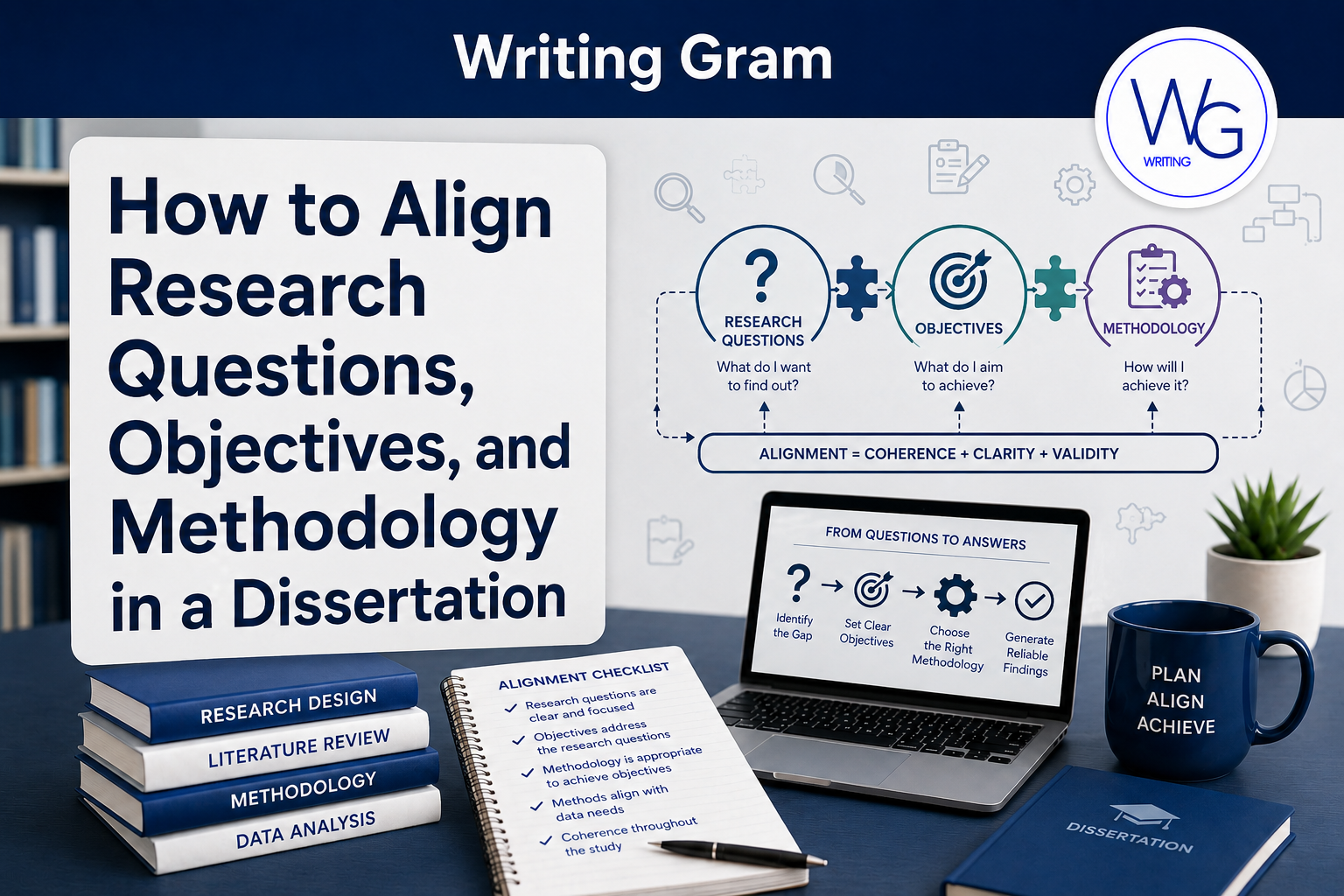
Capstone and dissertation writing help: learn how to align research questions, objectives, and methodology for stronger dissertation research alignment, clearer structure, and higher academic quality. This guide explains step-by-step methods, common mistakes, and proven strategies to improve conceptual consistency and research design success.
A well-written dissertation is more than a collection of chapters. It is a coherent research project in which every element works together to address a clearly defined problem. One of the most common reasons dissertations receive critical feedback is poor alignment between the research questions, objectives, and methodological approach. When these components are not logically aligned, the study may lack a clear sense of direction, making it challenging for readers and examiners to understand how the research was structured to address the central research problem.
Effective alignment influences several important aspects of dissertation quality, including:
The validity of the research design and findings
Examiner confidence in the rigor of the research process
The overall credibility of the dissertation
This process, often referred to as dissertation research alignment, ensures that every objective supports a research question and that the chosen methods provide the evidence needed to answer those questions. In other words, strong alignment between research questions and methodology creates a clear and defensible research pathway from the introduction through to the conclusion.
For doctoral, master's, and capstone projects, achieving this level of consistency can be challenging, particularly when refining research designs or responding to supervisor feedback.
This is where professional capstone and dissertation writing services can make a significant difference by helping students identify alignment gaps, strengthen the connection between key research components, and maintain methodological consistency throughout the dissertation. With expert guidance, students can develop a more coherent, well-structured study that clearly demonstrates how each element of the research contributes to addressing the central problem.
Need Expert Help Aligning Your Dissertation Research Questions?
At Writing Gram, we help students develop dissertations that demonstrate clear alignment between research questions, objectives, and methodology. Our experienced academic writers and editors review every component of your study to ensure it contributes to a unified and logically structured research project.
🎓 Place your order now and benefit from expert dissertation support, stronger methodological consistency, clearer research direction, improved academic structure, and professional guidance designed to help you submit a well-aligned dissertation with confidence.
Why Alignment Between Research Questions, Objectives, and Methodology Matters
Alignment is one of the most important indicators of dissertation quality because it demonstrates that every part of the study is working toward the same purpose. In academic research, conceptual consistency ensures that the research questions, objectives, and methodology are logically connected and collectively address the research problem. This principle, often referred to as dissertation conceptual alignment, helps create a clear pathway from the study's purpose to its findings.
When alignment is weak, several problems can emerge:
Findings may fail to answer the research questions effectively.
Methodology chapters may be criticized or rejected because the chosen methods do not support the stated objectives.
The study can lose focus, resulting in an unclear research direction.
The discussion chapter may fail to align with the other chapters, such as the findings and methodology chapters.
The abstract may provide information that is not in the dissertation.
Examiners may question the credibility and overall quality of the research design, raising concerns about whether the study was structured appropriately to address the research problem and objectives.
Strong dissertation conceptual alignment ensures that each research question is supported by appropriate objectives and that the selected methodology can generate the data needed to address them. For this reason, developing clear research objectives that dissertation committees can easily trace back to the research questions is essential. When these elements are aligned, the dissertation becomes more coherent, defensible, and persuasive.
The University of Southern California’s research writing guidance notes that the research design must align directly with the study’s questions and objectives to ensure valid and meaningful results.
Step-by-Step Guide to Aligning Your Dissertation Research Questions, Objectives, and Methodology for a Strong, Coherent Study
The following steps outline how to ensure your research questions, objectives, and methodology are properly aligned throughout your dissertation.
Step 1 — Start With Clear and Focused Research Questions
Strong dissertation writing begins with well-defined research questions because they set the direction for the entire study. Well-defined research questions help keep the study focused, manageable, and logically structured from the very beginning, ensuring that all parts of the dissertation remain aligned with the central purpose. In contrast, vague or overly broad questions often lead to weak alignment between the research design and the findings presented in the dissertation.
Effective research questions typically have the following characteristics:
They are specific and clearly defined
They are researchable within the available data and methods
They are structured in a way that allows analysis rather than description alone
Once research questions are clearly established, they guide all other components of the dissertation, including the formulation of objectives and the selection of methodology and research design. This is where aligning research questions and methodology becomes essential, as each methodological choice must logically connect back to what the study is trying to answer.
According to the George Washington University Graduate School of Education and Human Development, research questions should be clearly defined early in the research process because they determine the direction of data collection and analysis strategies. This shows that the structure of a study depends heavily on how well the research questions are framed from the very beginning of the research process.
Poorly constructed questions can result in misaligned methods, unclear objectives, and difficulties in interpreting findings, which is why a strong research design always begins with clearly defined research questions.
Step 2 — Translate Research Questions Into Research Objectives
Research objectives connect what the study seeks to understand with how it will be achieved, translating broad research aims into specific, actionable steps. While research questions define the core inquiry, objectives break that inquiry into clear, actionable steps. In this way, research objectives help keep the dissertation well-structured, measurable, and methodologically feasible.
A key distinction in dissertation planning is that research questions focus on “what” needs to be investigated, while objectives focus on “how” the investigation will be carried out. When this distinction is unclear, the study often loses direction and becomes difficult to execute effectively.
Well-structured objectives should:
Directly reflect and support each research question
Be specific enough to guide data collection and analysis
Be achievable within the chosen methodology and timeframe
Maintaining consistency at this stage is essential for matching methods to research questions, since objectives determine what type of data is needed and how it should be collected.
As outlined by Harvard University’s research methodology resources, research objectives should be clearly defined and logically derived from the research questions to ensure that the study design remains coherent and achievable. This reinforces the idea that a strong dissertation structure depends on a direct and traceable connection between inquiry and execution.
When objectives are properly aligned, they create a clear roadmap for methodology selection, ensuring that each stage of the dissertation contributes meaningfully to answering the research problem.
Examples of how to translate research questions into Research objectives
Example 1 (Quantitative Study)
Research Question: What is the impact of social media usage on academic performance among university students?
Objective: To measure the relationship between hours spent on social media and students’ GPA using statistical analysis.
Method implication: Survey and regression analysis
Example 2 (Qualitative Study)
Research Question: How do first-year students experience academic adjustment in university?
Objective: To explore students’ lived experiences of academic transition and identify common challenges.
Method implication: Semi-structured interviews and thematic analysis
Example 3 (Mixed Methods)
Research Question: How does online learning influence student engagement and satisfaction?
Objective: To assess engagement levels quantitatively and explore student perceptions qualitatively.
Method implication: Survey and interviews
Step 3 — Match Methodology to Your Research Objectives
The methodology serves as the part of a dissertation that turns research objectives into a practical plan for collecting and analyzing data. Once research objectives are clearly defined, the next step is ensuring that the chosen methods directly support those objectives. This is where matching methods to research questions becomes essential, because the methodological design determines whether the study can generate valid and reliable findings.
Different research approaches require different methodological strategies:
Qualitative studies typically use interviews, focus groups, and thematic analysis to explore experiences, meanings, and patterns.
Quantitative studies rely on surveys, experiments, regression analysis, and statistical testing to measure relationships between variables.
Mixed methods research combines both approaches to strengthen depth and generalizability.
Consistency must be maintained across three core areas:
Data collection methods must align with the research objectives
Analysis techniques must match the type of data collected
The overall research purpose must guide all methodological decisions
Without this consistency, the study risks methodological misalignment, where the data collected does not effectively answer the research questions. This is why aligning research questions and methodology is considered a critical principle in strong dissertation design.
According to a peer-reviewed article in BMC Medical Research Methodology, research design quality depends on ensuring coherence between study aims, data collection strategies, and analytical procedures. When research methods are properly matched to the research questions, every stage of the study contributes directly to addressing the core objectives.
Examples of How to Match the Dissertation Methodology to Your Research Objectives
Example 1 (Quantitative Alignment)
Research Objective: To examine the relationship between study hours and academic performance.
Methodology: Online survey collecting numerical data on study hours and GPA
Analysis: Regression analysis to test relationship strength
Example 2 (Qualitative Alignment)
Research Objective: To explore student experiences of remote learning challenges.
Methodology: Semi-structured interviews with students
Analysis: Thematic analysis to identify recurring patterns
Example 3 (Mixed Methods Alignment)
Research Objective: To assess student satisfaction and understand the reasons behind satisfaction levels.
Methodology: Survey (quantitative) + follow-up interviews (qualitative)
Analysis: Statistical testing + thematic coding
Step 4 — Ensure Internal Consistency Across the Dissertation
Internal consistency ensures that every chapter of a dissertation fits together to form a single, coherent argument. In a strong research design, alignment should extend beyond research questions, objectives, and methodology to include the literature review, analysis, and findings. This is a core principle in any effective dissertation consistency guide, helping maintain logical flow across the entire study.
A dissertation demonstrates strong alignment when:
The literature review directly supports the variables or concepts in the research questions
The methodology clearly translates the stated objectives into concrete research procedures and steps for data collection and analysis.
The findings respond directly to the research questions without introducing unrelated themes
Example of How to Maintain Internal Consistency Across a Dissertation
Example: Consumer Loyalty in Mobile Banking
For example, if a study examines customer loyalty in mobile banking platforms, then:
Literature Review Focus: Trust factors, digital payment adoption, user experience in fintech
Methodology Approach: Surveys measuring satisfaction and loyalty indicators
Findings Output: Statistical relationship between user experience and loyalty retention
This kind of structured flow strengthens dissertation research alignment and ensures the study remains coherent and defensible.
A peer-reviewed study published in the Systematic Reviews Biology Journal highlights that research quality improves significantly when all components of a study are logically aligned and methodologically consistent, reinforcing the importance of structured coherence in dissertation writing.
Why Writing Gram Is the Solution for Dissertation Alignment
Writing Gram uses the same structured approach found in professional capstone and dissertation writing services to ensure full alignment across all dissertation sections, carefully reviewing each project to maintain clear logical consistency from the research questions through to the final findings.
With Writing Gram, you benefit from:
Clear alignment between research questions, objectives, and methodology
Professionally structured dissertation chapters
Improved academic coherence and flow
Stronger methodological justification and clarity
Reduced risk of revision or rejection due to misalignment
Place your order now to benefit from expert dissertation structuring, stronger methodological coherence, improved academic clarity, and professionally aligned research support designed to help you complete your dissertation with confidence.
Common Mistakes That Break Research Alignment
One of the most frequent problems in dissertation design is weak alignment between research questions, objectives, and methodology. When these elements are not logically connected, the entire study becomes difficult to justify and interpret.
Common mistakes include:
Formulating overly broad or unfocused research questions and applying methods that are too narrow to adequately address them.
Example: A study asks “What are all the factors affecting climate change globally?” but uses only a small survey of 50 students in one university, which cannot meaningfully address the global scope of the question
Developing objectives that are not directly derived from the research questions leading to conceptual gaps.
Example: Research question focuses on “customer satisfaction in online banking,” but an objective is written as “to analyze mobile app design trends,” which does not directly answer satisfaction levels.
Using data collection or analysis methods that do not actually answer the stated research question
Example: A study asks about “how students experience exam stress,” but uses only a numerical Likert-scale survey without any qualitative exploration, limiting the depth of understanding.
Inconsistent terminology across chapters, which creates confusion in how variables or concepts are defined
Example: The introduction defines “academic performance” as GPA, but later chapters measure it using attendance rates, leading to conflicting interpretations of results.
A peer-reviewed study published in the Social Sciences & Humanities Open Journal highlights that misalignment between research aims, methods, and analysis is a key reason for reduced clarity and validity in academic research designs. The study emphasizes that coherence across research components is essential for producing reliable and interpretable findings.
These issues often appear in early dissertation drafts and proposals, especially when students treat each chapter independently rather than as part of a unified research structure. Therefore, maintaining consistency in structure, language, and methodological logic is essential for strong research design and effective academic outcomes.
Final Alignment Checklist for Your Dissertation
A strong dissertation depends on clear and consistent alignment between all its chapters. Before final submission, it is essential to evaluate whether your study maintains logical flow from research questions through to methodology and findings. This final check helps ensure strong dissertation research alignment and improves overall academic coherence.
Use the checklist below to ensure all chapters of your dissertation align:
Do your objectives directly reflect your research questions?
Does your methodology clearly answer each objective?
Is your data collection method fully justified and appropriate for the study design?
Is there consistency in terminology, variables, and concepts across all chapters?
Do your findings directly respond to the stated research questions without deviation?
A dissertation that meets these conditions presents a clear and well-organized structure, making it easier for examiners to follow the research logic and evaluate its validity.
Build a Fully Aligned Dissertation With Writing Gram Professional Capstone and Dissertation Writing Service for a Clear, Cohesive, and Convincing Academic Argument
Strong dissertations are not built from disconnected chapters, but from carefully connected and aligned sections that work together to support a single research purpose. When alignment is achieved, the study becomes clearer, more defensible, and significantly easier for examiners to evaluate. This is why aligning the research questions and the methodology plays such a central role in producing high-quality dissertations. Clarity at every stage directly translates into stronger research outcomes and improved academic credibility.
Writing Gram provides expert capstone and dissertation writing service support to ensure that every dissertation and capstone project remains clearly connected and logically consistent across all chapters.
With Writing Gram, you benefit from:
Clear alignment between research questions, objectives, and methodology
Improved logical flow across all dissertation chapters
Stronger academic clarity and structure
Reduced risk of inconsistencies or examiner revisions
Professionally guided dissertation development from start to finish
Get expert dissertation support with Writing Gram and ensure your research is fully aligned, clearly structured, and academically strong.
Place Your Order Now to receive professional guidance, improved coherence, and a dissertation that meets the doctoral-level standards.