Dissertation Help When Your Draft Is Complete but Your Argument Still Doesn’t Work
By Writing Gram • Sep 8, 2026
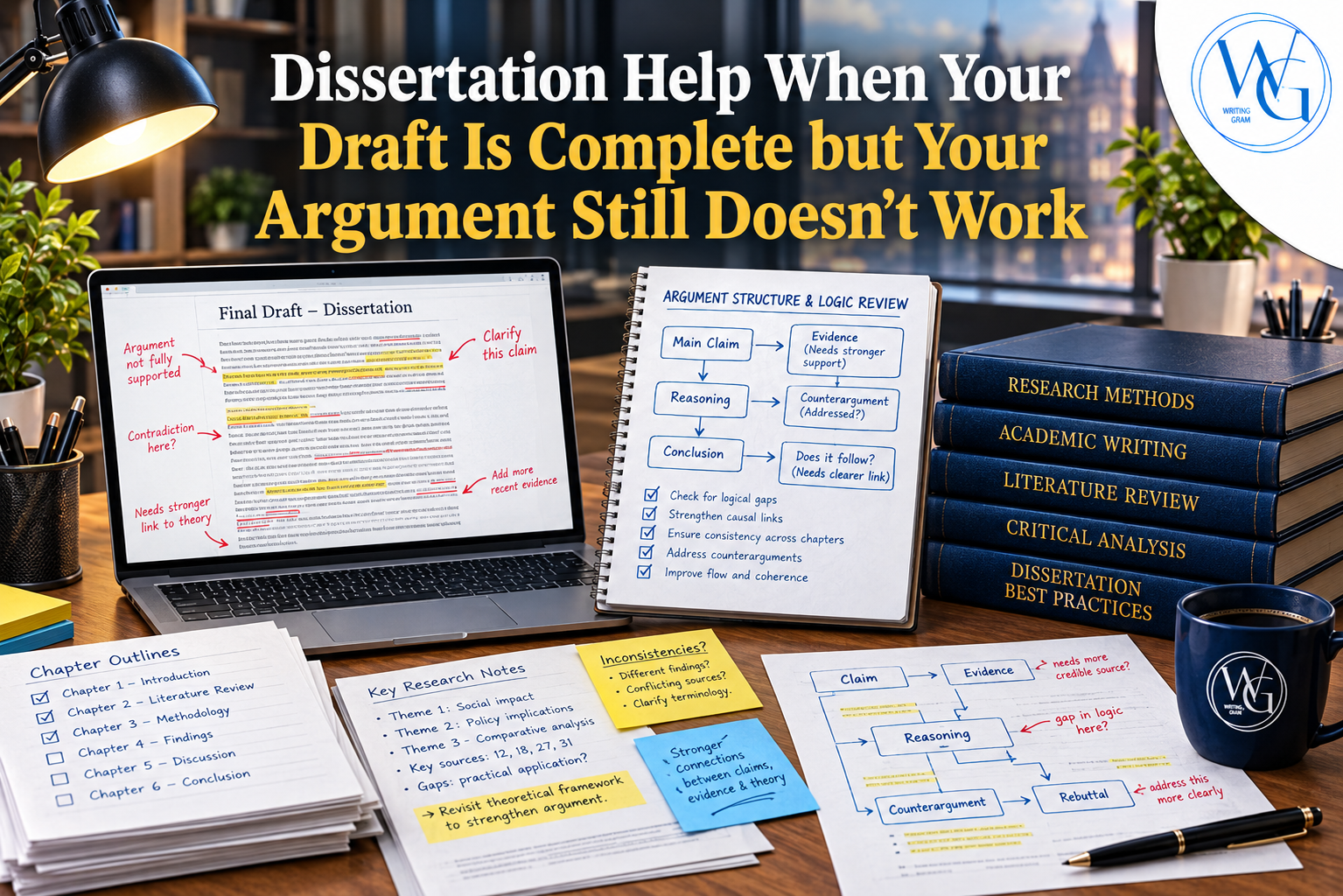
Need dissertation help because your completed draft still lacks a convincing argument? Get dissertation writing assistance to connect claims, evidence, reasoning, and conclusions.
Your Dissertation Is Written, But the Argument Still Feels Unconvincing
You have written the chapters, completed the literature review, explained your methodology, presented your findings, and added your references. Yet when you read the dissertation from the beginning to end, something still feels wrong. The research is there, but the argument does not seem to build toward one convincing answer.
This can happen even when individual chapters are well written. The problem may be the relationship between your claims, evidence, reasoning, and conclusions rather than grammar or sentence-level writing.
A useful way to diagnose the problem is to ask whether each major claim is supported by appropriate evidence and whether you explain why that evidence leads to the conclusion you draw. For example, Stanford University’s guidance on research argumentation, emphasizes using evidence to arrive at warranted claims that address the research question.
🚀 Get Dissertation Help to Strengthen Your Completed Draft
If your completed dissertation contains the research but the reasoning between its major parts is not working, Writing Gram can provide dissertation help focused on strengthening the argument already present in your draft.
Place your order now to identify reasoning gaps, connect your evidence to your claims, strengthen the relationships between your chapters, and develop a more convincing argument from the research you have already completed.
What It Means When a Dissertation Argument “Doesn’t Work”
A dissertation argument does not work when readers can understand the individual points but cannot clearly see how those points combine to answer the research question and support the dissertation’s central conclusion.
You may notice this problem when:
Individual claims sound reasonable but do not build on one another.
Evidence is presented without explaining what it establishes.
Your conclusions go further than your findings allow.
A chapter introduces ideas that are not developed later.
Your literature review identifies a gap that the research does not actually address.
Your findings are presented as results but are not used to develop the central argument.
Your conclusion makes claims that were not adequately established earlier.
Research writing therefore needs more than a collection of accurate information. The University of California, Berkeley’s research-writing guidance explains that researchers need to consider the relationship between the research question, evidence, and eventual argument, including whether evidence is relevant and accurately interpreted.
The important point is that your problem may not be that you need to write more. You may need to determine why the material you have already written, including your research notes, sources, and collected evidence, does not produce the argument your dissertation needs.
Find Where the Argument Breaks Across the Dissertation
Instead of rereading your dissertation repeatedly and hoping the problem becomes obvious, trace the argument through five connected stages:
Research problem — What problem does the dissertation establish?
Research question — What precisely is the study trying to answer?
Evidence — What does your research actually establish?
Interpretation — What does that evidence mean in relation to the research question?
Conclusion — What can reasonably be claimed because of the research?
This creates an Argument Chain Test:
Problem → Question → Evidence → Interpretation → Conclusion
Write one sentence explaining each stage. Then examine the connection between each pair.
Can you explain why the research problem leads to your question? Does the evidence actually answer that question? Does your interpretation explain what the evidence means rather than merely repeat the results? Does the conclusion follow from that interpretation?
This whole-draft approach is particularly useful because a dissertation can contain individually competent sections while still failing to produce a clear progression of reasoning. MIT’s guidance on PhD research proposals similarly connects the research question, objectives, evidence, analysis, and resulting implications as parts of one research process.
If you find a weak connection between two stages, that is a more useful place to begin revising than simply changing sentences throughout the document.
When Claims Are Stronger Than the Evidence
One of the most serious problems in a completed dissertation occurs when the conclusion makes claims that the findings, data, or analysis do not actually support.
Consider a simplified example:
Finding: Participants reported increased use of a particular service.
Overextended claim: The service causes better outcomes.
Better-supported interpretation: The findings indicate an association between use of the service and the reported outcomes, while the study design limits what can be concluded about causation.
The difference is not about making the writing sound more impressive. It is about ensuring that the conclusion corresponds to what the research actually demonstrates.
Therefore, your draft may need narrower claims rather than stronger-sounding claims.
This matters particularly when interpreting quantitative results, qualitative themes, interview responses, case-study evidence, or findings from multiple sources. A convincing argument does not hide the limits of the evidence. Instead, it uses those limits to establish exactly what can and cannot reasonably be concluded.
A useful question for every major conclusion is:
What does my evidence allow me to claim, and what am I adding that the evidence does not actually establish?
If the answer reveals a gap, the solution may involve revising the reasoning surrounding the finding rather than simply adding another citation.
When Evidence Is Present but the Reasoning Is Missing
“I have citations everywhere, so why does my argument still feel weak?”
Because evidence does not automatically become an argument simply because it has been cited.
The missing element is often the reasoning that explains the relationship between the evidence and your claim.
A useful pattern is:
Claim → Evidence → Explanation → Implication
For example:
Claim: A particular pattern appears across the cases examined.
Evidence: Your data demonstrates that pattern.
Explanation: You explain why the evidence supports your interpretation.
Implication: You show why that interpretation matters for the research question.
Cornell University’s guidance on organizing research papers recommends considering how each piece of evidence answers the guiding research question and emphasizes understanding how different pieces of evidence relate to one another.
One of the most serious problems in a completed dissertation occurs when the conclusion makes claims that go beyond what the findings and analysis show. This can be particularly important in article-based dissertations, where individual papers may also need to meet the standards of journals and support a clear overall contribution.
Therefore, when reviewing your completed draft, look for places where you present evidence and then state a conclusion without showing how that evidence leads to the conclusion.
If the examiner cannot see why the evidence supports your conclusion, that missing explanation may be weakening your argument.
When the Chapters Are Individually Strong but the Dissertation Does Not Build
A dissertation should show a clear connection between its chapters. Each chapter should build on the research, evidence, or argument developed in the chapters before it, with each chapter helping to answer the main research question and develop the dissertation's overall argument.
The surface structure may look like:
Literature review → Methodology → Findings → Discussion → Conclusion
But the reasoning underneath should develop more like:
What is known → What remains uncertain → What the study investigates → What the evidence shows → What that evidence changes or clarifies
For example, your literature review might identify an unresolved issue, but your research questions may not actually address it. Your methodology may be appropriate for the questions, but your findings may answer a slightly different question. Your findings may be interesting, but the discussion may fail to explain how they alter or extend what was established in the literature.
The conclusion can then become a recap of what each chapter discussed instead of explaining what the findings mean, what they show about the research question, and what the study ultimately found.
The University of Pennsylvania’s dissertation standards provide a useful illustration of this cumulative relationship: the research question, evidence, interpretation, and conclusions are expected to connect, with the conclusions following convincingly from the evidence.
When your dissertation has this type of problem, strengthening the argument may require examining the connections between chapters, not simply improving individual paragraphs.
How Dissertation Help Can Strengthen an Argument That Is Already Written
Dissertation writing assistance can be useful even when your draft is already complete. At this stage, the focus may be on reviewing what you have written, identifying weak or unsupported points, and making sure the evidence and analysis clearly support your main argument.
Dissertation argument help can involve reviewing what you have already written to:
Trace the central argument from the research problem through the conclusion.
Identify claims that are unsupported or extend beyond the available evidence.
Examine whether major findings actually answer the research questions.
Identify reasoning gaps between evidence and interpretation.
Strengthen explanations showing why particular evidence matters.
Connect findings more clearly with the issues established in the literature review.
Identify sections that contain useful information but do not advance the central argument.
Reorganize existing material when a different sequence would make the reasoning easier to follow.
This is also where dissertation argument support differs from simply proofreading a dissertation that is already complete. Proofreading can correct language problems, but it does not assess whether your findings support the conclusions you draw from them.
The University of Pennsylvania’s guidance on strong academic arguments specifically identifies the relationship between claims, evidence, reasoning, counterarguments, and the development of an argument across a piece of research writing.
If your dissertation already contains the research but the argument still feels incomplete, check whether the evidence, analysis, and conclusions clearly support your main argument before deciding that you need to write more pages.
When You Need Dissertation Writing Assistance Rather Than Another Proofread
A proofread may be appropriate when your main concern is grammar, spelling, punctuation, formatting, or sentence-level clarity.
But you may need help with dissertation writing when the underlying problem is more substantial:
You cannot clearly explain how your findings answer the research questions.
Your evidence is strong, but the connection between evidence and claims is unclear.
Your conclusion appears stronger than your findings.
Your chapters contain useful material but do not seem to build toward the same conclusion.
Your discussion introduces interpretations that were not sufficiently developed earlier.
You have received feedback that your dissertation is descriptive where it needs more explanation or interpretation.
You have revised individual sections repeatedly, but the overall argument still does not hold together.
You work full time while completing your PhD and need help reviewing and improving your dissertation without taking time away from your job and other responsibilities.
You have collected your data but are unsure whether you have gathered enough information to answer your research questions or how to use the data effectively in your analysis.
When your dissertation is already written, changing individual sentences may not solve problems with how your research questions, evidence, analysis, and conclusions connect. Check whether each section helps answer the research questions and whether the evidence and analysis support the conclusions you reach.
That can mean preserving much of your existing research while changing how claims, evidence, interpretation, and conclusions relate to one another.
Get Help With a Dissertation Draft That Is Finished but Not Yet Convincing
You do not necessarily need to start your dissertation again because the argument is not working. Your research, findings, sources, and existing chapters may already contain the material needed to develop a stronger case.
The task is to determine where the reasoning breaks, what the evidence genuinely supports, which claims need qualification, and how the different parts of the dissertation can work together to answer the research question.
📚 Get Dissertation Writing Assistance to Strengthen Your Argument, Connect Your Evidence, and Complete Your Draft
Writing Gram provides dissertation assistance for students who need help reviewing an existing dissertation draft, strengthening weak sections, connecting evidence to their claims, and making sure the conclusions are supported by the findings. Our expert dissertation writers can help you examine the reasoning across your completed dissertation, identify gaps between claims and evidence, strengthen connections between chapters, and develop a clearer argument from the research already in your draft.
📚 Place your order now to identify gaps in your reasoning, strengthen the connection between your claims and evidence, improve how your chapters support the main argument, clarify weak interpretations, and turn your existing draft into a stronger, more coherent dissertation.