Dissertation Conceptual Framework vs Theoretical Framework Explained
By Writing Gram • Jun 10, 2026
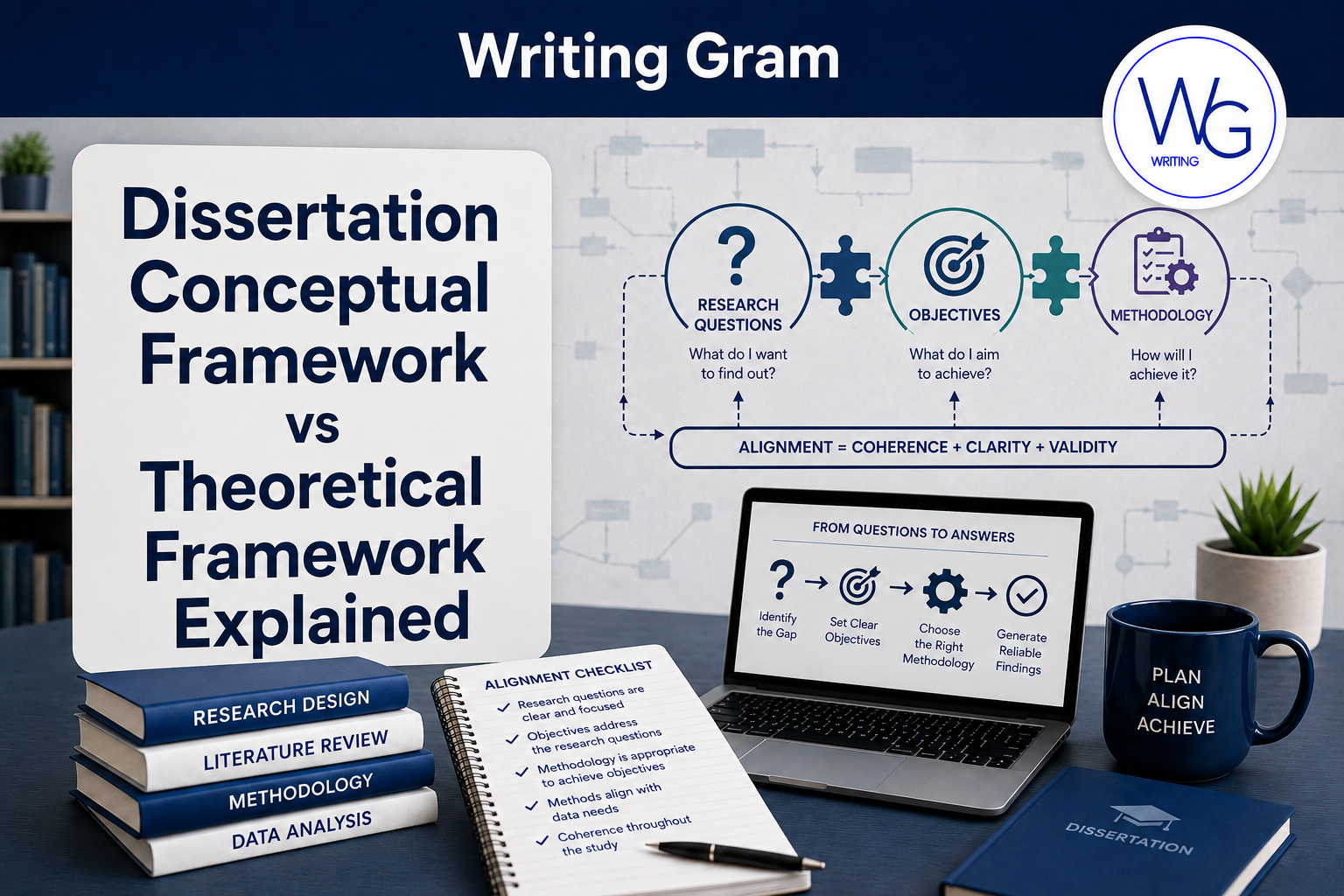
Dissertation help: Learn conceptual vs theoretical frameworks with clear examples, comparisons, and structure guidance to improve dissertation clarity, alignment, and quality.
A well-developed framework is one of the most important foundations of a successful dissertation. It provides a clear structure for understanding the research problem, guiding data collection, and interpreting findings. However, many students struggle to distinguish between conceptual and theoretical frameworks because both help explain the relationships and ideas that support a study. This confusion often leads to uncertainty when deciding which framework is appropriate for a particular research project.
This dissertation framework explained guide clarifies the differences between conceptual and theoretical frameworks, helping you understand when each approach is appropriate and how to apply it correctly in your dissertation. Understanding the role of a theoretical framework dissertation section versus a conceptual framework can help ensure that your study is logically organized and meets doctoral-level standards. Whether you are beginning a proposal, developing your literature review, or seeking help writing a dissertation, knowing how these frameworks function will strengthen the overall quality and consistency of your research.
If you need expert assistance developing a clear theoretical or conceptual framework for your dissertation, Writing Gram provides professional support tailored to your research topic, methodology, and academic requirements.
Place your order now and benefit from expert framework development, stronger alignment between research components, improved academic structure, clearer justification of concepts and theories, and professional dissertation support designed to help you meet your university's expectations.
What Is a Theoretical Framework in a Dissertation?
A theoretical framework provides the foundation for a research study by drawing on established theories that have been developed, tested, and refined by scholars over time. In a dissertation, it provides the academic lens through which the research problem is examined, helping researchers explain why certain relationships, patterns, or outcomes are expected to occur. Rather than relying on assumptions, a theoretical framework draws from existing knowledge to support the study's direction and analysis.
In a theoretical framework dissertation section, researchers identify a relevant theory and demonstrate how it connects to their research questions, variables, or key concepts. The selected theory helps explain relationships within the study and provides a basis for interpreting findings.
A strong theoretical framework serves several important functions:
Connects the study to established academic literature.
Explains relationships between variables or concepts.
Provides a logical foundation for research questions and hypotheses.
Guides data collection, analysis, and interpretation.
Strengthens the credibility and academic value of the research.
For example, a researcher examining technology adoption in organizations might use the Technology Acceptance Model (TAM) to explain how perceived usefulness and ease of use influence adoption decisions. The theory provides a structured explanation for the expected relationships among variables.
The theoretical framework is therefore a critical part of the overall framework structure of the dissertation because it ensures that the study is grounded in recognized scholarly knowledge rather than personal opinion. According to researchers at Sacred Heart University, a theoretical framework introduces and describes the theory that explains why a research problem exists and demonstrates how relevant concepts and theories relate to the study's topic. This connection helps position the research within a broader body of academic knowledge.
What Is a Conceptual Framework in a Dissertation?
A conceptual framework is a researcher-developed model that illustrates how the key concepts, variables, or factors in a study are expected to relate to one another. Unlike a theoretical framework, which is based on an established theory, a conceptual framework is created specifically for the research project. It combines insights from existing literature with the researcher's understanding of the problem to provide a clear roadmap for the study.
In a dissertation, the conceptual framework helps readers understand the logic behind the research design and the relationships being examined. It is particularly useful when a single theory does not fully explain the research problem or when the study draws from multiple sources of knowledge. For this reason, a conceptual framework PhD study may integrate ideas, models, and findings from different scholars into a unique framework tailored to the research objectives.
A conceptual framework typically serves the following purposes:
Identifies the key variables or concepts being studied.
Illustrates the expected relationships between those variables.
Guides data collection and analysis.
Provides a visual or narrative representation of the study's focus.
Helps maintain alignment between research questions, methods, and findings.
Example of a conceptual framework
One of the most useful research framework examples is a study examining the impact of social media use on academic performance. A researcher might develop a conceptual framework showing that social media usage influences study habits, which in turn affects academic performance. The framework could also include moderating factors such as time management skills and student motivation. This model is created by the researcher based on evidence from prior studies rather than being derived from a single established theory.
According to the Doctoral Writing Center at Westcliff University, a conceptual framework helps researchers focus on the variables they intend to study and explain how those variables connect. A conceptual framework is often more flexible than a theoretical framework because it is designed specifically for the study and can be refined as the research progresses.
Conceptual vs Theoretical Framework
Understanding the conceptual vs theoretical framework distinction is important because each framework plays a different role in guiding and structuring dissertation research. While both help organize a study, they differ in their source, structure, flexibility, and application.
The table below provides a simple comparison between conceptual and theoretical frameworks
Feature | Theoretical Framework | Conceptual Framework |
Source | Based on an established theory developed by scholars. | Developed by the researcher using literature, evidence, and logical relationships. |
Purpose | Explains the study through a recognized theoretical lens. | Illustrates how concepts or variables are expected to relate within the study. |
Flexibility | Generally follows the principles of an existing theory. | More adaptable and can be customized to fit the research problem. |
Scope | Focuses on testing, applying, or extending a theory. | Focuses on organizing concepts and relationships relevant to the study. |
Dissertation Usage | Common when a theory directly explains the phenomenon being studied. | Common when multiple ideas or factors need to be integrated into a single model. |
Important tip: A simple way to understand the difference between conceptual and theoretical frameworks is to see the theoretical framework as the lens used to interpret the research, while the conceptual framework works like a map that shows how the key concepts in the study are connected.
For example, a dissertation examining employee productivity might use Self-Determination Theory as its theoretical framework. The conceptual framework could then illustrate how motivation, workplace support, job satisfaction, and employee engagement interact to influence productivity. In this case, the theory explains the phenomenon, while the conceptual framework visually organizes the study's specific variables.
According to the University of Phoenix, theoretical frameworks provide the broader theory that guides a study, whereas conceptual frameworks identify the concepts and relationships that are most relevant to the specific research problem. This distinction helps researchers choose the most appropriate framework for their dissertation and maintain consistency throughout the study.
If you need help writing dissertation frameworks, understanding this difference between theoretical and conceptual frameworks is one of the most important steps toward building a strong research foundation.
Get Expert Help With Dissertation Framework Development
Creating an effective conceptual or theoretical framework requires more than defining terms. The framework must align with the research problem, objectives, questions, methodology, and literature to provide a coherent foundation for the entire study.
Writing Gram provides expert support for both conceptual and theoretical frameworks, helping students develop clear, well-structured, and doctoral-level dissertation chapters.
🎓Place your order now to get expert guidance, a framework tailored to your research topic, stronger alignment across your research components, clearer structure, and professional dissertation support from experienced academic writers.
How to Choose Between a Conceptual and a Theoretical Framework
Selecting between a conceptual and theoretical framework depends on the nature of the research problem, the availability of established theories, and the academic discipline guiding the dissertation. Both approaches contribute to the framework structure of the dissertation, but they are used differently depending on the study’s goals.
A theoretical framework is most appropriate when:
A well-established theory already explains the research problem
The study aims to test, extend, or apply an existing theory
The research requires a strong foundation in prior scholarly models
A conceptual framework is more suitable when:
The topic is broad, emerging, or not fully explained by one theory
The study combines multiple ideas, models, or perspectives
The researcher needs to build a custom structure to show relationships between variables
The choice of framework is also highly dependent on academic discipline. For example:
Social sciences often use both conceptual and theoretical frameworks, depending on the study design
Business and DBA studies frequently rely on conceptual frameworks to model organizational relationships
Nursing, including PhD in Nursing and DNP programs, often uses theoretical frameworks grounded in patient care models
Doctor of Education (EdD) and PhD in Education programs focus on applied conceptual models in learning environments
Engineering and computer science studies may use conceptual frameworks to map system components and processes
Public health research often blends both frameworks to explain health outcomes and interventions
Legal research, including a PhD in Law and Doctor of Judicial Science, may rely on theoretical foundations to interpret legal systems and principles
Understanding these distinctions helps ensure that the selected framework aligns with the research design, improves clarity, and strengthens the overall dissertation structure.
Research Framework Examples Across Different Disciplines
Understanding research framework examples becomes much easier when they are applied to real academic fields. Both conceptual and theoretical frameworks are used differently depending on the discipline, research design, and level of study.
In a social sciences dissertation, a theoretical framework might use Social Learning Theory to explain how individuals acquire behavior through observation, while a conceptual framework could map variables such as environment, peer influence, and motivation.
In business and DBA studies, a conceptual framework often models relationships like leadership style, employee engagement, and organizational performance without relying on a single theory.
In nursing (PhD in Nursing and DNP programs), frameworks such as the Health Belief Model may guide patient behavior studies, while conceptual models connect care quality, patient outcomes, and healthcare access.
In the Doctor of Education (EdD) and PhD in Education programs, conceptual frameworks frequently illustrate how teaching strategies, learning environments, and student performance interact.
In engineering and computer science, conceptual frameworks are used to map system architecture, data flow, and algorithm performance relationships.
In public health, frameworks often combine behavioral and environmental factors to explain disease prevention outcomes.
In legal studies (PhD in Law and Doctor of Judicial Science), theoretical frameworks may be used to interpret legal principles, while conceptual frameworks organize relationships between legislation, judicial interpretation, and policy outcomes.
According to Rosalind Franklin University of Medicine and Science research guidance, frameworks help structure how researchers conceptualize relationships between variables and organize their studies in a clear, systematic way.
Common Mistakes Students Make When Using Research Frameworks
Many students struggle with developing a clear conceptual vs theoretical framework, especially when writing a dissertation for the first time. These challenges often affect the clarity, structure, and overall quality of the research design.
Some of the most frequent mistakes include:
Confusing theoretical and conceptual frameworks
Students often confuse the two, even though the theoretical framework is grounded in established theories, while the conceptual framework is built from the study’s own ideas, concepts, and variables.
Example: A business student may incorrectly label a diagram showing “leadership style → employee motivation → productivity” as a theoretical framework, even though it is a conceptual model they created from multiple studies.Using a conceptual framework when a theoretical one is required
In theory-driven studies, failing to anchor the research in an established theory can weaken the academic foundation of the dissertation.
Example: A nursing PhD study on patient adherence may use a self-created model without applying the Health Belief Model or Theory of Planned Behavior, even though these established theories are expected in the field.Overcomplicating framework diagrams
Some learners include too many variables or unnecessary relationships, making the framework difficult to interpret.
Example: A public health dissertation may include unrelated variables such as income level, diet, healthcare access, exercise frequency, education level, and social media use all in one model without clear justification, making the diagram confusing and unfocused.Lack of alignment with research questions
The framework should directly support the study’s objectives, but it is often presented separately without a clear connection, which may cause the dissertation to fail.
Example: An education (EdD) study may focus on teaching strategies and student engagement in its research questions, but present a framework centered only on technology use, creating a mismatch between the study design and its conceptual model.
A well-structured example of a conceptual framework for a PhD study in business might show how leadership style influences employee performance through motivation and job satisfaction. If too many unrelated variables are added, the clarity of the model is reduced.
According to Harvard University Graduate School of Education, strong academic frameworks should remain focused, logically structured, and directly connected to the research problem to maintain clarity and consistency.
Struggling With Your Dissertation Framework? Get Expert Help Before It Slows Your Progress
Building a strong dissertation framework is often where many students get stuck, especially when trying to decide between a conceptual and theoretical approach. This stage is critical because it shapes how the entire study is structured, interpreted, and evaluated. When the framework is weak or unclear, it can affect the consistency of the research and make it harder to meet academic expectations.
A clear understanding of both frameworks helps improve:
Alignment between research questions, objectives, and methodology
Logical flow of ideas throughout the dissertation
Clarity in explaining relationships between key concepts or variables
Overall academic quality and coherence of the study
However, many students still find this section challenging because it requires combining theory, literature, and research design into one structured model. This is where many students start looking for help writing dissertation chapters, especially when they are unsure how to properly structure and distinguish between the different frameworks.
Getting professional support at this stage can prevent common issues such as unclear diagrams, weak theoretical grounding, or mismatched research models. It also ensures that the framework directly supports the study rather than existing as a disconnected section.
Writing Gram provides expert assistance in developing both conceptual and theoretical frameworks that are tailored to your specific dissertation topic, academic level, and field of study. Whether your research is in business, education, nursing, public health, engineering, or social sciences, the goal is to ensure your framework is clear, structured, and appropriate.
🎓Place your order now and benefit from:
Professionally developed conceptual and theoretical frameworks
Strong alignment with your research questions and methodology
Clear, well-structured dissertation sections that meet doctoral-level standards
Reduced stress and faster progress in your writing process
Expert guidance tailored to your specific field and research needs.