Dissertation Writing Assistance After a Dissertation Proposal Has Been Rejected
By Writing Gram • Sep 19, 2026
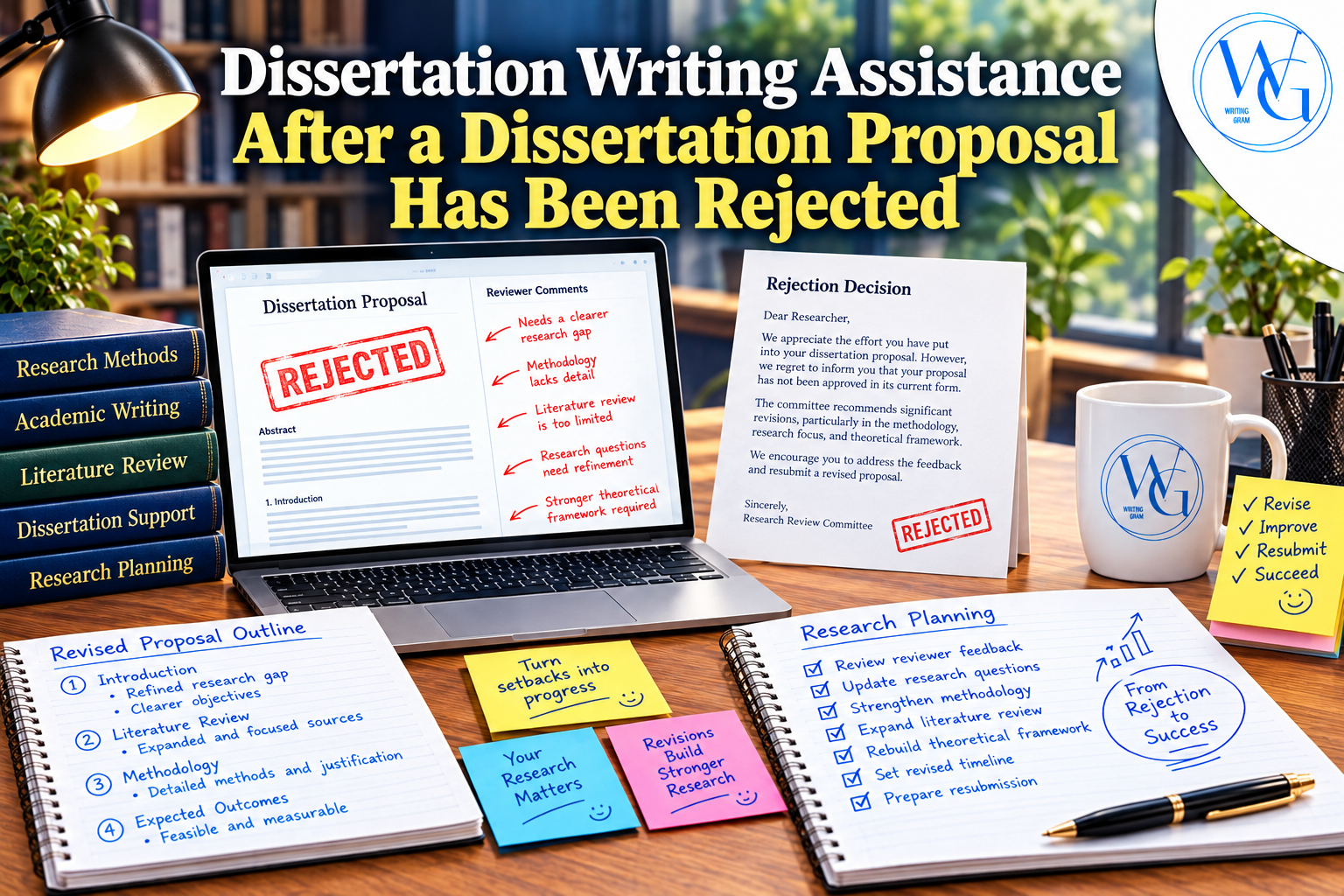
Get dissertation writing assistance after a proposal rejection. Get help revising your research, addressing committee feedback, and strengthening your dissertation.
If your dissertation proposal has been rejected, do not immediately assume that you need to abandon your doctoral research or start over from the beginning. In many cases, a rejection means that specific parts of your proposal need to be revised, clarified, or strengthened before you can move forward. First, identify why the proposal was rejected and determine whether the concerns involve your research question, literature, methodology, scope, feasibility, or overall structure. You can then use the feedback to create a focused revision plan and seek dissertation writing assistance where needed.
What Does a Rejected Dissertation Proposal Mean for Your Doctoral Project?
A rejected dissertation proposal can mean very different things depending on the feedback you receive from your advisor, dissertation committee review, department, or doctoral program. In some cases, the concerns can be resolved through focused revisions to specific sections of the proposal. In others, you may need to narrow the research question, revise part of the methodology, reduce the scope of the study, or substantially restructure the proposed research project before it can be approved.
The important point is that a rejected dissertation proposal does not automatically mean you have to abandon your doctoral research or start over from scratch. The first step is to understand exactly what your advisor, committee, department, or doctoral program identified as problematic so you can determine which parts of the proposal need to be revised and how extensive those changes need to be.
For example, Harvard University Kenneth C Griffin Graduate School of Arts explains that a dissertation proposal should establish a research question worth pursuing and present a well-designed and feasible way of investigating it. Its guidance also connects the literature review, research question, research methods, and dissertation planning.
That means a rejection may expose a problem with the relationship between several parts of your proposed study rather than with the entire idea.
Avoid immediately rewriting every page before determining what actually needs to change. Doing so can consume considerable time while leaving the underlying problem unresolved.
📚 Get Professional Dissertation Writing Assistance to Revise Your Proposal and Strengthen Your Research Plan and Your Dissertation
Writing Gram professional dissertation assistance helps you revise your existing dissertation chapters after a proposal rejection by identifying sections that need attention, improving the structure and clarity of your writing, strengthening the connection between your research questions and proposed research design, and restructuring chapters or sections that no longer align with your revised research direction.
👉 Place your order now to get professional help revising your dissertation chapters, addressing difficult sections, improving clarity, and reorganizing your work around the changes identified in your proposal feedback.
What Should You Review After a Dissertation Proposal Is Rejected?
Before deciding how much of your dissertation work needs to change, review the proposal systematically. A rejection may be connected to one major weakness or several problems that affect one another. The sections below highlight the main areas to review, starting with your research problem and questions and then moving through the literature and theoretical framework, methodology, and overall scope and organization of the project.
i. Research Problem and Question
Start with the research problem and research questions. Ask whether the problem is clearly defined, whether the questions directly address it, and whether the proposed study can realistically answer them. A research question that is too broad may create problems throughout the project, while a question that is too narrow may not provide enough scope for a doctoral dissertation.
ii. Literature and Theoretical Framework
Next, examine whether the literature review establishes the need for the proposed research. Consider whether you have examined the studies and research most relevant to your topic and whether the theoretical or conceptual framework actually supports your research questions.
iii. Methodology
Review whether the proposed methodology can answer the research questions. Consider the proposed population or sample, data sources, instruments, procedures, analytical methods, and practical constraints.
The Yale University Graduate Student Handbook provides an example of how a dissertation prospectus can connect significance, literature, research strategy, methodology, analysis, limitations, and alternative strategies.
iv. Scope and Organization
Finally, ask whether the project is simply too large, complicated, or difficult to complete within the available time and resources. You should also examine whether the proposed chapters and research activities form a logical project rather than a collection of disconnected sections.
How to Turn Committee Feedback Into a Dissertation Revision Plan
Once you understand the reasons for rejection, turn the feedback into a specific revision plan instead of changing individual sections without considering how those changes affect the rest of your dissertation.
Start by collecting all written comments and notes from meetings with your advisor or committee. Separate major concerns from minor corrections, then group comments that address the same underlying issue.
For example, supervisor feedback about an unclear research question may also explain weaknesses in your literature review, hypotheses, methodology, or proposed analysis. Treating each comment as an unrelated editing task could therefore leave the larger problem unresolved.
A clear dissertation revision plan can help you determine:
What needs to change
Why the change is necessary
Which section or chapter is affected
Whether existing material can be revised or needs to be replaced
What additional research or evidence may be required
What needs to be discussed with your advisor before revision
Cornell University Graduate School emphasizes seeking input from advisors, faculty, and others when developing research proposals and describes drafting, obtaining feedback, and revising as part of the process.
For a rejected dissertation proposal, turning the feedback into a specific revision plan can help you convert broad criticism into clear writing and research tasks, making it easier to determine what needs to be revised, added, removed, or discussed with your advisor before you resubmit the proposal.
When Dissertation Writing Assistance Can Help After Proposal Rejection
Professional dissertation writing assistance can be particularly useful when you already have substantial work but are unsure how to respond to the rejection.
You may need help reviewing the rejected proposal to identify sections that require substantial revision rather than simply correcting grammar. You may also need assistance restructuring existing chapters, improving the connection between your research problem and research questions, reorganizing a literature review, clarifying academic arguments, or making the methodology section better aligned with the proposed research. If you have already completed your analysis, you may also need help interpreting mediation and moderation results, explaining unexpected and non-significant findings, and connecting those findings to your research questions and hypotheses. For ABD students, dissertation assistance may also focus on addressing proposal feedback, revising unfinished chapters, resolving difficult sections, and completing the remaining dissertation work required for submission.
This type of assistance can also be useful when committee feedback is extensive or difficult to translate into actual changes to the document. Instead of making dozens of disconnected edits, you can work through the feedback according to the sections and issues it affects.
The goal should not simply be to produce another proposal that looks different from the first one. The more important task is to address the problems that prevented the original proposal from receiving approval.
That may involve revising existing material rather than starting from zero. It may also mean identifying sections that are still useful, sections that need substantial rewriting, and sections that no longer support the revised research direction.
How to Choose Dissertation Help After a Proposal Rejection
If you are considering professional dissertation help after a proposal rejection, look beyond basic proofreading. The assistance should fit the actual problem you are trying to solve.
Look for support that can work with:
Your existing dissertation proposal and committee feedback
Research questions and problem statements
Theoretical or conceptual frameworks
Existing dissertation chapters
Academic arguments and transitions
Structural and organizational problems
Substantial revisions rather than spelling and grammar alone
It is also important that the assistance builds on your existing research direction and helps you strengthen or revise the work you have already developed rather than replacing your project with an entirely different one.
The Princeton University Graduate School describes a dissertation prospectus as bringing together a defined research topic, the state of the field, methodology, sources, a research plan, timeline, and potentially a preliminary chapter outline.
That illustrates why help after rejection may need to address several connected components rather than simply polishing individual sentences.
Rebuilding the Dissertation After Proposal Rejection Without Starting From Scratch
A proposal rejection does not necessarily make everything you have already completed worthless. Some of your existing work may remain useful if it continues to support the revised research direction.
Depending on the supervisor's feedback, you may be able to retain and revise parts of your literature review, theoretical or conceptual framework, research questions, methodology plans, annotated sources, draft chapters, research instruments, or research notes.
However, previously written material should not be retained if it no longer fits the revised direction of your dissertation. Each section should be assessed based on whether it still supports your revised research problem and research questions.
The University of Michigan Rackham Graduate School notes that dissertation chairs help students refine dissertation topics, avoid overly ambitious goals, develop research and writing plans, and establish a timetable for completing the dissertation.
Your revision should therefore fit the requirements and guidance of your own doctoral program rather than following a generic template from another institution.
What to Do Before Resubmitting a Revised Dissertation Proposal
Before resubmitting, make sure you have addressed the issues that led to the original rejection rather than simply making the document longer or changing its wording.
Check that:
The research problem is clearly defined.
The research questions are specific and answerable.
The literature supports the proposed research.
The theoretical or conceptual framework fits the study.
The methodology can address the research questions.
The scope is realistic.
The proposed chapters and research activities fit the revised direction.
Major committee concerns have been addressed.
Your revisions comply with your department's requirements.
Your program's own requirements should take priority because doctoral procedures differ between universities and disciplines. The Duke University Graduate School advises graduate students to obtain written guidance from their program concerning requirements at different stages, including the dissertation prospectus and dissertation.
🎓 Get Dissertation Writing Assistance to Revise Your Rejected Dissertation Proposal, Strengthen Your Research Questions, and Improve Your Methodology
Writing Gram can help you revise a rejected dissertation proposal by working with the material you have already developed, identifying sections that need attention, improving the structure and clarity of your writing, and helping you address difficult revisions without treating the entire dissertation as if you have to start over.
👉 Place your order now to get dissertation writing assistance with reviewing existing material, restructuring problematic sections, strengthening research-question and methodology alignment, improving your academic writing, and preparing your revised work for the next stage of your doctoral process.