Dissertation Help: Common Supervisor Feedback on Dissertations and How to Fix Each Comment Effectively
By Writing Gram • May 21, 2026
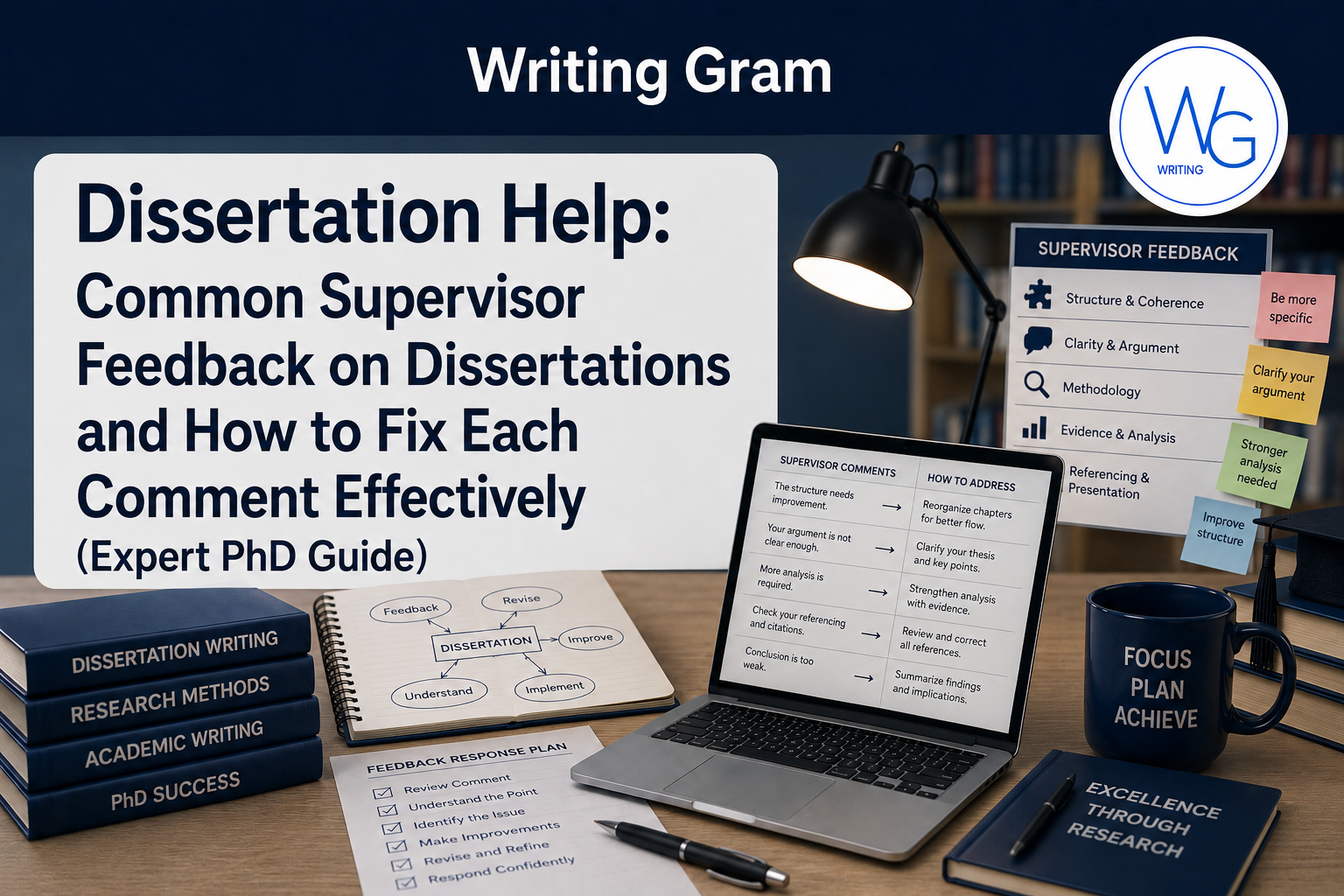
Struggling with dissertation supervisor feedback? Learn how to interpret comments, fix common revision issues, and improve your dissertation with expert dissertation help that boosts clarity, structure, and academic quality for stronger submissions.
Receiving revision comments from your supervisor is a normal and expected part of the dissertation writing process. Even strong dissertations typically go through multiple rounds of corrections before final approval because doctoral research is developed through review, clarification, and refinement. Dissertation supervisor feedback is designed to strengthen the quality of your work by improving the clarity of your arguments, the depth of your analysis, the structure of your chapters, and the credibility of your research methods.
Many students initially view supervisor comments as criticism, but in most cases, the feedback is intended to help align the dissertation with doctoral-level standards and examiner expectations. Revisions often reveal weaknesses that students may not notice on their own, such as vague arguments, unsupported claims, inconsistent referencing, or limited critical analysis. Addressing these issues early can significantly improve the overall quality, clarity, and credibility of the dissertation.
One of the biggest challenges students face is academic feedback interpretation. Supervisor comments are sometimes brief, indirect, or highly academic in tone, which can make them difficult to understand correctly. For example, a comment such as “develop this argument further” may actually indicate problems with evidence, analysis, or logical structure. Misunderstanding revision comments can lead to repeated mistakes, unnecessary delays, and additional correction rounds before approval is granted.
Effective revision requires more than simply fixing grammar or adding a few citations. Students must carefully analyze the purpose behind each supervisor's comment and understand how the requested changes affect the overall dissertation. This is especially important for PhD students, where supervisors expect deeper critical thinking, stronger methodological justification, and clearer academic positioning within the research field.
For students who need help with dissertation revisions, professional academic guidance can make the revision process faster, clearer, and less stressful.
At Writing Gram, we provide expert dissertation help tailored to supervisor feedback, helping students improve structure, clarity, analysis, referencing, and overall academic quality. Whether you are struggling to interpret revision comments or facing major dissertation corrections, our experienced academic writers and editors are ready to help you submit stronger work with confidence. Place your order today and get professional support that helps move your dissertation closer to approval.
Why Dissertation Supervisor Feedback Matters
Dissertation feedback is one of the most important parts of the research process because it helps students improve the quality, clarity, and academic strength of their work before final submission. Most dissertations go through several rounds of revisions, even when the research itself is strong. Supervisor comments are intended to identify weaknesses, strengthen arguments, and ensure the dissertation meets university and examiner expectations.
According to the Indiana University of Pennsylvania Writing Center, dissertation feedback helps students shape stronger arguments, engage more effectively with academic literature, and improve as scholarly writers and researchers. The university also explains that multiple rounds of revisions are normal during dissertation writing.
Key Reasons Dissertation Supervisor Feedback Is Important
Improves the overall academic quality of the dissertation
Helps students present ideas more clearly and logically
Strengthens research design and data analysis explanations
Identifies gaps in evidence, literature review, or argument development
Ensures claims are supported with credible academic sources
Reduces the risk of examiner criticism during final review
Helps students align their work with university standards
Many students underestimate the importance of dissertation supervisor feedback because they focus mainly on grammar corrections. In reality, supervisors often focus more on higher-level academic issues such as the clarity of the argument, depth of critical analysis, logical chapter structure, the quality of the abstract, the credibility of sources, and how effectively the findings are interpreted.
For example, a supervisor comment such as “expand this discussion” may indicate that:
The evidence provided is too weak
The analysis lacks depth
The argument is unclear
The findings are not fully connected to the research question
This is why academic feedback interpretation is an essential skill during dissertation revisions. Students who misinterpret supervisor comments may repeatedly make the same mistakes, which can delay approval and create unnecessary frustration.
Strong dissertation feedback also improves research credibility. A well-revised dissertation demonstrates that the student has critically evaluated their work, addressed weaknesses, and refined their research using expert academic guidance. This is especially important for PhD dissertations, where supervisors expect advanced critical thinking, deeper analysis, and clear justification for research decisions.
Another important point is that revision goes beyond basic editing and involves strengthening the overall academic quality of the dissertation. The University of Massachusetts Boston Writing Center explains that effective revision involves making substantial improvements to arguments, evidence, structure, and clarity rather than only correcting grammar or formatting.
Students who take supervisor comments seriously often produce stronger dissertations, perform better during defenses, and submit research that is more academically credible and professionally presented.
Common Supervisor Feedback on Dissertations and How to Fix Each One Effectively
Most dissertation students receive revision feedback from their supervisors, regardless of the strength or quality of their research. Supervisor feedback is part of the academic quality control process and is intended to improve clarity, analysis, structure, and research credibility before final submission. Understanding the meaning behind these comments can help students revise more effectively, address academic weaknesses more accurately, and avoid unnecessary corrections.
According to the University of North Carolina at Chapel Hill Writing Center, effective revision involves improving ideas, organization, evidence, and argument development rather than simply correcting grammar mistakes. This is particularly important during dissertation revisions, where supervisors expect substantial academic improvements across multiple chapters.
Some of the most common feedback comments you will get from your supervisor include:
“Your Research Question Is Too Broad”
This is one of the most common dissertation comments supervisors give, especially during the early proposal or literature review stages. A broad research question often leads to unfocused analysis, weak arguments, and difficulty managing the scope of the dissertation.
Common Reasons Supervisors Give This Feedback
The topic covers too many variables or concepts
The study attempts to address several research problems at once
The research lacks a clearly defined population, location, or timeframe
The dissertation objectives are unclear or overly ambitious
How to Fix It
Narrow your research question by following these strategies
Focus on one primary issue instead of multiple themes
Limit the study to a specific demographic, industry, or geographic area
Define a clear timeframe for the research
Ensure the research question directly aligns with your objectives and methodology
Example
Weak research question:
“How does social media affect students?”
Improved research question:
“How does Instagram usage affect academic performance among first-year university students in the United States?”
The revised version is clearer, more specific, and easier to research effectively.
“Your Literature Review Lacks Critical Analysis”
Many students mistakenly summarize sources instead of critically analyzing them. Supervisors expect dissertations to evaluate, compare, and interpret academic studies rather than simply describe what previous researchers said.
Difference Between Summary and Critical Analysis
Summary:
Repeats findings from sources
Describes studies individually
Provides limited interpretation
Critical analysis:
Compares different viewpoints
Identifies strengths and weaknesses in research
Explains patterns, contradictions, and research gaps
Shows how studies relate to your dissertation topic
How to Improve Critical Analysis
Compare studies instead of discussing them separately
Identify disagreements or limitations in previous research
Explain how your study contributes to the field
Use transition phrases that connect ideas logically
Helpful transition examples:
“In contrast…”
“Similarly…”
“However, this study differs because…”
“A major limitation of this research is…”
“Your Methodology Needs More Justification”
Supervisors often leave this comment when students explain what they did, but fail to explain why they chose those methods. Dissertation methodology sections should demonstrate that the research design fits the study objectives.
Common Problems in Methodology Chapters
Weak explanation of research design
No justification for sample size
Limited discussion of data collection methods
Failure to explain why one method was chosen over another
How to Fix It
Strengthen your methodology by:
Explaining why your chosen research design fits the research question
Justifying your sampling strategy
Discussing the strengths and limitations of your methods
Linking your methodology directly to your objectives
For example:
A qualitative interview approach may be appropriate when exploring personal experiences in depth.
A quantitative survey may be better when measuring trends across a larger population.
“Your Argument Lacks Clarity”
This feedback usually means the dissertation ideas are difficult to follow. Even strong research can lose marks if arguments are poorly organized or insufficiently explained.
Signs of an Unclear Dissertation Argument
Weak paragraph transitions
Repetitive points
Unsupported claims
Abrupt topic shifts
Inconsistent chapter flow
How to Improve Clarity
Create detailed outlines before revising
Use topic sentences to introduce paragraph ideas
Ensure each paragraph supports the main argument
Add transitions between sections
Remove irrelevant or repetitive information
Clear structure helps supervisors and examiners follow your reasoning more easily, which improves overall readability and academic quality.
Understanding Dissertation Rubrics and Supervisor Expectations
Many students ignore dissertation rubrics during revisions, yet rubrics often explain exactly what supervisors and examiners expect. A rubric is essentially an assessment guide that outlines how dissertations are evaluated across areas such as critical analysis, methodology, originality, structure, referencing, and academic writing quality.
Why Dissertation Rubrics Matter
Rubrics help students:
Understand grading criteria clearly
Prioritize important revisions
Identify weak sections in the dissertation
Align their work with university expectations
For example, if a rubric places significant weight on critical analysis, then simply summarizing sources will likely result in weaker marks even if the literature review contains many references.
How to Use Rubrics During Revisions
Compare supervisor comments against rubric categories
Highlight areas where marks are heavily weighted
Review whether your dissertation meets each assessment criterion
Use the rubric as a checklist before final submission
Students who actively revise using both supervisor comments and grading rubrics often produce stronger dissertations because they understand not only what needs fixing, but also why it matters academically.
“Your Findings Need Better Interpretation”
A common dissertation mistake is presenting results without properly explaining their meaning or significance.
Reporting vs. Interpreting Findings
Reporting findings:
States the results only
Interpreting findings:
Explains what the results mean
Connects findings to literature
Discusses implications and significance
How to Improve Interpretation
Compare findings with previous studies
Explain whether results support or challenge existing research
Discuss possible reasons for the findings
Link findings directly to research objectives
This deeper level of analysis demonstrates stronger academic thinking and improves dissertation quality significantly.
“Your Referencing Is Inconsistent.”
Referencing problems are very common in dissertations and can reduce the overall credibility of the work if they are not fixed.
Common Referencing Mistakes
Missing citations
Incorrect formatting
Mixing citation styles
Inconsistent bibliography entries
Using outdated sources incorrectly
How to Fix Referencing Problems
Follow your university’s required style guide carefully
Use referencing tools consistently
Double-check in-text citations against the reference list
Review formatting rules for journals, books, and websites separately
Accurate referencing strengthens academic integrity and demonstrates professionalism in scholarly writing.
If you need help with dissertation revisions, understanding supervisor comments, improving critical analysis, or correcting dissertation structure, professional academic guidance can save time and reduce revision stress.
At Writing Gram, we provide expert dissertation help tailored to real supervisor feedback, helping students improve clarity, structure, referencing, and overall academic quality before final submission. Place your order today and get professional support that ensures your dissertation follows all the feedback provided by your supervisor.
“This Section Needs More Academic Sources”
Another common piece of dissertation supervisor feedback is the need to use stronger, more credible academic sources. This usually means your argument isn’t strongly supported by credible research, not just that you need to include more references.
Supervisors typically raise this when they notice:
Overreliance on general websites or non-academic material
Limited use of peer-reviewed journal articles
Sources that are outdated or not relevant to current debates
Claims that are not clearly supported by evidence
Understanding this correctly is part of strong academic feedback interpretation, because the issue is usually about the quality of evidence, not quantity.
Why Source Quality Matters
High-quality academic sources strengthen your dissertation by:
Providing evidence-based support for your arguments
Improving credibility and academic trustworthiness
Showing engagement with current research in your field
Helping you avoid unsupported or opinion-based claims
The University of Wisconsin–Madison Libraries explains that scholarly (peer-reviewed) sources are essential because they are reviewed by experts before publication, ensuring reliability, accuracy, and doctoral-level standards.
How to Improve Your Sources Effectively
To respond to this feedback properly, focus on:
Replacing general websites with journal articles where possible
Using recent studies, especially in fast-changing fields
Ensuring every major claim has academic backing
Balancing foundational theories with up-to-date research
Checking whether each source directly supports your point
In most cases, when students are told they “need more sources,” the real issue is that the dissertation lacks a strong academic grounding rather than needing additional citations.
How to Interpret Supervisor Comments Correctly
Understanding dissertation supervisor feedback is not just about reading what is written; it’s about correctly interpreting what your supervisor actually means. Many students lose valuable time revising the wrong sections simply because the feedback was misunderstood.
A good starting point is to treat feedback as guidance on improvement rather than direct instructions. Supervisors often write short or indirect comments, expecting students to apply academic feedback interpretation skills to identify the deeper issue behind the note.
According to the Purdue University Online Writing Lab (OWL), effective revision requires students to move beyond surface-level edits and focus on improving clarity, logic, and argument development.
Key Ways to Interpret Supervisor Comments Effectively
To respond effectively to dissertation supervisor feedback, it helps to break the revision process into clear steps:
These steps are
Read all feedback first without editing immediately
This helps you understand the overall pattern of concerns before making changes.Group comments by theme instead of section
For example:Structure issues (argument flow, chapter organization)
Content issues (missing analysis, weak explanations)
Referencing issues (citations, sources)
Clarity issues (confusing or unclear writing)
Look for repeated concerns
If your supervisor mentions similar issues in different chapters, it usually signals a deeper structural problem rather than an isolated mistake.Prioritize major academic issues first
Focus on:Research argument clarity
Methodology justification
Literature review depth
Alignment with research questions
before fixing grammar or formatting.Ask targeted clarification questions when needed
If feedback is unclear, avoid guessing. Instead, ask specific questions like:“Should this section focus more on theory or application?”
“Do you want more recent studies or broader coverage?”
“Is the issue with structure or argument strength?”
Why Correct Interpretation Matters
When students misread feedback, they often:
Edit only minor issues while missing major weaknesses
Repeat the same mistakes across chapters
Delay submission due to unnecessary revisions
Reduce the overall quality of their dissertation
Correct interpretation ensures that revisions are meaningful, focused, and aligned with what examiners expect, rather than minor edits that don’t address core problems.
Common Mistakes Students Make When Revising Dissertations
Many students struggle with dissertation supervisor feedback, not because their research is weak, but because they don’t approach the revision process correctly. Understanding where students typically go wrong is a key part of improving both writing quality and academic feedback interpretation, especially when working through many supervisor comments.
According to the Yale Poorvu Center for Teaching and Learning, effective revision requires writers to rethink and restructure their ideas rather than focusing only on small grammar or wording changes.
Some of the common mistakes students make when they get feedback from their supervisor include
Editing Only Grammar Instead of Content
One of the most common mistakes is focusing only on grammar, spelling, or formatting while ignoring deeper academic issues.
This becomes a problem when:
The argument is unclear, but the writing is grammatically correct
Paragraphs lack logical flow or connection
The evidence is weak or not properly explained
Supervisors are usually more concerned with:
Strength of arguments
Clarity of explanation
Depth of analysis
Grammar fixes alone do not address these core academic expectations.
Ignoring Structural Issues in the Dissertation
Another major issue is failing to revise the structure of the work when needed.
Structural problems often include:
Poor chapter organization
Repetition of ideas across sections
Weak transitions between paragraphs
Misalignment between research questions and findings
Even strong content loses impact if the structure does not guide the reader clearly through the argument.
Rushing Through Revisions
Many students try to complete revisions too quickly, which leads to incomplete or careless changes.
Common results of rushed revisions:
Missing key supervisor instructions
Partially fixed sections that still contain errors
Inconsistent improvements across chapters
Failure to fully address repeated feedback
Effective revision requires time to carefully interpret comments and apply them consistently across the dissertation.
Misunderstanding Supervisor Comments
Misinterpreting feedback is one of the most common mistakes when writing your dissertation.
This often happens when:
Comments are often misunderstood because they are taken at face value without considering the broader context or intent behind them.
Students focus on wording instead of intent
Feedback is applied only to one section instead of the whole argument
For example, a comment like “needs more clarity” may refer to:
Weak argument logic
Unclear explanation of methods
Poor structure rather than writing style alone
Correct academic feedback interpretation ensures that revisions address the actual issue, not just the surface wording.
🎓 If you are struggling to correctly interpret supervisor feedback or keep making the same revision mistakes, getting expert guidance can make the process faster and clearer. Many students reach a point where they simply need help with dissertation revisions to properly address structure, clarity, and argument issues in a way that meets academic expectations. Writing Gram provides professional dissertation support to help you turn supervisor comments into a polished, submission-ready final draft with confidence.
Place your order with Writing Gram to turn confusing supervisor feedback into clear, targeted improvements that strengthen your dissertation’s structure, clarity, and quality so you can move confidently toward final submission.
When Professional Dissertation Help Can Be Useful
There are moments during dissertation writing when the dissertation supervisor's feedback becomes difficult to fully interpret or implement, especially when revisions involve multiple layers of structure, argument development, and academic clarity. In these cases, professional academic support can help students better understand what needs to be improved and how to apply changes effectively without losing the original research direction.
Professional dissertation assistance is most useful when you need targeted support in areas such as:
Editing for clarity and flow
Improving how ideas connect so arguments are easier to follow and more logically structured.Structural feedback
Identifying issues in chapter organization, paragraph sequencing, and overall dissertation coherence.Clarity improvements
Refining unclear explanations, strengthening argument expression, and making your points more precise.Referencing checks
Ensuring citations are consistent, correctly formatted, and properly aligned with academic standards.Proofreading
Removing language errors, improving readability, and ensuring a polished final draft.
For many students, this type of support becomes valuable when repeated revisions still do not fully resolve supervisor concerns. At that stage, the challenge is often not the research itself, but academic feedback interpretation—knowing how to turn comments into clear, meaningful improvements across the dissertation.
Using professional dissertation support helps ensure that revisions are not just cosmetic changes, but real improvements that strengthen the quality, clarity, and overall academic standard of the work.
Turn Supervisor Feedback Into a Stronger Dissertation Submission
Supervisor feedback is not a sign that your dissertation is weak—it is a normal and essential part of learning that helps sharpen your research into a more focused, credible, and well-structured final submission.
Most successful dissertations go through multiple rounds of revision, and each set of comments is designed to improve clarity, strengthen arguments, and align your work more closely with doctoral-level expectations.
The most effective way to handle dissertation supervisor feedback is to approach it strategically rather than react to it emotionally. Instead of revising randomly or focusing only on surface-level corrections, students should approach feedback with a clear plan that prioritizes structure, argument strength, and overall coherence.
A structured approach to revision typically includes:
Reviewing all comments together to understand overall patterns
Prioritizing major academic issues before minor edits
Linking feedback directly to research objectives and chapter goals
Ensuring each revision improves clarity and strengthens the overall argument
This kind of organized response is especially important when dealing with complex academic feedback interpretation, where comments may be brief but carry deeper meaning about structure, methodology, or analysis quality.
Ultimately, strong dissertation revisions are not about fixing isolated sentences—they are about improving the entire dissertation so that your research is clear, logical, and defensible. Students who apply feedback systematically tend to produce stronger final submissions with fewer revision cycles and greater academic confidence.
🎓 If you are still struggling to interpret or apply supervisor comments effectively, getting expert guidance can make your revision process much clearer and faster. Place your order today and turn complex dissertation feedback into a polished, high-quality final submission.