Dissertation Revision Help for Tackling Supervisor Feedback
By Writing Gram • Aug 26, 2026
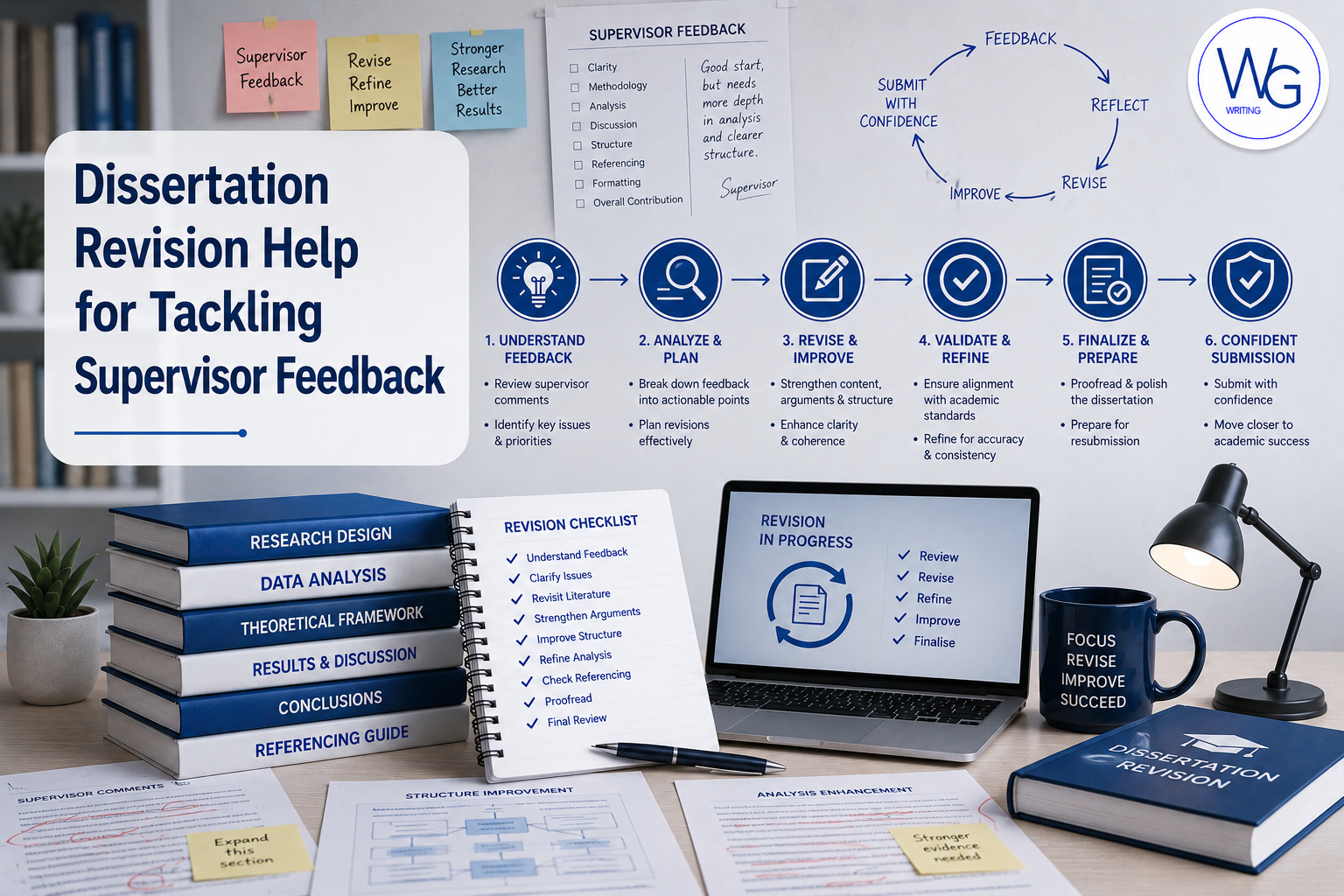
Get dissertation revision help to prioritize supervisor feedback, identify issues affecting multiple chapters, and tackle all the revisions in your dissertation.
When You Have Many Dissertation Comments, the Hardest Part May Be Knowing Where to Start
Receiving a dissertation back with extensive supervisor feedback can leave you with a difficult problem that is not about understanding what the comments mean, but figuring out how to address them. You may understand every comment and still have no clear idea what to revise first.
One comment may question your research questions. Another may ask you to revise the literature review. You may also have comments about the methodology, data analysis, discussion, conclusions, chapter organization, citations, wording, and formatting. Looking at all the supervisor comments in your dissertation can make the revision process feel like a long list of separate tasks, but that is often not what you are actually dealing with.
Some comments affect only a paragraph or a few pages. Others can affect the direction of an entire chapter and create changes elsewhere in the dissertation. For example, a supervisor's concern about whether your research questions align with your study may also affect how you describe your methodology, organize your analysis, and discuss your findings. The structure of your dissertation should connect the research questions, methods, results, and discussion rather than treating those chapters as independent sections.
That is why the order in which comments appear on your draft is not necessarily the order in which you should revise them. A formatting correction may be easy to complete immediately, but spending hours perfecting formatting before resolving a problem that could change several pages can create unnecessary work.
The better approach is to prioritize dissertation revisions based on how much each issue affects the rest of the project. Before rewriting anything, ask yourself which comments are limited to one location and which ones could require changes across several sections.
🎓 Get Dissertation Revision Help to Prioritize Your Supervisor Feedback
🎓 Writing Gram provides dissertation revision help to help you make sense of your supervisor’s feedback and identify which parts of your dissertation need your attention. Place your order now to get dissertation revision help that helps you identify which issues need attention first, see how changes in one part of your dissertation affect other sections, and make your revisions without wasting time reworking the same sections.
Start With Comments That Could Change Other Parts of Your Dissertation
Not every revision carries the same weight. One useful way to decide where to begin is to separate comments into foundational comments and isolated comments.
Foundational comments
A foundational comment raises an issue that can affect the direction, logic, or consistency of several parts of the dissertation. These comments should usually be addressed before you start the minor revisions.
Examples of foundational comments include:
Your research question does not match the study you have conducted.
Your chosen method does not clearly answer the research questions.
Important concepts are not clearly defined.
Your analysis does not address the stated objectives.
Your findings are presented, but the argument does not follow from the evidence.
The discussion does not clearly connect the findings back to the research questions.
These issues can have consequences beyond the page where the supervisor wrote the comment. A concern about methodological alignment, for instance, may require you to revisit how the study was designed, how the analysis is presented, and whether the conclusions are supported by what the research actually examined. Dissertation guidance from Indiana University of Pennsylvania similarly shows how the methods used in a dissertation are tied directly to the research questions the study is intended to answer.
That is why foundational revisions should come first. Until you determine what needs to change at this level, you may not know which later sections can remain as they are.
Isolated comments
Isolated comments are narrower and can usually be handled without changing the direction of the dissertation. They typically result in minor revisions. Isolated comments may include:
A paragraph that needs clarification
A missing or incorrect citation
A heading that needs to be revised
A sentence that is difficult to understand
A table or figure that needs formatting changes
Minor grammar or punctuation corrections
These revisions still need to be completed. The point is not that they are unimportant. The difference is that correcting a citation or rewriting an unclear sentence will usually not require you to reconsider your research questions or rewrite your analysis.
If you’re stuck on your dissertation after receiving a long list of supervisor comments, start by asking: “If I make this change, what else in my dissertation might need to change as a result?” The more parts of the dissertation that depend on that change, the sooner you should address the comment.
Map Comments That Point to the Same Problem Before You Start Revising
When several comments appear throughout a dissertation, it is easy to treat each one as a separate task. That can lead to repetitive work because multiple comments may be pointing to the same underlying issue.
Imagine your supervisor has written:
Clarify your research objectives.
The analysis does not fully address the objectives.
Strengthen the discussion of the findings.
At first, this looks like three different revisions. However, the comments may be part of one chain:
Unclear objectives → analysis that does not fully answer them → discussion that cannot clearly explain the results in relation to them
If you start with the discussion, you may spend time rewriting it before resolving the issue that caused the problem in the first place. By first clarifying the objectives, you can then review whether the analysis addresses them and whether the discussion accurately interprets the resulting findings.
The relationship between these sections is reflected in the Research Guides from the University of Southern California, which explains that the discussion should interpret findings in relation to the research questions and connect them to the literature already covered in the dissertation.
Before making individual changes, look across your supervisor's comments and ask:
Does one comment help explain another comment?
Could resolving one problem eliminate or reduce several other issues?
Will a change in one chapter require updates in another?
Are several comments pointing to the same weakness?
Does the same concern appear in different wording across the feedback?
This step can be particularly useful when you need help responding to dissertation comments because the real challenge may not be responding to each comment individually. Instead, you may need to identify which comments point to the same underlying issue and address that issue first.
How to Decide What to Revise First in Your Dissertation
There is no single revision order that applies to every dissertation. Your supervisor's instructions and the specific problems in your draft should always guide the work. Still, when several parts of your dissertation are affected, the following sequence can help you address the changes in the right order and reduce unnecessary rework.
Research questions, objectives, and the central argument
Methodology and research design
Analysis and interpretation
Discussion and the connection between findings and existing research
Chapter structure and the flow of the argument
Evidence, citations, and supporting literature
Grammar, wording, formatting, and presentation
The reason for this order is simple: earlier revisions can shape later sections. If the research questions need clarification, you may need to reconsider whether the analysis answers them. If the analysis changes, the discussion and conclusions may also need revision.
Dissertation Guidelines from the University of Kansas School of Journalism and Mass Communications illustrates these connections by describing results as answering the research questions and the discussion as interpreting those results and relating them back to previous research.
This does not mean you have to follow the list in exactly the order shown above. A supervisor may identify one specific chapter as the immediate priority, or your discipline may use a different dissertation structure. The goal is to avoid revising one section only to have to change it again after making revisions elsewhere.
In short, start with the revisions that affect other parts of your dissertation, then move on to sections that depend on those changes.
What If You Cannot Tell Which Supervisor Comment Is the Most Important?
Sometimes the comments are clear, but their priority is not. You may have several comments and no reliable way to determine whether you should begin revising the literature review, methodology, findings, or discussion.
In that situation, determine which comments to revise first by asking yourself these questions
Scope: How much of the dissertation does this issue affect?
Dependency: Will correcting it require changes elsewhere?
Research impact: Does it affect the research questions, method, analysis, findings, or conclusions?
Supervisor emphasis: Has your supervisor identified it as a major concern or returned to the same issue more than once?
Consequence: What problems could remain if the issue is not properly resolved?
A comment affecting one sentence and a comment questioning whether the analysis answers the research questions should not be treated as equal simply because both appear in the feedback. The second issue may have consequences across multiple chapters.
This is where professional dissertation revision help can help you determine what to revise first and how each change affects the rest of your dissertation. A student may know how to make individual corrections but still struggle to see how the supervisor's comments fit together. Reviewing the feedback alongside the full dissertation can help establish whether one revision needs to happen before another and whether a proposed change could create inconsistencies in the other chapters of the dissertation.
When Dissertation Revision Help Makes Sense
Dissertation revision support is not simply about correcting grammar or making surface-level changes to the text. In some cases, the student already knows that revisions are required but needs help working out the order and extent of those revisions.
Professional assistance can be particularly useful when you cannot determine:
Which supervisor comments should be addressed first
Which comments are pointing to the same underlying issue
Which changes could affect multiple chapters
Whether a revision actually resolves the supervisor's concern
Whether changes in one chapter have created inconsistencies elsewhere
Which comments require substantial rewriting rather than sentence-level editing
This is different from basic proofreading. Proofreading focuses on presentation-level issues such as grammar, punctuation, spelling, and consistency. Revision support can involve examining how supervisor feedback relates to the existing dissertation and determining what needs to be reconsidered before smaller corrections are made.
For students seeking PhD dissertation help or broader dissertation writing assistance, this distinction matters. You may not need every chapter rewritten. You may need an experienced reviewer to look at the feedback and the dissertation together, identify the revisions that have wider consequences, and help you work through all of the required changes without losing track of how they affect one another.
Get Expert Dissertation Revision Help to Tackle Supervisor Feedback
🎓 Writing Gram can help you prioritize your supervisor feedback, identify which revisions affect other parts of your dissertation, and work through your comments in the right order.
Place your order now to get dissertation revision support based on your supervisor’s feedback, identify all the required changes, reduce your revision workload, and save time revising your dissertation.
What to Give a Dissertation Revision Specialist
If you decide to get professional help with dissertation revisions, the quality of the assessment depends heavily on the information you provide. A specialist cannot accurately determine which supervisor comments should be handled first by looking at isolated comments without seeing the dissertation sections they refer to.
Prepare the following materials before requesting dissertation revision support:
Your latest dissertation draft — This allows the specialist to see the current state of the research rather than working from an older version.
Supervisor comments or feedback — Provide the complete feedback when possible rather than selecting only the comments that seem most important to you.
Marked-up chapters or annotated pages — If your supervisor has commented directly on specific passages, include those pages so the comments can be assessed in context.
Your research questions and objectives — These help establish whether requested changes affect the direction of the study or the relationship between chapters.
Your methodology details — Include the relevant methodology section and supporting information when the feedback concerns research design, data collection, or analysis.
Departmental or university revision instructions — These can clarify requirements that your supervisor expects you to meet before resubmission.
Previous supervisor feedback, when relevant — Earlier comments can reveal whether a concern has appeared repeatedly or whether a previous revision has already attempted to resolve it.
Providing these materials together gives a dissertation revision specialist a much better basis for assessing the feedback. For example, if a supervisor questions your research objectives and later comments that your analysis does not answer those objectives, the two comments need to be considered together rather than treated as unrelated tasks.
This approach is consistent with the guidance provided by Cornell University Graduate School, which recommends communicating clearly with advisors, keeping written records of agreed next steps, and using drafts and feedback as part of the ongoing dissertation process.
The more complete your materials are, the easier it is to distinguish a comment that requires a local edit from one that could lead to revisions elsewhere. That distinction is particularly important when your goal is not simply to respond to every comment, but to work through all the required revisions without repeatedly revisiting the same sections which can increase your workload substantially.
Get Help Prioritizing Your Dissertation Revisions
If you have received extensive supervisor feedback and are unsure how to turn it into an effective revision sequence, Writing Gram dissertation revision help can help you assess your supervisor’s comments in relation to the relevant sections and arguments in your dissertation. Rather than treating every comment as a separate task, our expert dissertation writers can help identify which issues affect multiple chapters, how to revise your work without increasing the workload unnecessarily, and how the requested changes relate to one another across your dissertation.
This can be especially important when your feedback includes comments on several areas at once. You may need to revise your research questions, reconsider part of your methodology, strengthen your analysis, restructure the discussion, and correct smaller issues throughout the document. Starting with the easiest comment is not necessarily the most efficient approach if a more substantial revision could change the sections you have already edited.
With professional dissertation writing assistance, you can get support based on your actual draft and supervisor requirements rather than trying to determine the revision sequence from a list of comments alone. The goal is to help you work through the complete set of requested changes while reducing unnecessary rewriting and preventing changes in one chapter from being overlooked in another.
🎓 Get Dissertation Revision Help to Work Through Supervisor Feedback
Writing Gram provides dissertation revision support tailored to your existing dissertation and supervisor feedback.
🎓Place your order now to get professional help assessing the comments, identifying revisions that affect multiple chapters, and working through all the required changes in a logical sequence—so you can spend less time second-guessing what to revise and more time completing the revisions your dissertation requires.