What a Professional Dissertation Writer Actually Does (Behind the Scenes Breakdown)
By Writing Gram • Jun 20, 2026
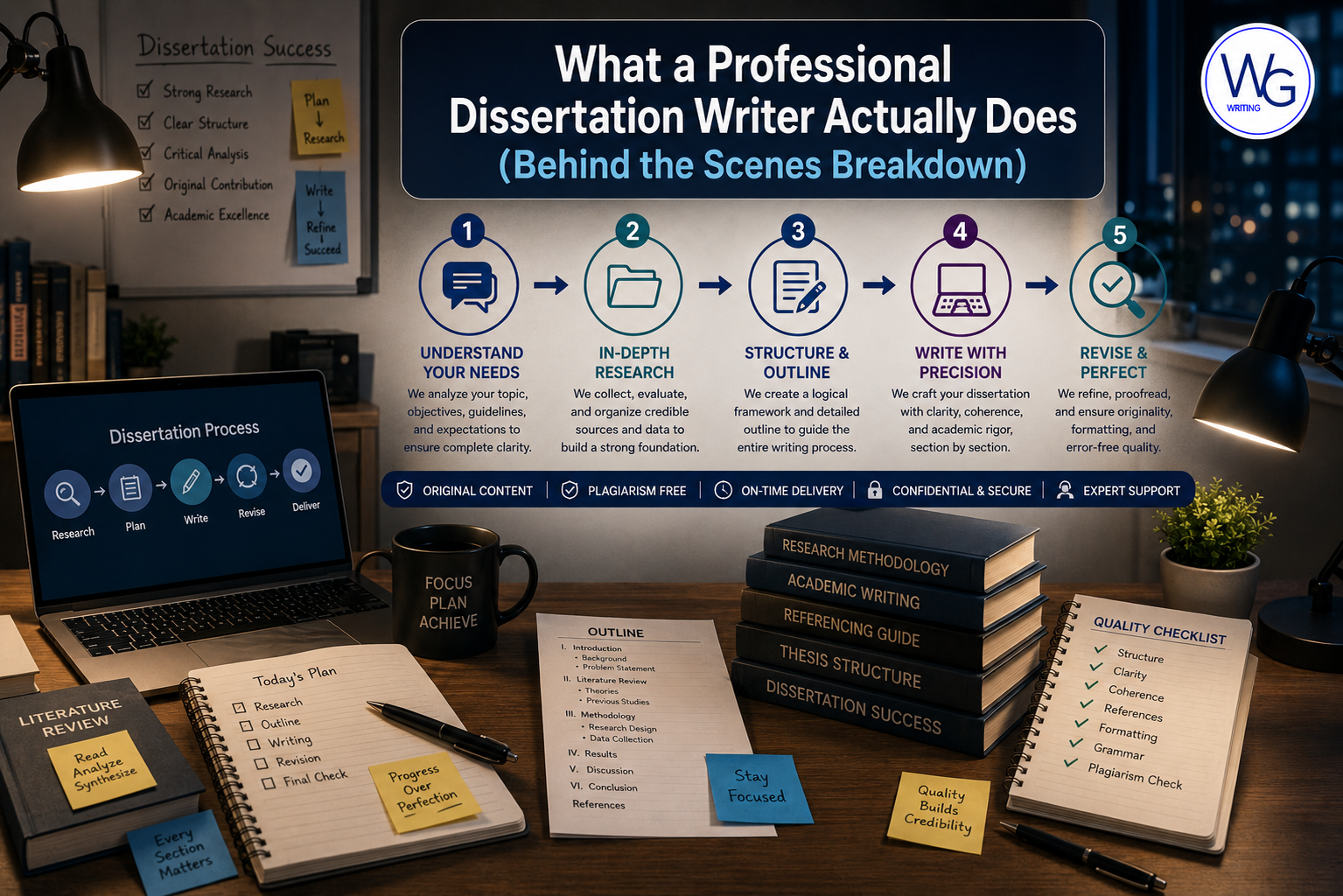
Discover what a professional dissertation writer actually does behind the scenes. Learn the process, quality checks, and how expert support helps improve your dissertation.
Many students consider hiring dissertation writing support at some point during their academic journey, yet few understand what happens behind the scenes once an order is placed. This lack of understanding often leads to confusion, skepticism, and misconceptions about how professional dissertation writing services actually operate.
One of the most common assumptions is that dissertation writers simply sit down and write an entire dissertation from start to finish without any planning, research, or quality control. In reality, professional dissertation support involves a structured process that includes requirement analysis, academic research, outlining, drafting, editing, referencing, and multiple quality reviews before a document is delivered to a client.
Another misconception is that all dissertation writing services work the same way. The quality of support can vary significantly depending on the experience of the writers, the research standards followed, and the processes used to maintain academic consistency. Students who understand how professional dissertation writers work are often better equipped to evaluate services, ask the right questions, and make informed decisions when seeking academic assistance.
Transparency is important because dissertation projects are complex academic documents that can span tens of thousands of words and require months of research, organization, and revision. A professional dissertation writing process is designed to manage that complexity through clearly defined stages rather than treating the dissertation as a simple writing task.
Behind every well-developed dissertation is a series of steps that help ensure the research question is addressed effectively, the structure remains logical, the evidence is relevant, and the writing aligns with academic expectations. Understanding these stages can help students appreciate the level of work involved and identify what separates professional support from low-quality or unreliable providers.
In this behind-the-scenes breakdown, we will examine what a professional dissertation writer actually does, how academic writers work throughout a dissertation project, and the processes used to ensure your dissertation meets your university’s requirements. Whether you are considering dissertation assistance for the first time or simply want a clearer academic writing service explanation, understanding the process can help you make more confident and informed decisions.
Get Professional Dissertation Support From Experienced Academic Writers
At Writing Gram, every dissertation project follows a structured process that prioritizes research quality, academic consistency, and clear communication from start to finish. Our team works closely with clients to ensure requirements are understood, sources are carefully selected, and each section is developed according to academic standards.
Place your order now and benefit from:
Clear dissertation planning and organization
Research-driven academic writing support
Proper citation and referencing practices
Consistent communication throughout your project
Thorough editing and quality review procedures
Reliable support for undergraduate, master's, and PhD-level dissertations
Place your order now and get professional dissertation support designed to help you manage complex academic projects with greater confidence, stronger organization, and a structured path toward successful completion.
Understanding the Role of a Professional Dissertation Writer
Many students ask the question, " What does a dissertation writer do? The answer is more complex than simply "writing a dissertation." A professional dissertation writer serves as an academic support specialist who helps manage the research, organization, development, and refinement of a complex academic project.
Dissertations are among the most demanding assignments students complete during their academic careers. They require extensive research, critical analysis, logical organization, proper referencing, and adherence to institutional guidelines. Because of these requirements, professional dissertation writers often perform a variety of academic support functions that extend far beyond drafting content.
A dissertation writer's role is centered on helping students navigate the dissertation process more effectively by applying subject knowledge, research skills, and academic writing expertise.
A Professional Dissertation Writer Is More Than a Writer
Professional dissertation writers typically approach projects through a structured academic process rather than treating them as ordinary writing assignments. Their work often involves:
Analyzing dissertation requirements and university guidelines
Reviewing research questions and project objectives
Ensuring proper citation and referencing practices
Improving clarity, coherence, and academic presentation
Ensuring effective communication that ensures your dissertation meets the required academic standards.
This process helps create a dissertation that follows accepted academic conventions while addressing the specific requirements of the student's field of study.
Research-Based Academic Support
One of the most important responsibilities of a dissertation writer is supporting the research process.
Before any substantial writing begins, academic writers often spend significant time reviewing scholarly literature, evaluating sources, identifying research gaps, and organizing evidence that supports the dissertation's objectives.
Research is particularly important because weak source selection can undermine the quality of an entire dissertation. Effective academic writing relies on credible evidence, current scholarship, and a clear understanding of existing research within the discipline.
Research on doctoral writing has also highlighted the importance of structured academic support systems in helping students manage complex writing projects and academic expectations. According to a peer-reviewed study published in Frontiers in Education, doctoral students frequently benefit from academic writing support, guidance, and structured assistance throughout the writing process.
Structure Development and Organization
A well-written dissertation is not simply a collection of information. It must present ideas in a logical sequence that allows readers to follow the research argument from beginning to end.
Professional dissertation writers often assist with:
Chapter planning and organization
Section sequencing
Transitions between chapters and sections
Good organization ensures that every section contributes to the overall purpose of the dissertation and supports the central research question.
Academic Editing and Formatting Guidance
Another important aspect of the professional dissertation writing process involves editing and formatting.
Even well-researched dissertations can lose effectiveness if they contain inconsistent formatting, citation errors, unclear sentences, or structural weaknesses. Academic writers frequently review documents to improve:
Grammar and sentence construction
Academic tone and language consistency
Citation accuracy
Reference list formatting
Table and figure presentation
Compliance with institutional requirements
These refinements help ensure that the dissertation maintains a professional and academically appropriate presentation.
How Academic Writers Work Throughout a Dissertation Project
Professional academic writers typically complete dissertations through multiple stages of planning, research, writing, revision, and quality review rather than attempting to complete the entire project in a single stage. This often includes:
Requirement analysis
Research planning
Dissertation outlining
Chapter development
Final quality review
By working systematically, writers can maintain consistency, reduce errors, and ensure that each section aligns with the overall objectives of the project.
Understanding the role of a dissertation writer helps clarify what happens behind the scenes of professional dissertation support. Rather than focusing solely on writing, experienced academic writers contribute research expertise, organizational skills, academic knowledge, and quality control processes that help manage the many challenges involved in completing a dissertation.
What Professional Dissertation Writers Actually Do
Step 1: Initial Consultation and Requirement Analysis
One of the most important stages in the professional dissertation writing process takes place before any research or drafting begins. Professional dissertation writers do not immediately start writing after receiving an order. Instead, they conduct a detailed consultation and requirement analysis to understand the project's objectives, academic requirements, and scope.
This stage serves as the foundation for the entire dissertation. Even highly skilled writers can struggle to produce effective work if the project's requirements are unclear from the beginning. A thorough analysis helps ensure that the dissertation remains aligned with the student's goals, university expectations, and research objectives throughout the writing process.
For students seeking an academic writing service explanation, this initial stage is where professional support differs significantly from low-quality services that rush directly into writing without proper planning.
The Initial Consultation and Requirement Analysis involves:
i. Reviewing Client Instructions and Supporting Documents
The process typically begins with a review of all materials provided by the student. These documents help the writer understand the academic context of the dissertation and identify any institution-specific requirements.
Writers often examine:
Research questions or hypotheses
Project briefs
Departmental guidelines
Previous chapters or drafts
Sample papers provided by the university
These materials provide critical information about what the dissertation must achieve and how success will be evaluated.
ii. Analyzing the Research Topic and Research Question
Before developing an outline or conducting research, professional dissertation writers carefully evaluate the dissertation topic and research question.
This analysis helps determine:
The overall focus of the study
The academic discipline involved
The complexity of the research problem
The types of sources that will be required
The most appropriate research approach
A clearly defined research question is essential because it influences every chapter of the dissertation, from the literature review to the conclusion. If the research question is poorly understood, the entire project can lose direction.
iii. Evaluating University Requirements and Academic Standards
Universities often have unique requirements regarding dissertation structure, formatting, methodology, and assessment criteria. Professional writers review these requirements carefully before beginning any substantive work.
Important factors typically include:
Required chapter structure
Word count expectations
Formatting guidelines
Submission requirements
Understanding these standards early helps reduce the risk of structural or formatting issues later in the process.
Recent research has emphasized the importance of clear expectations and structured guidance during academic writing projects. A peer-reviewed study published in the MDPI Journal found that doctoral students benefit significantly when writing expectations, supervision processes, and project requirements are clearly communicated from the beginning. The peer-reviewed study highlights how clarity of expectations contributes to more effective doctoral writing and project management.
iv. Identifying Citation and Referencing Requirements
Accurate referencing is a fundamental part of dissertation writing. Different institutions and academic disciplines may require different citation styles, making early identification essential.
Professional writers verify:
Harvard referencing conventions
Discipline-specific citation preferences
Establishing the correct citation framework at the beginning helps maintain consistency throughout the dissertation and reduces time-consuming corrections during later stages.
v. Assessing Project Scope and Timeline
Another key component of requirement analysis involves evaluating the project's scope and deadline.
This includes determining:
The number of chapters required
Expected research depth
Revision timelines
Submission deadlines
Milestones for project completion
Proper scope assessment allows writers to create realistic work plans and allocate sufficient time to each stage of the dissertation.
Why Requirement Analysis Is Critical for Dissertation Success
The initial consultation and requirement analysis stage influences every subsequent step in the dissertation development process. It establishes the framework that guides research, outlining, drafting, editing, and quality review.
A comprehensive requirement analysis helps:
Prevent misunderstandings later in the project
Maintain alignment with university expectations
Improve research efficiency
Support stronger dissertation organization
Reduce revision requirements
Create a clearer path toward completing the dissertation
Because dissertations are complex academic projects, investing time in understanding requirements before writing begins is often one of the most important factors contributing to a well-structured and coherent final document.
Step 2: Research and Academic Source Mapping
Once the project requirements have been analyzed, professional dissertation writers move to one of the most important stages of the entire process: research and academic source mapping.
Many students assume that writing begins immediately after a topic is approved. In reality, experienced academic writers spend considerable time building a strong research foundation before drafting a single chapter. This stage helps ensure that every argument, finding, and conclusion is supported by credible academic evidence rather than opinion or unsupported claims.
The quality of a dissertation is often determined by the quality of the research that supports it. For this reason, professional writers prioritize source evaluation, literature analysis, and evidence mapping before developing content.
The research and academic source mapping process involves:
Building a Research Foundation Before Writing Begins
A dissertation should not be viewed as a collection of individual sources. Instead, it should demonstrate an understanding of how existing research relates to the study's objectives.
Before writing begins, academic writers typically:
Identify key concepts related to the research topic
Explore major theories and academic frameworks
Examine current scholarly debates
Analyze relationships between different studies
Organize evidence into logical themes
This process creates a research foundation that guides the direction of the dissertation and helps ensure that every chapter contributes to answering the research question.
How Professional Dissertation Writers Gather Credible Sources
A core part of the professional dissertation writing process involves locating reliable and academically appropriate sources.
Professional writers generally prioritize scholarly materials that have undergone academic review and are widely recognized within the discipline. These sources help strengthen the credibility of the dissertation and support evidence-based arguments.
Common source types include:
Peer-reviewed journal articles
Academic books and book chapters
Government publications
Industry reports from reputable organizations
Conference proceedings
University research publications
Official statistical databases
Depending on the subject area, writers may also use discipline-specific databases to locate highly relevant literature and current research findings.
Using Academic Frameworks to Organize Research
One characteristic that distinguishes professional academic writing from basic information gathering is the use of academic frameworks.
Rather than summarizing sources individually, experienced writers examine how studies connect to broader theoretical perspectives and conceptual models.
Examples may include:
Behavioral theories in psychology
Leadership frameworks in business research
Economic and policy analysis frameworks
Academic frameworks provide structure and help researchers interpret findings within an established body of knowledge.
Recent research published in BMC Medical Research Methodology highlights the importance of systematic approaches to evidence identification, selection, and synthesis when conducting rigorous academic research. This peer-reviewed study emphasizes the value of structured evidence selection and evaluation in producing reliable research outcomes.
Filtering Sources for Relevance and Quality
Finding sources is only the beginning. Professional dissertation writers must also determine which sources are suitable for inclusion in the dissertation.
Not every academic publication is equally valuable. Writers evaluate sources based on several criteria to ensure that only relevant and credible evidence supports the research.
Important considerations include:
Relevance to the research question
Publication date and currency
Research methodology quality
Author expertise
Journal credibility
Citation frequency within the field
Alignment with the dissertation objectives
This filtering process helps eliminate weak evidence and improves the overall quality of the literature review and subsequent chapters.
Avoiding Weak or Non-Academic References
One of the most common mistakes students make is relying on sources that lack academic authority.
Professional dissertation writers generally avoid using:
Personal blogs
Anonymous websites
Unverified online articles
Opinion-based content
Unsourced claims
Promotional or marketing materials
While these sources may provide general background information, they rarely meet the evidence standards expected in dissertation-level research.
Instead, academic writers focus on scholarly sources that contribute meaningful evidence and withstand academic scrutiny.
Why Research Mapping Matters
Research and academic source mapping create the intellectual foundation of a dissertation. Without this stage, writers risk producing arguments that lack depth, coherence, or sufficient evidence.
A carefully planned research strategy helps ensure that:
Literature reviews are comprehensive and focused
Arguments are supported by credible evidence
Research gaps are identified accurately
Chapters remain aligned with the research objectives
Findings are interpreted within an appropriate academic context
For professional dissertation writers, research is not simply a preliminary task. It is the framework that supports every stage of dissertation development and influences the quality, credibility, and academic value of the final document.
Step 3: Structuring the Dissertation Before Writing Begins
Before professional dissertation writers begin drafting chapters, they typically develop a detailed structure for the entire project. This stage is a critical part of the professional dissertation writing process because it creates a roadmap that guides the research and writing activities that follow.
Many dissertation problems originate from poor organization rather than weak research. Without a clear structure, students may repeat ideas across chapters, present evidence in the wrong sections, or develop arguments that lack logical progression. Creating a comprehensive outline before writing begins helps avoid these issues and ensures that every chapter contributes to answering the research question.
Why Dissertation Structure Matters
A dissertation is a large academic document that must guide readers through a complex research process. Each chapter has a specific purpose and should connect logically to the chapters before and after it.
Effective structure helps:
Maintain a clear research focus
Improve logical flow between chapters
Reduce repetition and unnecessary content
Strengthen argument development
Ensure alignment with dissertation objectives
Professional writers often spend significant time refining the structure before drafting because changes made at this stage are easier and more efficient than major revisions later.
Typical Dissertation Structure Planning
Although requirements vary by institution and discipline, most dissertations include several core components.
Professional writers commonly plan the following sections:
Introduction
Defines the research problem
Presents the research objectives
Introduces the significance of the study
Explains the dissertation's scope
Literature Review
Examines existing research
Identifies knowledge gaps
Discusses key theories and concepts
Establishes the study's academic context
Methodology
Explains how the research was conducted
Describes data collection methods
Addresses reliability and validity considerations
Analysis and Discussion
Presents research findings
Interprets results
Connects findings to existing literature
Evaluates implications of the study
Conclusion
Summarizes key findings
Answers the research question
Discusses limitations
Suggests directions for future research
Preventing Inconsistencies and Weak Arguments
One of the primary goals of dissertation structuring is preventing inconsistencies.
Professional writers often use outlines to map how ideas will develop across chapters. This approach helps ensure that:
Research questions align with methodology
Findings address stated objectives
Conclusions reflect the evidence presented
Arguments develop logically throughout the dissertation
The University of Southern California Library Research Guides emphasizes that coherent structure and logical organization play an important role in effective academic communication and reader comprehension. This peer-reviewed open-access study highlights the importance of clear organizational structures in scholarly writing.
By creating a detailed framework before drafting begins, professional dissertation writers establish a foundation that supports clarity, consistency, and stronger academic arguments throughout the dissertation.
Step 4: Drafting the Dissertation Chapter by Chapter
After the structure has been finalized, professional dissertation writers begin drafting the dissertation. Contrary to common misconceptions, dissertations are rarely written in a single continuous process. Instead, they are developed chapter by chapter, allowing writers to maintain consistency, evaluate progress, and refine arguments as the project evolves.
This approach reflects how academic writers work when managing large and complex research projects.
i. Writing in Manageable Stages
Breaking the dissertation into chapters allows writers to focus on the specific purpose of each section while maintaining alignment with the overall research objectives.
A chapter-by-chapter approach helps:
Improve organization
Maintain research focus
Reduce inconsistencies
Facilitate quality control
Simplify revisions and updates
Each chapter is developed with consideration for how it contributes to the dissertation as a whole.
ii. Maintaining Academic Tone Consistency
One challenge in dissertation writing is maintaining a consistent academic voice across thousands of words.
Professional writers focus on:
Objective language
Precise terminology
Evidence-based discussion
Appropriate scholarly tone
Consistent style throughout chapters
Consistency helps improve readability and ensures that the dissertation meets academic expectations.
iii. Developing Strong Academic Arguments
Dissertation writing involves more than presenting information. Writers must analyze evidence, evaluate competing perspectives, and develop arguments that support the study's objectives.
Strong argument development typically involves:
Presenting evidence clearly
Explaining the significance of findings
Comparing different viewpoints
Connecting evidence to the research question
Drawing logical conclusions
This process transforms research findings into meaningful academic contributions.
iv. Creating Logical Flow Between Sections
Readers should be able to follow the progression of ideas from one chapter to the next without confusion.
Professional writers create flow by:
Using clear transitions
Linking chapters to research objectives
Maintaining consistent terminology
Ensuring findings build upon previous sections
This approach improves readability and strengthens the overall coherence of the dissertation.
v. Adapting Writing to Different Academic Disciplines
Dissertation requirements vary across fields of study. Professional writers adapt their approach based on disciplinary expectations.
Examples include:
Business dissertations that emphasize strategic analysis
Nursing dissertations and DNP capstone projects that prioritize evidence-based practice
Law dissertations that focus on legal interpretation
Education dissertations that explore learning theories
Engineering dissertations that present technical findings
Understanding disciplinary conventions helps ensure that the dissertation aligns with academic expectations within the relevant field.
Step 5: Referencing, Citations, and Academic Integrity Checks
Accurate referencing is a fundamental component of dissertation writing. Citations allow readers to verify evidence, acknowledge original authors, and evaluate the credibility of the research.
Professional dissertation writers devote significant attention to citation accuracy because referencing errors can undermine the quality and credibility of an academic document.
Why Citation Accuracy Matters
Proper referencing demonstrates that arguments are supported by credible evidence rather than unsupported opinion.
Accurate citations help:
Strengthen academic credibility
Support transparency
Acknowledge original authors
Allow source verification
Reduce the risk of academic misconduct
Every claim, theory, or finding derived from another source should be cited appropriately.
Avoiding Plagiarism Through Proper Source Use
Professional writers employ several techniques to maintain originality standards.
These may include:
Careful paraphrasing
Accurate quotation practices
Source attribution
Evidence synthesis
Citation verification
Originality involves more than changing words. Effective academic writing demonstrates understanding, analysis, and proper integration of scholarly sources.
Reference Management Tools
Many academic writers use specialized tools to manage citations efficiently and maintain consistency.
Common tools include:
Zotero
EndNote
Mendeley
RefWorks
These systems help organize sources, generate citations, and reduce formatting errors throughout the dissertation.
Supporting Academic Integrity
Research published in the Higher Education Research & Development Journal highlights the importance of academic integrity practices, citation competence, and responsible source use in higher education. This peer-reviewed study examines factors that contribute to responsible academic writing and source attribution.
Professional dissertation writers use structured citation and review procedures to help ensure that dissertations meet accepted academic integrity standards and institutional requirements.
Step 6: Editing, Proofreading, and Quality Refinement
Once drafting is complete, the dissertation enters what many professional writers consider the final academic refinement stage. Editing and proofreading help identify issues that may not be visible during the drafting process and improve the overall quality of the document. The editing, proofreading, and quality refinement process involves:
i. Multi-Layer Review Process
Professional editing often involves several review stages rather than a single read-through.
Key areas examined include:
Grammar and Language
Sentence structure
Grammar accuracy
Punctuation
Word choice
Flow and Readability
Logical transitions
Chapter coherence
Paragraph development
Consistency of terminology
Argument Clarity
Strength of analysis
Evidence integration
Logical reasoning
Alignment with objectives
Formatting Consistency
Headings and subheadings
Citation formatting
Tables and figures
Reference list accuracy
ii. Reviewing Against University Criteria
Professional writers often compare the dissertation against the original assessment criteria and institutional requirements.
This review may include checking:
Research objectives
Dissertation structure
Formatting standards
Word count expectations
Assessment rubric requirements
This additional review helps identify areas requiring improvement before finalization.
Step 7: Final Review and Client Alignment
The final stage focuses on ensuring that the completed dissertation aligns with the requirements established during the initial consultation.
At this point, professional writers evaluate the dissertation from a project-wide perspective rather than focusing on individual chapters.
Verifying Compliance With Original Requirements
The final review often includes checking:
Research question alignment
Chapter completeness
Formatting consistency
Citation accuracy
Word count compliance
Instruction adherence
This process helps confirm that the dissertation remains consistent with the project's objectives.
Reviewing Document Consistency and Coherence
Professional writers also conduct a final consistency check to identify issues that may affect the reader's experience.
Areas commonly reviewed include:
Terminology usage
Chapter transitions
Argument progression
Reference accuracy
Formatting uniformity
Consistency across the entire dissertation contributes to a more professional presentation.
c. Understanding the Revision Process
Many professional dissertation services include a revision stage to address reasonable feedback and ensure that the final document aligns with agreed requirements.
Revisions may involve:
Clarifying arguments
Improving organization
Addressing formatting concerns
Refining specific sections
Incorporating additional information when appropriate
The final review and revision process helps ensure that the dissertation reflects the original project requirements and maintains a consistent standard of quality throughout the document.
Get Professional, Research-Driven Dissertation Support Tailored to Your Study
🎓 If you want structured, research-driven dissertation support that follows a clear academic process from consultation to final review, Writing Gram provides professional assistance designed to help you stay organized, meet your university requirements, and move through your dissertation with clarity and direction.
🎓 Place your order today to begin receiving guided academic support tailored specifically to your research goals and academic requirements.
Behind the Scenes: What Makes Professional Writers Different
Professional dissertation writers operate in a very different way compared to general academic or freelance writers. Their work is not based on simply producing text, but on a structured academic process that combines research expertise, analytical thinking, and subject-specific knowledge.
At the core of this work is academic research expertise, which allows writers to interpret scholarly literature, evaluate sources critically, and build arguments grounded in evidence. This ensures that every section of the dissertation is supported by credible academic reasoning rather than surface-level explanations.
Another key difference is structured thinking. Dissertation writing is not linear; it requires careful planning of ideas, logical sequencing of chapters, and alignment between research questions, methodology, and findings. Professional writers break complex topics into manageable components and ensure that each part contributes to the overall academic argument.
Subject-specific understanding also plays an important role. Whether the dissertation is in business, education, nursing, psychology, or engineering, writers must adapt their approach to match disciplinary expectations, terminology, and analytical style. This ensures the work remains academically appropriate within its field.
To maintain consistency and quality, professional services also rely on strict quality control systems, which may include:
Multi-stage editing and proofreading
Plagiarism screening and originality checks
Structural and logical flow reviews
Citation and referencing verification
Final compliance checks against academic requirements
These systems ensure that the final dissertation is not only well-written but also academically consistent, properly structured, and aligned with institutional expectations.
Together, these elements demonstrate that professional dissertation writing is a disciplined, research-driven process rather than a simple writing task. It requires expertise, methodology, and careful academic execution at every stage.
Why Transparency Matters in Dissertation Writing Services
Transparency is one of the most important factors when evaluating any dissertation writing service. Many students approach these services with caution due to concerns about quality, reliability, and academic integrity. These concerns are valid, especially in an environment where service quality can vary significantly.
Clear transparency helps address these concerns by showing exactly how the dissertation process works from start to finish. When students understand how research is conducted, how chapters are structured, and how quality is maintained, it becomes easier to build trust in the service.
Ethical dissertation support operates through clearly defined processes, including:
Clear explanation of the research and writing workflow
Defined communication between writer and client
Structured milestones for progress tracking
Transparent revision and feedback handling
Clear alignment with academic requirements
This level of openness helps ensure that students are not left uncertain about how their dissertation is being developed.
Transparency also contributes directly to student success outcomes. When expectations are clearly set from the beginning, students experience:
Better understanding of dissertation structure
Reduced confusion during the writing process
Improved clarity in research direction
Lower stress levels throughout project development
More confidence in academic decision-making
Ultimately, transparency is not just about service quality—it is about creating a clear, structured environment where academic work can be developed in a responsible and understandable way.
Turning Academic Stress Into Professional, Structured Support
Understanding what happens behind the scenes of dissertation writing reveals a clear pattern: professional dissertation support is built on structure, research, and systematic academic development rather than simple content creation.
From initial consultation and requirement analysis to research mapping, structuring, drafting, editing, and final review, each stage plays a specific role in producing a coherent and academically aligned dissertation. This structured approach ensures that research is not only well-developed but also logically organized and properly supported by academic evidence.
It also shows that dissertation writing is not a random or unstructured activity. Instead, it is a carefully managed academic process that requires planning, subject understanding, and continuous quality refinement at every stage.
Get Professional Dissertation Support From Start to Finish
If you are ready to move forward with a more structured and guided approach to your dissertation, Writing Gram provides reliable academic support designed to bring clarity, organization, and consistency to every stage of your project. From research planning to final refinement, each step is handled through a clear academic process built to support your specific requirements.
Place your order now and benefit from:
Clear dissertation planning and organization
Research-driven academic writing support
Proper citation and referencing practices
Consistent communication throughout your project
Thorough editing and quality review procedures
Reliable support for undergraduate, master's, and PhD-level dissertations