Can a Dissertation Writing Service Match My University Requirements Exactly?
By Writing Gram • Jun 16, 2026
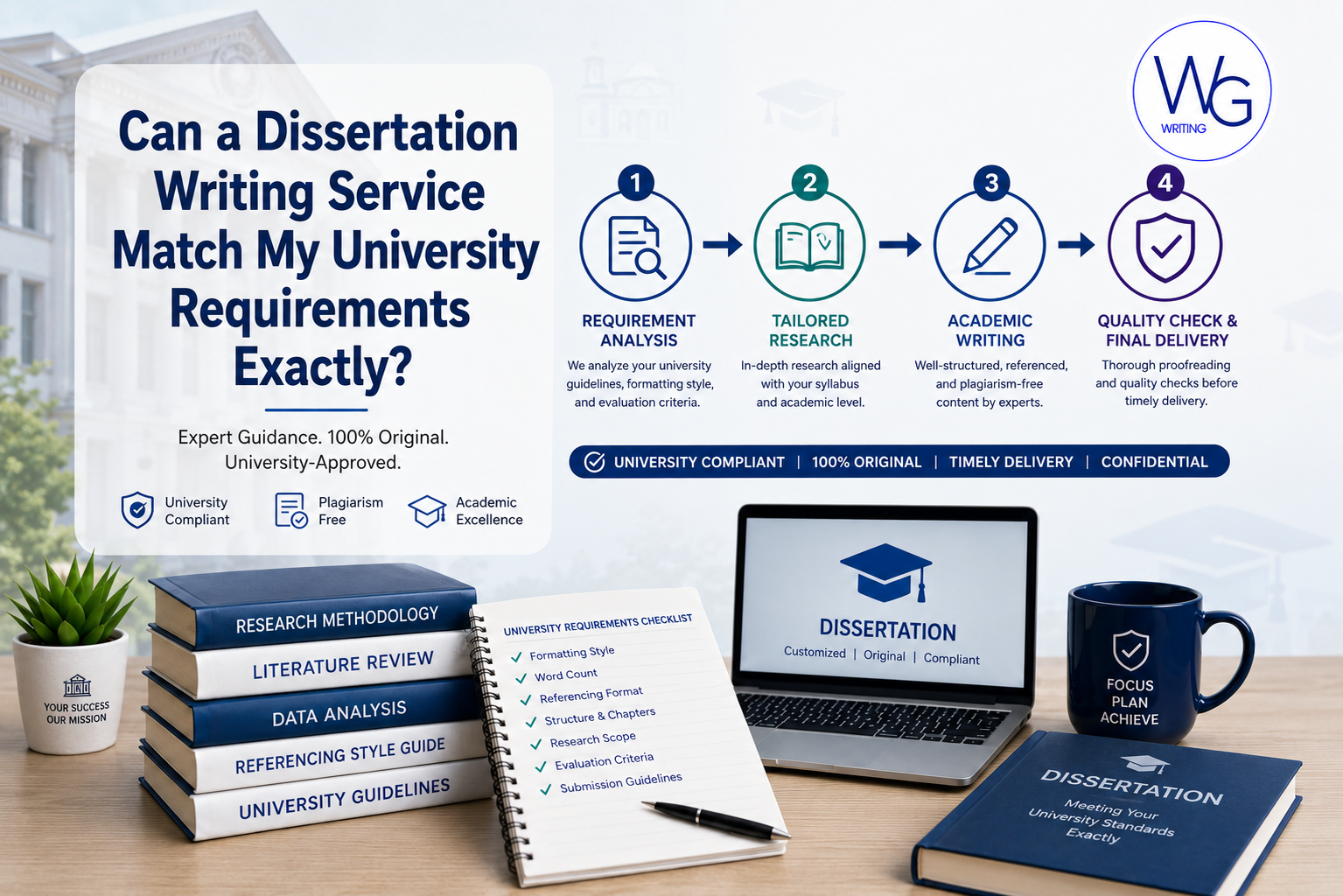
Can a dissertation writing service match your university requirements? Learn how professional dissertation support follows guidelines, formatting, and academic standards.
One of the biggest concerns students have when seeking dissertation assistance is whether the final document will actually meet their university's requirements. Universities often have detailed expectations covering formatting, structure, research methodology, referencing styles, and submission guidelines. Even a well-researched dissertation can face challenges if it fails to follow these requirements accurately.
For many students, keeping track of every instruction can feel overwhelming. Different universities, departments, and supervisors may have specific requirements regarding chapter organization, citation styles, formatting rules, and research standards. As dissertation projects become more complex, ensuring full compliance while managing coursework, employment, or personal responsibilities can be challenging.
This leads to an important question: can a professional dissertation writing service truly match university requirements? The answer depends largely on the service's ability to understand and follow detailed instructions rather than simply producing generic academic content. A high-quality provider should be capable of reviewing assignment briefs, departmental guidelines, assessment rubrics, and supervisor feedback to create a dissertation that aligns with the institution's expectations.
The concept of a dissertation meeting university requirements goes beyond correct grammar and strong writing. It involves ensuring that every aspect of the document—from formatting and referencing to research design and chapter organization—reflects the standards established by the student's university. Understanding how this process works can help students make informed decisions when evaluating dissertation support services.
In this guide, we will explore what university compliance really means, how reputable dissertation writing services approach requirement matching, and the factors students should consider before choosing professional assistance.
Need Dissertation Support Tailored to Your University Requirements?
At Writing Gram, we carefully review your university guidelines, assessment criteria, formatting requirements, and supervisor instructions before beginning any dissertation project. Our goal is to provide customized dissertation support that aligns with your institution's expectations while maintaining high standards of quality, accuracy, and originality.
Benefits of ordering with Writing Gram:
Customized dissertations based on your university guidelines
Accurate formatting and referencing styles
Subject-specific writers with dissertation experience
Revision support for supervisor feedback
Original, research-based academic content
Confidential and reliable customer support
Place your order now and receive dissertation support designed to match your university requirements with precision and attention to detail.
Why University Dissertation Requirements Are So Strict
University dissertation requirements are designed to ensure consistency, maintain academic standards, and provide a clear framework for conducting and presenting research. They are designed to ensure that every dissertation is evaluated fairly, demonstrates original research, and meets the academic standards expected at a particular institution. Whether a student is completing an undergraduate dissertation, master's thesis, or doctoral project, universities use detailed guidelines to maintain consistency and protect the credibility of their qualifications.
One of the primary reasons universities enforce strict dissertation requirements is to uphold academic integrity. Institutions expect students to present original work, properly acknowledge sources, and follow ethical research practices. Clear dissertation guidelines help reduce plagiarism, research misconduct, and other academic integrity concerns. A 2022 study published in the International Journal for Educational Integrity found that clear institutional policies, academic support systems, and integrity-focused education contribute significantly to maintaining academic standards and research quality in higher education.
Another reason for detailed requirements is standardized evaluation. Dissertation projects are often assessed by multiple academics, examiners, or review committees. Without a consistent framework, it would be difficult to evaluate research fairly across different students and topics. Requirements relating to chapter structure, methodology, literature reviews, referencing, and presentation ensure that examiners can assess work against clear and transparent criteria.
Research quality control is equally important. Universities are responsible for ensuring that dissertations demonstrate appropriate research methods, critical analysis, and scholarly rigor. Guidelines help students understand what is expected regarding research design, data collection, ethical approval, and evidence-based conclusions. By setting clear standards, institutions encourage higher-quality academic work and improve the reliability of research findings.
Although many dissertation expectations are similar worldwide, requirements often differ between institutions and educational systems. In the United Kingdom, dissertations commonly emphasize independent research, critical evaluation, and strict adherence to departmental handbooks. Universities in the United States may place greater emphasis on committee oversight, proposal approvals, and specific citation styles such as APA or MLA. Across many European universities, dissertation requirements can vary significantly depending on national regulations, degree frameworks, and institutional policies. These differences make it essential for students to follow the specific instructions provided by their own university rather than relying on generic academic templates.
The complexity of university guidelines for dissertation writing becomes even more apparent when formatting and presentation requirements are considered. Some universities require APA referencing, while others prefer Harvard, MLA, Chicago, or institution-specific styles. Requirements may also dictate margins, font sizes, chapter organization, table formatting, appendices, and word count limits. In addition, students are often expected to meet originality thresholds, demonstrate critical engagement with scholarly literature, and ensure that their research methods are appropriate for their field of study.
For these reasons, a dissertation is not judged solely on the quality of its writing. Universities evaluate whether the work complies with established academic, ethical, structural, and formatting standards. Understanding the purpose behind these requirements helps explain why dissertation compliance is such an important consideration for students seeking academic support.
What “Matching University Requirements” Actually Means
When students ask whether a dissertation writing service can match university requirements, the answer depends on understanding what “matching” actually involves. It is not simply about producing well-written content. Instead, it refers to the ability to align a dissertation with a detailed set of academic expectations that govern structure, presentation, methodology, and evaluation standards.
At its core, dissertation compliance includes several interconnected components. The first is formatting and citation style, which ensures that the work follows institutional rules such as APA, Harvard, MLA, or Chicago referencing. Even minor inconsistencies in citations or layout can affect how examiners assess the work, making formatting accuracy a critical part of compliance.
Another essential element is research depth and methodology alignment. Universities expect dissertations to demonstrate clear research design, logical argumentation, and appropriate use of academic sources. This means that the methodology section must not only be well-written but also appropriate for the research question and discipline. A mismatch between research design and academic expectations can weaken even a strong dissertation.
Structural alignment is equally important. Most universities require dissertations to follow a defined format, typically including chapters such as introduction, literature review, methodology, findings, discussion, and conclusion. Within this structure, students must also ensure that objectives, hypotheses, and research questions remain consistent throughout the document. A well-structured dissertation ensures that the argument develops logically and meets assessment criteria.
Another key factor is word count adherence. Universities often set strict limits for each section, not just the overall dissertation. Exceeding or falling short of these limits can indicate a lack of precision or poor planning, both of which may impact academic evaluation.
A common misconception is that “matching requirements” means achieving an identical version of a model dissertation or template. In reality, true alignment is closer to academic consistency—ensuring that the work meets institutional expectations while still reflecting the specific research topic, discipline, and supervisor guidance. This is where a thesis requirements matching service becomes relevant, as it focuses on adapting work to specific institutional criteria rather than applying a one-size-fits-all structure.
It is also important to recognize that university requirements are not universal. Even within the same country, different departments and supervisors may interpret guidelines differently. For example, one supervisor may prioritize theoretical depth in the literature review, while another may focus more on methodological justification or empirical analysis. This variability means that compliance is not static; it often evolves based on ongoing supervisor feedback and institutional expectations.
Recent academic discussions in Education Sciences, a peer-reviewed journal published by MDPI, emphasize that clarity in assessment criteria and alignment between student work and institutional expectations significantly improve academic writing outcomes. The journal highlights that when students understand evaluation frameworks and structural expectations, they are better able to produce work that meets academic standards consistently. This reinforces the idea that dissertation compliance is closely linked to understanding guidelines rather than simply writing ability alone.
Ultimately, matching university requirements involves integrating multiple layers of academic expectations—formatting, structure, methodology, and supervisory feedback—into a single coherent piece of research. It is this combination of precision and adaptability that defines whether a dissertation truly meets institutional standards.
Can a Dissertation Writing Service Really Meet My University’s Standards?
A dissertation writing service can closely align with university requirements, but only when it operates through a structured and guideline-driven process. Meeting doctoral standards is not about producing a generic piece of writing; it is about interpreting detailed institutional instructions and translating them into a coherent, discipline-specific dissertation.
Professional academic writers typically begin by carefully reviewing the brief provided by the student. This includes assessment criteria, formatting instructions, marking rubrics, and any supervisor comments. These documents form the foundation of the writing process, ensuring that the work reflects the expectations of the specific university rather than relying on general academic conventions.
A key factor in meeting expectations is the use of structured academic frameworks. Experienced writers often rely on university-approved dissertation models to shape the structure of the work. These frameworks guide how chapters are organised, how arguments are developed, and how evidence is presented. However, they are not applied rigidly. Instead, they are adapted to match the specific research topic and academic level of the student.
Another important element is discipline-specific expertise. A dissertation in nursing, for example, follows different methodological expectations compared to one in business, education, engineering, or a DNP capstone project. This is where subject-specialist writers play a crucial role. Their familiarity with academic conventions within a field helps ensure that arguments, terminology, and methodological choices remain appropriate for the discipline.
In addition, services that align with academic writing service university standards typically incorporate multiple layers of quality control. These may include structural reviews, referencing checks, and proofreading stages designed to ensure consistency with institutional expectations. Attention to detail in citation style, argument flow, and academic tone helps reduce the risk of non-compliance with university guidelines.
However, it is also important to understand the limitations of this process. Even when a dissertation is carefully prepared according to university requirements, final approval is not fully within the control of the writing service. Universities ultimately evaluate the work through supervision feedback, internal review, and formal assessment processes conducted by academic staff. This means that compliance is a collaborative process that depends not only on writing quality but also on ongoing alignment with supervisory input.
Recent peer-reviewed research published in Frontiers in Education highlights that clarity in academic expectations and structured support systems significantly improve student success in higher education writing tasks. The study emphasizes that when learners engage with clearly defined academic standards and iterative feedback processes, the quality and consistency of their written work improve substantially.
This reinforces the idea that meeting dissertation standards is not a single-step outcome but a process shaped by interpretation, refinement, and continuous alignment with academic expectations throughout the research journey.
How High-Quality Dissertation Services Ensure Compliance
High-quality dissertation writing services do not rely on guesswork or generic templates. Instead, they follow a structured, step-by-step process designed to ensure that every dissertation aligns closely with university expectations from the dissertation proposal to the final work.
The process typically begins with requirement analysis, where all provided documents are carefully reviewed. This includes assignment briefs, marking rubrics, departmental guidelines, and any supervisor instructions. This stage is critical because it determines how every section of the dissertation will be shaped. Even small details in the brief can influence structure, argument direction, and methodological choices.
Once the requirements are fully understood, the next step is topic alignment with academic scope. A strong dissertation is not only about choosing an interesting topic but ensuring that it fits within the academic boundaries of the course. This includes matching the subject level, research expectations, and available academic literature. A poorly aligned topic can make it difficult to meet assessment criteria, even if the writing itself is strong.
After this, writers move into structure planning based on the university format. Most institutions expect dissertations to follow a standard academic framework, but the exact requirements can vary. High-quality services adapt the structure to match the specific institution’s expectations, ensuring that chapters such as the introduction, literature review, methodology, findings, and conclusion flow logically and meet academic standards. This stage also ensures that research questions, objectives, and arguments remain consistent throughout the document.
Another essential component is referencing and citation accuracy checks. Universities place strong emphasis on correct referencing styles, and even minor inconsistencies can affect academic evaluation. High-quality services carefully apply the required citation style throughout the dissertation and cross-check all in-text citations with the reference list to ensure consistency and accuracy.
To maintain academic integrity and originality, proofreading and plagiarism checks are conducted before final delivery. This ensures that the dissertation is not only well-written but also free from duplication issues and language inconsistencies. Proofreading also improves clarity, grammar, and academic tone, which are essential for meeting institutional expectations.
In addition to these steps, strong providers of PhD dissertation compliance help implement multiple layers of quality control. This often includes editing and rewriting, rounds, peer reviews, and final checks to ensure that the dissertation meets both academic and structural requirements. These quality control systems help reduce errors and improve consistency across all sections of the work.
Finally, revision support plays an important role in maintaining compliance. Since dissertations are often reviewed by supervisors during the writing process, feedback may require adjustments to structure, argumentation, or methodology. High-quality services ensure that revisions are handled carefully so that the final document remains aligned with updated academic expectations.
Work with Writing Gram
Writing Gram provides high-quality dissertation support tailored to meet university, master’s, PhD, and doctoral-level standards. Each dissertation is developed through a structured process that focuses on accuracy, clarity, and strict alignment with academic requirements.
Place your order now to benefit from:
Dissertation writing aligned with your university guidelines
Subject-specific academic expertise
Strict formatting and referencing compliance
Multiple quality checks and revisions
Confidential and reliable academic support
This ensures your dissertation is developed with precision, consistency, and full alignment with academic standards from start to finish.
The Role of Customization in Meeting University Standards
One of the main reasons many dissertations fail to meet university expectations is the use of a “one-size-fits-all” approach. Universities do not assess dissertations based on generic writing quality alone; they evaluate how well the work aligns with specific institutional guidelines, departmental expectations, and subject requirements. Because these expectations vary widely, customization becomes essential for achieving true compliance with the specific requirements of every dissertation.
A standardized dissertation structure may appear organized on the surface, but it often lacks the flexibility needed to meet individual university requirements. Each institution has its own approach to assessment, including variations in formatting rules, methodological expectations, and emphasis on critical analysis. Without customization, important academic details can easily be missed, leading to misalignment with marking criteria.
Why Customization Matters in Dissertation Writing
Customization ensures that every part of the dissertation is tailored to the student’s exact academic context. This includes:
Custom academic formatting help that aligns the document with specific university guidelines, including referencing style, layout rules, and structural expectations
Discipline-specific writing style, ensuring that language, terminology, and analytical depth match the academic field (e.g., business, nursing, law, engineering)
Supervisor feedback adjustments, where revisions are made based on ongoing academic comments to ensure continuous alignment with expectations
Each of these elements plays a different role in ensuring that the dissertation is not only well-written but also meets academic expectations.
How Customization Improves Academic Compliance
When dissertations are customized rather than standardized, they are more likely to meet assessment criteria effectively. This is because customization allows for:
Better alignment with marking rubrics and departmental expectations
Improved consistency between research objectives, methodology, and conclusions
Accurate application of university-specific formatting and citation rules
Stronger integration of supervisor feedback throughout the writing process
Customization also helps ensure that the dissertation reflects the correct academic level. For example, master ’s-level work requires deeper critical analysis than undergraduate writing, while doctoral research demands a higher level of originality, methodological precision, and theoretical contribution. Without tailored adjustments, these distinctions can be overlooked.
Hence, customization is what transforms a general academic paper into a dissertation that is closely aligned with university standards. It ensures that structure, content, and presentation all work together to meet institutional expectations.
Common Reasons Dissertations Fail to Meet Requirements (Even When Well-Written)
Even when a dissertation is well-written and based on strong research, it can still fall short of university requirements.. This usually happens when there is a mismatch between the academic work and the specific requirements set by the institution. Universities assess dissertations using detailed criteria, and missing even one key element can affect the final evaluation.
The following are the most common reasons why dissertations fail to meet the required standards:
Misalignment with the marking rubric
One of the most common issues is failing to fully address the assessment rubric. Universities evaluate dissertations based on specific learning outcomes, including critical thinking, research depth, and methodological clarity. When sections of the dissertation do not clearly reflect these criteria, the overall score can be affected even if the writing quality is strong.
Incorrect referencing style
Referencing errors are another frequent problem. Different universities require different citation styles, such as APA, Harvard, or MLA, and even small inconsistencies can affect the final grade. This includes issues like incorrect in-text citations, incomplete reference lists, or inconsistent formatting throughout the document.
Weak methodology justification
A dissertation must clearly explain why a particular research method was chosen and how it supports the research objectives. When the methodology section is unclear or lacks justification, it weakens the credibility of the entire study. Examiners expect a clear link between research questions, data collection methods, and analytical approach.
Poor structure flow
A strong dissertation should follow a logical progression from the introduction to the conclusion. When chapters do not connect well or arguments feel fragmented, it becomes difficult for examiners to follow the research narrative. This often reduces clarity, even if individual sections are well-written.
Ignoring supervisor feedback
Supervisor input plays a major role in shaping the final dissertation. Ignoring or only partially applying feedback can lead to misalignment with university expectations. In many cases, supervisors guide students toward what examiners are specifically looking for in terms of structure, depth, and academic tone.
Institutional expectations and evaluation standards
Universities are highly specific about how dissertations should be assessed. For example, Harvard University’s academic guidance on writing and research standards emphasizes clarity, structure, and evidence-based argumentation as key components of effective academic work, reinforcing the importance of aligning with institutional expectations.
When these factors are not fully addressed, even a strong dissertation may fall short of meeting required academic standards. The issue is rarely the quality of writing alone, but rather how well the work aligns with structured academic expectations and evaluation frameworks.
What Students Should Check Before Choosing a Dissertation Writing Service
Choosing a dissertation writing service is a significant academic decision, and the quality of the service can directly affect how well the final work aligns with university expectations. Because dissertation requirements vary across institutions, students need to carefully evaluate whether a service is capable of delivering work that meets specific academic standards rather than offering generic writing support.
A reliable way to assess this is by reviewing how well the service understands and applies university-specific requirements. Dissertation compliance depends on attention to detail, structured processes, and the ability to adapt to different academic frameworks.
Key factors to evaluate before choosing a service
Understanding of university guidelines
A professional dissertation writing service should be able to interpret detailed academic instructions, including formatting rules, marking rubrics, and structural requirements. This ensures the dissertation aligns with institutional expectations from the beginning.Revision support based on feedback
Dissertations often go through multiple stages of review. A dependable service should be able to revise content based on supervisor feedback, ensuring that the dissertation remains aligned with evolving academic requirements throughout the process.Availability of discipline-specific samples
Reviewing previous samples in a relevant academic field helps students understand whether the service has subject-level expertise. Different disciplines require different approaches to argumentation, methodology, and referencing.Accuracy in formatting compliance
Formatting is one of the most common areas where dissertations lose marks. A high-quality dissertation writing service should demonstrate consistency in citation styles, chapter structure, headings, spacing, and overall presentation according to university standards.Clarity in academic approach
A trustworthy service should demonstrate a clear process for how dissertations are developed, from understanding the brief to final proofreading. This includes how research is structured and how academic sources are integrated.Consistency in quality and communication
Reliable services maintain consistent quality throughout the dissertation and ensure clear communication with students when clarification is needed. This helps reduce misunderstandings that could lead to misalignment with requirements.
Evaluating these factors helps students identify whether a service is capable of producing work that aligns with academic expectations rather than simply providing general writing support. In dissertation writing, precision, structure, and adherence to institutional guidelines are just as important as the quality of the content itself.
Why Precision Matters More Than Just Writing Quality
A well-written dissertation is important, but it is not enough on its own to meet university expectations. Many students assume that strong language, clear arguments, and good research automatically guarantee high marks. In reality, universities assess dissertations using detailed academic criteria where precision often matters more than general writing quality.
Good writing vs compliant dissertation work
Good writing focuses on clarity, grammar, flow, and presentation of ideas. It ensures the reader can understand the argument easily and follow the logic of the research. However, a compliant dissertation goes beyond readability. It must also meet strict academic requirements set by the institution.
This includes:
Following the correct structure required by the university
Applying the exact referencing and citation style
Aligning arguments with the research questions and objectives
Meeting formatting rules such as headings, spacing, and margins
Ensuring consistency across all chapters
A dissertation can be well-written but still fail if it does not align with these technical requirements.
How universities actually evaluate dissertations
Academic evaluation is based on structured marking criteria rather than writing quality alone. Examiners typically assess:
Clarity and relevance of research objectives
Depth of literature engagement
Appropriateness of methodology and analysis
Logical flow of arguments across chapters
Accuracy in referencing and academic presentation
Even when the writing is well-developed, failure to meet any of these criteria can affect the overall grade. For this reason, careful attention to detail is essential throughout the dissertation writing process.
Why small formatting errors matter more than expected
Formatting may seem like a minor detail, but universities treat it as part of academic standards. Small errors can influence how professional and consistent the dissertation appears. Common issues include:
Inconsistent citation formatting within the text
Incorrect heading hierarchy or numbering
Misaligned tables, figures, or appendices
Deviations from the required font size or spacing
These issues may not affect the research content directly, but they can create a negative impression of carelessness or lack of attention to academic guidelines.
The importance of alignment with institutional expectations
Every university has its own expectations for dissertation structure and presentation. Even within the same academic field, requirements can differ between institutions and departments. This means students must prioritize alignment with the specific guidelines of their supervisors rather than relying on general academic writing standards.
Precision ensures that:
The dissertation meets the marking criteria consistently
The structure supports the research argument effectively
Formatting and referencing remain academically acceptable
The work reflects institutional expectations throughout
Therefore, precision is what ensures that strong research and writing translate into strong academic performance. Without it, even high-quality content can fall short of the required university standards.
Final Answer – Can a Dissertation Writing Service Match University Requirements Exactly?
Professional dissertation writing services are capable of producing work that meets university expectations in terms of structure, formatting, referencing, and academic tone. They achieve this by following guidelines such as chapter organization, citation styles, and research design requirements. When these elements are correctly interpreted, the final dissertation can closely reflect what universities expect in submitted academic work.
However, success depends on several important conditions:
Accuracy of the initial brief: The more detailed and clear the university instructions are, the more accurately the dissertation can be aligned with them
Ongoing communication: Clarifications between the student and writer help ensure that feedback, expectations, and supervisor comments are properly reflected
Level of customization: Dissertations must be adapted to the specific subject area, academic level, and institutional marking criteria rather than produced using a generic template
Responsiveness to feedback: University expectations often evolve during the supervision process, meaning revisions may be required to maintain alignment
It is also important to understand that universities ultimately retain the final authority in evaluation. Even when a dissertation closely follows all provided guidelines, it is still evaluated by academic staff who may interpret quality, depth, and originality differently.
For this reason, dissertation compliance should be seen as a structured and collaborative process rather than a guaranteed outcome. A professional dissertation writing service can significantly improve alignment with university requirements, but the final evaluation always depends on how the work is reviewed within the academic institution.
Thus, “matching university requirements exactly” is less about perfection and more about achieving consistent coherence and alignment across the structure, content, and presentation while adapting to feedback and institutional expectations.
Get Dissertation Support That Aligns With Your University Standards
Meeting university dissertation requirements often requires careful attention to structure, formatting, methodology, and academic expectations. Many students struggle not because of a lack of understanding, but because of the complexity involved in aligning all these elements consistently throughout a long research project.
Writing Gram provides professional dissertation support designed to reflect your university’s specific guidelines. Each project is developed with close attention to the requirements provided, ensuring that the final work follows the correct academic format and maintains consistency from start to finish.
What you can expect from this support
Requirement-based writing tailored to your university brief, marking criteria, and academic level
Formatting accuracy, including correct referencing styles, structure, and presentation rules
Revision support to help adjust your dissertation based on supervisor feedback and academic updates
This approach focuses on creating alignment between your research and institutional expectations, ensuring that every section of your dissertation is developed with academic consistency and clarity.
Place your order today for customized dissertation support aligned with your university guidelines.