How Long Does It Take to Write a PhD Dissertation
By Writing Gram • May 2, 2026
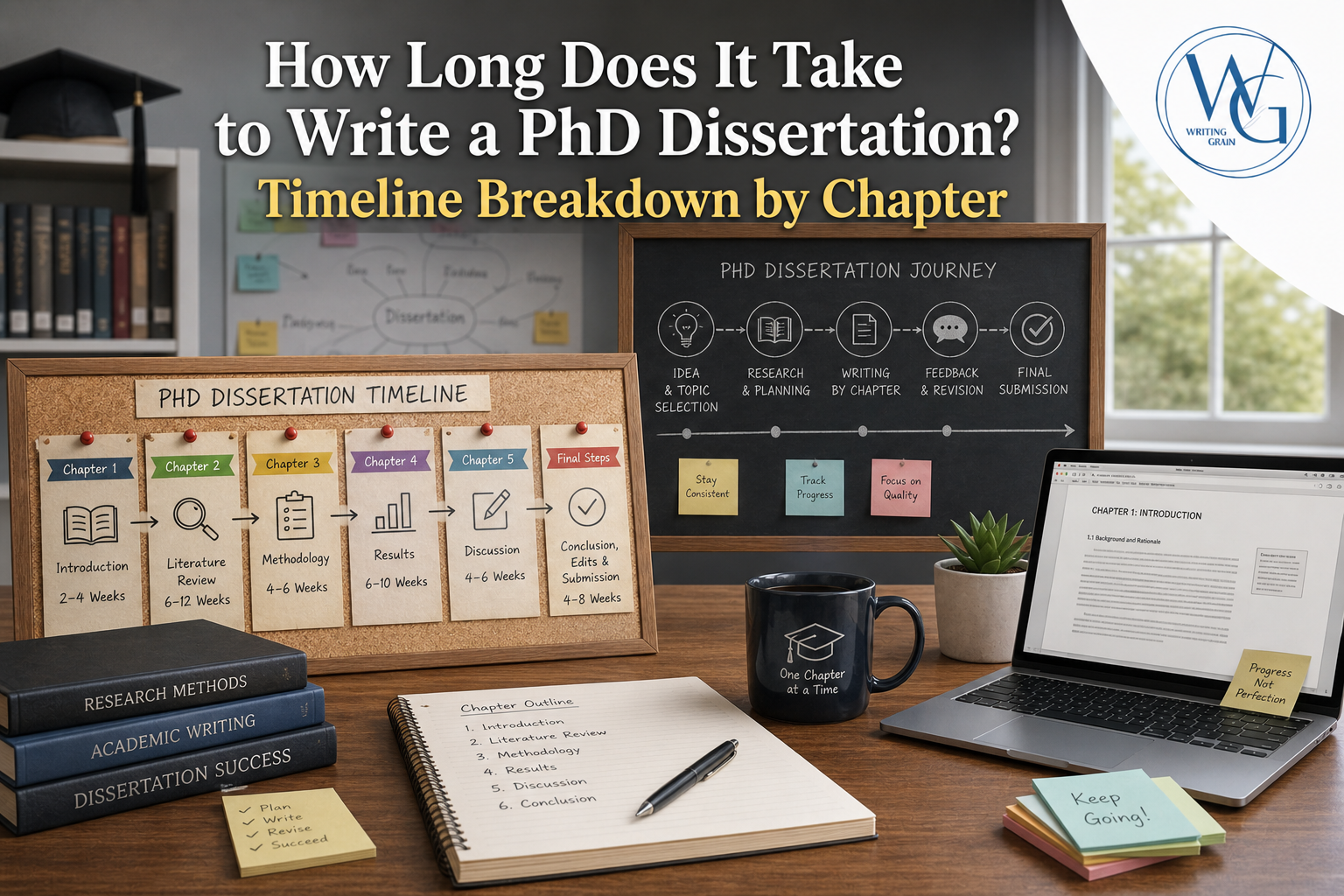
Learn how long it takes to write a PhD dissertation with a clear chapter-by-chapter timeline, key factors affecting duration, and realistic time estimates for each stage.
Most PhD students start their dissertation expecting it to take a few months, only to realize the process is far more demanding once they begin writing. So, how long does it take to write a PhD dissertation? In most cases, the answer ranges from 6 to 24 months, depending on factors such as your research area, the complexity of your data, and how quickly you receive feedback from your supervisor. The overall PhD dissertation duration also varies based on your writing experience and consistency. This guide breaks down the full timeline by chapter, giving you a realistic view of what to expect and how to plan each stage effectively.
🚀 Stop worrying about how long your dissertation will take. Whether you’re just starting or stuck midway, our expert academic writers are ready to support you at any stage. Get professional dissertation help today and stay on track with your deadline while we deliver a well-structured, high-quality, plagiarism-free dissertation tailored exactly to your instructions.
Average PhD Dissertation Timeline (What to Expect Overall)
The time it takes to write a dissertation depends on your schedule and commitments, but most PhD students typically spend between 6 and 24 months completing the writing once their research is finished.
Students who have already analyzed their data and planned a clear structure can sometimes finish in 3–6 months, while those still refining their research or collecting data often take much longer. This is why there’s no single answer to how many months to write a dissertation—your progress before you start writing directly affects how quickly you can complete each section.
The timeline also varies across disciplines. In STEM fields, the writing phase is often shorter because most of the time is spent earlier in the PhD on experiments and data collection. In contrast, humanities and social sciences usually involve continuous writing throughout the research process. This difference is important because it shows that dissertation writing is not a one-size-fits-all process, and comparing timelines across fields can be misleading.
According to the University of Nebraska Medical Center, dissertation writing follows several structured stages, including drafting, supervisor feedback, revisions, and meeting final submission deadlines before the defense. For example, many institutions require students to submit a full draft several weeks before the defense so that the committee can review it in advance, showing that writing is just one part of a longer, structured academic process.
Planning and consistency are what ultimately determine whether you stay within your expected timeline. Breaking your dissertation into clear stages—such as literature review, methodology, writing, and revisions—makes the workload more manageable and prevents last-minute pressure. Without a clear plan, it’s easy to waste weeks figuring out what to do next, which is one of the main reasons dissertations often take longer than expected.
Dissertation Timeline Breakdown by Chapter
Chapter 1 – Introduction (2–4 Weeks)
The introduction chapter is usually the starting point of the dissertation and typically takes about 2–4 weeks to complete, depending on how clearly the research problem is defined. In this section, you are expected to introduce the research topic, define the problem statement, outline your objectives, and clearly state the scope of the study. A strong introduction also shows the significance of your research and briefly guides the reader on what to expect in the rest of the dissertation. According to the University of North Carolina at Chapel Hill, a dissertation introduction should clearly establish the research problem, provide background context, and explain the significance of the study while guiding the reader into the rest of the document. This reinforces the idea that the introduction is not just a summary, but a critical academic foundation that frames the entire research process.
In practice, this chapter is often revised several times, as supervisors may request changes to the scope or clarity of the research questions. This is why the introduction chapter usually takes little time to draft, but can take much longer due to repeated revision cycles.
Chapter 2 – Literature Review (1–3 Months)
The literature review is often the most time-consuming chapter at the beginning of a dissertation and typically takes about 1 to 3 months to complete. This is because it involves extensive reading, evaluation, and synthesis of existing academic work related to your topic. Instead of simply summarizing studies, you are expected to critically compare theories, identify gaps in existing research, and position your study within the relevant academic field.
This stage is also where many students begin to fully understand the time required for PhD thesis writing, as the depth of reading often expands beyond initial expectations. The quality of this chapter depends heavily on how well you organize themes and arguments rather than listing studies one by one.
A strong literature review builds the academic foundation of your dissertation and directly influences the strength of your later chapters, especially your methodology and discussion sections.
Chapter 3 – Methodology (3–6 Weeks)
The methodology chapter typically takes 3–6 weeks, especially if your research design was already approved during your proposal stage. This section explains exactly how the research was conducted, including the design, sampling method, data collection tools, and analysis techniques.
It is considered one of the more structured chapters because it focuses on explaining “how” your study was done rather than interpreting results. Once the research framework is clear, writing becomes relatively faster compared to other chapters.
However, clarity is critical here because this chapter must allow another researcher to replicate your study if needed. As a result, students often refine this section multiple times to ensure accuracy and alignment with their actual research process.
Chapter 4 – Results / Findings (1–2 Months)
The results or findings chapter usually takes 1–2 months, depending on the complexity of the data and analysis tools used. This chapter focuses solely on presenting findings in a clear, structured way, often using tables, charts, or thematic breakdowns.
At this stage, interpretation is usually kept minimal, as the main discussion is reserved for the next chapter. Instead, the focus is on objectively showing what the data reveals.
The dissertation chapter timeline for this section can vary significantly because quantitative studies with large datasets or qualitative studies with extensive interviews require more time to organize and present clearly.
Chapter 5 – Discussion & Conclusion (1 Month)
The final chapter usually takes around 1 month and combines both discussion and conclusion. This is where you interpret your findings, connect them back to your research questions, and explain what they mean in the broader academic context.
You also compare your results with existing literature, highlight contributions to knowledge, and acknowledge limitations of your study. The conclusion then summarizes the entire dissertation and may suggest areas for future research.
This chapter is critical because it brings together the entire study into a coherent academic argument. A well-written discussion often determines the overall strength of the dissertation.
Key Factors That Affect Dissertation Writing Time
The overall PhD dissertation duration varies widely depending on several factors. These include the level of supervisor feedback, complexity of the research topic, availability of data, and the student’s writing discipline. Some students progress quickly when feedback is consistent, while others experience delays due to revisions or data challenges.
Time management also plays a major role, especially when balancing research with work or other responsibilities. Even well-planned dissertations can take longer if progress is inconsistent or if chapters require repeated revisions.
If you look at the full dissertation writing timeline, it’s clear that each chapter comes with its own demands, delays, and revision cycles. From the literature review, which can take months of reading, to the results and discussion chapters, which require careful structuring and interpretation, the process is rarely as straightforward as students expect. This is why many PhD candidates struggle to maintain momentum or accurately estimate how many months it takes to write a dissertation without getting stuck midway.
Instead of losing time figuring out each stage on your own or falling behind because of repeated revisions, you can have each chapter properly structured and aligned from the start. Writing Gram helps you move through the entire dissertation process with clarity—so every section, from introduction to conclusion, is written in a way that reduces delays, improves flow, and keeps your progress consistent.
👉 If you’re ready to stop struggling with chapter-by-chapter delays and want a complete dissertation that follows a clear, realistic timeline, you can place your order today and get expert support across your entire PhD dissertation.
Key Factors That Affect Dissertation Writing Time
Supervisor feedback delays
One of the most common reasons dissertations take longer than expected is delayed or inconsistent feedback from supervisors. Even a well-written chapter can stall if revisions are not reviewed on time, which creates delays in progress and disrupts the overall writing flow. Over time, these delays can significantly extend the completion period, especially when multiple chapters are under review at different stages.
Research complexity
The complexity of the research topic plays a major role in determining how long the dissertation takes to complete. According to Harvard University Graduate School guidelines on doctoral research structure, complex research often requires extended periods for data collection, validation, and iterative analysis before writing can even progress smoothly.
This means that topics involving large datasets, mixed methods, or fieldwork naturally take longer to organize and interpret, directly increasing the time needed for each chapter and affecting the overall PhD dissertation duration.
Student experience level
Students who are more familiar with academic writing, research methods, and referencing systems tend to progress faster through each stage. In contrast, first-time researchers often spend additional time learning how to structure arguments, integrate literature, and meet academic standards, which slows down early drafts and increases revision cycles.
Time management and external commitments
Dissertation progress is also heavily influenced by how well students manage their time alongside other responsibilities. Work, family, or teaching commitments can reduce consistent writing time, leading to uneven progress and longer completion periods. Even small interruptions can build up over time, making consistent scheduling one of the most important success factors.
Realistic Timeline Examples (Full-Time vs Part-Time Students)
Understanding how many months to write a dissertation becomes clearer when you compare full-time and part-time study patterns, since the available time and pace of research differ significantly between the two.
Full-time students (6–12 months)
Full-time PhD candidates usually complete their dissertation writing within 6–12 months once their research is fully developed and ready for the writing phase. This is because they can dedicate most of their time to writing, analysis, and revisions without major external commitments or interruptions. In most cases, progress is steady, and chapters are completed in a more continuous flow, which helps maintain consistency across the dissertation writing timeline.
Part-time students (12–24+ months)
Part-time students typically take 12–24 months or longer to complete their dissertation writing phase. This extended duration is mainly due to work commitments, limited research hours, and interruptions in writing schedules. As a result, progress is often spread out, and maintaining consistency becomes more challenging, which naturally extends the overall completion period.
🚀 Whether you are a full-time or part-time PhD student, Writing Gram offers professional PhD dissertation help to make your academic journey less stressful. Simply place your order today and relax while our expert academic writers handle your dissertation, allowing you to focus on your work, lectures, and research.
How to Speed Up Your Dissertation Without Sacrificing Quality
• Set weekly writing targets- Breaking your dissertation into weekly goals helps you maintain steady progress without feeling overwhelmed. Instead of focusing on the entire project at once, you concentrate on small, achievable tasks such as completing a section of a chapter, reviewing literature, or refining arguments. This approach keeps your momentum consistent and prevents long periods of inactivity, which are a major cause of delays in the overall dissertation writing timeline.
• Work chapter-by-chapter- Focusing on one chapter at a time helps you maintain clarity and structure in your writing. Each chapter has a specific purpose, so completing it fully before moving on reduces confusion and repeated edits later. This method also ensures your arguments develop logically, making the entire dissertation easier to refine during the final review stages.
• Get early feedback
Sharing drafts with your supervisor early in the process helps you identify issues before they become deeply embedded in your work. Early feedback allows you to correct direction, improve structure, and align your writing with academic expectations. This reduces the risk of major revisions at the later stages, which often slow down progress significantly.
• Avoid last-minute writing
Rushing through chapters as deadlines approach often results in errors, weaker arguments, and an inconsistent structure. Spacing out your writing gives you time to reflect, revise, and improve the quality. A consistent pace not only improves clarity but also makes your entire dissertation process more manageable and less stressful.
Final Takeaway: Understanding the Real Dissertation Timeline
A realistic answer to how long does it take to write a PhD dissertation depends on how well each stage of your research is planned and executed. While some students complete their work within a year, others take much longer due to delays in writing, revisions, or data-related challenges. The key factor is not just speed, but consistency across every chapter of your work.
When you follow a clear structure and manage your time properly, the entire process becomes far more predictable and less overwhelming. Careful planning, steady progress, and addressing each chapter as early as possible ensure that your dissertation moves forward without unnecessary setbacks and it is completed within the required timeframe.
👉 Stay Ahead of Your Dissertation Schedule with Expert Support
Completing a PhD dissertation is rarely just about writing; it involves managing time, structure, and revisions across multiple chapters without losing momentum. Many students fall behind not because they cannot write, but because delays in feedback, unclear structure, and repeated revisions extend the time required for PhD thesis writing far beyond what was initially expected. Having expert support helps you avoid these setbacks by ensuring each chapter is properly structured, aligned with academic expectations, and ready for review without unnecessary rework. This reduces delays, improves consistency across your dissertation, and helps you stay on track with your overall timeline from introduction to conclusion.
👉 If you want to complete your dissertation faster with fewer revisions and a clear, structured writing process, place your order today and get expert support throughout every stage of your PhD dissertation.