SPSS vs NVivo vs Excel Dissertation Help
By Writing Gram • May 19, 2026
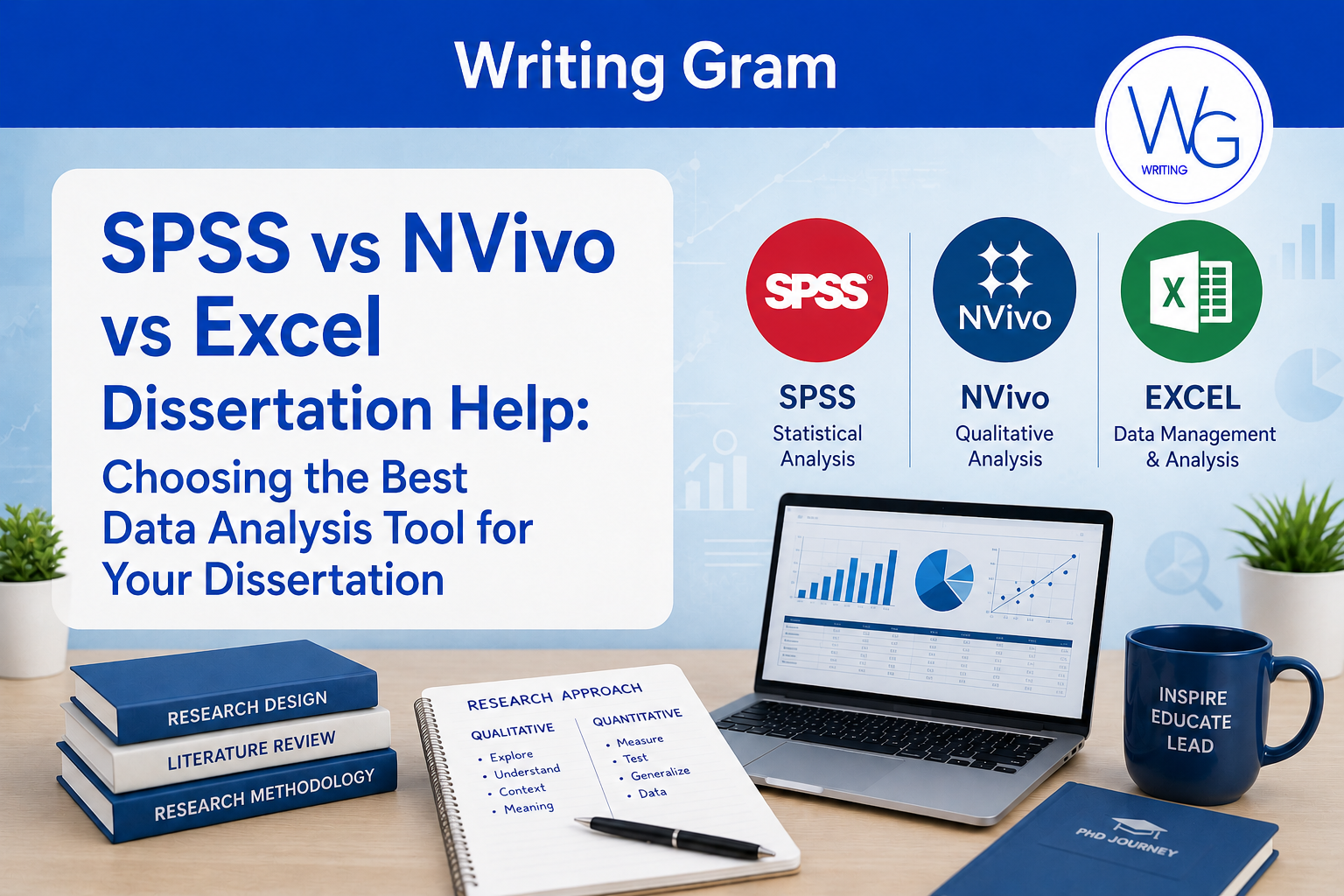
Struggling with SPSS, NVivo, or Excel for your dissertation? Get expert dissertation help for data analysis and learn how to choose the right tool for quantitative, qualitative, or mixed-method research. Improve accuracy, clarity, and results with professional guidance tailored to your PhD or master’s study.
Selecting the right software for research data analysis is one of the most important decisions students make when writing a dissertation. Different dissertation data analysis tools are designed for specific research methods, meaning the best option depends on whether your study uses quantitative, qualitative, or mixed-methods research. Choosing the wrong tool can make data interpretation more difficult, weaken methodological alignment, and create unnecessary challenges when writing the analysis and findings chapters of a dissertation.
Many PhD and graduate students struggle to determine which software best fits their research design. This confusion is common because modern dissertations often involve complex datasets, multiple research questions, and strict academic expectations from supervisors and university committees. Students are also expected to justify their choice of analysis method and software in the methodology chapter, making this decision even more important.
SPSS, NVivo, and Excel are among the most commonly used data analysis tools in academic research. SPSS is commonly used for statistical analysis in quantitative research, while NVivo is designed for coding and analyzing qualitative data, such as interviews and focus groups. Excel, on the other hand, is commonly used for organizing datasets, generating charts, and carrying out basic data analysis.
Understanding the differences between quantitative and qualitative analysis tools is essential for selecting software that properly aligns with your dissertation objectives and research methodology.
In many cases, students seek professional dissertation data analysis help to ensure that their methodological approach, data interpretation, and selection of analytical software are fully aligned with doctoral-level standards. Whether you are conducting survey-based statistical analysis or thematic coding for qualitative research, selecting the appropriate tool can significantly enhance the clarity, credibility, and overall academic quality of your dissertation.
At Writing Gram, we provide expert dissertation assistance for quantitative, qualitative, and mixed methods research. Our academic experts can help you choose the right analysis software, interpret your findings correctly, structure your methodology chapter, and ensure your dissertation meets graduate-level academic standards. Place your order today to receive professional support, accurate data analysis, plagiarism-free work, timely delivery, and personalized assistance throughout your dissertation writing journey.
Understanding the Role of Data Analysis in a Dissertation
Data analysis is a core part of any dissertation because it is the stage where raw information is transformed into meaningful, evidence-based findings. Without proper analysis, even well-designed research can produce unclear or unreliable conclusions. This is the reason why universities place strong emphasis on methodological clarity and the correct application of analytical techniques.
In most postgraduate research, data analysis is not just about running software—it is about ensuring that the chosen methods align with the research questions, objectives, and overall study design. Whether a dissertation uses surveys, interviews, experiments, or mixed methods, the analysis stage determines how effectively the data answers the research problem.
Why data analysis is critical in dissertation methodology
It converts raw data into structured findings that support your research objectives
It ensures your conclusions are evidence-based rather than descriptive assumptions
It strengthens the credibility and academic validity of your dissertation
It helps connect your literature review, methodology, and results into a coherent argument
In most universities, students are expected to clearly justify their analytical approach within the methodology chapter. For example, institutions such as the University of California, Berkeley emphasize that research design must be closely aligned with appropriate methods of data collection and analysis to ensure valid conclusions. Hence, data analysis is not optional; it is a central and indispensable component of the research process.
How incorrect tool selection affects validity and interpretation
Choosing the wrong analytical tool can significantly weaken a dissertation. Different tools are designed for different types of data, and mismatches can lead to incorrect interpretations or incomplete results.
Common issues caused by poor tool selection include:
Misinterpretation of statistical relationships or trends
Inability to properly analyze qualitative or quantitative data
Weak or unsupported conclusions in the results chapter
Reduced confidence from supervisors and examiners in the findings
For example, relying on basic spreadsheet functions when advanced statistical modeling is required can significantly limit the depth and quality of the analysis. Similarly, attempting to analyze interview transcripts without proper qualitative software may lead to missed themes or inconsistent coding. This is why understanding appropriate statistical tools for dissertation work is essential for producing valid, defensible, and empirically supported doctoral research findings.
Why supervisors expect methodological justification
Universities require students to justify the methods they use, including their choice of data analysis software. This expectation exists because:
It demonstrates an understanding of research design principles
It shows that the analysis is appropriate for the data type
It ensures transparency and replicability of the study
It aligns the dissertation with academic standards of precision, transparency, and integrity.
Supervisors often expect clear explanations for why specific tools were chosen, particularly when working with SPSS, NVivo, or Excel in quantitative, qualitative, or mixed-methods research. Strong justification not only improves the quality of the methodology chapter but also strengthens the overall academic credibility of the dissertation.
SPSS for Dissertation Data Analysis (Quantitative Research)
SPSS is one of the most widely used tools for handling quantitative research data in dissertations. It is especially popular in fields such as social sciences, psychology, education, and business because it allows students to perform complex statistical tests without needing advanced programming skills. Many universities describe SPSS as a statistical software package designed to manage, analyze, and visualize numerical data in a structured way. For example, the University of California, Irvine explains that SPSS is used for statistical analysis, including t-tests, ANOVA, regression, and data visualization in research settings.
When comparing SPSS vs NVivo for dissertation work, SPSS is primarily suited for quantitative research, while NVivo is used for qualitative analysis, such as coding interviews and identifying themes.
What SPSS is best used for in dissertations
SPSS is ideal when your dissertation involves numerical or structured data such as surveys, experiments, or large datasets. It is commonly used to test hypotheses and identify statistical relationships between variables.
Typical applications include:
Survey data analysis (Likert scales, questionnaires, structured responses)
Experimental research (pre-test and post-test comparisons)
Correlation and regression analysis
Group comparisons (e.g., gender, age, or treatment effects)
This makes SPSS one of the most important statistical tools for dissertation research when working with quantitative methodologies.
Key strengths of SPSS in academic research
SPSS is widely adopted in universities because of its balance between usability and statistical power. According to research guides from James Madison University, SPSS can import data from multiple sources, generate statistical reports, create graphs, and perform both simple and advanced analyses.
Its main strengths include:
Advanced statistical functions
Regression analysis
Correlation testing
ANOVA and t-tests
User-friendly interface (menu-driven system, no coding required)
Strong academic acceptance across universities and journals
Data visualization tools for charts, graphs, and summaries
Ability to handle large datasets efficiently
Because of these features, SPSS is often recommended for students seeking the best software for PhD data analysis in quantitative research.
Limitations of SPSS in dissertation research
Despite its strengths, SPSS also has limitations that students should consider when planning their methodology:
Not suitable for qualitative data analysis (no thematic coding features)
Requires a basic understanding of statistics to interpret outputs correctly
Limited flexibility compared to programming-based tools like R or Python
Can be less effective for highly customized or exploratory data analysis
These limitations highlight why tool selection must align carefully with research design, especially when dealing with mixed methods studies.
Why SPSS is widely used in universities
SPSS remains a standard tool in academic research because:
It simplifies complex statistical procedures into accessible workflows
It produces outputs that are widely accepted in dissertations and peer-reviewed journals
It supports reproducible analysis through both menu-based and syntax-based systems
It is integrated into many university research training programs.
Overall, SPSS remains a powerful and reliable option for students conducting quantitative dissertation research, especially when statistical accuracy and academic acceptance are key priorities.
Our dissertation data analysis help has expert academic writers who have experience in performing data analysis using SPSS.
NVivo for Dissertation Data Analysis (Qualitative Research)
NVivo is a widely used software tool for analyzing qualitative data in dissertations. It is specifically designed to help researchers organize, code, and interpret non-numerical data such as interview transcripts, focus group discussions, documents, and open-ended survey responses. When comparing NVivo coding vs SPSS analysis, NVivo focuses on identifying patterns and themes in textual or visual data, while SPSS is used for statistical analysis of numerical datasets.
According to Stanford University Libraries, qualitative analysis tools like NVivo support researchers in systematically organizing large volumes of unstructured data, making it easier to identify patterns, themes, and relationships within the material.
What NVivo is best used for in dissertations
NVivo is useful for qualitative and mixed-methods dissertations where the goal is to understand meanings, experiences, and perceptions instead of statistical patterns or numerical trends.
Common applications include:
Interview transcription analysis
Focus group discussion coding
Thematic analysis of textual data
Open-ended survey response interpretation
Organizing large qualitative datasets into meaningful categories
This makes NVivo one of the most important tools in quantitative vs qualitative analysis tools comparisons, especially for students working with narrative or descriptive data.
Key strengths of NVivo in academic research
NVivo is widely adopted in universities because it allows researchers to handle complex qualitative datasets efficiently while maintaining academic rigor.
Its main strengths include:
Thematic coding of qualitative data (manual and automated coding features)
Ability to identify patterns, themes, and relationships across datasets
Efficient organization of large volumes of text, audio, and visual data
Visualization tools such as word clouds, charts, and concept maps
Supports mixed-methods research by linking qualitative insights with quantitative data
These features make NVivo a strong option for students seeking structured and reliable qualitative analysis in dissertation research.
Limitations of NVivo in dissertation research
While NVivo is powerful for qualitative analysis, it also has limitations that students should consider:
Not designed for statistical or numerical data analysis
Requires time to learn coding and qualitative analysis techniques
Interpretation still depends heavily on the researcher's judgment
Can become complex when managing very large or multi-layered projects
These limitations highlight the importance of selecting the right tool based on research design rather than preference.
Why NVivo is widely used in universities
NVivo is commonly used in academic institutions because it supports systematic and transparent qualitative analysis. Universities value it for its ability to help researchers:
Organize large qualitative datasets efficiently
Maintain traceability of coding decisions for academic transparency
Improve consistency in thematic analysis
Strengthen the credibility of qualitative findings in dissertations
As a result, NVivo is often recommended for students conducting qualitative research or seeking structured dissertation analysis support in non-numerical studies.
Excel for Dissertation Data Analysis (Basic but Practical Tool)
Excel is one of the most accessible and widely used tools for dissertation data analysis, especially in the early stages of research. While it is not as advanced as SPSS or NVivo, it plays an important role in organizing datasets, performing basic calculations, and visualizing results. In many dissertation projects, Excel is used alongside more specialized software rather than as the primary tool for advanced data analysis.
According to Duke University Libraries, Excel is commonly used in research settings for data organization, basic statistical functions, and creating charts and tables that help researchers understand their datasets before conducting deeper analysis.
What Excel is best used for in dissertations
Excel is most effective for handling structured and straightforward datasets where advanced statistical or qualitative tools are not required.
Common uses include:
Data entry and cleaning (removing duplicates, fixing formatting errors)
Organizing survey or experimental data into tables
Creating basic descriptive statistics (mean, median, mode)
Producing charts, graphs, and visual summaries
Managing small to medium-sized datasets before export to SPSS or other tools
This makes Excel a practical starting point within broader dissertation data analysis tools workflows, especially for students preparing data for more advanced analysis.
Key strengths of Excel in academic research
Excel remains popular in dissertation research because it is easy to access and does not require advanced technical skills.
Its main strengths include:
User-friendly interface suitable for beginners
Widely available across academic institutions and personal devices
Strong data organization capabilities using spreadsheets
Basic built-in formulas for simple statistical calculations
Quick generation of charts and visual representations
Because of these features, Excel is often used in combination with other tools in statistical analysis for dissertation work, particularly during the data preparation stage.
Limitations of Excel in dissertation research
Despite its usefulness, Excel has clear limitations when used for academic data analysis:
Not suitable for advanced statistical modeling or hypothesis testing
Limited capabilities for qualitative data analysis
Prone to human error in manual data entry
Lacks advanced research-specific features found in SPSS or NVivo
Can become inefficient with very large datasets
These limitations mean Excel should not be relied on as the primary analysis tool for complex dissertations, especially at the PhD level.
Why Excel is still widely used in universities
Even with its limitations, Excel remains a standard tool in academic research because:
It is ideal for initial data preparation and cleaning
It provides a simple way to visualize early trends in data
It integrates easily with SPSS, NVivo, and other research software
It helps students understand their dataset before advanced analysis
As a result, Excel continues to play a foundational role in many dissertation projects, particularly in the early stages of analysis or when working with straightforward quantitative data.
If you are struggling to choose among SPSS, NVivo, or Excel for your dissertation, Writing Gram provides professional data analysis help tailored to your specific research design and methodology.
Place your order now to get expert support in selecting the right tool, correctly analyzing your data, and presenting clear, evidence-based results that align with your methodology requirements, ensuring faster progress, accurate findings, and a stronger, well-structured dissertation that is ready for submission.
SPSS vs NVivo vs Excel: Key Differences Explained Simply
Choosing between SPSS, NVivo, and Excel depends entirely on the type of data you are working with and the goals of your dissertation. Each tool serves a different role in the research process, and understanding these differences helps ensure your analysis is accurate, structured, and aligned with your methodology.
SPSS → Statistical analysis (quantitative data)
SPSS is designed for numerical and statistical analysis in quantitative research. It is widely used in dissertations that involve surveys, experiments, or structured datasets.
Performs advanced statistical tests such as regression, correlation, and ANOVA
Ideal for hypothesis testing and identifying relationships between variables
Commonly used in social sciences, business, psychology, and education research
Produces structured outputs that can be directly used in dissertation results chapters
NVivo → Thematic analysis (qualitative data)
NVivo is built for analyzing non-numeric data in qualitative research. It helps researchers identify patterns, themes, and meanings within textual or multimedia data.
Used for coding interview transcripts and focus group discussions
Supports thematic analysis by grouping recurring ideas and concepts
Helps organize large volumes of unstructured qualitative data
Useful in studies focused on experiences, perceptions, and behaviors
Excel → Basic analysis and data organization
Excel is a general-purpose tool used for managing and preparing data before deeper analysis is conducted using more specialized software.
Organizes datasets into structured spreadsheets
Performs basic calculations such as averages and percentages
Creates simple charts and graphs for data visualization
Often used for data cleaning and preliminary analysis
Key takeaway: no single best tool
There is no universal best software for PhD data analysis because each tool serves a different research purpose. The correct choice depends on your research design:
Quantitative studies → SPSS
Qualitative studies → NVivo
Basic data handling or early-stage analysis → Excel
In most dissertation projects, especially mixed-methods research, students may even use a combination of these tools to ensure complete and accurate analysis.
Which Tool Should You Use for Your Dissertation?
The right choice of analysis software depends on your research design, the type of data you collect, and the degree of analytical detail required in your findings. There is no single tool that fits every dissertation, which is why aligning your choice with your methodology is essential when making this decision.
If your research is quantitative, SPSS is the most appropriate option because it supports statistical testing, hypothesis analysis, and numerical data interpretation.
If your research is qualitative, NVivo is the better choice as it allows structured coding and thematic analysis of interviews, texts, and other non-numerical data.
If your study is mixed-methods or at an early stage, Excel can be used for data organization and preliminary analysis, in combination with SPSS or NVivo for deeper evaluation.
Most PhD students do not rely on a single tool throughout their entire dissertation. Instead, they combine different statistical tools for dissertation analysis depending on the stage of research—for example, using Excel for cleaning data, SPSS for statistical testing, and NVivo for qualitative coding. This combination approach helps ensure both accuracy and depth in the final findings while maintaining alignment with doctoral research standards.
Get Expert Dissertation Data Analysis Help with SPSS, NVivo & Excel from Writing Gram
Choosing the right analysis tool is not just a technical decision—it is a methodological decision that directly affects the quality, credibility, and clarity of your dissertation findings. Whether you are working with quantitative data, qualitative insights, or a combination of both, your chosen tool must align with your research design from the start.
Why methodology alignment matters in data analysis
A strong dissertation is built on consistency between the research questions, data collection methods, and analysis tools. When these elements are not aligned, it can lead to weak interpretations or findings that do not properly answer the research problem.
Key reasons alignment is essential:
Ensures your analysis directly answers your research questions
Strengthens the validity and reliability of your findings
Helps maintain consistency across methodology, results, and discussion chapters
Improves how examiners evaluate your overall research approach
Choosing the right tool based on your research design
Each software serves a specific purpose in dissertation research:
SPSS → Best suited for quantitative research involving statistical testing and numerical datasets
NVivo → Ideal for qualitative research focused on interviews, themes, and textual analysis
Excel → Useful for data organization, cleaning, and basic preliminary analysis
Selecting the wrong tool can make analysis unnecessarily complex or reduce the depth of your findings, which is why careful selection is critical at the early stages of your dissertation.
Why students struggle with tool selection and analysis
Many students find it difficult to decide which tool to use or how to apply it correctly within their methodology. This often happens because:
Research methods and statistical concepts can be complex
Different tools require different levels of technical understanding
Supervisors expect clear justification for every methodological choice
Mixed-methods research may require multiple tools used together
This is why many students seek professional dissertation support to ensure their data analysis approach aligns correctly with their methodology and academic requirements.
Get expert support for your dissertation analysis
Writing Gram provides specialized dissertation data analysis help for SPSS, NVivo, and Excel users at all academic levels. Our support ensures your analysis is accurate, well-structured, and aligned with your research design so your findings are clear, defensible, and meet doctoral expectations for evidence and argumentation.
🎓Place your order now to get expert support in selecting the right tool, correctly analyzing your data, and presenting clear, evidence-based results that align with your methodology requirements, ensuring faster progress, accurate findings, and a stronger, well-structured dissertation that is ready for submission.