How to Maintain Coherence Across Dissertation Chapters
By Writing Gram • May 31, 2026
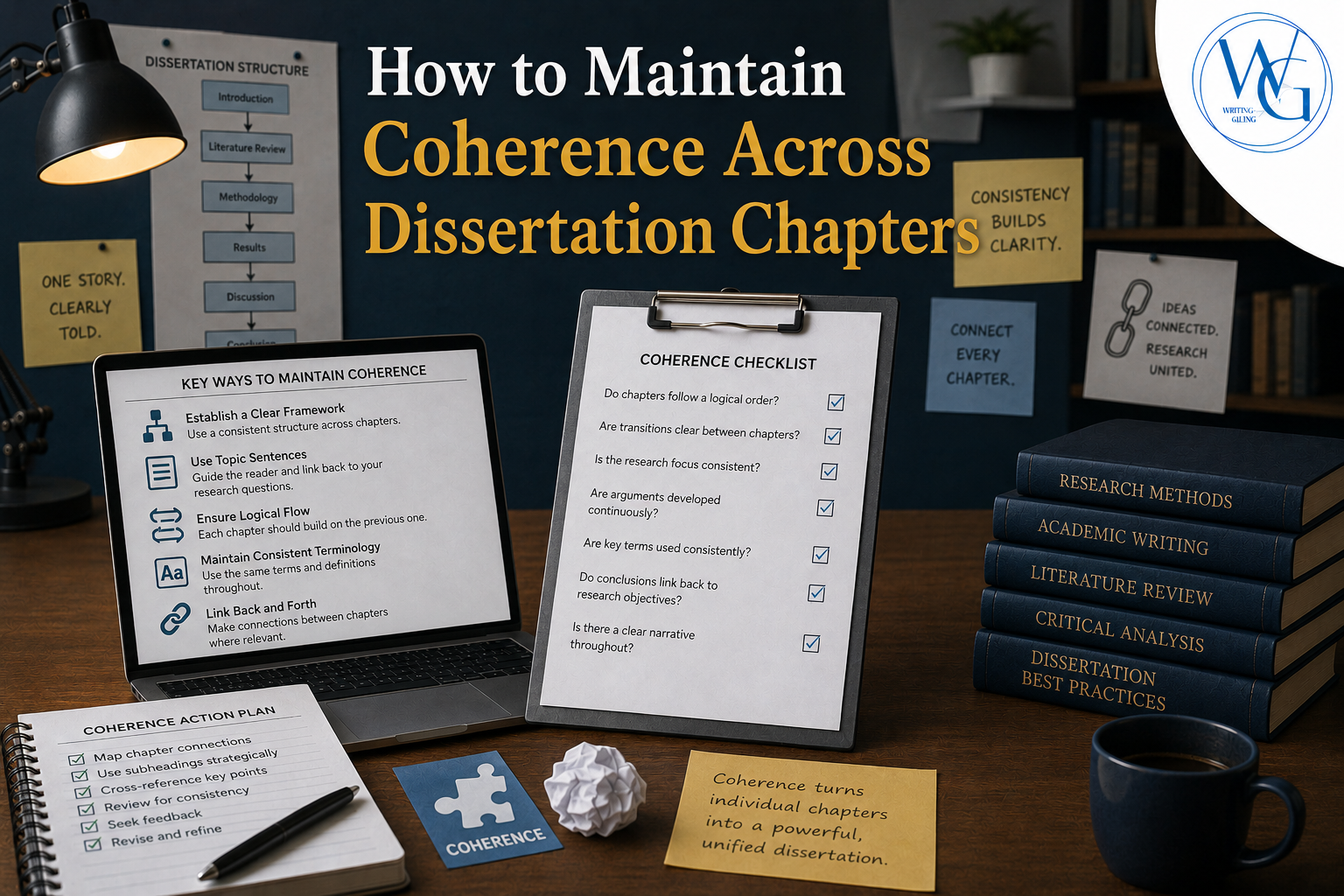
Struggling with dissertation structure? Discover how to maintain coherence across chapters, improve logical flow, and create a clear, examiner-ready academic argument.
Why Dissertation Coherence Matters
Dissertation coherence is essential because it ensures that all chapters, arguments, and findings work together to support a clear and consistent line of inquiry, allowing the research to read as a unified scholarly investigation rather than a collection of disconnected sections.
Regardless of how strong individual sections may be, a dissertation must present a clear and continuous line of reasoning that guides readers from the research problem to the final conclusions. When ideas, evidence, and arguments connect logically throughout the document, readers can easily understand how each chapter contributes to the overall purpose of the study.
Examiners evaluate a dissertation as a complete research project rather than assessing individual chapters separately. They examine how effectively each chapter contributes to answering the research question, supports the study's objectives, and strengthens the overall argument of the dissertation.
A well-organized dissertation demonstrates that the researcher has developed a systematic approach to investigating the topic, interpreting evidence, and drawing conclusions. Strong coherence also improves readability by helping readers follow the progression of ideas without confusion or unnecessary repetition.
One of the most common challenges in doctoral and postgraduate research is maintaining a logical flow across chapters. Students often spend months or even years writing different sections at different times, which can lead to inconsistencies in terminology, arguments, theoretical perspectives, or research focus. As a result, the literature review may not fully support the methodology, the findings may not align with the research objectives, or the discussion chapter may introduce ideas that were not developed earlier in the study.
These disconnects can weaken the dissertation's ability to present a clear, logical, and convincing response to the research question. Even high-quality research may appear less convincing when chapters fail to connect naturally. Readers may struggle to understand how evidence supports conclusions, while examiners may question the consistency and development of the research argument. In contrast, a coherent dissertation creates a clear narrative that demonstrates critical thinking, logical reasoning, and a thorough understanding of how each stage of the research contributes to answering the research question.
🎓At Writing Gram, we help students strengthen dissertation coherence by improving chapter connections, refining argument development, enhancing structural consistency, and ensuring every section supports the research objectives. Our dissertation specialists also assist with editing, proofreading, formatting, literature reviews, methodology chapters, findings analysis, and overall dissertation improvement.
Place your order now to receive expert dissertation support that improves clarity, strengthens your argument, enhances academic quality, saves valuable time, and helps you submit a more polished and professional dissertation with confidence.
Understanding Coherence in Dissertation Writing
Dissertation coherence refers to the logical connection of ideas, arguments, and evidence throughout a research project. In academic writing, coherence ensures that every chapter contributes to the same research objective and supports the overall argument of the study. Rather than presenting information as separate sections, a coherent dissertation creates a clear intellectual pathway that allows readers to follow the development of the research from the introduction to the conclusion.
According to the George Mason University Writing Center, coherence helps guide readers through a piece of writing by connecting ideas, strengthening arguments, and building logical relationships between different sections of a document. These connections make academic work easier to understand and evaluate because readers can clearly see how one idea leads to the next.
What Does Coherence Mean in a Dissertation?
In dissertation writing, coherence involves more than simply organizing chapters in the correct order. It requires:
A consistent research focus throughout the dissertation
Clear relationships between chapters and sections
Logical progression of arguments and evidence
Alignment between research objectives, methodology, findings, and conclusions
Consistent use of key concepts, theories, and terminology
When coherence is maintained, readers can understand how each chapter contributes to answering the central research question.
Chapter Quality vs. Whole Dissertation Flow
Many students focus heavily on writing strong individual chapters but overlook how those chapters connect together. This creates a common academic problem where individual chapters may be well written, but the dissertation lacks clear logical connections between sections.
A chapter may be well-written on its own, yet still weaken the dissertation if it does not connect effectively to the broader argument.
For example:
A literature review may discuss theories that are never applied in the findings chapter.
A methodology chapter may introduce research objectives that are not addressed in the discussion section.
A conclusion may present arguments that were not developed in earlier chapters.
Strong dissertation coherence ensures that readers can clearly follow how each major section connects and contributes to the overall research argument.
Why Coherence Is About Argument Consistency, Not Formatting
Many researchers mistakenly assume that coherence is mainly about formatting, headings, or chapter structure. While organization is important, coherence is fundamentally about maintaining a continuous argument throughout the dissertation.
A coherent dissertation should demonstrate:
Consistent reasoning across chapters
Alignment between evidence and conclusions
Continuous development of key themes
Clear explanation of how findings address the research problem
This is particularly important in coherent PhD thesis writing because doctoral-level research is expected to present an original and sustained academic argument. Examiners evaluate not only the quality of individual chapters but also how effectively they integrate to support the dissertation’s overall contribution to knowledge.
By focusing on argument continuity and not just formatting requirements, researchers can create dissertations that are more persuasive, better structured, and easier for examiners to evaluate.
The Core Principle: One Central Argument Across All Chapters
The foundation of dissertation coherence lies in maintaining argument consistency throughout the entire research project. A dissertation is not a collection of independent essays; it is a single, evolving argument that develops progressively across chapters. Every section must contribute directly to the central research question, ensuring that the reader can clearly follow how ideas are introduced, developed, tested, and concluded.
A strong dissertation is built around one continuous intellectual thread. This means that each chapter has a specific role in advancing the overall argument rather than introducing disconnected ideas. When this structure is followed correctly, the dissertation becomes easier to read, evaluate, and defend.
As highlighted by the Harvard College Writing Center, effective academic writing depends on clear organization and logical connections between ideas, allowing readers to understand how each part contributes to the overall argument. In dissertation writing, this principle becomes even more important because of the scale and complexity of the research.
How Each Chapter Contributes to a Single Argument
To maintain strong coherence, each dissertation chapter should serve a defined purpose within the overall research narrative:
Introduction: Establishes the research problem and central argument
Literature Review: Builds the theoretical and conceptual foundation supporting the argument
Methodology: Explains how the argument will be investigated and validated
Results/Findings: Presents evidence that directly responds to the research question
Discussion: Interprets findings in relation to the central argument and existing literature
When these chapters are aligned, the dissertation functions as a unified structure rather than a collection of separate sections.
Connecting the Dissertation Chapters in Practice
Strong connecting dissertation chapters requires intentional alignment at every stage of writing. This includes:
Ensuring the research question is reflected in every chapter
Reusing key concepts and definitions consistently across sections
Linking findings back to the theoretical frameworks introduced earlier
Avoiding new, unrelated ideas in later chapters
Reinforcing how each chapter advances the central argument
This approach creates a smooth logical progression that strengthens both readability and academic credibility.
Why This Principle Matters for Dissertation Quality
A dissertation that maintains a single central argument demonstrates:
Strong analytical thinking
Clear research direction
Academic maturity and discipline
Effective synthesis of literature and evidence
Higher examiner confidence in the research findings
Without this consistency, even well-written chapters may appear fragmented or unrelated, weakening the overall impact of the study.
By treating the dissertation as one continuous argument, researchers ensure that every section works together to support a clear academic purpose rather than functioning in isolation.
How to Build Logical Flow Between Chapters
A strong dissertation depends heavily on logical flow, where each chapter connects smoothly to the next without abrupt shifts in argument or focus. Logical flow ensures that the reader can clearly follow how the research develops from identifying a problem to presenting findings and drawing conclusions. When this flow is weak, even high-quality research can feel fragmented and difficult to interpret.
One of the most important principles of dissertation coherence is that chapters should not exist in isolation. Instead, they should function as interconnected components of a single academic argument. According to the University of North Carolina at Chapel Hill Writing Center, effective academic writing requires clear connections between ideas so that readers can easily follow the progression of thought and understand how each part contributes to the overall argument.
You can build logical flow between the chapters of your dissertation through these strategies
Use Clear Chapter Linkages
One of the most effective ways to improve dissertation coherence is through deliberate chapter linkage. This involves ensuring that each chapter explicitly connects to the one before it and prepares the reader for what follows. These linkages create dissertation chapter transitions that guide the reader through the research in a structured and predictable way.
Effective chapter linkages include:
Briefly summarizing key insights from the previous chapter before introducing a new one
Explaining how the upcoming chapter builds on or responds to earlier findings
Using transitional phrases that signal continuity (e.g., “building on this,” “as discussed earlier,” “in response to this gap”)
Ensuring that each chapter opens with context rather than abrupt new information
These techniques help maintain continuity and prevent the dissertation from feeling like a collection of separate academic tasks.
Maintain Thematic Consistency Across Chapters
Another essential element of logical flow is maintaining consistent themes throughout the dissertation. This ensures that all chapters remain focused on the same research problem and theoretical direction.
To achieve thematic consistency:
Reuse key concepts and definitions across chapters
Align literature review themes with methodology and findings
Avoid introducing unrelated theories late in the dissertation
Keep terminology consistent throughout the document
Follow the provided rubric
This consistency reinforces the central argument and improves the reader’s ability to follow the research progression.
Reinforce the Research Question Continuously
Every chapter should contribute directly to answering the research question. This creates a clear intellectual pathway that strengthens coherence and improves examiner understanding.
To reinforce the research question effectively:
Restate the research focus where appropriate within chapters
Show how each section contributes to answering the main question
Link findings back to the objectives introduced in the introduction
Ensure the discussion chapter directly interprets results in relation to the research aim
This approach ensures that the dissertation remains focused and avoids unnecessary digressions.
Why Logical Flow Improves Dissertation Quality
Maintaining a strong logical flow provides several academic benefits:
Improves readability and clarity for examiners
Strengthens the overall research argument
Enhances academic credibility and professionalism
Reduces confusion caused by disconnected sections
Makes the dissertation easier to defend during evaluation
When chapters are properly connected, the dissertation reads as a unified academic contribution rather than separate written sections.
🎓 Writing Gram Support for Strong, Well-Connected Dissertation Structure
Writing a dissertation with a strong logical flow requires careful structuring, consistent argument development, and precise chapter transitions. This is where professional support becomes valuable.
At Writing Gram, our dissertation assistance specialists help students strengthen:
Logical flow in the dissertation structure
Clear and effective chapter transitions
Argument consistency across all sections
Thematic alignment between chapters
Academic clarity and coherence
We also provide expert help with literature reviews, methodology structuring, findings interpretation, editing, proofreading, and full dissertation refinement.
🎓Place your order now to receive expert dissertation support that improves clarity, strengthens logical flow, enhances academic quality, reduces revision stress, and helps you submit a polished, well-structured dissertation with confidence and precision.
Practical Techniques for Dissertation Chapter Transitions
Strong dissertation chapter transitions are essential for maintaining coherence and ensuring that readers can follow the progression of ideas without disruption. While each chapter in a dissertation serves a distinct purpose, transitions act as the “bridges” that connect these sections into a unified academic argument. Without them, even well-written chapters may feel disconnected and difficult to interpret.
According to the University of Wisconsin–Madison Writing Center, effective academic writing depends on clear transitions and cohesive links between ideas to help readers understand how one point leads to the next. In dissertation writing, this principle is even more important because of the length and complexity of the document.
You can use the following techniques to ensure smooth transitions in your dissertation
Use Clear Signposting Language
The University of Newcastle notes that signposting is one of the most effective tools for improving chapter transitions. It helps guide the reader through the structure of the dissertation and clarifies how each section contributes to the overall argument.
Examples of effective signposting include:
“This chapter builds on the previous discussion by…”
“In contrast to the findings presented earlier…”
“The next section examines…”
“As established in Chapter 2…”
“Following this analysis…”
These phrases create a logical roadmap that improves readability and reinforces the logical flow in dissertation writing.
Maintain Consistent Terminology Across Chapters
Consistency in language is essential for maintaining coherence throughout a dissertation. When key terms or concepts change across chapters, readers may become confused or lose track of the central argument.
To maintain consistency:
Use the same definitions for key concepts throughout the dissertation
Avoid introducing alternative terms for the same idea unless clearly explained
Ensure theoretical frameworks are referenced consistently
Align terminology used in the literature review with later chapters
This consistency strengthens connecting dissertation chapters and helps maintain a stable academic narrative.
Use Mini-Summaries at the End of Chapters
Mini-summaries are brief concluding paragraphs that reinforce the key points of a chapter before transitioning to the next one. They act as cognitive checkpoints for the reader, ensuring that the main ideas are clearly understood.
Effective mini-summaries should:
Restate the main findings or arguments of the chapter
Highlight how the chapter contributes to the research question
Prepare the reader for the next stage of analysis
Avoid introducing new information
This technique improves continuity and helps maintain a smooth intellectual flow throughout the dissertation.
Examples of Mini-Summaries
Example 1 – Literature Review Chapter
This chapter reviewed the key theories and empirical studies related to employee motivation, highlighting significant gaps in the existing literature. The analysis demonstrated the need for further investigation into remote work environments. Building on these findings, the next chapter outlines the research methodology used to address these gaps.
Example 2 – Methodology Chapter
This chapter explained the research design, data collection procedures, and data analysis methods employed in the study. The chosen approach was justified as the most appropriate for answering the research questions. The following chapter presents the results obtained through these methods.
Example 3 – Results Chapter
The findings revealed a strong relationship between leadership style and employee engagement across the sampled organizations. Several patterns emerged that directly addressed the study's objectives. The next chapter discusses these results in relation to the existing literature and theoretical framework.
Example 4 – Discussion Chapter
This chapter interpreted the study's findings and demonstrated how they contribute to current knowledge in the field. The discussion highlighted both theoretical implications and practical applications. The final chapter concludes the dissertation by summarizing the key contributions, limitations, and recommendations for future research.
Ensure Smooth Transitions Between Sections
Within and between chapters, transitions should feel natural and purposeful. Abrupt shifts in topic can disrupt the reader’s understanding and weaken the overall coherence of the dissertation.
To create smooth transitions:
Link each section to the previous one using logical progression
Avoid sudden topic changes without explanation
Use bridging sentences to connect ideas
Ensure each section builds on the argument rather than restarting it
These techniques ensure that the dissertation reads as a continuous academic argument rather than disconnected sections.
Why Transition Techniques Matter
Effective transition techniques contribute directly to the quality of a dissertation by:
Improving clarity and readability
Strengthening argument development
Enhancing academic professionalism
Reducing confusion for examiners
Supporting a unified research narrative
When transitions are carefully constructed, the dissertation becomes easier to navigate and more persuasive in presenting its findings.
Common Mistakes That Break Coherence in a Dissertation
A major reason many dissertations lose clarity is not the quality of the research itself, but how the chapters are structured and connected. Even when individual sections are well written, small structural errors can disrupt dissertation coherence and weaken the overall argument. These issues often affect maintaining argument consistency, making the dissertation feel fragmented rather than unified.
According to the University of Illinois Urbana-Champaign Writer’s Workshop, effective writing depends on maintaining clear connections between ideas so that readers can follow a logical progression without confusion. In dissertation writing, failing to maintain these connections can significantly reduce clarity and academic impact.
The following are the common mistakes that break coherence in a dissertation:
i. Treating Chapters as Separate Essays
One of the most common mistakes is writing each chapter as if it were an independent assignment rather than part of a single research argument. This breaks the continuity required for a coherent dissertation.
Signs of this issue include:
Literature review that does not connect to the methodology or findings
Methodology chapter that introduces ideas not referenced earlier
Discussion chapter that presents entirely new concepts
Repetition of background information instead of progression
When chapters are treated in isolation, the dissertation loses its unified structure and becomes harder for examiners to follow.
ii. Weak or Missing Transitions
Weak transitions are another major factor that disrupts the connection between dissertation chapters. Without clear linking statements, readers struggle to understand how one section leads to the next.
Common transition problems include:
Sudden shifts between topics without explanation
Lack of bridging sentences between chapters
Overuse of standalone paragraphs with no connection to prior ideas
Absence of signposting language that guides the reader
Strong transitions are essential for maintaining logical flow in dissertation writing, as they ensure continuity across the entire document.
Iii. Inconsistent Terminology Across Chapters
Using different terms for the same concept across chapters can confuse readers and weaken the academic argument. Consistency in language is essential for clarity and coherence.
Typical issues include:
Changing key terms between the literature review and methodology
Using synonyms inconsistently for core research concepts
Redefining theories without explanation
Mixing academic terminology with informal phrasing
To maintain clarity, key concepts should be defined once and used consistently throughout all chapters.
Iv. Late Introduction of Theories or Concepts
Introducing important theories too late in the dissertation is another common structural weakness. This disrupts the logical development of the argument and can make earlier chapters feel incomplete or disconnected.
This problem often appears as:
Theories introduced in the discussion that were not mentioned earlier
Key frameworks appearing after findings have already been presented
Methodological choices not justified using established literature
Sudden inclusion of concepts without prior grounding
A well-structured dissertation ensures that all theoretical frameworks are introduced early and developed progressively throughout the document.
v. Why These Mistakes Matter
These coherence issues negatively affect dissertation quality by:
Weakening the overall academic argument
Creating confusion for examiners and readers
Reducing clarity in research progression
Breaking the logical structure of the study
Making the dissertation appear disjointed
Avoiding these mistakes is essential for producing a clear, structured, and academically strong dissertation.
Turn Disjointed Chapters into a Cohesive, Examiner-Friendly Dissertation
Fixing coherence issues requires more than proofreading—it requires expert-level structural refinement. Writing Gram helps students strengthen dissertation flow by addressing core issues such as weak transitions, inconsistent terminology, and fragmented chapter structure.
Our dissertation assistance specialists help improve:
Logical flow in dissertation chapters
Consistency in academic argument development
Clear and effective chapter transitions
Structural alignment across all sections
Overall academic clarity and coherence
We also provide support with editing, proofreading, literature reviews, methodology structuring, findings interpretation, and full dissertation refinement.
By using Writing Gram, students can eliminate structural weaknesses that reduce dissertation quality and ensure every chapter works together as a unified academic argument.
Place your order now to receive expert support that improves clarity, strengthens coherence, enhances academic quality, and helps you submit a polished dissertation with confidence.
Ensuring Argument Consistency at the PhD Level
At the PhD level, maintaining argument consistency is not optional—it is a core requirement of scholarly writing. A doctoral dissertation is expected to demonstrate a sustained, logical, and well-supported argument that develops across all chapters. This means every section must align with the research problem, theoretical framework, methodology, and final interpretation of findings. When this alignment is weak, even strong research can appear disjointed or incomplete.
According to the University of Michigan Sweetland Center for Writing, advanced academic writing requires writers to maintain clear connections between claims, evidence, and analysis so that the overall argument remains coherent and persuasive. In doctoral research, this expectation is significantly higher due to the depth and originality required at this level.
Supervisor Expectations for Coherence
Supervisors play a key role in evaluating whether a dissertation maintains logical consistency across chapters. At the PhD level, they expect more than well-developed individual sections; they expect a unified research narrative.
Common supervisor expectations include:
A clearly defined research question that remains central throughout the dissertation
Consistent alignment between objectives, methodology, and findings
Logical development of theoretical and conceptual frameworks
Clear justification for each chapter’s contribution to the overall argument
Evidence of continuous refinement of ideas across drafts
Failure to meet these expectations often results in repeated revisions focused on structure rather than content.
Importance of Proposal-Stage Alignment
Strong dissertation coherence begins at the proposal stage. If the initial research design is not logically structured, it becomes difficult to maintain consistency during the writing process.
Effective proposal-stage alignment involves:
Clearly defining the research problem and objectives early
Selecting a methodology that directly supports the research question
Identifying theoretical frameworks that will guide analysis throughout
Mapping how each chapter will contribute to the final argument
Ensuring early consistency between literature review themes and research aims
When this foundation is weak, later chapters often drift away from the original research focus, weakening overall coherence.
Revision Process for Strengthening Coherence
Maintaining argument consistency is not achieved in a single draft. It requires continuous revision focused on improving structure, clarity, and logical flow across chapters.
Effective revision strategies include:
Reviewing whether each chapter directly supports the research question
Checking for repetition or gaps in the argument structure
Ensuring terminology and definitions remain consistent throughout
Aligning findings with both the literature and methodology sections
Rewriting transitions to improve logical flow in dissertation writing
This process is essential for identifying structural issues that may not be visible during initial writing.
Examiner Perception of Dissertation Structure
Examiners evaluate dissertations based not only on content quality but also on how effectively the argument is structured and sustained. A coherent dissertation demonstrates control, clarity, and academic maturity.
From an examiner’s perspective, strong coherence indicates:
A well-developed and logically structured argument
Strong understanding of the research topic and field
Ability to integrate theory, data, and interpretation effectively
Clear progression of ideas across chapters
High level of coherent PhD thesis writing suitable for doctoral standards
In contrast, weak coherence can make even valuable research appear less credible due to difficulty in following the argument.
Maintaining argument consistency at the PhD level is therefore essential for ensuring that the dissertation is not only well supported by evidence but also clearly communicated and easy to evaluate.
Strategies of Writing a Coherent Dissertation
At the PhD level, achieving strong connecting dissertation chapters requires more than good writing—it requires a deliberate structural system that ensures every chapter contributes to a unified academic argument. A coherent thesis is built through planning, mapping, and continuous refinement, rather than being assembled at the end of the writing process.
The Stanford University Writing Center emphasizes that strong academic writing depends on clear organization and purposeful structure, where each section is designed to support the central argument rather than exist independently. This principle is especially important in dissertations, where multiple chapters must function as a single integrated study.
You can write a coherent dissertation by following the following strategies:
Dissertation Argument Map
A dissertation argument map is a planning tool that visually or structurally outlines how the central research argument develops across chapters. It ensures that the dissertation remains focused and logically connected from the beginning to the end.
A strong argument map typically includes:
The central research question, hypothesis, or aim
Key theoretical concepts that support the study
How each chapter contributes to answering the research question
The progression of ideas from introduction to conclusion
Key evidence or data expected in each section
This mapping process helps prevent structural gaps and ensures that every part of the dissertation has a clear purpose.
Chapter-Function Mapping
Each chapter in a dissertation must serve a specific function within the overall argument. Without this clarity, chapters may overlap, repeat information, or drift away from the central research focus.
Effective chapter-function mapping includes:
Introduction: Defines the research problem and establishes direction
Literature Review: Identifies gaps and builds a theoretical foundation
Methodology: Explains how the research question will be investigated
Findings: Presents evidence aligned directly with research objectives
Discussion: Interprets findings in relation to the theory and research question
Conclusion: Synthesizes insights and highlights contributions
This structured approach ensures that every chapter contributes uniquely to the development of the argument.
Keyword and Concept Tracking Across Chapters
Consistency in terminology and how key ideas are applied is essential for maintaining dissertation coherence. Without it, readers may struggle to follow the progression of ideas or understand how different sections relate to each other.
To maintain consistency effectively:
Track key academic concepts used throughout the dissertation
Ensure definitions remain consistent across all chapters
Reuse core theoretical terms to reinforce continuity
Avoid introducing alternative terms for the same concept without explanation
Align the literature review terminology with the findings and discussion chapters
This process strengthens logical flow in dissertation writing by maintaining stable conceptual references throughout the study.
Global Editing Strategy for Flow
Global editing focuses on improving the dissertation as a complete system rather than correcting individual sections in isolation. This is essential for ensuring overall coherence and readability.
A strong global editing strategy includes:
Reviewing the dissertation as a complete narrative rather than separate chapters
Checking whether each chapter logically leads to the next
Identifying gaps in argument progression or missing links between sections
Ensuring consistent tone, terminology, and academic voice
Strengthening transitions to improve dissertation coherence
Global editing helps refine the dissertation into a unified academic document where all parts work together seamlessly.
A well-structured tdissertation framework not only improves readability but also enhances academic credibility, ensuring that the research is presented as a coherent and fully integrated scholarly contribution.
Why Coherence Is the Difference Between an Average and Exceptional Dissertation
Dissertation coherence is not just a stylistic preference—it is one of the defining factors that separates an average submission from a high-quality dissertation. When a dissertation demonstrates strong coherence, it presents a clear, continuous, and persuasive argument that guides the reader from the research problem through to the final conclusions without confusion or disruption.
In contrast, weak coherence can make even well-researched work appear fragmented. This is because examiners are not only evaluating what is written, but also how effectively ideas are connected across chapters. A dissertation with strong dissertation coherence signals that the researcher has maintained control over structure, logic, and academic direction throughout the entire study.
According to the University of California, Berkeley – Student Learning Center, effective academic writing requires clear organization and logical connections between ideas so that readers can follow the progression of an argument without difficulty. This principle is especially critical in dissertation writing, where multiple chapters must function as a unified academic narrative.
Why Coherence Directly Impacts Dissertation Quality
A coherent dissertation improves academic quality in several important ways:
It strengthens the clarity of the research argument
It ensures smooth progression from introduction to conclusion
It improves readability for examiners and supervisors
It reduces confusion caused by disconnected ideas
It enhances the overall academic credibility of the work
When ideas are properly connected, the dissertation becomes easier to follow and more persuasive in presenting its findings.
The Risk of Weak Chapter Flow
Weak chapter flow is one of the most common reasons dissertations become less effective in presenting a clear and convincing argument. Even when research content is strong, poor structure can reduce its effectiveness.
Typical consequences of weak flow include:
Difficulty in understanding how the chapters relate to each other
Repetition of ideas without progression
Gaps between literature, methodology, and findings
Lack of clear development in the central argument
Reduced examiner confidence in the research structure
This is why logical flow in dissertation writing is considered just as important as the quality of the research itself.
Structured Writing as a Marker of Academic Excellence
A well-structured dissertation demonstrates more than technical writing ability; it reflects critical thinking, planning, and the ability to develop a clear and sustained argument. Structured writing ensures that every chapter plays a clear role in advancing the research argument.
Structured writing includes:
Clearly defined chapter purposes
Consistent terminology and conceptual alignment
Logical transitions between sections
Continuous reinforcement of the research question
A unified argument that develops across the entire dissertation
These elements ensure that the dissertation reads as a cohesive scholarly contribution rather than separate pieces of writing.
Ultimately, dissertation success is not determined only by the depth of research but also by how effectively that research is communicated. Strong structure and coherence ensure that ideas are not only presented but also understood in the way they were intended.
When a dissertation achieves strong coherence, it reflects:
Clear intellectual direction
Strong academic organization
Effective synthesis of research and analysis
High-level scholarly communication skills
A fully developed and integrated academic argument
This is why coherence remains one of the most important standards in evaluating dissertation quality at the highest academic level.
Get Expert Assistance for a Fully Coherent, Well-Structured Dissertation
If you want your dissertation to be coherent and easier for examiners to follow, Writing Gram can help you achieve that. Our team focuses on strengthening dissertation coherence, improving logical flow in dissertation writing, fixing weak chapter transitions, and ensuring every section supports a clear, unified argument from start to finish.
With support from our dissertation assistance specialists, you get more than just editing—you get full structural refinement that improves clarity, consistency, and academic strength across your entire thesis.
We provide expert help for:
Dissertation coherence and argument consistency
Clear and effective chapter transitions
Improved logical structure across all sections
Professional academic editing and refinement
A fully polished, submission-ready dissertation that is easy to follow from beginning to end
🎓Place your order now to receive expert help from Writing Gram, where our dissertation assistance specialists strengthen dissertation coherence, ensure argument consistency, improve chapter transitions, refine logical structure across all sections, and provide professional academic editing so your work becomes a fully polished, submission-ready dissertation that reads smoothly, clearly, and is easy to follow from start to finish.