Why PhD Students Fail After Writing Their Dissertations Without Professional Help
By Writing Gram • Jun 18, 2026
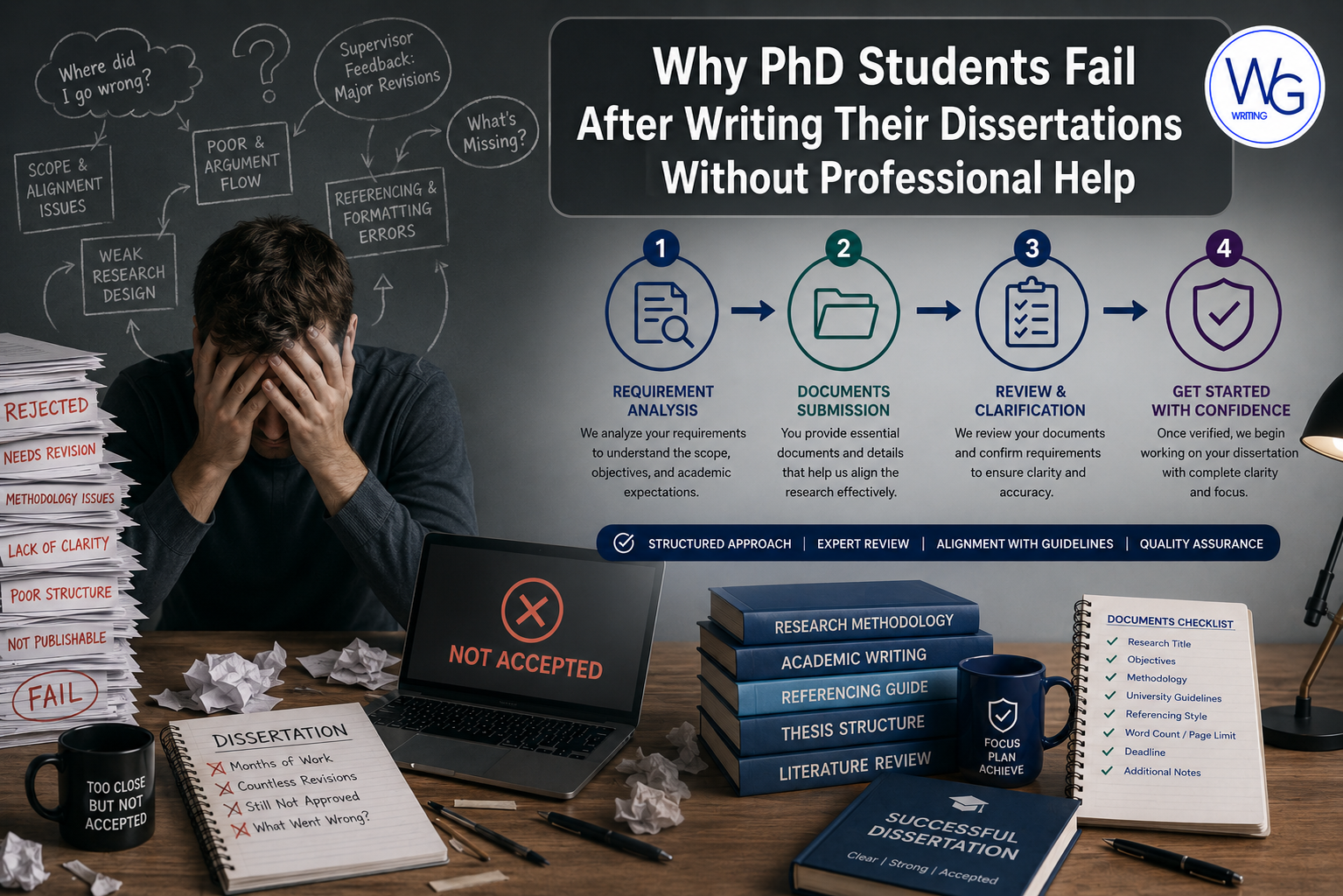
Discover why PhD students fail after writing their dissertations. Learn the most common dissertation rejection causes and how to avoid costly mistakes before submission.
The Hidden Risk of Completing a Dissertation Without Professional Help
Completing a PhD dissertation is a significant milestone, but submission alone does not determine the final outcome. The dissertation must still undergo review, meet committee expectations, and satisfy all university requirements before the doctoral journey is fully complete.
Many doctoral candidates spend years conducting research, analyzing data, and writing chapters, only to discover that the final evaluation process can present challenges they did not anticipate. A completed dissertation is still subject to detailed academic scrutiny, and even strong research can encounter problems if important issues remain unresolved before submission.
One of the biggest misconceptions among doctoral students is that finishing the writing process means the hardest part is over. In reality, submission marks the beginning of another critical stage. Supervisors, examiners, and university review committees evaluate not only the quality of the research itself but also the clarity of the argument, methodological consistency, academic presentation, originality, and compliance with institutional requirements.
This is one of the primary reasons why PhD students fail dissertation assessments despite investing significant time and effort into their research. The problem is often not a lack of intelligence or commitment. Most dissertation failures occur because of critical weaknesses in the research, analysis, argumentation, or presentation are not identified and addressed before the work reaches examiners.
In many cases, the risks emerge after the writing stage is complete. For example:
A dissertation may contain strong findings but present them in a way that lacks logical flow.
Research objectives and conclusions may not align as clearly as examiners expect.
Formatting, citation, or structural issues may create unnecessary concerns during evaluation.
Methodology sections may leave important questions unanswered.
Language and presentation problems may reduce the overall impact of otherwise valuable research.
These issues can have serious consequences. Depending on the university's assessment process, students may face:
Major revisions that add months to the completion timeline.
Requests for substantial restructuring of the dissertation.
Delayed graduation and additional academic expenses.
Resubmission requirements.
In severe cases, dissertation rejection or broader academic setbacks.
The reality is that completing a dissertation draft and submitting a dissertation are not the same thing. The difference often lies in the quality assurance process that takes place before submission. A thorough review can help identify weaknesses that students may overlook after spending months or years working on the same document.
At Writing Gram, we help PhD students strengthen their dissertations before submission through careful academic review, editing, proofreading, formatting, and quality checks. Our goal is to help students submit high-quality, plagiarism-free, non-AI dissertations that align closely with their university requirements and supervisor expectations. By addressing potential issues before submission, students can approach the evaluation process with greater confidence.
🚀 Place Your Order Now and Submit With Confidence
✅ High-quality dissertation support tailored to your requirements
✅ Plagiarism-free and original academic work
✅ Non-AI content written and reviewed by human academic experts
✅ Professional proofreading, editing, and formatting assistance
✅ Alignment with university guidelines and supervisor instructions
✅ Secure ordering process and confidential handling of your work
📚 Don't let avoidable mistakes put years of research at risk. Place your order today and receive professional dissertation support designed to help you submit your work at the highest possible standard.
Why Dissertation Submission Is Not the Final Step
Many doctoral candidates believe that completing their dissertation means the most difficult part of the PhD journey is over. However, writing the dissertation and successfully passing the examination process are two different stages. After submission, the dissertation undergoes a detailed academic evaluation that can determine whether the student graduates, completes revisions, or faces significant delays.
This distinction helps explain why some students encounter problems even after spending years conducting research and writing their dissertations. In many cases, the final outcome depends not only on the quality of the research but also on how effectively the work meets academic and institutional expectations.
Recent research highlights the scale of challenges in doctoral completion. A study published in PLOS ONE noted that doctoral attrition remains a significant issue in higher education, with previous research frequently reporting that approximately 40% to 50% of doctoral students do not complete their programs. The study emphasizes that doctoral success is influenced by multiple academic and institutional factors rather than research ability alone.
While not all non-completions result from dissertation rejection, the findings demonstrate an important reality: reaching the dissertation stage does not automatically guarantee successful completion. Students must still satisfy numerous academic requirements before their doctorate can be awarded.
What Happens After Dissertation Submission?
Once a dissertation is submitted, it typically enters a formal review process that may involve several academic stakeholders.
Supervisors
Review whether the dissertation meets departmental and university standards.
Assess whether revisions requested during the research process have been addressed.
Determine whether the work is ready for examination.
Examiners
Evaluate the originality and significance of the research.
Examine the quality of the methodology and analysis.
Assess whether conclusions are supported by evidence.
Identify weaknesses, inconsistencies, or areas requiring revision.
Graduate Committees or Examination Panels
Ensure compliance with institutional policies.
Review examination reports.
Approve final outcomes, revisions, or resubmission requirements.
Because multiple reviewers may examine the dissertation from different perspectives, issues that appeared minor during the writing process can become significant concerns during formal evaluation.
What Examiners Look For Beyond Research Quality
Strong research alone is not always enough. Examiners typically evaluate a dissertation as a complete academic document rather than focusing solely on its findings.
Important assessment areas often include:
Argument clarity – Whether the dissertation presents a clear and logical research narrative.
Methodological consistency – Whether research methods align with objectives and research questions.
Originality – Whether the study contributes meaningful knowledge to the field.
Academic presentation – Whether the writing is clear, professional, and appropriate for doctoral-level work.
Referencing accuracy – Whether sources are properly cited and documented.
Formatting compliance – Whether the dissertation follows university requirements.
Chapter integration – Whether each section supports the overall research argument.
A dissertation can contain valuable research findings, but still encounter problems if these areas are not adequately addressed.
Common Dissertation Submission Rejection Causes
Most causes of dissertation submission rejection are not related to a student's intelligence or effort. Instead, they often stem from issues that could have been identified before submission.
Examples include:
Inconsistent arguments across chapters.
Weak connections between research questions and conclusions.
Methodological limitations that are not sufficiently justified.
Formatting errors that violate university requirements.
Referencing mistakes and citation inconsistencies.
Insufficient evidence supporting key claims.
Originality concerns identified during plagiarism screening.
Failure to fully address supervisor feedback.
These issues can lead to major revisions, delayed graduation timelines, resubmission requirements, or, in rare cases, dissertation rejection.
Why Professional Review Can Reduce Risk
One challenge many doctoral students face is becoming deeply familiar with their own work. After spending months or years on a dissertation, it can become difficult to identify weaknesses, unclear sections, or structural inconsistencies.
An independent academic review provides a fresh perspective and can help identify:
Logical gaps in the research argument.
Areas requiring clarification or stronger evidence.
Formatting and citation issues.
Language and readability concerns.
Potential compliance problems with institutional requirements.
This does not replace the role of supervisors or examiners. Instead, it serves as an additional quality-control step that can help students identify potential issues before the dissertation reaches the formal evaluation stage.
For this reason, successful dissertation submission involves much more than completing the writing process. The final outcome often depends on how effectively the dissertation satisfies academic, institutional, and examination expectations after it has been submitted.
Major Causes of PhD Dissertation Failure After Writing
Completing a dissertation is a significant milestone, but completion alone does not guarantee a successful outcome. Most dissertation failure causes emerge during the evaluation stage when examiners assess the quality, consistency, and presentation of the research. Even well-researched dissertations can encounter problems if important weaknesses remain unresolved before submission.
The following are the main reasons why dissertations fail:
Weak Argument Structure and Logical Flow
One of the most common issues identified during dissertation examination is the absence of a clear and coherent research narrative. A doctoral dissertation is not simply a collection of chapters. Each chapter should contribute to a unified argument that guides readers from the research problem to the final conclusions.
Common problems include:
Chapters that appear disconnected from one another.
Research findings that do not clearly address the research questions.
Literature reviews that are not effectively linked to the methodology or results.
Conclusions that introduce ideas not supported by the evidence presented.
According to the writing experts at George Mason University Writing Center, coherence helps readers follow the main sections of a paper by connecting ideas, building details, and strengthening the overall argument.
For doctoral dissertations, this coherence becomes even more important because examiners evaluate the work as a complete research project rather than as individual chapters.
Methodological Inconsistencies
Methodology is often one of the most heavily scrutinized sections of a dissertation. Examiners expect the research design, data collection methods, analysis techniques, and research objectives to work together logically.
Potential issues include:
Research methods that do not adequately answer the research questions.
Data analysis procedures that are poorly explained.
Inconsistencies between the methodology and the findings.
Insufficient justification for selecting specific research approaches.
Conclusions that extend beyond what the data supports.
When methodological choices are unclear or unsupported, examiners may question the reliability and validity of the research, even when the study addresses an important topic.
Language, Clarity, and Academic Tone Issues
Strong research can lose impact if it is presented in unclear or unprofessional language. Examiners must be able to understand the research argument without unnecessary confusion or ambiguity.
Common language-related issues include:
Overly informal writing.
Vague explanations and unsupported claims.
Grammar and sentence structure problems.
Excessively complex wording that reduces readability.
Inconsistent terminology throughout the dissertation.
For international and multilingual doctoral students, language challenges can sometimes make it difficult to communicate complex ideas effectively. While minor language issues rarely determine the outcome of a dissertation on their own, widespread clarity problems can affect how examiners interpret the quality of the research.
Lack of Proper Referencing and Academic Integrity Issues
Referencing errors remain one of the most preventable dissertation failure causes. Universities expect doctoral students to demonstrate careful engagement with existing research while properly acknowledging all sources used.
Problems often arise when students:
Omit citations for paraphrased material.
Use inconsistent referencing styles.
Include incomplete reference lists.
Rely heavily on a limited number of sources.
Fail to clearly distinguish their original contributions from existing research.
Even when plagiarism is unintentional, citation errors can create concerns about academic integrity. Because doctoral research is expected to contribute original knowledge, accurate referencing plays an important role in demonstrating credibility and scholarly responsibility.
Failure to Follow University Guidelines
Universities establish detailed dissertation requirements for a reason. These guidelines help ensure consistency, academic quality, and compliance with institutional standards.
Common submission issues include:
Incorrect formatting and page layout.
Improper heading structures.
Citation style violations.
Missing required sections.
Failure to follow dissertation submission instructions.
Non-compliance with department-specific requirements.
Many students focus heavily on the research itself while overlooking technical requirements. However, failure to comply with university guidelines can create unnecessary delays, revision requests, and administrative complications during the examination process.
When examining PhD thesis rejection reasons, it is often not a single major flaw that creates problems. Instead, multiple smaller weaknesses across structure, methodology, writing quality, referencing, and compliance can combine to reduce the overall quality of the dissertation and increase the likelihood of revision or rejection concerns.
Why Students Who Skip Professional Help Are More at Risk
One of the most overlooked factors in dissertation outcomes is the absence of an external, critical review before submission. Many PhD students work in isolation for months or even years, refining their research independently. While this independence is part of doctoral training, it can also create blind spots that affect how the dissertation is ultimately evaluated.
At the submission stage, these blind spots become more significant because examiners approach the work with a highly analytical and objective lens. Without an external review process, students may unknowingly submit work that contains issues they can no longer see clearly.
The following are common issues that occur when doctoral students fail to seek professional dissertation help:
i. Lack of Expert Review Before Submission
When students do not seek professional or external feedback, they often miss opportunities to strengthen their dissertation before it reaches examiners. A fresh, experienced perspective can identify weaknesses that are not obvious to the author.
Key risks include:
Overlooking unclear sections that appear understandable to the writer but not to the reader.
Missing inconsistencies between chapters or arguments.
Failing to refine complex ideas into clear academic language.
Submitting work that has not been tested against strict academic evaluation standards.
As emphasized by the Harvard University Library Research Guides, revision is a critical part of academic writing because it allows writers to refine ideas, improve clarity, and strengthen argument structure through feedback and re-evaluation.
This principle is especially important in doctoral research, where even minor gaps in clarity or reasoning can influence an examiner's judgment.
ii. Inability to Identify Structural or Methodological Weaknesses
Without external input, students may struggle to recognize deeper structural issues within their dissertations. These weaknesses are often not visible during the writing process because the author is too familiar with the content.
Common hidden issues include:
Weak alignment between research questions and conclusions.
Sections that do not contribute meaningfully to the central argument.
Overly complex or underdeveloped methodological explanations.
Gaps in logical progression between chapters.
Professional review helps expose these issues early, giving students the chance to correct them before submission becomes final.
iii. Overconfidence After Completing Writing
After completing a dissertation, many students naturally feel a sense of completion and relief. However, this stage can also lead to overconfidence, where the assumption is that the work is already “finished” and ready for evaluation.
This mindset can result in:
Skipping final in-depth revisions.
Underestimating the level of scrutiny applied by examiners.
Relying only on self-review instead of independent evaluation.
Assuming that supervisor feedback alone is sufficient for final quality assurance.
In reality, dissertations often require multiple rounds of refinement before they meet examination expectations.
iv. No External Academic Validation Before Examination Stage
A key advantage of professional review is external validation. This means the dissertation is assessed from a perspective that closely mirrors how examiners will evaluate it.
Without this step, students risk:
Submitting work that has only been reviewed from a single perspective.
Missing critical feedback that could improve clarity and coherence.
Facing unexpected concerns during the examination process.
Increasing the likelihood of revisions or delayed approval.
External validation acts as a bridge between writing and examination, helping ensure the dissertation is aligned with academic expectations before submission.
Impact on Dissertation Outcomes
Failing to seek external support does not guarantee poor results, but it significantly increases the likelihood of overlooking issues that could have been addressed early.
Many PhD thesis rejection reasons and dissertation failure causes are linked not only to the research quality but also to the presentation, structure, and alignment with academic standards.
When these issues are not identified early, they are often only detected during the examination stage, when making corrections becomes more difficult and time-consuming.
Reducing Risk Through Structured Support
Working with experienced academic support services helps address these challenges by providing structured review and refinement. This includes:
Objective assessment of argument clarity and structure.
Identification of gaps in logic or methodology.
Improvement of academic tone and readability.
Checking alignment with institutional expectations.
Ensuring the dissertation is coherent from the introduction to the conclusion.
By incorporating an external review process before submission, students significantly reduce the risk of avoidable revision cycles and improve the overall presentation of their research.
Fix Critical Dissertation Issues Early with Expert Dissertation Help Before They Reach the Examination Stage
Avoid unnecessary setbacks caused by missed errors or a lack of external review.
At Writing Gram, we offer professional dissertation support designed to strengthen clarity, coherence, formatting, and academic presentation while ensuring originality and plagiarism-free work tailored to university requirements.
📘 Get expert dissertation support today and submit with greater confidence
🚀 Improve structure, clarity, and academic alignment before submission
🛡️ Reduce avoidable revision risks with professional review
👉 Place your order now and get the support your dissertation deserves.
Common Mistakes After Completing a Dissertation
Even after a dissertation is fully written, many PhD candidates encounter difficulties during the submission stage because of avoidable post-writing mistakes. These errors often occur not because of weak research, but because the final refinement stage is rushed or overlooked. At this point, small issues can significantly influence how examiners evaluate the work. These issues are:
Submitting Too Quickly Without Revision Cycles
One of the most frequent mistakes is submitting the dissertation immediately after finishing the final draft. After months or years of writing, it is natural to feel ready to submit. However, skipping structured revision cycles often means unresolved issues remain in the document.
Common consequences include:
Unrefined arguments that lack clarity or depth
Inconsistent flow between chapters
Overlooked gaps in explanation or evidence
Weak transitions that disrupt the research narrative
Academic writing at the doctoral level requires multiple rounds of revision to ensure clarity, coherence, and completeness. Without this process, even strong research can appear underdeveloped.
Ignoring Supervisor Feedback or Misinterpreting It
Supervisor feedback is one of the most valuable resources available during the dissertation process, yet it is often underutilized in the final stages. Some students either delay incorporating feedback or misinterpret its purpose.
Typical issues include:
Addressing feedback partially instead of fully integrating suggestions
Focusing on minor edits while ignoring major structural concerns
Assuming earlier approval means no further changes are needed
Overlooking recurring feedback themes across multiple drafts
As highlighted by the Perspectives on Medical Education journal, effective revision involves actively engaging with feedback and using it to reshape ideas, not just correct surface-level errors.
This principle is especially important in dissertations, where feedback often points to deeper issues in argument structure or research framing.
Failing to Proofread at a Professional Level
Proofreading is more than correcting grammar and spelling mistakes. At the dissertation level, it involves reviewing clarity, consistency, and academic tone across the entire document.
Common proofreading issues include:
Inconsistent terminology across chapters
Repeated grammatical or sentence structure errors
Ambiguous phrasing that weakens arguments
Formatting inconsistencies that affect readability
Overlooked typographical errors in tables, figures, or references
Even minor language issues can influence how examiners perceive the professionalism and reliability of the research.
Not Running Plagiarism and Consistency Checks
Originality is a core requirement of doctoral research, and universities use advanced tools to assess academic integrity. However, students sometimes assume that writing in their own words automatically guarantees originality.
Potential risks include:
Unintentional similarity with existing academic work
Improper paraphrasing of source material
Inconsistent citation practices across chapters
Missing references for adapted ideas or frameworks
The University of California, Berkeley Graduate Division emphasizes the importance of maintaining academic integrity through careful citation practices and originality checks as part of the final submission process.
Failing to conduct thorough plagiarism and consistency reviews before submission can lead to unnecessary revisions or delays in the examination process.
Assuming Content Quality Alone Guarantees Approval
A common misconception among doctoral candidates is that strong research content alone is sufficient for approval and getting good grades. While content quality is essential, examiners also evaluate structure, presentation, compliance, and academic alignment.
This assumption can lead to:
Overlooking formatting and structural requirements
Underestimating the importance of clarity and coherence
Ignoring institutional submission guidelines
Failing to refine the dissertation as a complete academic document
In reality, dissertation evaluation is holistic. Examiners evaluate the dissertation as an integrated whole, assessing how all components, including the abstract, work together in alignment with the assessment rubric rather than reviewing research findings only.
The Role of Professional Dissertation Support (Quality Assurance Perspective)
Professional dissertation support plays an important role in strengthening a doctoral thesis before submission by focusing on quality assurance rather than replacing the student’s research effort. At the PhD level, even well-developed studies can contain subtle issues that are difficult for the author to identify after prolonged engagement with the material. External academic support helps ensure the dissertation is presented in its most coherent, structured, and academically aligned form.
The role of professional dissertation writing services includes:
Objective Review To Improve Structure and Clarity
One of the most valuable contributions of professional support is providing an objective review of the entire dissertation. Unlike the author, who may be closely attached to the content, an external reviewer evaluates the work from a reader’s perspective.
This helps to:
Identify unclear or overly complex sections
Improve logical flow between chapters
Strengthen transitions between ideas
Refine explanations for better readability
This objective distance often reveals structural issues that are not obvious during self-review.
Helps Align Research With Academic Expectations
Every university and department has specific expectations regarding how research should be presented and evaluated. These expectations extend beyond the content itself and include how arguments are structured, how evidence is presented, and how conclusions are justified.
Professional support helps ensure:
The research aligns with doctoral-level expectations
Arguments are presented in a clear academic format
Methodology and findings remain consistent with research objectives
The dissertation maintains a formal academic tone throughout
This alignment reduces the risk of misinterpretation during examination and helps the work meet institutional standards more effectively.
Ensures Formatting, Referencing, and Coherence Accuracy
Formatting and referencing are often underestimated, yet they play a significant role in how a dissertation is received. Even strong research can appear unpolished if presentation standards are inconsistent.
Quality assurance support focuses on:
Correct application of citation styles throughout the document
Consistency in headings, spacing, and layout
Proper alignment of tables, figures, and appendices
Accuracy in reference lists and in-text citations
Maintaining consistent academic formatting across all chapters
Coherence checks also ensure that each section contributes meaningfully to the overall argument rather than functioning as isolated parts.
Identifies Hidden Weaknesses Students Miss
After extensive time spent developing a dissertation, students often become too familiar with their own work to notice certain weaknesses. These issues are usually subtle but can influence examiner perception.
Professional review helps detect:
Gaps in logical reasoning that disrupt argument strength
Sections where evidence does not fully support claims
Repetition or redundancy across chapters
Areas where the explanation depth is insufficient
Inconsistencies in terminology or in the conceptual and theoretical frameworks.
These hidden issues are often only visible when the dissertation is reviewed with a fresh and critical perspective.
Quality Assurance as Support, Not Replacement of Academic Work
It is important to understand that professional dissertation support does not replace the student’s original research or intellectual contribution. Instead, it acts as a quality assurance service that helps refine and polish the work before submission.
The role of this support includes:
Enhancing clarity without altering research intent
Improving presentation without changing core findings
Strengthening academic expression while preserving originality
Supporting alignment with academic expectations and standards
In this way, professional support acts as a final safeguard, helping ensure the dissertation reflects the full value of the student’s research effort in a clear, structured, and academically appropriate form.
Real Impact of Dissertation Rejection
Dissertation rejection or major revision requirements can have far-reaching consequences that extend beyond the academic document itself. While the focus is often on the written work, the real impact is experienced in time, finances, emotional well-being, and academic progress. Understanding these outcomes helps explain why dissertation quality and preparation before submission are so critical.
Dissertation rejection and major revisions cause:
Delayed Graduation Timelines
The most common effect of dissertation rejection or major revisions is a delay in graduation. PhD programs are structured around specific submission and examination timelines, and any disruption can extend the completion period significantly.
This delay may involve:
Additional months spent revising the dissertation
Waiting for the next examination cycle or review window
Re-submission and re-evaluation processes
Postponed graduation ceremonies and degree confirmation
For many candidates, this delay also affects future academic or professional plans that depend on timely completion.
Financial and Emotional Stress
Extended dissertation timelines often lead to increased financial pressure and emotional strain. Many PhD students are balancing research with limited funding, employment, or personal commitments, and delays can intensify these challenges.
Common impacts include:
Continued tuition or administrative fees in some programs
Loss of expected income opportunities after graduation
Increased living costs during extended study periods
Stress and frustration linked to prolonged academic uncertainty
Emotionally, the experience can also lead to fatigue and reduced motivation, especially after years of sustained academic effort.
Loss of Academic Confidence
Another significant consequence of dissertation rejection is the effect it can have on a student’s academic confidence. After investing substantial time and effort into research, receiving critical feedback or revision requirements can feel discouraging.
This may result in:
Doubt about research ability or academic competence
Reduced confidence in future academic writing tasks
Hesitation to pursue further research or publications
Increased anxiety during revision or resubmission phases
While revision is a normal part of doctoral assessment, the psychological impact can still be significant if expectations were not fully met.
Potential Need for Full Rework or Resubmission
In more serious cases, dissertation evaluation outcomes may require extensive revisions or complete resubmission. This typically occurs when fundamental issues are identified in structure, methodology, or academic alignment.
Possible scenarios include:
Major restructuring of chapters or research framework
Re-analysis of data or revision of methodology
Significant rewriting of sections to improve clarity and coherence
Full resubmission for re-evaluation by examiners
These requirements can substantially extend the overall PhD journey and increase the workload significantly.
PhD Academic Failure Dissertation Reasons
In rare but serious cases, unresolved issues can contribute to significant negative outcomes in overall academic performance. These cases are usually not caused by a single problem but by a combination of weaknesses that affect the overall quality of the dissertation.
Common PhD academic failure dissertation reasons include:
Persistent lack of coherence across chapters
Weak alignment between research questions and conclusions
Methodological flaws that undermine research validity
Failure to meet institutional submission requirements
Inadequate revision despite prior feedback
While many students successfully revise and recover from initial setbacks, these risks highlight the importance of thorough preparation before submission and careful attention to doctoral standards throughout the dissertation process.
How to Reduce the Risk of Dissertation Failure
Reducing the risk of dissertation failure requires a deliberate and structured approach to the final stages of academic writing. While strong research is essential, the way a dissertation is refined, reviewed, and prepared for submission often determines how it is received during examination. Each stage of the final review process helps ensure the work meets academic expectations in clarity, structure, and compliance.
You can use the following strategies to reduce the chances of your dissertation failing or being rejected:
i. Multiple Revision Cycles Before Submission
One of the most effective ways to improve dissertation quality is through repeated revision cycles. A single read-through is rarely enough to identify deeper issues in argument flow or structure.
Effective revision cycles typically involve:
Reviewing one chapter at a time for clarity and coherence
Checking whether each section supports the central research question
Refining transitions between ideas and arguments
Ensuring consistency in tone, terminology, and structure
Each revision cycle strengthens the dissertation incrementally, helping transform a draft into a polished academic document.
ii. Independent Proofreading and Structural Review
Independent proofreading goes beyond correcting grammar and spelling. It focuses on how clearly the dissertation communicates ideas and whether the structure supports the overall argument.
Key areas of focus include:
Sentence clarity and readability
Logical flow between paragraphs and sections
Consistency in academic tone
Formatting and presentation accuracy
Elimination of repetitive or unclear phrasing
A structural review is equally important, as it ensures that chapters are logically connected and contribute to a unified research narrative rather than functioning in isolation.
iii Supervisor Engagement and Feedback Integration
Supervisor feedback is one of the most valuable resources in the dissertation process, but its effectiveness depends on how well it is applied. Regular engagement helps ensure the research remains aligned with academic expectations.
Best practices include:
Actively reviewing and responding to all feedback points
Asking clarification questions when guidance is unclear
Revising both content and structure based on suggestions
Tracking recurring feedback themes across drafts
Consistent engagement with supervisors helps prevent misalignment between student expectations and examiner standards.
iv. Pre-Submission Academic Evaluation
A pre-submission evaluation provides a final opportunity to assess the dissertation from an academic perspective before it enters formal review. This step helps identify issues that may not be visible to the author due to familiarity with the content.
A strong evaluation process typically checks:
Alignment between research questions and conclusions
Strength of argument development across chapters
Methodological consistency and justification
Clarity of analysis and interpretation of findings
Compliance with academic and institutional standards
This stage acts as a final safeguard before submission, ensuring the dissertation is fully prepared for examination.
v Use of Professional Dissertation Help and Review Services as a Safeguard
Professional dissertation writing and review services can provide an additional layer of quality assurance by offering an objective assessment of the dissertation. Unlike self-review, this process is based on external academic standards and reader perspective evaluation.
Such services typically help with:
Identifying structural gaps and inconsistencies
Improving clarity and academic expression
Checking formatting and referencing accuracy
Enhancing overall coherence and readability
Ensuring the dissertation is submission-ready
When used appropriately, this form of support acts as a safeguard that complements the student’s own work, helping reduce avoidable errors and strengthen the final presentation of the research.
Why Post-Writing Quality Determines Dissertation Success
Writing a PhD dissertation is a major academic achievement, but it is only one part of the overall evaluation process. What ultimately determines success is not just the research itself, but how effectively the final document is refined, structured, and aligned with academic expectations before submission. At the doctoral level, even strong research can face challenges if the final presentation does not meet examiner standards.
Writing Is Only One Stage of the Process
Many students assume that once the dissertation is written, the most difficult part is complete. In reality, writing is only the foundation. The final outcome depends heavily on how well the dissertation is prepared for academic evaluation.
Key aspects that go beyond writing include:
Structural consistency across all chapters
Clear alignment between research questions and conclusions
Logical flow of arguments and evidence
Academic tone and clarity of expression
Compliance with institutional formatting and submission requirements
A dissertation is assessed as a complete academic product, not just a written document.
Final Assessment Depends On How Well The Work Has Been Refined And Aligned With The Required Criteria.
Examiners evaluate dissertations based on how well all components work together. This means that even strong research findings can be questioned if the presentation lacks coherence or alignment.
Final judgment often focuses on:
Whether the argument develops logically from the introduction to the conclusion
Whether the methodology supports the research objectives
Whether the evidence is clearly connected to claims
Whether the dissertation meets the academic standards of clarity and precision
This is why refinement after writing plays a critical role in shaping the final evaluation outcome. Small inconsistencies or unclear sections can influence how the entire work is interpreted.
Avoiding Preventable Academic Setbacks After Years of Work
After years of research and writing, avoidable errors in the final stage can have a disproportionate impact. Many dissertation challenges do not come from the research itself, but from issues that remain unresolved before submission.
These often include:
Overlooking structural weaknesses due to familiarity with the work
Missing inconsistencies in argument development
Submitting without sufficient revision cycles
Underestimating the level of examiner scrutiny
Failing to fully align with academic expectations
Because of this, the final stage of dissertation preparation is not just about completion, but about ensuring the work is fully ready for formal academic evaluation.
Summary of Post-Writing Risks
These common mistakes demonstrate that dissertation success depends not only on writing but also on careful refinement before submission. Small oversights at this stage can significantly affect evaluation outcomes, even when the underlying research is strong.
🎓 Transform Your Dissertation into a Fully Polished Academic Document Ready for Final Assessment with Expert Dissertation Help Services
Strong research deserves to be presented in a way that fully reflects its value. Writing Gram supports PhD students by refining structure, improving clarity, and ensuring dissertations meet university and supervisor expectations without compromising originality or academic integrity.
We focus on delivering:
High-quality academic refinement and editing
Plagiarism-free and non-AI-assisted academic writing support
Alignment with institutional and supervisor requirements
Clear, structured, and submission-ready dissertations
📌 Ensure your hard work is presented at the highest academic standard
📚 Strengthen clarity, coherence, and formatting before submission
🛡️ Reduce avoidable risks in the final evaluation stage
👉 Place your order now and get expert dissertation support designed to help you submit with confidence and a clear, well-structured academic argument.