How to Synthesize Research Sources Instead of Summarizing Them (Dissertation Guide)
By Writing Gram • Jun 4, 2026
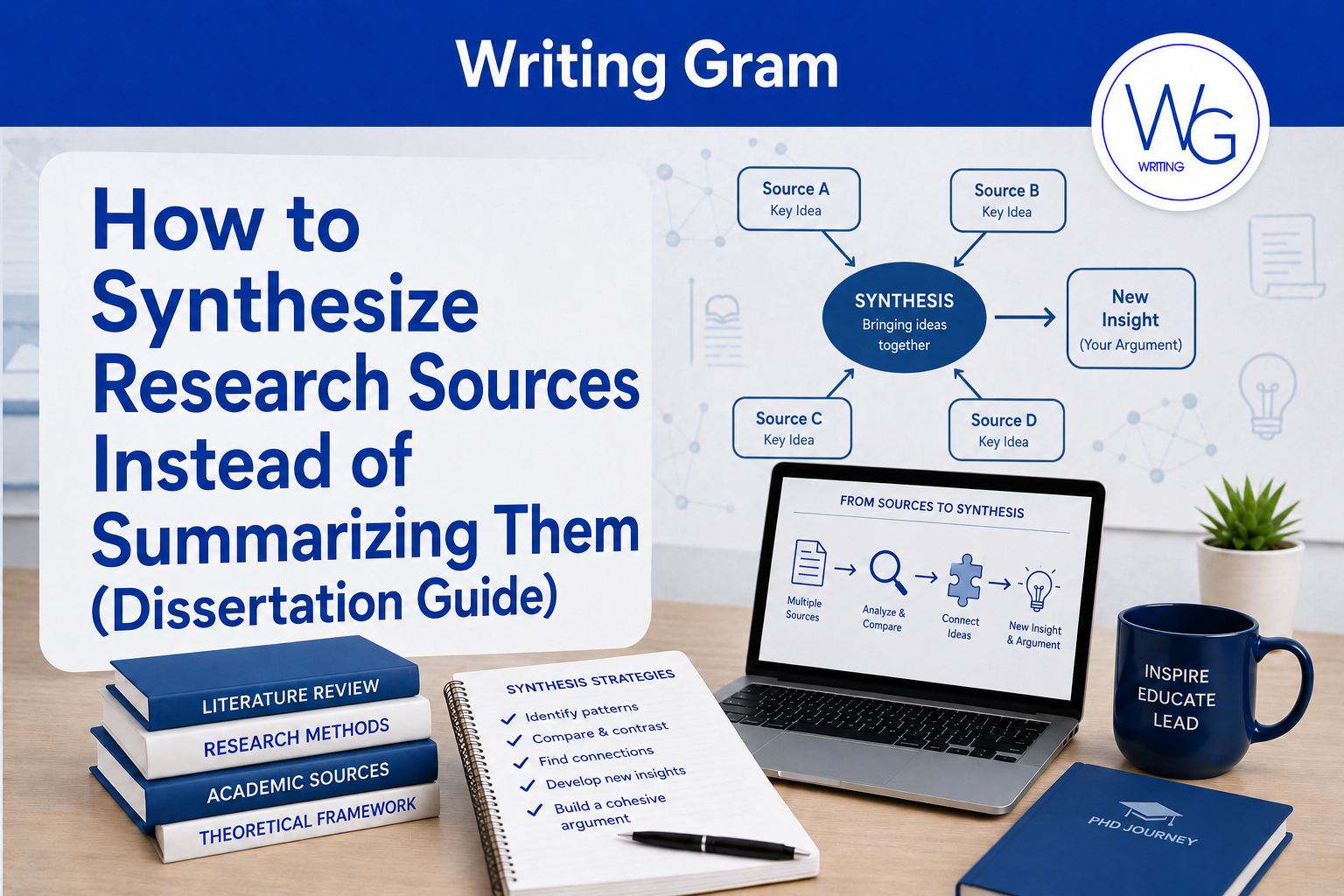
Master how to synthesize dissertation sources instead of simply summarizing studies. Learn clear techniques for literature synthesis, source integration, and critical analysis, with expert doctoral dissertation help to improve structure, strengthen your literature review, and enhance overall academic quality.
Many dissertation students believe they are engaging in critical analysis when, in reality, they are simply summarising individual studies in sequence without evaluating, comparing, or connecting the evidence to build a stronger argument. This is one of the most common weaknesses examiners identify in literature reviews. While summaries demonstrate that you have read the research, they do not show how different sources connect, support, challenge, or build upon one another. As a result, a literature review can become a collection of disconnected study descriptions rather than a coherent academic discussion.
Effective research synthesis dissertation writing requires more than reporting what previous authors have said. It involves bringing multiple sources together to identify patterns, trends, areas of agreement, conflicting findings, and gaps in existing knowledge. Instead of treating each study as a separate piece of information, synthesis examines how the evidence collectively contributes to understanding a research topic.
This distinction is particularly important because dissertation examiners are not simply evaluating whether you have read relevant literature. They are assessing your ability to analyze research, develop informed arguments, and demonstrate a clear understanding of the scholarly conversation surrounding your topic. A literature review that relies heavily on summarizing the sources often appears descriptive and lacks analytical depth. In contrast, a synthesized literature review shows that you can evaluate evidence, compare perspectives, and draw meaningful conclusions from the existing body of research.
Understanding how to synthesize literature review sources is, therefore, a critical academic skill. Rather than organizing your writing around individual authors or studies, synthesis encourages you to organize information around themes, concepts, debates, methodologies, or findings. This approach creates stronger connections between sources and helps readers follow a logical argument throughout the chapter.
For example, a summary-focused paragraph might discuss three studies separately and describe each author's findings in sequence. A synthesized paragraph, however, would compare those studies, highlight where their findings align or differ, and explain the significance of those relationships for the research topic. This analytical approach strengthens the quality of the literature review and helps establish the foundation for the dissertation's overall argument.
This article explains the difference between summarizing and synthesizing research, outlines practical techniques for integrating multiple sources effectively, and provides examples that demonstrate what strong synthesis looks like in academic writing. By applying these strategies, you can create a literature review that contributes to a stronger, more persuasive dissertation.
Need Help Synthesizing Sources in Your Dissertation?
Producing a well-synthesised literature review requires far more than collecting journal articles and summarising their findings. It involves critically evaluating the evidence, identifying patterns and themes across studies, comparing different perspectives, and demonstrating how the existing research relates to your own research question.
If you need expert support, Writing Gram can help you develop a clear, coherent, and well-structured literature review that strengthens your dissertation and meets academic expectations.
Our doctoral dissertation writing services are designed to help students develop stronger literature reviews, integrate sources effectively, identify key themes in the research, and present well-supported academic arguments that meet university expectations. We provide:
✅ Professionally structured literature reviews
✅ Strong source integration and synthesis
✅ Clear thematic organization
✅ Improved critical analysis and argument development
✅ Expert dissertation writing support across disciplines
Place your order now and let Writing Gram help you create a dissertation that demonstrates meaningful research synthesis, stronger academic analysis, and a more compelling scholarly argument.
What It Really Means to Synthesize Research Sources
Many dissertation students assume that reviewing the literature simply involves describing what individual authors found. While this demonstrates an understanding of the existing research, it does little to show how the studies connect, where they agree or disagree, and what they collectively reveal about the topic. This is why synthesis is such a critical component of an effective literature review.
In their article published in BMC Medical Research Methodology, Barnett-Page and Thomas explain that synthesis involves bringing together evidence, ideas, findings, and perspectives from multiple sources to develop a more comprehensive understanding of a research topic.
Rather than treating each source as a separate piece of information, synthesis examines the relationships between sources and uses those connections to develop an argument, identify patterns, highlight disagreements, and reveal gaps in existing knowledge. Research on knowledge synthesis emphasizes that effective synthesis involves integrating findings from multiple studies to generate broader insights that extend beyond individual sources.
At its core, source synthesis academic writing focuses on making connections. Instead of asking, "What did this author say?" synthesis asks, "How does this source relate to other research on the topic?" This shift in perspective transforms a literature review from a collection of summaries into a critical discussion that contributes to scholarly understanding.
Summarizing vs. Synthesizing: Understanding the Difference in Dissertations
Although the terms are often used interchangeably, summarizing and synthesizing serve different purposes in academic writing.
Summarizing involves condensing the main points of a single source. The goal is to explain the author's findings, arguments, or conclusions accurately and concisely. Summary is useful because it demonstrates comprehension of the literature.
Synthesizing, however, goes a step further. It compares and combines information from multiple sources to identify themes, trends, contradictions, and relationships. The goal is not simply to report information but to analyze how different pieces of evidence fit together.
Consider the difference:
Summary Example
Smith (2022) found that remote learning improved student flexibility. Johnson (2023) reported that online education increased access to learning resources. Brown (2021) concluded that digital platforms supported independent learning.
This paragraph summarizes three studies individually, but it does not explain how the findings relate to one another.
Synthesis Example
Research on remote learning suggests that digital education environments provide several interconnected benefits for students. Studies have consistently found improvements in flexibility, access to educational resources, and opportunities for independent learning (Smith, 2022; Johnson, 2023; Brown, 2021). Together, these findings indicate that online learning may support greater learner autonomy while expanding educational accessibility.
The second example synthesizes evidence from multiple studies to develop a broader conclusion. Rather than discussing each study separately, it integrates their findings into a unified argument.
This distinction is particularly important in dissertation writing because examiners are typically looking for evidence of critical thinking and analytical engagement with the literature. A synthesized literature review demonstrates that you understand not only what researchers have discovered but also how their findings contribute to the larger academic conversation. By identifying relationships between studies instead of merely reporting them, you create a stronger foundation for your own research and establish a more persuasive scholarly argument.
Why Synthesis Matters in a Dissertation Literature Review
Synthesis is one of the most important skills required in dissertation writing because it demonstrates that a researcher can move beyond description and engage critically with existing knowledge. While summarizing studies shows that you have read the literature, synthesis shows that you understand how individual pieces of research connect to broader academic debates and contribute to the development of knowledge within your field.
A dissertation literature review is not intended to be a collection of article summaries. Instead, it should provide a structured analysis of what researchers have discovered, where they agree or disagree, and what questions remain unanswered. This is why synthesis is often considered a defining characteristic of high-quality postgraduate writing.
According to Hong, Pluye, Bujold, and Wassef (2017) in the peer-reviewed journal Systematic Reviews, effective literature reviews go beyond reporting the findings of individual studies by integrating evidence from multiple sources to develop broader insights and a more comprehensive understanding of the research topic. This principle is equally important in dissertation writing, where examiners expect students to analyze relationships between studies rather than merely describe their findings
Synthesis Demonstrates Critical Thinking
One of the primary reasons synthesis matters is that it provides evidence of critical thinking. Examiners want to see that you can evaluate research rather than merely report it.
When synthesizing sources, you are expected to:
Compare findings across multiple studies.
Evaluate the strengths and limitations of existing research.
Identify conflicting viewpoints.
Assess the quality and relevance of evidence.
Explain how findings contribute to the overall understanding of a topic.
These activities demonstrate analytical engagement with the literature and help establish your credibility as a researcher.
Synthesis Helps Identify Research Gaps
Every dissertation aims to contribute something meaningful to existing knowledge. To justify your research, you must first demonstrate that a gap exists within the literature.
Synthesis makes this possible because it allows you to examine multiple studies collectively rather than individually. By comparing findings, methodologies, populations, and theoretical perspectives, you can identify:
Areas that have received limited attention.
Contradictory findings that require further investigation.
Underrepresented populations or contexts.
Emerging issues that previous studies have not fully explored.
Without synthesis, these gaps often remain hidden because the literature is presented as a series of disconnected summaries.
Synthesis Strengthens the Argument Structure of a Literature Review
A common weakness in dissertation literature reviews is the tendency to organize content around individual authors or studies. This approach often produces a descriptive chapter that lacks a clear direction.
Synthesis helps solve this problem by encouraging researchers to organize information around themes, concepts, debates, or trends. Instead of discussing one article at a time, you develop sections that examine how multiple sources contribute to a particular issue.
This approach creates a stronger academic argument because:
Evidence is grouped logically.
Relationships between studies become clearer.
Key themes emerge more naturally.
Readers can follow the progression of ideas more easily.
As a result, the literature review becomes a coherent discussion rather than a list of research findings.
Synthesis Improves the Overall Coherence of the Chapter
A well-synthesized literature review creates clear connections between studies and helps readers understand how different pieces of evidence fit together. This improves the overall flow of the chapter and makes your argument more persuasive.
Rather than moving abruptly from one study to another, synthesis enables you to build logical transitions between ideas. Readers can see how evidence accumulates, where disagreements exist, and why your research is needed.
In the following sections, several literature synthesis examples will demonstrate how effective source integration can transform a literature review from a descriptive summary into a critical and doctoral-level discussion.
Thus, synthesis is not simply a writing technique. It is a research skill that enables you to evaluate evidence, identify knowledge gaps, construct persuasive arguments, and produce a dissertation literature review that meets examiner expectations and reflects a strong understanding of the existing research.
The Key Difference Between Summarizing and Synthesizing Research
Understanding the difference between summarizing and synthesizing research is essential for producing a strong dissertation literature review. While both approaches involve working with academic sources, they serve very different purposes and lead to very different levels of analytical depth. Examiners consistently look for synthesis because it demonstrates critical thinking, not just comprehension of readings.
Summarizing Research Sources
Summarizing focuses on presenting the main findings of a single study in a clear and concise way. Each source is treated independently, without comparison or connection to other studies.
Key characteristics of summarizing include:
One study is discussed at a time
Ideas are presented in a linear and descriptive structure
No comparison between different authors or findings
Focus is on what each study says, not how it relates to others
For example, a summary approach might describe one researcher’s findings on student performance, then move to another study on the same topic without linking the two.
While summarizing is useful for demonstrating understanding of individual sources, it does not show how knowledge develops across the field. This is why dissertations that rely heavily on summaries often appear descriptive rather than analytical.
Synthesizing Research Sources
Synthesizing research goes beyond description by combining findings from multiple studies to develop broader insights, patterns, and arguments. Instead of treating studies separately, synthesis organizes literature around themes, ideas, or debates.
Key characteristics of synthesizing include:
Grouping ideas across multiple studies rather than discussing them individually
Identifying agreements, contradictions, and patterns in the literature
Building thematic arguments supported by multiple sources
Explaining relationships between findings and their significance
According to Li, Mathrani, and Susnjak (2025) in the peer-reviewed journal PLOS ONE, advances in evidence synthesis research show that modern systematic reviews should go beyond simple data collection and instead focus on the structured integration of findings across studies to support deeper interpretation and more reliable methodologies, as demonstrated in their study on automated meta-analysis and synthesis frameworks.
Synthesis is, therefore, what transforms a literature review into a credible academic argument. Instead of listing what each study found, the writer explains how the studies collectively contribute to understanding the topic.
Summary vs Synthesis (Practical Illustration)
To clearly distinguish the two approaches, consider the same topic presented in both styles:
Summary approach:
Study A finds that online learning improves flexibility. Study B reports increased student engagement in virtual classrooms. Study C identifies challenges with digital access.Synthesis approach:
Research on online learning presents mixed but connected outcomes. While studies consistently highlight improvements in flexibility and engagement (Study A; Study B), they also reveal persistent challenges related to digital access and inequality (Study C). Together, these findings suggest that the effectiveness of online learning depends on both pedagogical design and access to technology.
The second version demonstrates synthesis because it connects findings, highlights relationships, and builds an interpretive argument rather than listing results independently.
This distinction is central to how to synthesize literature review writing, especially at the dissertation level, where analytical depth is a key marker of academic quality.
Step-by-Step Method to Synthesize Journal Articles in a Dissertation
A strong dissertation literature review depends on your ability to move beyond describing individual studies and instead build a connected, thematic understanding of the research. This is where many students struggle with synthesizing journal articles in dissertation writing, often because they are trained to summarize sources rather than integrate them. The following step-by-step method provides a practical approach to developing a more analytical literature review that meets assessment expectations.
Step 1 – Identify Themes Instead of Studies
The first step in synthesis is shifting your focus from individual authors to broader ideas. Rather than organizing your literature review around “what each study says,” you group research based on recurring themes, concepts, or problems.
To do this effectively:
Scan multiple studies and note recurring ideas
Look for patterns in findings across different authors
Group similar arguments under shared thematic headings
Avoid structuring sections around single studies
For example, instead of creating a paragraph for each article on online learning, you might develop themes such as student engagement, accessibility, and learning outcomes. This immediately shifts your writing from descriptive reporting to analytical organization.
Step 2 – Compare Findings Across Sources
Once themes are identified, the next step is to actively compare how different studies contribute to each theme. This is the core of synthesis because it shows relationships between sources rather than isolated insights.
Focus on:
Where studies agree or reinforce each other
Where findings differ or contradict
Differences in methodology or context that explain variations
Strengths and limitations across the evidence base
At this stage, your writing shifts from simply reporting findings to demonstrating critical thinking by organising and interpreting the literature to show how ideas, findings, and perspectives in the field connect and relate to one another.
Step 3 – Build a Thematic Argument
After comparing sources, the next step is to turn your themes into an argument. Each paragraph should function like a mini-argument supported by multiple studies, rather than a collection of individual summaries.
To strengthen this stage:
Write topic sentences that state the main idea of the paragraph
Support each idea with multiple academic sources
Explain what the combined evidence suggests overall
Highlight implications or gaps in the literature
This is where synthesis becomes most visible. Instead of focusing on what each study found, you explain what the body of research collectively means. This is also where strong dissertations distinguish themselves from average ones.
Step 4 – Integrate Citations Naturally
Effective synthesis is not only about structure but also about how you present evidence. Citations should support ideas rather than dominate the paragraph.
Best practices include:
Using multiple citations to support a single claim
Avoiding one-study-per-sentence writing
Blending citations into analytical sentences
Prioritizing interpretation over listing authors
This approach improves readability and demonstrates that you are engaging with the literature as a whole rather than treating studies in isolation.
When applied correctly, this method ensures that your literature review becomes a coherent academic discussion rather than a descriptive summary of individual articles. It also strengthens your ability to build arguments, identify research gaps, and present a clear scholarly position throughout your dissertation.
Need Expert Help With Dissertation Source Integration?
Mastering synthesis takes practice, especially when working with large volumes of academic literature and complex research themes. Many students struggle to structure their arguments, connect studies effectively, or maintain a consistent analytical tone throughout their literature review.
This is where Writing Gram provides support through its doctoral dissertation writing services, helping students develop well-structured literature reviews that demonstrate strong synthesis, clear thematic organization, and effective academic argumentation.
Place your order now and benefit from professionally structured literature reviews, improved academic coherence, stronger source integration, and expert guidance designed to help your dissertation meet examiner expectations.
Practical Example of Literature Synthesis (Before and After)
A clear way to understand literature synthesis examples is to compare how the same body of research is handled using a summary approach versus a synthesized approach. This is especially important in dissertation writing across disciplines such as nursing, education, public health, law, and business, where examiners expect integrated analysis rather than isolated descriptions of studies.
Example of Summary Style (Weak)
A summary approach treats each study separately, without connecting findings or developing an overarching argument. This often leads to fragmented writing that lacks analytical depth.
Example (PhD in Nursing – Pressure Ulcer Prevention):
Study A found that repositioning patients every two hours reduces pressure ulcer incidence in long-term care facilities.
Study B reported that foam-based support surfaces decrease skin breakdown in ICU patients.
Study C concluded that nurse workload impacts adherence to pressure ulcer prevention protocols.
Although accurate, this structure simply lists findings without explaining how they relate to each other or what they collectively imply about clinical practice.
Example of Synthesized Writing (Strong)
A synthesized approach integrates multiple studies to develop a unified, analytical argument around a theme.
Example (PhD in Nursing – Pressure Ulcer Prevention):
Research on pressure ulcer prevention highlights a combination of clinical interventions and systemic challenges that influence patient outcomes. Evidence suggests that repositioning strategies and advanced support surfaces are both effective in reducing skin breakdown in acute and long-term care settings (Study A; Study B). However, these clinical interventions are often constrained by staffing limitations and workload pressures, which affect the consistency of prevention protocols (Study C). Together, the literature indicates that successful pressure ulcer prevention depends not only on evidence-based clinical techniques but also on organizational factors such as nurse staffing levels and workflow design.
Literature Synthesis Examples
Synthesis is required across all doctoral and professional fields because it supports critical reasoning and evidence integration.
PhD in Education (Teacher Professional Development)
Instead of describing separate studies on teacher training, synthesis connects how ongoing professional development, institutional support, and classroom practice interact to influence teaching effectiveness across different school contexts.
Doctor of Nursing Practice (DNP – Chronic Disease Management)
Rather than listing studies on diabetes care, synthesis integrates findings on patient education, medication adherence, and community health interventions to explain how coordinated care models improve long-term outcomes.
Doctor of Education (EdD – Leadership in Schools)
A synthesized review combines research on leadership styles, teacher motivation, and school performance to show how distributed leadership frameworks influence student achievement across diverse educational environments.
PhD in Public Health (Maternal Health Outcomes)
Instead of summarizing studies on maternal mortality separately, the synthesis links access to prenatal care, socioeconomic determinants, and healthcare system capacity to explain disparities in maternal outcomes across populations.
PhD in Law (Access to Justice)
Rather than reporting individual legal studies, synthesis integrates research on legal aid availability, court efficiency, and socioeconomic barriers to demonstrate how structural inequalities affect access to justice systems.
Doctor of Juridical Science (SJD – Comparative Constitutional Law)
A synthesized approach connects studies across jurisdictions to evaluate how constitutional interpretation, judicial independence, and political context interact to shape rights protection.
DBA (Doctor of Business Administration – Organizational Performance)
Instead of listing case studies on leadership or strategy, synthesis integrates findings on corporate governance, employee engagement, and innovation to explain how organizational performance is influenced by interdependent business factors.
Why These Examples Matter
Across all disciplines, synthesis strengthens doctoral writing by:
Moving beyond description into analysis
Connecting findings across multiple studies
Highlighting contradictions and consistencies
Building coherent academic arguments
Demonstrating examiner-level critical thinking
In all cases, the goal is not to report what each study says individually, but to explain what the collective body of research reveals about the topic as a whole. This is what distinguishes advanced academic writing from basic literature review structure.
Common Mistakes Students Make When Synthesizing Research Sources
Even when students understand the idea of synthesis, many still struggle to apply it effectively in their dissertation literature review. These mistakes often reduce the quality of academic writing and shift the work back toward description rather than analysis. Understanding these pitfalls is essential for improving academic source integration and producing doctoral-level writing.
The following are the most common mistakes that students make when synthesizing sources in their dissertations
Listing Studies Instead of Integrating Them
One of the most frequent mistakes is presenting research as a sequence of individual studies rather than connecting them around shared ideas. This results in fragmented writing that reads like annotated summaries instead of a critical review.
Common signs include:
Paragraphs structured as “Study A says… Study B says… Study C says…”
No comparison between findings
Lack of overarching theme or argument
A peer-reviewed study by Snyder (2019) in the Journal of Medical Library Association emphasizes that modern literature synthesis must move beyond study-by-study reporting and instead integrate evidence across sources to generate higher-level understanding, highlighting that “systematic approaches are required to bring together findings in a way that supports interpretation rather than description”. This reinforces the importance of connecting studies rather than isolating them.
Overusing Citations Without Analytical Commentary
Another common issue is excessive citation use without explaining what the evidence means. While citations are important for academic credibility and to prevent plagiarisim, they must support an argument rather than replace it.
Typical problems include:
Long strings of citations without explanation
No interpretation of what the studies collectively show
Weak or missing topic sentences to guide the paragraph
Effective synthesis requires balance: evidence should support your argument, not stand in place of it.
Ignoring Contradictions in the Literature
Strong synthesis acknowledges that research does not always agree. However, many students focus only on similarities and ignore conflicting findings, which weakens critical analysis.
To avoid this mistake:
Identify studies with opposing conclusions
Explain possible reasons for differences (methodology, sample, context)
Discuss what contradictions reveal about the research gap
Addressing disagreement in the literature demonstrates deeper engagement with the field and strengthens the overall argument.
Writing Descriptive Rather Than Analytical Paragraphs
A major weakness in dissertation writing is the tendency to describe what studies found without explaining why it matters.
Descriptive writing often:
States findings without interpretation
Lacks comparison between sources
Fails to connect evidence to the research question
In contrast, analytical synthesis:
Explains relationships between studies
Identifies patterns and themes
Links evidence directly to the research purpose
Moving from description to analysis is one of the most important steps in improving literature review quality.
Avoiding these mistakes is essential for developing a strong synthesis structure. When research is properly integrated rather than listed, the literature review becomes more coherent, more persuasive, and more aligned with the expectations of doctoral-level writing across all disciplines.
How to Improve Source Integration in Academic Writing
Improving source integration is one of the most effective ways to strengthen a dissertation literature review and move from descriptive writing to analytical synthesis. Strong academic source integration ensures that evidence from multiple studies works together to support an argument rather than appearing as isolated summaries. This is also a key expectation in doctoral-level assessment, where examiners look for coherence, interpretation, and critical engagement with the literature.
You can improve synthesis in your dissertation by following these strategies:
i. Use Thematic Grouping Instead of Study-by-Study Writing
One of the most effective ways to improve synthesis is to organize literature around themes rather than individual authors. Thematic grouping helps you connect ideas across multiple studies and build a clearer academic argument.
To apply this approach:
Identify recurring concepts across your sources
Group studies that address similar research problems
Structure paragraphs around ideas rather than authors
Ensure each theme contributes to answering your research question
According to Kunisch, Denyer, Bartunek, Menz, and Cardinal (2022) in the peer-reviewed journal Journal of Management Studies, research synthesis in academic literature reviews involves integrating findings across multiple studies into new conceptual arrangements and arguments, rather than describing studies individually, to generate higher-order theoretical insight and coherent scholarly contributions. This highlights that strong literature reviews depend on conceptual organization rather than linear reporting of studies.
ii. Use Linking Phrases to Show Relationships Between Studies
Another important improvement technique is using linking/transition words to clearly show how studies relate to each other. This helps transform disconnected statements into a flowing, analytical discussion.
Useful linking phrases include:
Similarity: “similarly,” “in agreement with,” “consistent with.”
Contrast: “however,” “in contrast,” “on the other hand.”
Extension: “furthermore,” “in addition,” “building on this”
Implication: “this suggests that,” “this indicates that”
These phrases guide the reader through your argument and make relationships between studies more explicit, which is essential for synthesis.
iii. Prioritize Argument Over Description
A common issue in literature reviews is that students focus too much on describing what studies found rather than explaining what those findings mean collectively. Strong synthesis always prioritizes argument development.
To improve this:
Start paragraphs with a clear analytical claim
Use multiple studies to support one idea
Avoid single-study paragraphs whenever possible
Explain what the combined evidence reveals
This approach ensures that your writing contributes to an academic discussion rather than repeating research findings.
iv. Always Explain Why Each Source Matters
Effective integration does not end with presenting evidence. You must also explain the significance of each source in relation to your topic and research question. This step is often missing in weaker dissertations but is essential for demonstrating critical thinking.
When integrating sources, always consider:
Why is this study relevant to my argument?
What does it add to the overall theme?
Does it support, challenge, or extend existing knowledge?
How does it help identify gaps in the literature?
By consistently answering these questions, your literature review becomes more analytical, coherent, and aligned with doctoral-level expectations across fields such as nursing, education, public health, law, and business research.
Conclusion: Moving from Summary to Synthesis in Your Dissertation
A strong dissertation literature review is defined not by how many studies you include, but by how effectively you connect and interpret them. The shift from summarizing research to synthesizing it is what transforms a basic literature review into a critical academic argument that meets doctoral-level expectations.
The key takeaway is that synthesis strengthens every part of the literature review process. When you synthesize sources, you are not simply reporting what individual studies found—you are building meaning from them. This approach leads to higher-quality analysis because it allows you to identify patterns, contradictions, and gaps across the literature, which are essential for justifying your research focus.
In contrast, summary-based writing often results in a fragmented structure where studies appear disconnected. While this may demonstrate reading effort, it does not demonstrate analytical depth. Examiners typically reward writing that shows clear relationships between sources and a well-developed academic argument, which is only possible through synthesis.
Moving toward synthesis requires a deliberate change in how you engage with research. Instead of asking what each study says, the focus should shift to what the collective evidence reveals. This transformation improves clarity, strengthens argumentation, and ensures that the literature review contributes meaningfully to the overall dissertation rather than functioning as a list of studies.
Across disciplines such as nursing, education, public health, law, and business, this skill remains central to producing high-quality academic work. A well-synthesized literature review ultimately demonstrates not only knowledge of the field but also the ability to critically interpret and integrate research at a professional scholarly level.
Need Help With Research Synthesis in Your Dissertation?
Producing a strong literature review that demonstrates clear synthesis is one of the most challenging parts of dissertation writing. Many students can locate relevant sources, but struggle to integrate them into a coherent argument that meets examiner expectations. This is especially common in complex research projects where large volumes of academic literature must be organized, compared, and critically analyzed.
A professional doctoral dissertation writing service can provide expert support in transforming fragmented notes and summaries into a well-developed, analytical literature review. The goal is not just to improve writing style, but to strengthen how evidence is interpreted and connected across studies.
Writing Gram supports students by focusing on the core elements that examiners assess most:
Clear thematic organization of literature
Strong synthesis of multiple academic sources
Logical argument development across chapters
Improved academic tone and clarity
Proper integration of citations and research evidence
Instead of producing a list of studies, the focus is on building a structured academic narrative where each source contributes to a larger argument. This approach helps ensure that your literature review demonstrates depth, critical thinking, and alignment with doctoral-level standards.
For students working under tight deadlines or struggling with synthesis, structured guidance can significantly improve both the quality and coherence of their dissertations. Writing Gram is designed to bridge that gap by helping you move from descriptive writing to high-level academic analysis.
Place your order today to receive professional dissertation support that improves source integration, strengthens your literature review, enhances academic clarity, and helps you submit a more compelling, examiner-ready dissertation.