How Dissertation Rubrics Actually Work in US Universities (What Gets You High Grades)
By Writing Gram • May 15, 2026
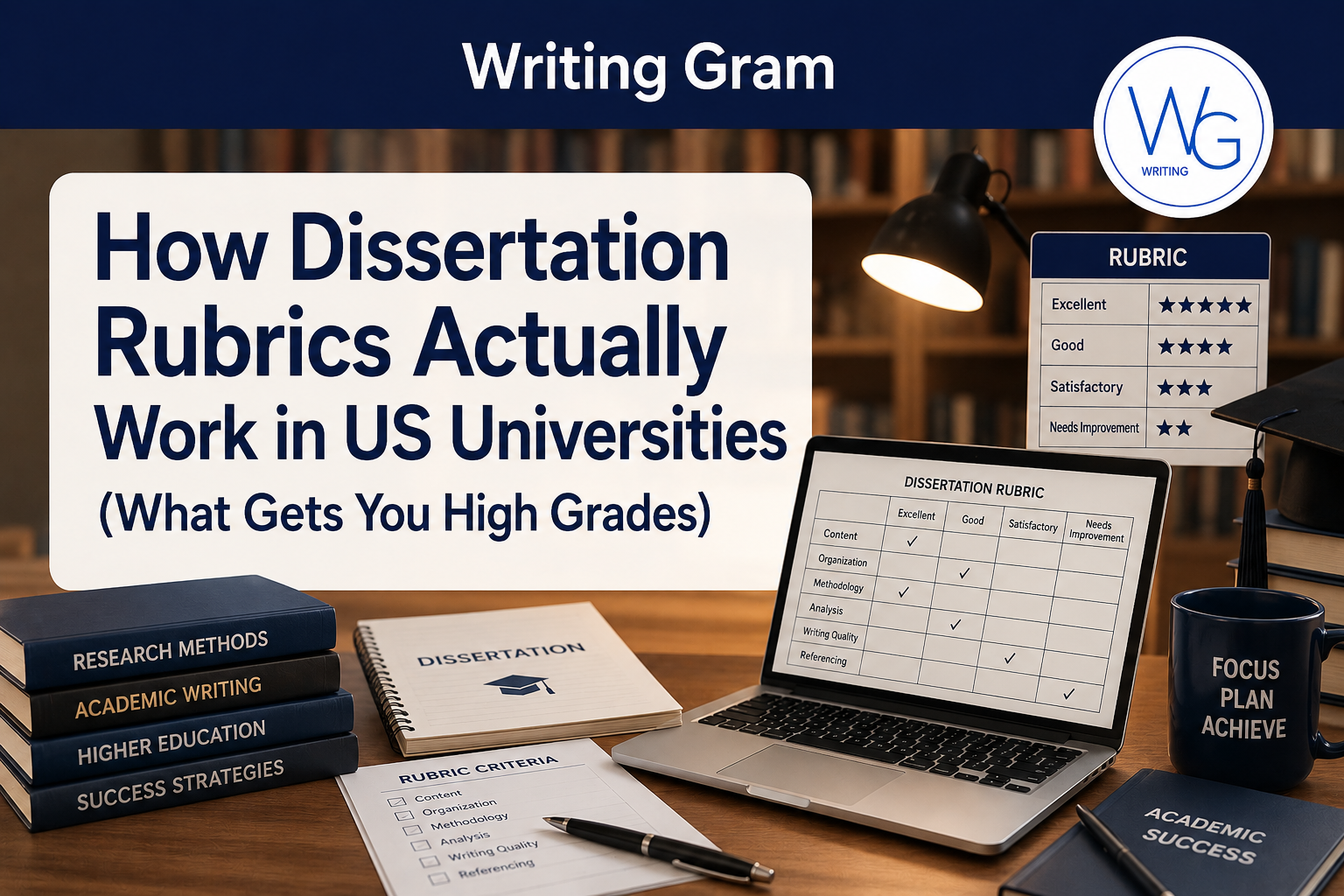
Learn how dissertation rubrics actually work in US universities, what professors look for when grading dissertations, and how to improve your chances of higher grades with expert rubric-focused dissertation help.
Many students begin their dissertation journey without fully understanding how their work will actually be evaluated. Dissertation grading is not based on subjective impressions or personal preference, but on clearly defined academic standards established by the university. This is where the dissertation rubric USA becomes essential, as it provides a structured breakdown of what examiners expect in each section of the dissertation.
Despite this, many learners still struggle because they do not engage deeply with the marking framework. In reality, how dissertations are graded rubrics is based on detailed evaluation sheets that assess specific areas such as the research quality, methodology, analysis, and academic writing. Each section carries its own weight, and understanding this structure is the key to producing a high-scoring dissertation.
When students align their work with these expectations from the start, they greatly improve their chances of earning higher grades instead of having to guess what the examiner is looking for.
At Writing Gram, we help PhD students make sure their dissertations align with the rubric and meet all evaluation criteria.
If you need professional help with your dissertation, our experts will ensure it aligns with the rubric and meets all marking criteria.
👉 Place your order now to receive a custom, plagiarism-free, human-written dissertation tailored to the rubric requirements.
What Is a Dissertation Rubric in US Universities?
In US universities, a dissertation is not graded randomly or based on general impressions. Instead, universities rely on structured evaluation tools known as rubrics. A dissertation rubric refers to a formal grading framework used by examiners to assess the quality of a student’s research work in a consistent and transparent way.
A dissertation rubric acts as a scoring guide that breaks the dissertation into specific assessment criteria. This ensures that every student is evaluated against the same academic expectations, regardless of who marks the work.
Most institutions use detailed university dissertation evaluation sheets that divide the dissertation into measurable categories such as research design, literature review, methodology, analysis, and academic writing quality. These categories are then assessed using performance levels like “excellent,” “good,” or “needs improvement.”
According to the University of Virginia’s doctoral dissertation assessment framework, examiners evaluate areas such as:
Clarity and strength of the central argument
Theoretical grounding and use of literature
Appropriateness of research methods
Overall quality of writing and academic execution
This shows that dissertation grading is systematic and not subjective.
In most US universities, how dissertations are graded rubrics follows a similar structure:
Each section is scored separately
Each score contributes to an overall evaluation
Multiple examiners may review the same work for fairness
Feedback is tied directly to rubric criteria rather than personal opinion
While the exact structure may vary between institutions, the core academic standards remain consistent across most PhD and master’s programs. This ensures fairness, transparency, and academic integrity in dissertation evaluation across the United States.
The Main Categories Professors Use to Grade Dissertations
Most US universities assess dissertations using structured rubrics that break the work into clear academic performance areas. These categories are designed to ensure consistency among examiners and reduce subjectivity in grading. A typical PhD marking criteria explanation shows that dissertations are not graded as a single document, but as a collection of interrelated academic skills such as research design, argument quality, and analytical depth. In many cases, the examiner’s dissertation grading criteria are outlined in official university evaluation sheets that organize assessment into clearly defined sections and levels of achievement.
A sample rubric structure from West Virginia University highlights how dissertations are evaluated based on criteria such as clarity, structure, and integration of research evidence.
Research Problem and Originality
This section evaluates whether the dissertation presents a meaningful and researchable problem statement.
Professors focus on:
Clarity of the research question and whether it is clearly defined
Importance of the research gap and why it matters in the professional, academic and real-world setting.
Contribution to the field in terms of new knowledge or perspective
A strong dissertation does not simply repeat existing studies—it clearly positions itself within a knowledge gap and explains why the research is necessary.
Literature Review Quality
This section measures how well the student engages with existing academic work.
Key evaluation points include:
Depth of sources (use of credible, peer-reviewed literature)
Critical analysis rather than a simple summary of studies
Integration of evidence into a coherent academic argument
At this stage, examiners expect synthesis, meaning the student must connect ideas across multiple studies rather than describe them one by one. Weak literature reviews often lose marks for being descriptive instead of analytical.
Methodology and Research Design
This is one of the most heavily weighted sections in many US dissertation rubrics.
Examiners assess:
Whether the chosen methods are appropriate for the research question
How well data is collected and analyzed
Reliability, validity, and ethical considerations in the research design
A strong methodology section shows that the research approach is not only correct but is also fully justified. If the method does not align with the research question, it significantly lowers the overall evaluation score.
Academic Writing and Structure
This section focuses on how clearly the dissertation is communicated.
Typical assessment criteria include:
Logical organization of chapters and arguments
Clarity of writing and academic tone
Accuracy of citations and referencing style
Consistency in formatting and structure
Even strong research can lose marks if it is poorly structured or difficult to follow. Universities emphasize clarity because dissertations must communicate complex ideas effectively to the reader.
Analysis, Discussion, and Conclusions
This final category evaluates how well the student interprets and communicates findings.
Examiners look at:
How thoroughly are research results interpreted in the data analysis section
Logical reasoning behind conclusions
Strength and relevance of conclusions to the research question
This section often distinguishes average dissertations from high-scoring ones because it shows whether the student can critically evaluate their findings instead of simply presenting the data.
This shows that each section is assessed independently, but all scores contribute to the final score. This structured approach ensures fairness and transparency when grading dissertations.
How Professors Actually Score Dissertation Rubrics
In most US universities, dissertation grading is far more structured than many students expect. Instead of relying on subjective judgment, examiners use detailed scoring systems that assign numerical values to each part of the dissertation. As a result, dissertation scoring becomes a transparent process grounded in specific academic criteria rather than subjective judgment.
In most cases, how dissertations are graded rubrics is based on weighted categories, meaning some sections carry more importance than others. For example, methodology and analysis may contribute more to the final grade than formatting or presentation. Each section is scored individually, and the combined weighted total determines the final result.
Typical scoring systems include:
Numerical grades assigned to each rubric category (e.g., 1–5 or percentage-based scoring)
Weighted contribution of sections such as literature review, methodology, and analysis
Final aggregation of all category scores into an overall dissertation mark
Many universities also require multiple layers of review. This often includes:
A primary supervisor or examiner
A second reader or committee member
In some cases, an external examiner to ensure fairness
According to Purdue University’s graduate assessment guidance, dissertation evaluation relies on structured criteria and multi-level review to ensure consistency and academic integrity across examiners.
Ultimately, high dissertation grades are not achieved by excelling in only one section. Instead, strong performance comes from consistently meeting rubric expectations across all the categories and by showing balanced competence in research, analysis, and academic writing.
Common Reasons Students Lose Marks on Dissertation Rubrics
Many students lose marks not because their topic is weak, but because their dissertation does not fully meet the requirements outlined in the marking rubric. In most cases, the examiner's grading dissertation criteria are very specific, and even small weaknesses across multiple sections can reduce the final score.
A key issue highlighted in many US graduate assessment frameworks, including the dissertation evaluation guidance from the University of Michigan Rackham Graduate School, is that dissertations are assessed based on clarity, consistency, and quality of academic reasoning rather than the writing effort alone.
Below are the most common reasons students lose marks:
Weak or unclear research questions that do not clearly define the study’s purpose
Poor synthesis of literature, where sources are summarized instead of being critically analyzed
Inconsistent methodology that does not align with the research question or data analysis approach
Lack of critical thinking in discussion sections, with findings described but not interpreted in depth
Formatting, referencing, and citation errors that weaken the academic quality of the dissertation.
Weak or unsupported conclusions that do not clearly connect back to the research objectives
These issues may seem minor individually, but together they can significantly affect how examiners evaluate the dissertation against the rubric criteria.
In many cases, students only recognize these issues after receiving feedback, when it is already too late to make major improvements. This is why understanding rubric expectations early is critical for achieving higher grades.
At Writing Gram, we help students avoid these common pitfalls by developing dissertations that are fully aligned with university rubrics from the start.
If you want expert help with dissertation writing that meets every marking requirement,
🎓 Place your order now to get a custom, non-AI and plagiarism-free dissertation that follows your rubric requirements.
How to Use Dissertation Rubrics to Improve Your Grade
Understanding the grading framework before you begin writing can significantly improve the quality of your dissertation. A well-structured dissertation rubric USA provides a roadmap that shows exactly what examiners expect in each section of the paper. Instead of treating the rubric as something to check at the end, successful students use it throughout the entire writing process.
According to Harvard University’s graduate writing guidance, students should evaluate their work against assessment expectations continuously rather than waiting until the final submission.
Here are practical ways to use dissertation rubrics more effectively:
Review the rubric before writing your proposal or first chapter
Use rubric categories as checklists for each dissertation chapter or section
Compare your draft against the grading criteria before submission
Ask your advisor to clarify unclear expectations early in the process
Revise weak sections based on scoring categories rather than general editing alone
Learning how professors score dissertations also helps students focus on what matters most. In many cases, students lose marks because they prioritize word count or formatting while overlooking analytical depth, methodological clarity, and critical discussion. Using the rubric strategically helps ensure that every chapter directly meets the standards examiners are looking for.
Get a Dissertation That Is Written Around Your University’s Grading Rubric
Understanding how dissertation rubrics work can make the difference between an average grade and a high-scoring dissertation. In most US universities, examiners evaluate research using structured academic criteria that assess everything from originality and methodology to critical analysis and academic writing quality. This is why a strong PhD marking criteria explanation is essential for students who want to align their work with what professors are actually looking for.
At Writing Gram, we help students develop dissertations that are carefully aligned with university grading rubrics from the beginning.
Whether you need dissertation writing, editing, proofreading, or rubric-based evaluation, our team focuses on ensuring your work meets the academic standards required by examiners.
Place your order now to get a custom, plagiarism-free, and non-AI dissertation that follows your university's rubric requirements.