Dissertation Assistance to Rework Your Existing Research Without Starting Over
By Writing Gram • Sep 10, 2026
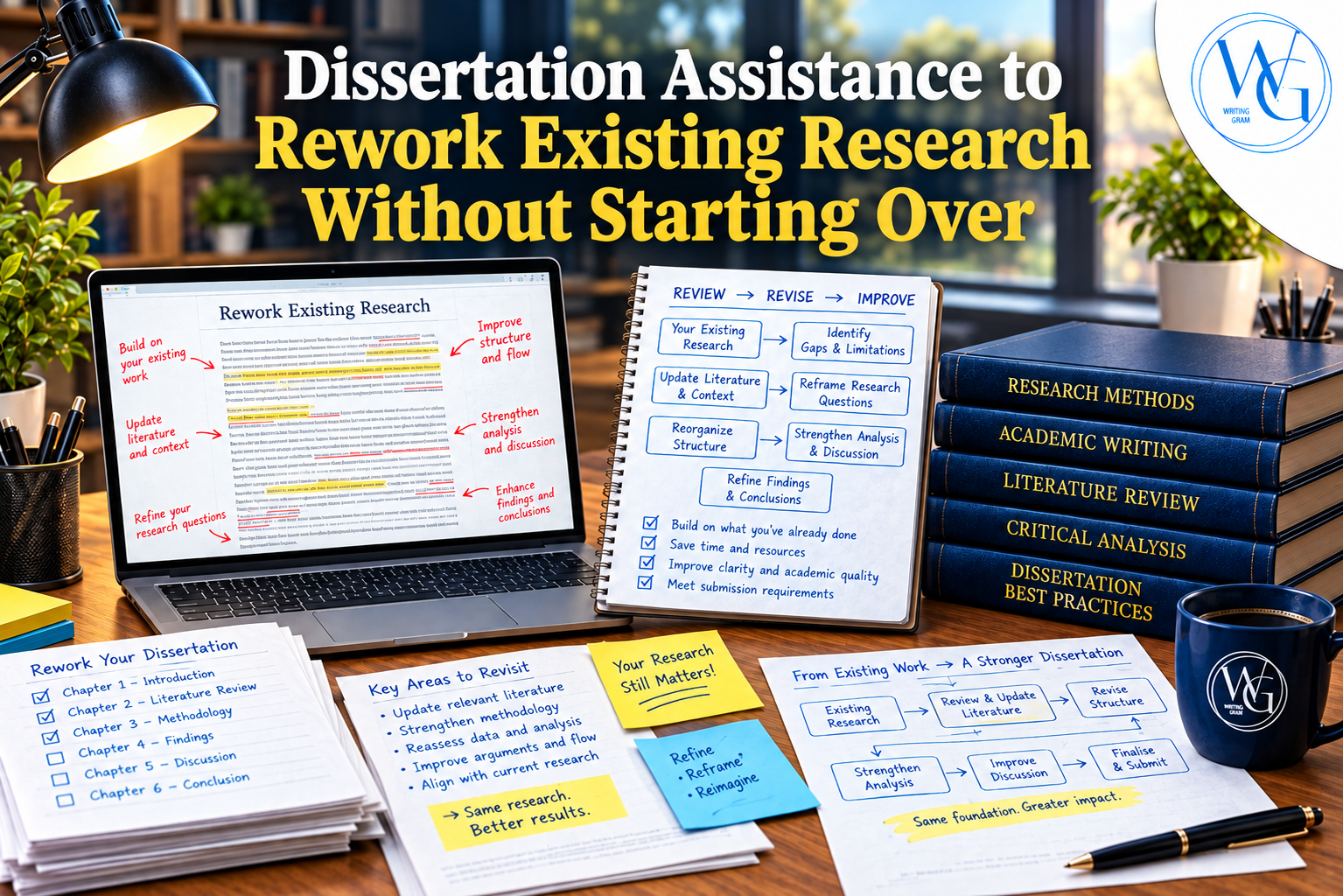
Need dissertation assistance because your existing research no longer works? Learn how to rework your research, restructure the dissertation, and decide what can be retained.
When Your Research Direction No Longer Works For Your Dissertation
You may already have done a great deal of work on your dissertation. Perhaps you have completed the literature review, collected and analyzed your data, conducted interviews, developed your methodology, or drafted several chapters. Yet you may still find that your dissertation has gaps in its argument, unclear connections between chapters, or sections that do not adequately support your research questions.
Your original research question may no longer fit what your evidence shows. Your findings may point toward a different research problem. You may have collected data that does not fully answer your research questions, making it difficult to support some of the claims you planned to make in your dissertation.Feedback from your supervisor or committee may also reveal that several chapters contain valuable information but do not contribute to a coherent overall argument.
This matters because a dissertation needs more than a collection of good research materials. The research question, evidence, analysis, and argument need to work together. For example, the Harvard College Writing Center explains that a strong thesis needs to be supported by evidence and should contribute to understanding a problem or question.
In many cases, you can keep much of the work you have already completed while revising the sections that are causing problems.
In many situations, you can revise the work you have already completed so that it answers your research questions and supports a clear dissertation argument, rather than starting again from scratch. Some material may remain useful, some may need to be reframed, some chapters may need major restructuring, and other sections may need to be replaced with new research.
📚 Get Dissertation Assistance to Rework Your Existing Research
Writing Gram provides dissertation assistance for researchers who need to review the work they have already completed, determine which sections and findings can be retained, restructure chapters, strengthen connections between them, and rewrite sections so they directly support the research questions and main argument.
📌 Place your order now to get professional dissertation assistance using the research you have already completed, keeping the material that supports your study, fixing disconnected chapters, strengthening your argument, and rewriting weak sections without starting your dissertation from scratch.
Reworking a Dissertation Is Different From Revising a Finished Draft
Revising a dissertation and reworking a dissertation are not the same task.
A conventional revision assumes that the research you have already conducted still answers your research questions and provides the evidence needed for your dissertation. You may need to strengthen an argument, improve transitions, clarify explanations, reorganize paragraphs, respond to supervisor comments, or correct weaknesses in individual chapters.
Reworking goes deeper.
You may need to reconsider the relationship between your research questions, methodology, evidence, findings, and conclusions because the original research direction no longer produces a coherent dissertation.
The distinction is important because simply editing existing chapters does not solve a structural research problem.
The Stanford University dissertation guidance emphasizes the importance of making the structure and relationships between ideas clear in a dissertation, while also stressing originality and precision.
Revision improves the writing and structure of research that already fits the dissertation, while reworking may require reorganizing the research, changing how findings are presented, and rewriting chapters so they answer the research questions and support the main argument.
That may involve changing the emphasis of the research, restructuring chapters, revising research questions, reconnecting findings with the research problem, or determining where new research is genuinely required.
Signs Your Existing Research May Need to Be Reworked
i. Your research questions no longer match your findings
One of the clearest warning signs appears when your findings answer a different question from the one your dissertation was originally designed to address.
Perhaps your analysis produced an unexpected pattern. Maybe participants emphasized an issue that was barely considered in your original framework. Your quantitative results may also have failed to support the relationship you expected to investigate.
You do not necessarily need to discard the data you have already collected. Start by examining whether your findings answer any of your research questions and whether they provide enough evidence to build your dissertation around those findings.
ii. Your methodology produced useful evidence for a different argument
You may have conducted interviews, surveys, observations, experiments, archival research, or secondary-data analysis that produced valuable material, even though the original argument no longer fits it.
Therefore, the problem may be that the methodology does not align with the research question, rather than that your data cannot support the dissertation.
The University of Michigan research seminar materials specifically encourage dissertation evaluation through questions about whether the research question fits the overall research and whether the question, literature, methodology, and evidence are aligned.
That type of assessment is particularly important before you decide that all of your existing research is unusable.
iii. Your chapters contain valuable material but do not form one argument
You may have strong literature-review sections, detailed methodology, useful findings, and substantial discussion material, yet the chapters may not clearly connect to the same research questions or support the same overall argument.
This often happens when the research direction changes after data collection or analysis.
You may be able to reorganize and revise the chapters you have already written instead of deleting everything. A literature review may need to support a revised problem. Findings may need to be reorganized around different research questions. A discussion chapter may need to be rebuilt around what the evidence actually demonstrates.
iv. Supervisor feedback exposes a deeper research problem
Not every supervisor feedback or comment means you need to rewrite a few paragraphs.
Comments such as “the argument is unclear,” “the research questions do not align with the findings,” “the methodology does not answer the question,” or “the contribution is not established” may point to a deeper problem.
If you respond by repeatedly editing individual sections without addressing the underlying issue, you may spend weeks improving chapters that still do not work together.
v. Continuing the original approach would mean repeating work you have already done
Starting again may seem simple, but it would require you to repeat much of the work you have already completed.
You may need to conduct another literature review, develop a new research design, seek approvals, collect new data, conduct another analysis, and rewrite the dissertation around an entirely different project.
Before taking that route, it is worth determining whether your existing research contains enough useful material to support a revised direction.
What Can Be Salvaged From Existing Dissertation Research?
When you need to rework a dissertation, the first step should not be assuming that everything is either usable or unusable. Different components need to be assessed separately.
You should check the following to determine which parts of your dissertation require rewriting:
a. Literature review material
A change in research direction does not necessarily make your entire literature review irrelevant.
Some sources may still establish the background to the revised problem. Other sections may need to be shortened, repositioned, expanded, or replaced because they were selected to support the original research question.
The goal is to determine which literature still helps establish the problem, explain the research gap, and support the revised argument.
b. Research data and findings
Existing data may represent some of the most valuable material in your dissertation.
However, having data does not automatically mean that it supports every possible research question. The collection process, variables, participants, measures, interview questions, sample, and analytical approach all matter.
If the revised research question is genuinely supported by the existing evidence, your data may remain central to the dissertation. If it requires information that was never collected, new research may be necessary.
This is especially important when a dissertation includes multiple studies or research phases, because the existing data from each study must support the research questions assigned to it and contribute to the overall argument.
c. Methodology
Your methodology may remain suitable, require modification, or need to be reframed.
For example, the research design may still support the revised question even though the original theoretical framing has changed. In another case, the existing method may answer only part of the revised question.
The University of Pennsylvania Graduate School of Education explains that methodological choices are shaped by research questions and conceptual frameworks, illustrating why a change in research direction may require the relationship between these elements to be reconsidered.
d. Theoretical or conceptual framework
Your theoretical or conceptual framework may still explain an important part of the revised research problem.
Alternatively, your findings may reveal that another theoretical perspective provides a better explanation of what you discovered.
This does not always require abandoning your theoretical or conceptual framework. The important issue is whether it genuinely supports the revised argument and helps explain the evidence you are presenting.
e. Existing chapter material
Some chapters may remain largely usable. Others may need substantial restructuring.
A section originally written for one research question might become part of a different chapter. A findings section might need to be reorganized around revised questions. A discussion section might need to be rewritten so that it interprets the findings in relation to the revised contribution.
This is why it is useful to salvage dissertation material that already supports your draft argument before rewriting entire chapters.
When Reworking Existing Research Is Not Enough
Reworking is not always the right solution
There are situations where starting again, collecting additional data, or substantially redesigning the research is genuinely necessary.
For example, existing data may not provide enough evidence to answer any defensible version of the research question. Ethical or methodological problems may also undermine the validity of the evidence. A revised question may require completely different participants, variables, measurements, or forms of data collection.
The research design may also be incapable of supporting the conclusions you want the dissertation to reach.
Another important consideration is the doctoral contribution. Even if you have hundreds of pages of existing material, those pages do not automatically satisfy the requirements for an original contribution to knowledge.
The University of California, Berkeley Geography graduate handbook notes that a dissertation outline should explain each chapter's argument and its relationship to the overall dissertation, while its prospectus guidance emphasizes a coherent thread connecting the research problem, literature, data, and methodology.
That is why a professional assessment should happen before you spend weeks rewriting large portions of the dissertation. That is why professional dissertation assistance is especially useful for working professionals and researchers balancing doctoral work with demanding careers, helping them avoid wasting weeks on changes that do not solve the underlying problem, reduce the time spent figuring out what to keep or rewrite, and make better use of the limited time they have available for their dissertation.
What Dissertation Restructuring Help Should Actually Examine
Good dissertation restructuring help should go beyond moving headings around or improving transitions.
The central question is whether the different components of your research still work together after the direction of the dissertation changes.
Professional dissertation restructuring help examines the following:
I. Research question and objective alignment
The revised research questions and objectives need to match what your existing research actually investigates.
If your data addresses one issue while your revised question asks another, the problem needs to be identified before substantial rewriting begins.
II. Evidence and argument
The dissertation needs an argument that the available evidence supports.
This means examining whether the claims you want to make are justified by the data, analysis, and relevant literature.
Writing research notes can also help you trace where each claim, finding, and supporting source came from when developing the dissertation’s argument.
III. Methodology and findings
The methodology needs to support the findings being used in the revised dissertation.
If the research question changes, the analysis may also need to change. In some cases, the existing methodology remains appropriate. In others, additional analysis or new research may be required.
IV. Chapter architecture
Changing the research direction often changes the role of individual chapters.
A chapter that previously served as a major part of the argument may become supporting material. Two chapters may need to be reorganized. A discussion section may need to be rebuilt around a revised contribution.
Restructuring should therefore establish how the chapters work together instead of simply rearranging their order.
That is why keeping the dissertation aligned from the original proposal through the final submission is important, so that changes to the research questions, chapters, and findings do not leave the final dissertation disconnected from what you originally proposed.
V. Gaps that must be filled
Finally, the assessment should distinguish between writing gaps and research gaps.
A writing gap may require rewriting, explanation, organization, or stronger connections between existing sections.
A research gap may require new literature, additional analysis, new data, or further investigation.
That distinction prevents you from paying for extensive rewriting when the real problem requires additional research.
How Dissertation Assistance Can Help You Rework Existing Research
Dissertation writing help does not always mean producing an entirely new dissertation from the beginning.
For researchers whose existing research has become difficult to use in its original form, dissertation assistance may focus on understanding what has already been completed and rebuilding the dissertation around a defensible direction that can withstand scrutiny during the viva voce or dissertation defense.
This may involve reviewing your existing research and identifying material that remains usable, restructuring chapters around a revised argument, revising research questions and objectives where appropriate, reconnecting findings with the research problem, identifying sections that require new research, and rewriting material whose original purpose has changed.
It may also involve improving the relationship between methodology, findings, discussion, and conclusions so that the dissertation reads as one research project rather than a collection of disconnected chapters.
This type of PhD dissertation help is particularly valuable when the researcher has already invested significant time in the project and does not want to discard useful work simply because the original direction has stopped working.
The objective is not to preserve every sentence you have written. It is to determine what deserves to remain, what needs to change, what needs to be rewritten, and what genuinely needs to be replaced.
📚 Order Dissertation Writing Help to Rebuild Your Existing Research, Save Time, and Avoid Repeating Work You Have Already Done
Writing Gram provides dissertation assistance for researchers whose existing research needs more than proofreading or ordinary chapter editing. The service is designed to help assess the research, identify usable evidence and literature, restructure the dissertation, rewrite affected chapters, and develop a coherent research argument from the material already available.
🚀 Place your order now to get professional dissertation writing help that addresses the research direction, chapter structure, evidence, methodology, findings, discussion, and conclusions together — so you know what to retain, what to rewrite, and what new research is actually needed.
What to Send for a Dissertation Rework Assessment
A dissertation rework assessment should begin with the research you already have, rather than assuming that you need to produce an entirely new dissertation. The clearer you are about the existing research and why the dissertation needs to change, the easier it is to determine which material remains usable, which sections need revision, and where new work is actually necessary.
You can use our checklist to determine the information, documents and materials that you should upload to help us ensure your dissertation meets your instructions
You should provide your current dissertation chapters, including sections that you believe no longer fit the direction of the research. Material that feels outdated or disconnected may still contain useful evidence, analysis, literature, or explanations that belong in the revised dissertation.
Your dissertation proposal is also important because it shows the original purpose of the study and provides a point of comparison for what has changed.
Include your current research questions and objectives so the assessment can examine whether they still match your evidence, methodology, findings, and intended contribution. If you have already changed the questions informally, include the newer version as well.
Your methodology should also be reviewed. This helps establish what your existing research actually allows you to investigate and whether a revised research question remains compatible with the way your evidence was collected and analyzed.
If you have completed your analysis, provide your existing findings or information about your dataset. This makes it possible to examine what your research actually discovered instead of rebuilding the dissertation around assumptions about what the results should have shown.
You should also provide supervisor or committee comments, particularly if the decision to rework the dissertation came from feedback. Comments about weak alignment, unclear research questions, methodology, findings, argument, structure, or contribution may reveal the underlying reason the original direction stopped working.
Your university's dissertation requirements should also be included where relevant. A revised structure still needs to satisfy the requirements of your program, department, or degree.
Finally, explain what changed in the research. Perhaps the findings contradicted your original expectations. Maybe your supervisor rejected the original direction. You may have discovered that your research question does not fit the data, or your literature review may have revealed a different and more promising problem.
The assessment should then produce a practical four-part decision:
What can stay → what needs restructuring → what needs rewriting → what requires new research.
That distinction is important. You do not want to rewrite material that remains suitable, preserve material that no longer supports the dissertation, or mistake a genuine research gap for a writing problem.
You May Not Need to Start Your Dissertation Again
A dissertation that no longer works in its current form does not mean that the research you have already completed is wasted. In many cases, the existing research, data, and writing can be reworked into a strong dissertation without throwing away everything you have already done.
A change in your original research question does not mean that the literature review, data, methodology, findings, and chapters you have already completed have to be discarded. Their value depends on whether they can support the revised research question and the dissertation you are now trying to develop.
The first step is to establish the right direction before spending weeks on more writing.
You may discover that your existing data supports a revised research question. Your literature review may already contain much of the foundation needed for a new argument. A methodology that appeared unsuitable for the original question may still support another question. Findings that seemed disappointing may become central once the research problem is reframed around what the evidence actually shows.
In other cases, the assessment may reveal that some material needs to be replaced. That is still different from automatically starting the entire dissertation again.
The objective of dissertation restructuring is to make these decisions deliberately.
Instead of asking, “How do I rewrite all of this?” you should ask yourself the following questions to help you make a better decision
What research do I already have?
What does that research actually support?
Which parts still serve the revised research question?
Which chapters need to change?
Which sections need to be rewritten?
Where does new research genuinely need to be added?
Does the revised dissertation still have a defensible contribution?
Answering those questions first prevents you from spending substantial time polishing chapters that ultimately need to be discarded.
You can also use our checklist to identify the right questions to ask when hiring dissertation help services, so you can choose a service that delivers high-quality work and follows your instructions and requirements.
This is also why dissertation assistance for this situation needs to go beyond proofreading. If the underlying problem is that your research direction has changed, improving grammar and sentence structure will not resolve the relationship between your research question, methodology, evidence, findings, and conclusions.
Frequently Asked Questions About Reworking Existing Dissertation Research
Can a dissertation be reworked instead of started again?
Yes, in some situations. It depends on whether your existing literature, data, methodology, analysis, findings, and chapters can support a revised research question and the dissertation you need to produce. The goal is to assess what you have already completed before deciding that it all needs to be discarded.
Can you revise existing dissertation research?
Yes. Existing literature, data, methodology, findings, and chapter material should be assessed individually. Some components may remain suitable, while others may need restructuring, rewriting, or replacement.
This approach is more useful than treating the entire dissertation as either completely usable or completely unusable.
How do I know whether my dissertation research can be salvaged?
A good starting point is to examine these four connected elements:
Research questions → methodology → evidence → intended contribution.
If these elements can be brought into a defensible relationship through restructuring or additional research, substantial parts of the existing dissertation may still be usable.
What does dissertation restructuring help include?
Dissertation restructuring help may involve reorganizing existing chapters, changing the relationship between sections, revising research questions or objectives, reconnecting findings with the research problem, rewriting affected sections, identifying weaknesses in the argument, and determining where new research is required.
It addresses the structure and logic of the dissertation, not simply its grammar.
Do I have to rewrite my entire dissertation if the research question changes?
No. A changed research question does not automatically make every existing chapter unusable.
The effect depends on how closely each component of the dissertation depends on the original question. Some literature, methodology, evidence, analysis, and findings may still support the revised direction.
Can existing dissertation data be used for a new research question?
It depends on the nature of the data and the revised question. The existing data needs to provide legitimate evidence for the new question, and the revised analysis needs to remain methodologically defensible.
A different research question does not automatically make existing data unusable, but the connection needs to be established carefully.
Can a dissertation writer work with research I have already completed?
Yes. Dissertation writing help may involve working with research that has already been conducted instead of assuming that the entire dissertation needs to be produced from scratch.
The existing material can be assessed first to determine what should be retained, restructured, rewritten, or replaced.
What if only some chapters of my dissertation still work?
The dissertation should be assessed at both the chapter level and the research-component level.
One chapter may remain largely intact while another requires substantial rewriting. Material from several chapters may also need to be reorganized into a new structure.
Is dissertation restructuring the same as dissertation editing?
No.
Editing primarily improves existing writing, such as grammar, clarity, sentence structure, citations, and readability.
Restructuring addresses deeper relationships between the research question, argument, evidence, methodology, findings, discussion, conclusions, and chapter organization.
A dissertation with a structural research problem needs more than proofreading.
Can PhD dissertation help include restructuring existing research?
Yes. PhD dissertation help may address the relationship between the research problem, research questions, methodology, evidence, findings, contribution, and overall dissertation structure.
This becomes particularly important when doctoral research has produced useful material but the original research direction no longer provides a coherent basis for the dissertation.
When should I seek dissertation assistance for research that no longer works?
When should I seek dissertation assistance for research that no longer works?
It is best to seek assistance before you spend significant time rewriting the dissertation based on a new research approach.
What if my supervisor says my dissertation needs a completely different direction?
Start by determining what the feedback actually means for your existing research.
A different direction may require a new research question, but it does not automatically mean that every source, dataset, finding, or chapter must be abandoned. The supervisor's comments should be examined alongside the research you have already completed.
What if my existing findings contradict my original research question?
Contradictory or unexpected findings do not automatically mean that the research has failed.
The important issue is whether the findings reveal a meaningful research problem that the existing evidence can support. If they do, the dissertation may need to be reframed around what the research actually demonstrates.
Can I rework my dissertation if I have already written several chapters?
Yes. In fact, this is precisely when a careful assessment of existing material becomes important.
The number of completed chapters does not determine whether the dissertation needs to start again. Their relevance to the revised research direction does.
What if reworking the dissertation still requires new research?
That is possible. Reworking existing research does not mean forcing old material to answer questions it cannot support.
The assessment should identify which parts of the dissertation remain usable and where additional literature, analysis, data, or research is genuinely required.
🚀 Get Dissertation Assistance to Identify What to Keep, What to Rewrite, and What New Research You Need
Writing Gram provides dissertation assistance for researchers whose existing research no longer fits their original direction but still contains valuable material that may be developed into a viable dissertation.
📚 Place your order now to get professional dissertation writing help that assesses the research you have already completed, shows you what to keep and what needs to change, helps you avoid repeating work you have already done, saves you weeks of unnecessary rewriting, connects your existing evidence to your research questions, rewrites the sections that no longer fit, and identifies exactly where additional research is needed.