How Dissertation Writing Assistance Strengthens Evidence-Based Academic Decision Making
By Writing Gram • Jul 31, 2026
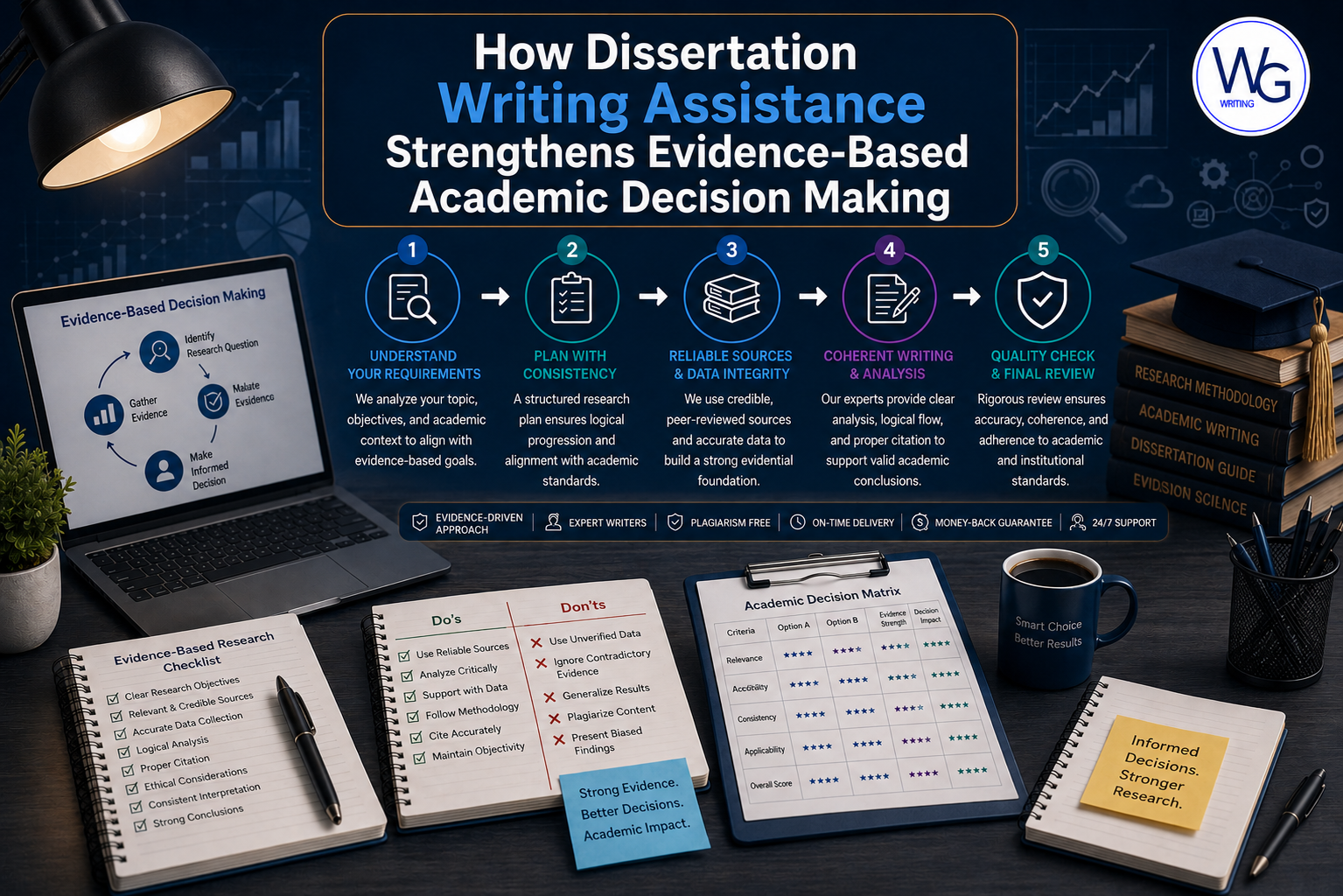
Need dissertation writing assistance? Get expert dissertation help to strengthen evidence evaluation, defend research decisions, and build stronger dissertation arguments.
How Dissertation Writing Assistance Strengthens Evidence-Based Academic Decision Making
Completing a dissertation involves far more than collecting sources and presenting findings. Every dissertation chapter involves critical research choices—from selecting evidence and justifying methods to interpreting findings—that determine whether your research is persuasive, defensible, and ready for doctoral evaluation. From selecting peer-reviewed literature to choosing a theoretical framework, justifying a research methodology, interpreting results, and defending conclusions, each decision must be supported by credible evidence rather than personal opinion. This is what transforms an ordinary dissertation into an evidence based dissertation.
Many doctoral candidates focus on polishing their writing or strengthening the conclusion, assuming these are the primary factors examiners evaluate. However, examiners also assess the quality of the evidence, methodology, analysis, and reasoning across the entire dissertation. A well-written dissertation can still receive extensive revisions if the evidence supporting its arguments is weak, outdated, inconsistent, or poorly justified. Strong research demonstrates not only how complex research problems were addressed but also why the chosen solutions were more appropriate than alternative methodologies, analytical techniques, or evidence-based interpretations.
This is where professional dissertation writing assistance helps researchers work through complex research problems by identifying the most appropriate methodological and analytical approach and explaining why those choices best address the research objectives Rather than replacing the research process, experienced dissertation specialists help strengthen the evidence behind key research decisions by evaluating source credibility, identifying stronger supporting literature, improving methodological justification, and ensuring evidence consistently supports every chapter The result is a dissertation built on logical, defensible academic reasoning instead of unsupported assumptions.
🚀 Get Dissertation Writing Assistance That Strengthens Every Chapter Before Submission
Writing Gram helps you strengthen the quality of your research before weaknesses in evidence, methodology, or data interpretation result in costly dissertation revisions. Our dissertation writing assistance helps improve evidence quality, refine methodological and analytical reasoning, strengthen research justification, and ensure every chapter presents a clear, well-supported academic argument.
🚀 Order now and receive dissertation writing assistance that strengthens your evidence, improves methodological justification, and helps you develop well-supported arguments throughout every chapter of your dissertation.
Why Evidence-Based Decision Making Determines Dissertation Quality
Every successful dissertation is the product of hundreds of evidence-based decisions made throughout the research journey. While readers often focus on the conclusions, examiners pay close attention to the reasoning behind those conclusions. They evaluate whether each research decision is supported by credible academic evidence and whether alternative approaches were considered and appropriately justified. This systematic reasoning is what distinguishes an evidence based dissertation from one that relies on assumptions or weak academic support.
A single weak research decision can affect multiple chapters. For example, selecting an inappropriate theoretical framework may weaken the literature review, influence the research methodology, complicate data interpretation, and ultimately reduce the credibility of the discussion and conclusion. Similarly, relying on outdated or low-quality studies may undermine otherwise well-written arguments because the supporting evidence is no longer sufficiently robust.
According to the University of North Carolina at Chapel Hill Writing Center, strong academic arguments depend on carefully selected evidence that is both relevant and effectively integrated into the discussion rather than merely presented as isolated information. This principle applies throughout every stage of doctoral research, where evidence should consistently support each academic decision rather than simply increase the number of citations.
Evidence-based decision making appears throughout a dissertation in numerous ways, including:
Selecting peer-reviewed literature that directly addresses the research problem.
Choosing theoretical or conceptual frameworks that align with the study objectives.
Selecting variables and research instruments supported by previous scholarly research.
Choosing participants or sampling strategies appropriate for the research design.
Defending analytical methods using established methodological literature.
Interpreting conflicting research findings through balanced critical analysis.
Supporting practical recommendations with empirical evidence instead of personal opinion.
Perhaps the most common misconception among doctoral researchers is believing that adding more references automatically strengthens a dissertation. In reality, evidence quality is significantly more important than evidence quantity. A carefully evaluated collection of highly relevant, methodologically sound, and authoritative sources provides stronger academic evidence support than dozens of loosely related citations that contribute little to the research argument. Examiners are interested in whether the evidence justifies your decisions—not how many references appear in the bibliography.
How Dissertation Writing Assistance Helps Evaluate Research Evidence
One of the greatest challenges in doctoral research is determining whether available evidence genuinely supports a research decision. Finding journal articles is only the first step. The more difficult task is evaluating which evidence is credible, relevant, consistent, and academically defensible. Professional dissertation writing assistance helps researchers make these evaluations systematically, reducing the likelihood of unsupported arguments and strengthening the overall quality of the dissertation.
Professional dissertation writers help to evaluate research evidence in the following ways:
Source Credibility
Not every published source contributes equally to a dissertation. Experienced dissertation specialists help researchers evaluate the overall strength of academic evidence by considering factors such as:
Whether studies have undergone rigorous peer review.
The reputation and scholarly standards of the publishing journal.
The appropriateness of the research design for the study objectives.
The reliability and authority of frequently cited foundational studies.
Whether newer research provides stronger evidence than older publications.
This structured evaluation helps ensure that dissertation arguments are built on dependable academic evidence rather than sources selected simply because they are easy to locate.
Evidence Relevance
Even highly credible research may not strengthen a dissertation if it does not directly support the research objectives. Effective evidence evaluation focuses on alignment rather than availability.
Professional dissertation specialists often assess whether supporting evidence directly contributes to:
The stated research objectives.
The research questions or hypotheses.
The selected conceptual or theoretical framework.
The chosen methodology and research design.
The interpretation of research findings.
This process improves logical research consistency throughout the dissertation by ensuring every major research decision is supported by evidence that genuinely addresses the purpose of the study.
Evidence Consistency
Doctoral research rarely presents perfectly consistent findings. High-quality dissertations acknowledge conflicting evidence and justify why the conclusions drawn are the most appropriate based on the available evidence. Rather than ignoring contradictions, experienced specialists help researchers evaluate competing evidence and develop balanced academic arguments.
Professional evidence evaluation commonly includes:
Identifying stronger supporting empirical studies.
Comparing competing findings across multiple scholarly sources.
Removing weak, outdated, or poorly aligned references.
Strengthening the academic justification for research decisions.
Improving literature integration so evidence forms a coherent argument instead of summarizing the sources.
By systematically evaluating evidence before it is incorporated into the dissertation, researchers develop stronger academic reasoning that extends across the literature review, methodology, findings, discussion, and conclusion.Instead of simply increasing the number of citations, professional dissertation writing assistance helps ensure every piece of evidence serves a clear purpose in supporting your research arguments, methodological choices, and conclusions.
🎯 Strengthen Your Dissertation Before It Reaches Your Dissertation Committee
Weak evidence often leads to examiner questions, major revisions, and arguments that are difficult to defend. Writing Gram's dissertation writing assistance helps you evaluate stronger academic evidence, improve research justification, eliminate unsupported claims, and ensure every major research decision is backed by credible, relevant scholarly sources. From your literature review and methodology to your discussion and conclusion, our experienced dissertation writers help strengthen academic reasoning, improve evidence integration, and develop well-supported arguments throughout your dissertation.
🚀 Order now and receive expert dissertation writing assistance designed to strengthen your research, improve the quality of your evidence, and help you deliver a dissertation that demonstrates clear academic reasoning across every chapter.
Supporting Dissertation Arguments With Stronger Academic Evidence
Finding credible research is only part of writing a strong dissertation. The greater challenge is showing exactly how that evidence supports each argument. Simply adding citations after a statement is rarely enough. Every source should contribute to the reasoning behind your discussion, helping readers understand why your interpretation is more convincing than other possible explanations. This process is central to supporting dissertation arguments that can withstand doctoral review.
Strong evidence answers important questions throughout the dissertation, including:
Why is this source relevant to the research problem?
How does this evidence support the claim being made?
Why is one explanation more appropriate than competing viewpoints?
How do multiple studies work together to support the overall argument?
Instead of treating journal articles as isolated pieces of information, successful dissertations combine findings from multiple studies to create a logical and well-supported discussion. This approach demonstrates critical thinking because it compares evidence, identifies patterns, explains disagreements between studies, and justifies the conclusions drawn from the available research.
The University of Wisconsin–Madison Writing Center emphasizes that effective academic writing goes beyond summarizing sources by analyzing and connecting evidence to justify research claims and conclusions. In doctoral research, this means demonstrating why selected evidence deserves greater weight within the context of the study rather than simply reporting what previous researchers have written.
Professional dissertation help strengthens these argument chains by identifying gaps in supporting evidence, improving how sources are connected, reducing unsupported claims, and ensuring each chapter develops a clear and consistent line of reasoning. Instead of presenting disconnected citations, the dissertation becomes a coherent academic discussion where every major claim is supported by relevant, credible evidence.
Defending Your Evidence During Dissertation Review
A dissertation is not judged solely on its conclusions. Examiners also evaluate whether the evidence supporting each part of the research is convincing. During the review process, they often examine the reasoning behind key choices and expect those choices to be supported by scholarly evidence rather than personal preference.
Common questions include:
Why was this research approach selected?
Why were these participants appropriate for the study?
Why was this theory chosen instead of another?
Why does this interpretation best fit the findings?
Why do the recommendations logically follow from the evidence?
The stronger the supporting evidence, the easier it becomes to answer these questions confidently. When every section is backed by relevant research, there are fewer weaknesses that reviewers can identify and fewer areas requiring substantial revision.
Evidence commonly used to justify these choices includes:
Established research guidance within the discipline.
Recognized standards published by professional organizations.
Systematic reviews that summarize findings across multiple studies.
Well-established theoretical frameworks.
High-quality empirical research directly related to the research problem.
According to the University of Minnesota Center for Writing, academic arguments are strongest when claims are supported with carefully selected evidence and clear reasoning. This principle becomes even more important at the doctoral level, where reviewers expect every important conclusion to be supported by credible research.
When evidence consistently supports the reasoning throughout the dissertation, reviewers can focus on the contribution of the research instead of questioning whether important claims are sufficiently justified.
Signs Your Dissertation May Need Stronger Evidence Evaluation
Many dissertation problems begin long before the writing stage. In many cases, the issue is not grammar or structure but whether the evidence is strong enough to support the overall argument. Identifying these warning signs early can help prevent extensive revisions later.
Your dissertation may benefit from stronger evidence evaluation if you notice any of the following:
You rely heavily on older studies while overlooking recent research.
You struggle to explain why your research approach was selected.
Your literature review feels disconnected or lacks a clear direction.
Important claims in the discussion chapter have little supporting evidence.
Conflicting research findings are mentioned but never explained.
Reviewer feedback repeatedly asks for stronger justification.
You are unsure whether your sources provide enough support for your conclusions.
These challenges often indicate weaknesses in evidence selection and evaluation rather than shortcomings in structuring or expressing research arguments. Even well-written chapters can lose credibility when the supporting research is outdated, loosely connected, or insufficient to justify important conclusions.
Professional dissertation writing assistance helps identify these issues before submission by reviewing the strength, relevance, consistency, and balance of the supporting evidence. Strengthening the evidence early often reduces revisions while making the dissertation more persuasive from the proposal through the final chapter.
Why Professional Dissertation Help Strengthens Evidence Throughout Your Dissertation
Professional dissertation help provides value far beyond editing completed chapters. One of its greatest advantages is helping researchers strengthen the evidence supporting their work before weaknesses affect the overall dissertation.
A thorough evidence review can help you:
Identify stronger and more relevant scholarly sources.
Organize supporting literature into a logical progression.
Improve the justification for important research choices.
Create clearer links between evidence and conclusions.
Reduce unsupported statements throughout the dissertation.
Maintain consistency from one chapter to the next.
These improvements strengthen every stage of the dissertation, including the proposal, literature review, research approach, findings, discussion, and conclusion. Instead of treating each chapter as a separate document, the evidence works together to support one consistent and defensible research argument.
For doctoral candidates facing reviewer comments, uncertainty about source quality, or difficulty defending key arguments, professional dissertation support offers an opportunity to strengthen the foundation of the dissertation before submission rather than responding to preventable revisions afterward.
Frequently Asked Questions
How does dissertation writing assistance improve evidence evaluation?
Professional dissertation writing assistance helps review whether supporting evidence is credible, relevant, current, and consistently aligned with the research questions, literature review, findings, and conclusions. It also helps identify weak sources, unsupported claims, and opportunities to strengthen the overall argument.
What is an evidence-based dissertation?
An evidence-based dissertation is a research project in which every major claim, conclusion, and justification is supported by credible, relevant, and defensible scholarly evidence instead of assumptions or personal opinion.
Can dissertation help strengthen dissertation arguments?
Yes. Professional dissertation help improves how evidence supports individual claims, connects related studies into a logical discussion, addresses conflicting viewpoints fairly, and strengthens the overall flow of the argument while maintaining academic integrity.
Why do examiners question research evidence?
Examiners evaluate whether conclusions are supported by reliable evidence and sound reasoning. They expect researchers to explain why specific sources, theories, research approaches, and interpretations are appropriate and why those choices are better supported than reasonable alternatives.
🎯 Strengthen the Evidence Behind Every Dissertation Argument with Professional Dissertation Assistance
Weak evidence can lead to difficult reviewer questions, repeated revisions, and arguments that fail to convince your dissertation committee. Writing Gram's dissertation writing assistance helps you strengthen the evidence supporting every chapter by improving source selection, reinforcing research justification, connecting supporting literature more effectively, and eliminating unsupported claims before submission. Whether you are developing your proposal or refining your final discussion chapter, our team helps ensure your dissertation is supported by credible evidence from beginning to end.
🚀Order now and receive dissertation writing assistance designed to strengthen your evidence, improve the quality of your analysis, and help you present persuasive, well-supported research throughout your dissertation.