How Dissertation Assistance Helps Students Handle Unexpected Research Challenges
By Writing Gram • Jul 26, 2026
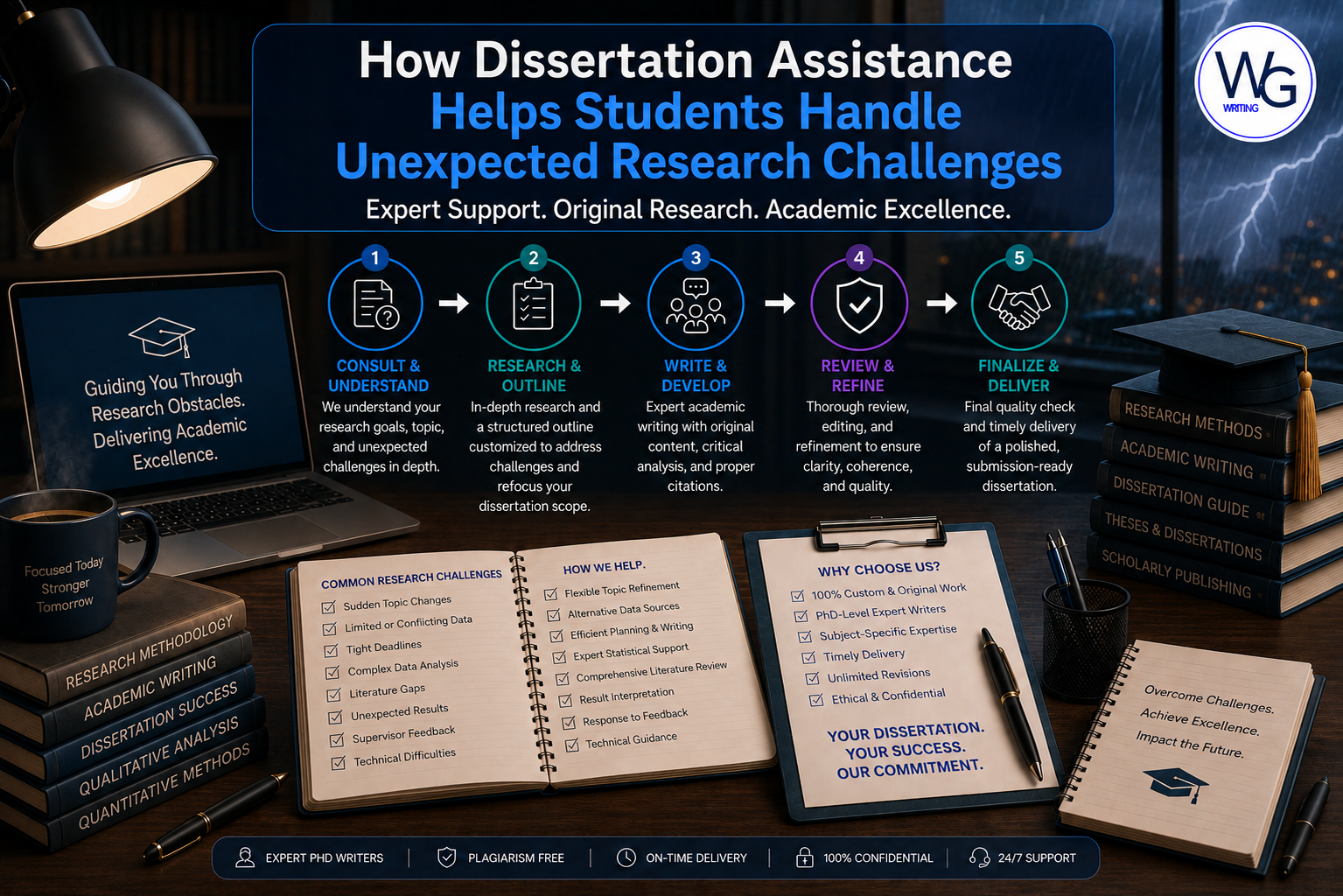
Facing participant recruitment, weak evidence, or unexpected findings? Get expert dissertation assistance to overcome research challenges and finish your PhD with confidence.
How Dissertation Assistance Helps Students Handle Unexpected Research Challenges
Every doctoral research project begins with a carefully designed plan, but very few progress exactly as expected. A study that appeared straightforward during the proposal stage can become far more complex once data collection begins, participants become difficult to recruit, or published evidence contradicts initial assumptions. These unexpected dissertation research challenges are not signs of poor planning—they are common obstacles that require informed academic decisions.
Many students find that unexpected research challenges take more time to resolve than writing the dissertation itself. A chapter can only be written after reliable evidence has been collected, analyzed, and interpreted correctly. When participant recruitment falls short, the literature provides limited evidence, or findings differ from expectations, progress often slows while students try to determine the appropriate course of action. Weeks of uncertainty can quickly become months of missed milestones.
This is where professional dissertation assistance becomes valuable. Rather than simply helping with writing, experienced dissertation specialists evaluate the research problem itself, identify practical solutions that align with the approved methodology, and help students justify those decisions using the relevant evidence and appropriate research design. Identifying and resolving research obstacles early reduces the risk of methodological issues and analytical inconsistencies later in the dissertation.
🚀 Overcome Research Challenges Before They Disrupt Your Dissertation Progress
Unexpected research obstacles can quickly derail your dissertation if they are not resolved using sound methodological approaches. Whether you're struggling with participant recruitment, limited evidence, unexpected findings, or conflicting research, Writing Gram's dissertation specialists provide personalized guidance to help you identify effective solutions while maintaining the quality and credibility of your study.
📖🚀 Place your order today for expert dissertation assistance and get practical solutions for complex research challenges before they compromise your methodology, delay your progress, or affect the quality of your final dissertation.
Why Unexpected Research Challenges Are One of the Biggest Causes of Dissertation Delays
Unexpected research problems often emerge after a dissertation has already received approval and data collection is underway. At this stage, changing direction is not easy because every decision must remain consistent with the approved research design, ethical requirements, and study objectives. As a result, even relatively small research issues can interrupt progress for weeks or months if they are not addressed promptly.
Research projects naturally evolve as new information becomes available. Participant response rates may differ from initial estimates, newly published studies may challenge the theoretical framework, or preliminary findings may reveal patterns that were not anticipated. These developments require thoughtful evaluation rather than quick fixes because each decision influences the credibility of the entire dissertation.
Supervisors play an important role in guiding doctoral research, but they may not always be available to provide immediate feedback. Many supervise several doctoral candidates simultaneously while balancing teaching, research, and administrative responsibilities. This can leave students waiting for clarification, causing delays that affect multiple dissertation chapters.
Not every research difficulty represents a serious problem. Minor issues, such as adjusting interview schedules or clarifying survey questions, are common and usually manageable. More significant doctoral research obstacles, however, require careful academic evaluation because they directly affect the quality and validity of the study. These include:
Inadequate participant recruitment that threatens the required sample size
Limited or inconsistent scholarly literature within the research area
Unexpected findings that challenge the original hypothesis
Conflicting evidence across previous studies
Missing or incomplete datasets that affect statistical or qualitative analysis
Recognizing the difference between routine research adjustments and project-threatening challenges allows students to respond before delays become increasingly difficult to overcome.
Guidance from the University of Minnesota emphasizes that research is an iterative process in which investigators continually evaluate evidence, refine decisions, and respond appropriately to challenges that arise throughout the study. Understanding that adaptation is a normal part of research helps students focus on evidence-based solutions rather than assuming their project has failed.
Common Dissertation Research Challenges That Require Immediate Attention
Poor Participant Recruitment
Participant recruitment is one of the most common reasons doctoral research falls behind schedule. Many students estimate response rates based on optimistic assumptions, only to discover that eligible participants are difficult to reach or unwilling to participate. Others encounter recruitment bias, where responses come primarily from one subgroup, reducing the representativeness of the sample.
Several factors contribute to recruitment difficulties, including:
Low response rates despite multiple recruitment attempts
Strict inclusion and exclusion criteria
Limited access to the target population
Ethical restrictions on recruitment methods
Participants withdrawing before completing the study
Rather than abandoning the project or collecting lower-quality data, dissertation assistance can help students evaluate acceptable recruitment strategies. This may involve broadening recruitment channels, refining participant communication, reassessing sample size calculations where appropriate, or documenting recruitment limitations clearly while remaining consistent with the approved research objectives.
A Literature Review That Doesn't Provide Enough Evidence
Some research topics have abundant scholarly literature, while others reveal surprisingly limited evidence once systematic searching begins. Students may find that most available studies are outdated, focus on different populations, or produce inconsistent conclusions that make it difficult to establish a strong research foundation.
A weak evidence base often results from:
Emerging research areas with relatively few published studies
Heavy reliance on outdated sources.
Narrow search strategies that overlook relevant disciplines
Inconsistent findings across existing publications
Limited high-quality empirical research and literature review.
Professional dissertation help focuses on strengthening the evidence base rather than simply increasing the number of citations. This includes identifying interdisciplinary research that addresses similar concepts, expanding database search strategies, evaluating theoretical frameworks from related fields, and distinguishing between genuinely limited evidence and literature that has simply been overlooked.
Unexpected Findings That Do Not Match the Hypothesis
Many doctoral students assume that unexpected findings indicate something went wrong during the research process. In reality, results that differ from the original hypothesis are common in academic research and often provide meaningful contributions to knowledge when interpreted appropriately.
Attempting to manipulate data or ignore unexpected outcomes can damage the credibility of the dissertation. Instead, students should evaluate why the findings occurred and consider whether contextual factors, methodological limitations, or theoretical perspectives offer reasonable explanations.
Experienced dissertation assistance helps students examine unexpected findings objectively by:
Comparing results with previous empirical studies
Identifying factors that may explain differences
Evaluating whether additional analysis is appropriate
Explaining the academic significance of unexpected outcomes
Developing balanced discussions that acknowledge both strengths and limitations
According to guidance from North Carolina State University, research frequently produces unexpected results, and these outcomes can generate valuable insights when researchers evaluate and report them transparently rather than attempting to force conclusions that were not supported by the evidence.
Conflicting Evidence Across Different Sources
Few research topics produce complete agreement among scholars. One group of studies may report positive outcomes, while another reaches the opposite conclusion using different populations, research methods, or analytical approaches. Students often struggle to determine which evidence should guide their own interpretation.
Conflicting evidence commonly appears because of:
Different theoretical perspectives
Variations in research methodology
Differences in geographical or cultural settings
Diverse participant characteristics
Contradictory empirical findings across multiple studies
Dissertation assistance helps students organize these differences into a coherent academic discussion instead of treating conflicting evidence as a weakness. By evaluating why studies reached different conclusions and identifying patterns across the literature, students can demonstrate critical analysis while positioning their own findings within the broader scholarly conversation.
Missing or Incomplete Data
Data problems can occur even when research has been carefully planned. Participants may leave the study before completion, survey responses may contain significant omissions, interview recordings may become unusable, or electronic datasets may become corrupted. These situations often create uncertainty about whether the research can continue without starting over.
The appropriate response depends on the nature and extent of the missing information. Possible academic approaches include evaluating whether the remaining data satisfy the research objectives, determining whether additional data collection is justified, assessing the potential impact on the findings, and documenting the limitations transparently within the dissertation.
Restarting an entire research project is rarely the first or only option. Careful evaluation often identifies practical alternatives that preserve the integrity of the study while allowing meaningful conclusions to be drawn.
How Dissertation Assistance Helps Solve Research Problems Without Compromising Academic Integrity
Effective dissertation assistance focuses on helping students make academically defensible research decisions instead of taking shortcuts. When unexpected research problems arise, the objective is to evaluate the available evidence, determine the appropriate methodology, and ensure that every decision is clearly justified within the dissertation.
Depending on the specific challenge, dissertation specialists can help students:
Evaluate realistic methodological alternatives that remain consistent with the approved research design.
Determine whether additional participant recruitment or data collection is necessary.
Strengthen the justification for research decisions using relevant scholarly evidence.
Interpret unexpected findings within the context of existing literature instead of treating them as research failures.
Align revised discussions with the original research questions and objectives.
Document research limitations clearly while demonstrating how they affect the interpretation of the findings.
These practical decisions help students move forward with confidence while preserving the credibility of their research. Instead of spending weeks trying to determine the best course of action independently, they receive focused guidance tailored to the specific challenges affecting their dissertation project.
📖 Turn Research Obstacles Into a Stronger Dissertation
Unexpected findings, limited evidence, or missing data do not have to prevent you from completing a high-quality dissertation. Writing Gram's dissertation specialists can help you evaluate academically appropriate solutions, strengthen your research decisions, and keep your project moving toward submission.
📚 Place your order today for expert dissertation assistance and resolve complex research challenges before they disrupt your dissertation timeline or delay your graduation.
When Research Challenges Become a Sign You Should Consider Dissertation Assistance
Many doctoral students try to solve every research problem independently, believing that persistence alone will eventually produce a solution. While independent problem-solving is an important part of doctoral education, there comes a point where continuing without experienced guidance can extend delays rather than resolve them. Recognizing that point early can save weeks or even months of unnecessary setbacks.
One of the clearest warning signs is making little or no meaningful progress despite investing significant time. Spending weeks searching for additional sources, revising recruitment strategies, or reanalyzing the same data without reaching a clear conclusion often indicates that the challenge requires a different perspective rather than more time.
You should also consider dissertation assistance if your supervisor's feedback continues to identify the same unresolved issues across multiple drafts. Repeated comments about insufficient justification, inconsistent interpretation, or gaps in the literature usually suggest that the underlying research problem has not yet been addressed.
Other signs include:
Literature searches repeatedly produce the same limited or conflicting evidence.
Participant recruitment remains unsuccessful despite multiple recruitment efforts.
You are uncertain whether your findings should be interpreted as meaningful or as methodological limitations.
Completing one chapter becomes difficult because unresolved research issues affect subsequent chapters.
Every potential solution appears to create additional methodological questions.
Your dissertation timeline continues to slip because research decisions remain unresolved.
Waiting too long can make these challenges increasingly difficult to manage. For example, delaying decisions about missing data may affect the analysis chapter, discussion, conclusions, and recommendations simultaneously. Addressing the research issue promptly is often more efficient than revising several completed chapters later.
Walden University explains that research often requires investigators to reassess research questions, refine data collection strategies, evaluate emerging evidence, and adjust analytical approaches as new information becomes available. This reinforces an important principle for doctoral students: encountering research challenges is normal, but responding to them with well-reasoned academic decisions is what strengthens the overall quality of the dissertation.
Rather than viewing dissertation help as a last resort, many doctoral candidates use it strategically when research obstacles begin affecting progress. Receiving experienced guidance at the right stage allows students to make informed decisions before isolated research issues develop into project-wide difficulties.
What to Look for Before Choosing Dissertation Assistance for Research Challenges
Not every dissertation assistance service is equipped to address complex research problems. Some focus primarily on editing completed chapters, while others specialize in helping students evaluate methodological issues, interpret evidence, and resolve research obstacles before they affect the entire dissertation. Choosing the right expertise can make a significant difference when your research has reached a difficult stage.
When comparing dissertation assistance, look beyond general claims and evaluate whether the service can work with the specific challenges affecting your research.
Important qualities include:
Experience With Your Research Methodology
Research challenges differ depending on whether your study uses qualitative, quantitative, or mixed methods. Someone familiar with your methodology is better positioned to evaluate issues such as participant recruitment, sampling, data interpretation, or analytical procedures within the context of your research design.
Familiarity With Your Academic Discipline
Research expectations vary across fields. A solution that works for a business dissertation may not be appropriate for nursing, psychology, education, engineering, or public health research. Discipline-specific knowledge allows recommendations to reflect the conventions and expectations of your field.
Ability to Explain Methodological Decisions
Research decisions should never be presented as arbitrary changes. Effective dissertation assistance helps students understand why a particular course of action is appropriate and how to justify that decision within the dissertation itself.
Evidence-Based Recommendations
Recommendations should be grounded in established research methods, published scholarship, and accepted academic practice rather than personal opinion. This helps ensure that every research decision can be supported during supervisor review and final examination.
Working With Existing Research Instead of Starting Over
Unexpected research challenges do not automatically require a completely new dissertation. An experienced dissertation help service should first evaluate whether your existing literature review, methodology, data, and analysis can be strengthened before recommending major changes. Building on completed work often saves considerable time while maintaining consistency throughout the dissertation.
Choosing dissertation assistance based on genuine research capability rather than marketing claims increases the likelihood of resolving research problems efficiently while preserving the quality and continuity of your doctoral study.
Frequently Asked Questions
Can dissertation assistance help if my participant recruitment fails?
Yes. Dissertation assistance can help evaluate why recruitment has been unsuccessful and identify appropriate alternatives, such as refining recruitment strategies, reassessing eligibility criteria where permitted, or determining whether additional recruitment methods are justified. The objective is to resolve recruitment challenges while remaining consistent with ethical requirements and the approved research design.
Can unexpected research findings still produce a successful dissertation?
Absolutely. Many high-quality dissertations report findings that differ from the original hypothesis. What matters is how those findings are interpreted, justified, and connected to existing scholarship. Unexpected results often contribute valuable knowledge when discussed objectively and supported by appropriate academic analysis.
What should I do if my literature review has limited evidence?
Begin by evaluating whether the search strategy can be expanded to include additional databases, related disciplines, theoretical literature, or more recent publications. If the research area genuinely has limited evidence, your dissertation should acknowledge that limitation while explaining how your study contributes to addressing the existing knowledge gap.
Is conflicting research evidence acceptable in a dissertation?
Yes. Conflicting evidence is common in many research fields. Rather than attempting to ignore contradictory findings, students should evaluate why different studies reached different conclusions and explain how their own findings fit within the broader body of scholarly evidence.
When should I seek dissertation assistance during my research?
The best time is when research challenges begin preventing meaningful progress. Seeking dissertation assistance early—before delays affect multiple chapters—often makes it easier to evaluate practical solutions, maintain methodological consistency, and avoid unnecessary revisions later in the research process.
🚀 Don't Let Unexpected Research Challenges Delay Your Doctoral Progress
Research obstacles rarely resolve themselves through additional time alone. Problems such as poor participant recruitment, conflicting evidence, limited literature, unexpected findings, or incomplete data require informed academic decisions that keep your dissertation moving in the right direction. Addressing these challenges early can prevent months of avoidable delays and reduce the risk of problems spreading across multiple chapters.
If your research has reached a standstill, Writing Gram can help you evaluate practical solutions that align with your methodology, research objectives, and academic expectations. Whether you need assistance interpreting unexpected findings, strengthening a weak evidence base, or overcoming complex dissertation project difficulties, our specialists provide personalized dissertation assistance focused on solving real research problems—not generic advice.
📖 Place your order today for expert dissertation help and overcome unexpected research challenges with clear, evidence-based solutions that keep your doctoral research on track for successful submission.