How Professional Dissertation Assistance Helps Maintain Alignment From Proposal to Final Submission
By Writing Gram • Aug 10, 2026
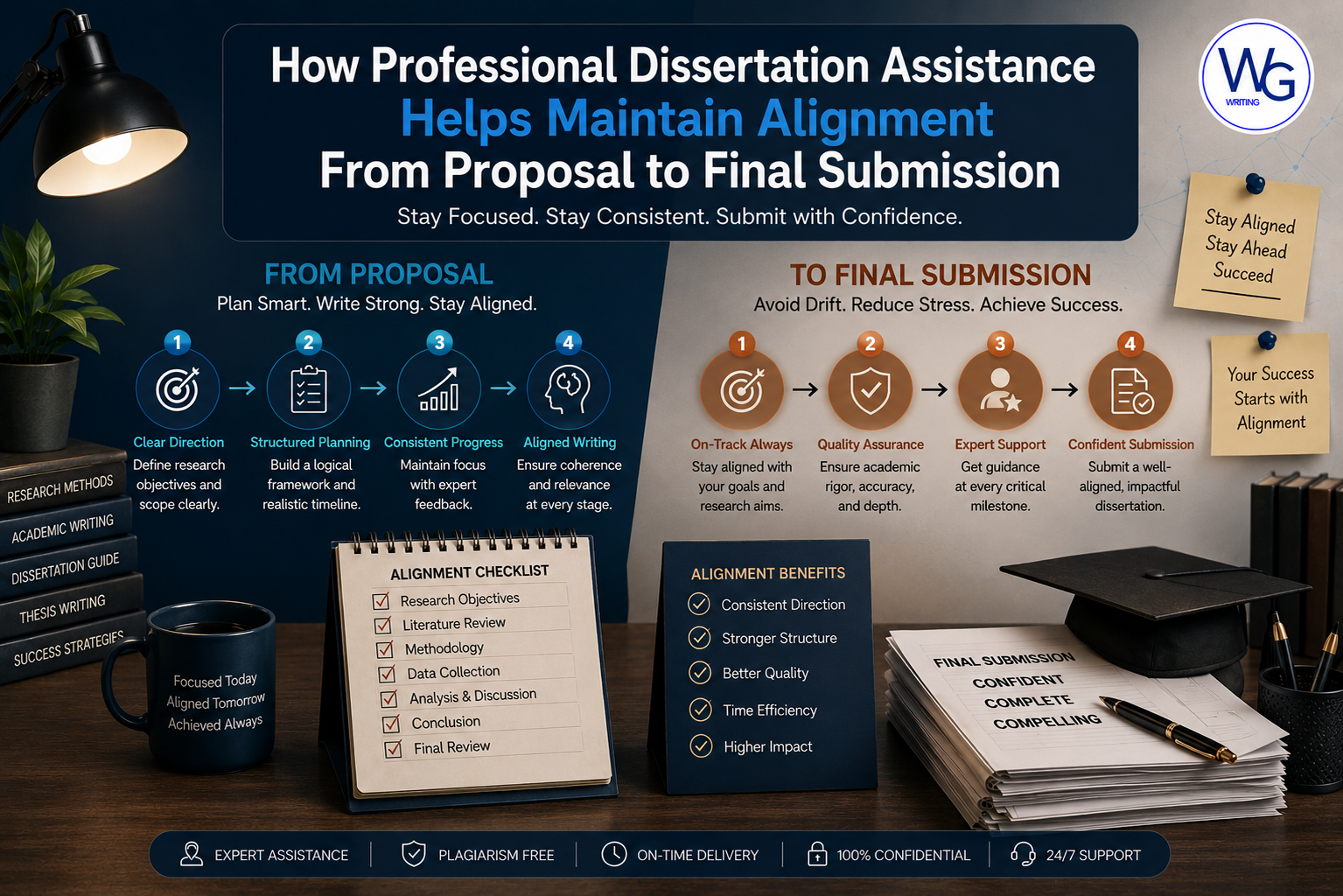
Get dissertation assistance that maintains research alignment from proposal approval through analysis, revisions, and final submission.
Why Dissertation Alignment Must Survive the Entire Doctoral Lifecycle 🎓
A dissertation can have a clear flow across chapters while still drifting from the research plan established in the approved proposal. The reason for this is simple: doctoral research changes as students reach key milestones, receive supervisor feedback, encounter unexpected research challenges, collect evidence, analyze results, and revise their interpretations. Therefore maintaining alignment means more than making chapters consistent. It means keeping the research problem, purpose, questions, evidence, findings, and conclusions connected as the project moves through each doctoral milestone.
The proposal establishes an important reference point for that process. For example, Stanford Graduate School of Education describes the dissertation proposal as a comprehensive statement of the student’s proposed research and requires revisions identified after the proposal hearing to be addressed and documented.
🎯 Get Dissertation Assistance Before Research Changes Create Costly Revisions
Writing Gram gives you dissertation assistance to keep your research aligned as your project develops, helping you identify inconsistencies early, address supervisor feedback clearly, and prevent small changes from creating larger revisions later.
Place your order now and get the dissertation assistance you need to identify inconsistencies, address supervisor feedback, track changes across your research, and keep every chapter connected to your approved research plan.
What Can Break Alignment Between a Proposal and Final Dissertation?
Alignment can weaken gradually as the research develops, especially when changes made along the way are not reflected across the dissertation.
A research question may be adjusted after committee feedback, the available evidence may differ from what the student expected, or a new finding may change how an argument is developed.These changes can be necessary as the research develops, but failing to reflect them in later chapters can create inconsistencies across the dissertation.
This gradual separation can be described as alignment drift: the difference between what the approved research originally set out to investigate and what the completed dissertation ultimately presents.
Several points in the doctoral process can create this drift:
Supervisor or committee feedback: A requested change to the scope or research questions can require corresponding revisions elsewhere in the dissertation.
Changes in the evidence: Participants, documents, datasets, or other sources may not match what was anticipated in the proposal.
Changes during analysis: Results can challenge the expectations established earlier, requiring the interpretation to be reconsidered without changing the original research question unnecessarily.
New literature: Later sources may alter how the research gap or significance is explained.
Late-stage revisions: New claims can sometimes appear during editing without sufficient evidence elsewhere in the dissertation.
The importance of monitoring these changes becomes clearer when doctoral programs treat the proposal as a milestone followed by continued research progress. For example, Duke University notes doctoral students in philosophy revise their dissertation proposals following committee feedback and subsequently report on dissertation progress through annual doctoral committee meetings.
That progression shows why alignment cannot be checked only when the proposal is approved or when the final dissertation is almost finished.
How Dissertation Assistance Supports Alignment at Each Doctoral Milestone
Proposal Approval
The proposal gives the research a documented starting point. Dissertation writing assistance can help students compare the approved proposal with subsequent drafts and identify whether changes have affected the research problem, purpose, questions, scope, evidence, or planned analysis.
This comparison is particularly useful after substantial committee feedback. Instead of treating the proposal as an old document that no longer matters, the student can use it as a reference for explaining how the project developed.
Ethics and Research Preparation
The next consideration is whether the final dissertation remains within the scope of research approved by the committee. If recruitment plans, participant groups, research materials, access arrangements, or other approved elements change, those differences need to remain visible when the research is later described.
Assistance at this stage can focus on comparing the approved research plan with the account eventually presented in the dissertation, helping prevent descriptions of the research process from becoming disconnected from what was actually conducted.
Data Collection
Data collection introduces another opportunity for alignment drift. The proposal may describe an anticipated participant group or evidence base, while the completed study may contain something different.
A useful review asks:
What evidence was originally anticipated?
What evidence was actually obtained?
What changed between those two points?
Does the difference affect the research questions the study can answer?
The goal is not to force the final dissertation to resemble the proposal word for word. It is to make sure that changes in the research are accurately reflected in the claims made later.
Data Analysis
Data analysis should remain tied to the questions established by the research project. New patterns may emerge, but that does not automatically mean they should become new central claims.
A practical alignment chain is:
Research question → Evidence → Finding → Interpretation
If a finding cannot be connected to the relevant research question and supporting evidence, it deserves closer review before becoming part of the central argument.
Findings, Discussion, and Final Submission
The same principle continues into the final chapters. Findings should answer the research questions, the discussion should explain what those findings mean in relation to the research problem and previous research, and the conclusions should reflect what the evidence can support.
Final editing should therefore include more than grammar, formatting, and sentence-level improvements. A complete dissertation review should also examine whether important research decisions made earlier in the doctoral process remain accurately represented in the final document.
Using a Dissertation Alignment Record to Track Research Changes
One practical way to maintain dissertation continuity is to keep an alignment record alongside the main dissertation files. This does not need to become another lengthy academic document. A simple table can capture the major changes that occur throughout the project.
Research element | Original position | Approved change | Current position |
Research problem | Proposal | Scope adjusted after committee feedback | Final problem statement |
Research questions | Proposal | Question revised | Findings and analysis |
Evidence | Planned sources | Actual sources obtained | Evidence presented |
Scope | Initial boundary | Boundary narrowed or expanded | Final interpretation |
Key claims | Anticipated | Revised after findings | Conclusion |
The value of this record is its traceability. A student can see what changed, when it changed, and where that change needs to appear in the dissertation.
It can also prevent a common late-stage problem: remembering that a research decision changed but forgetting which chapters, tables, interpretations, or conclusions were affected by that decision.
University of Pennsylvania's Wharton doctoral program similarly connects the approved dissertation plan to the work that follows: students present a written dissertation plan to their committee, receive feedback on the work and plans for completing the dissertation, and later submit and defend the completed dissertation.
That sequence reinforces the importance of treating dissertation development as an ongoing process rather than a collection of unrelated writing tasks.
When Dissertation Writing Assistance Is Most Valuable
Dissertation writing assistance can be particularly useful when a student needs to keep the proposal, research, analysis, and final chapters consistent with one another rather than simply improve one section.
This includes situations such as:
receiving extensive supervisor or committee feedback;
changing the scope after proposal approval;
discovering that the available evidence differs from the original plan;
writing chapters at different points over several semesters;
managing multiple versions after substantial revisions;
finding that the findings require a different interpretation from the initial expectations;
preparing the complete dissertation for committee review;
incorporating requested changes after a defense or formal review.
The most useful role in these situations is not replacing the student's research decisions. It is helping the student see how those decisions affect the written dissertation as a whole.
For example, changing a research question may affect the literature review, analysis, findings, discussion, and conclusion. Narrowing the study population may affect the description of the research, interpretation of results, limitations, and claims about applicability. Without a deliberate cross-check, a change made in one chapter can leave outdated information elsewhere.
That is why dissertation continuity requires repeated alignment checks throughout the doctoral lifecycle—not one final review immediately before submission.
🎯 Get Professional Dissertation Assistance to Keep Every Revision Aligned
Writing Gram professional dissertation assistance helps you keep your dissertation aligned when your research changes, whether you are responding to committee feedback, working with new evidence, revising chapters, or interpreting new findings.
Place your order now for professional dissertation assistance that helps you connect those changes across your research, address inconsistencies, and keep your final dissertation aligned with your research questions, findings, and conclusions.
How to Check Dissertation Continuity Before Final Submission
The final review should ensure that the dissertation maintains a clear connection between its opening claim, supporting evidence, analysis, and final conclusion. This differs from proofreading because the focus is on ensuring that the dissertation remains logically connected, coherent and consistent from its opening claim to its final conclusion, while catching contradictions, unsupported conclusions, and unresolved changes before the committee or graduate school reviews it.
A useful final check can ask:
Does the final problem statement describe the study that was actually completed?
The opening problem should accurately represent the investigation presented in the later chapters.Do the research questions correspond to the analysis and findings?
Each question should have a clear place in the results rather than being left unanswered or replaced by an unrelated finding.Does every major claim have supporting evidence?
Conclusions should not extend beyond what the reported results can realistically support.Do the abstract, introduction, findings, discussion, and conclusion describe the same study?
Important differences between the abstract, introduction, findings, discussion and conclusion can signal that one part was not updated after later revisions.Do the conclusions answer the research questions directly?
A conclusion should bring the investigation to a close rather than introduce a new research issue that was never examined.Can the development of the study be explained from proposal through completion?
A student should be able to explain the major changes made during the project and why the final dissertation reflects those changes.
Cornell University’s Graduate School places the completed dissertation, final examination, required revisions, and electronic submission in a defined sequence. Its guidance also requires the final dissertation to contain the required sections and supporting components before submission. This makes the final review an important checkpoint for more than formatting: students need to establish that the version being submitted accurately represents the research they completed.
🎓 Get Dissertation Assistance That Supports the Full Research Journey
Dissertation help can be especially useful when students need to keep the connections between their research questions, evidence, analysis, and conclusions clear throughout a long doctoral project. Instead of focusing only on individual chapters, dissertation writing assistance can be used to review the relationship between the proposal, subsequent revisions, supervisor feedback, analysis, findings, discussion, and final conclusions.
Writing Gram can help you examine those connections before submission, identify sections that no longer reflect later research changes, organize revision requirements, and strengthen the continuity of the completed dissertation.
Place your order now for dissertation assistance tailored to your current stage of doctoral research, whether you need help reconciling major revisions, checking connections between research questions and findings, or reviewing the complete dissertation before final submission.