How Supervisors Evaluate Dissertation Proposals Before Approval
By Writing Gram • May 11, 2026
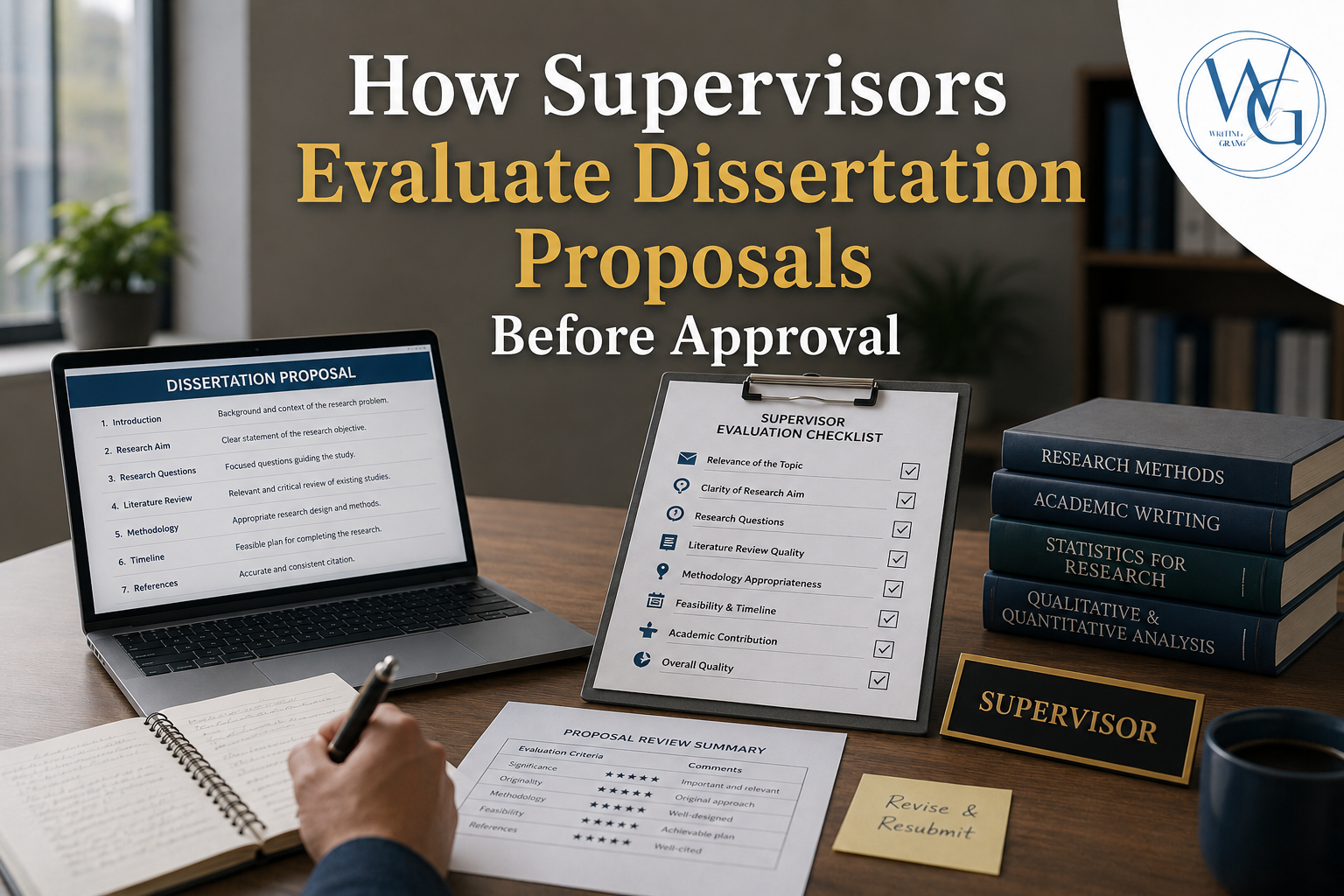
Learn how supervisors evaluate dissertation proposals before approval, including key approval criteria, common rejection reasons, methodology checks, and tips to improve your chances of acceptance.
Before any student begins writing a full dissertation, the proposal must first pass through a strict academic evaluation stage. This is the point where supervisors decide whether the research idea is strong enough, realistic, and has academic merit to proceed. Many proposals never make it past this stage because they fail to meet key academic expectations such as clarity, originality, or methodological strength.
Understanding how supervisors evaluate PhD proposal submissions is essential for students who want approval on the first attempt. Supervisors do not simply skim the document; instead, they carefully assess whether the topic contributes to existing knowledge, whether the research questions are well-defined, and whether the study can realistically be completed within the given timeframe and resources.
At this stage, the PhD proposal review process is highly structured. Supervisors examine the academic quality of the work, including the depth of the literature review, the appropriateness of the methodology, and the overall coherence of the research plan. They also look for alignment between the proposed topic and the department’s areas of expertise to ensure proper guidance throughout the research journey.
A significant number of proposals are rejected or returned for revision because they lack focus, present vague objectives, or fail to demonstrate a clear research gap. In some cases, the idea may be promising, but the structure is not convincing enough to justify full dissertation approval. This is why understanding the expectations behind proposal evaluation is crucial for every research student.
Strong proposals stand out because they are well-organized, logically structured, and grounded in credible academic sources. Supervisors are not only evaluating the idea itself but also the student’s ability to execute the research effectively from start to finish.
Writing Gram helps you refine, structure, and strengthen your dissertation proposal with expert academic support, ensuring clarity, originality, and higher approval chances. Place your order now for a plagiarism-free, non-AI dissertation proposal that is fully customized to your research needs.
Understanding Dissertation Proposal Approval Criteria
The dissertation proposal approval criteria are the academic standards supervisors use to decide whether a student’s research proposal is strong enough to move forward into full dissertation writing. In most universities, this process is not informal or subjective—it follows a structured evaluation system where supervisors assess clarity, academic value, feasibility, and research design before approving.
Academic Relevance
One of the first things supervisors check is whether the topic is academically relevant. The research must clearly fit within the discipline and contribute to ongoing academic discussions. Universities expect proposals to demonstrate a clear research gap and show how the study adds something new to the existing literature rather than repeating established work.
Research Significance
Supervisors also assess whether the study is meaningful in academic settings and in the real world. A strong proposal explains why the research matters and what impact it may have on the field. Without clear significance, even well-written proposals are often rejected because they do not justify the time and resources required for a full dissertation.
Clear Objectives
A major part of what makes a dissertation proposal accepted is the clarity of its objectives. Supervisors expect precise, focused, and researchable questions. Vague or broad objectives are a common reason for rejection because they make it difficult to evaluate direction, outcomes, and overall academic contribution.
Feasibility Within Timeline
Supervisors carefully evaluate whether the proposed research can realistically be completed within the required timeframe. This includes checking data availability, methodological practicality, ethical approval requirements, and resource constraints. Even strong ideas can be rejected if they are not achievable within the expected timeframe.
Structure and Organization
A well-organized proposal is essential. Supervisors expect a logical flow between sections, proper academic formatting, and a clear progression of ideas. Poor structure often signals weak planning, which can lead to rejection even if the topic itself is strong.
According to the Purdue University Online Writing Lab (OWL), a strong research proposal must clearly define the research problem, explain its significance, and outline a feasible methodology that demonstrates how the study will be conducted effectively. This aligns directly with how supervisors evaluate proposals across most academic institutions.
Supervisors apply all these criteria together to determine whether a proposal is ready for approval. A strong submission demonstrates clarity, originality, feasibility, and academic relevance, all of which work together to justify the research.
How Supervisors Assess the Research Topic and Research Questions
One of the most important stages in the evaluation of a dissertation proposal is how supervisors assess the research topic and research questions. At this point, they are trying to determine whether the study has a clear academic direction, whether it is meaningful within the field, and whether it is realistic to develop into a full dissertation. Many proposals fail here because the topic or questions are either too vague, too broad, or not academically grounded. Supervisors assess the following factors to determine whether to approve or reject a dissertation proposal:
Topic Originality
Supervisors first evaluate whether the topic is original enough to contribute to existing knowledge. A strong dissertation proposal should not simply repeat what has already been widely researched. Instead, it should introduce a fresh angle, a new perspective, or an underexplored issue within the discipline. For example, the University of North Carolina at Chapel Hill notes in its graduate research guidance that successful research proposals must clearly demonstrate “a focused and original research problem that contributes to scholarly understanding”. This expectation is central to how supervisors judge whether a proposal is worth approving.
Research Gap
After originality, supervisors closely examine the research gap. The Southern New Hampshire University Shapiro Library explains a research gap as what is missing or underexplored in existing academic literature and research. The proposed study should address that gap. A weak or unclear research gap is one of the most common reasons proposals are rejected because it suggests that the student has not fully understood the existing body of knowledge. Strong proposals clearly explain what has already been studied and what still needs further investigation.
Clarity of Research Questions
Supervisors also assess whether the research questions are clearly defined, focused, and researchable. Well-written research questions guide the entire dissertation process, while unclear or broad questions create confusion about the study’s direction. If the questions cannot be answered through a realistic methodology, the proposal is likely to be revised or rejected.
Alignment with Academic Discipline
Another key factor is whether the topic aligns with the academic discipline and program. Supervisors must ensure that the proposed research fits within the scope of the program and that there is adequate academic support available. A mismatch between the topic and the discipline is one of the subtle yet significant reasons for proposal rejection, especially when students attempt to combine unrelated fields without a clear theoretical connection.
Topic Scope: Too Broad or Too Narrow
Supervisors also carefully evaluate the scope of the topic. If the research is too broad, it becomes unmanageable within the time and word limit of a dissertation. If it is too narrow, it may not provide enough depth for academic analysis. Finding the right balance is essential for approval. This is one of the most common reasons dissertation proposals are rejected, especially among early-stage researchers who struggle to define realistic boundaries for their study.
Overall, supervisors assess the research topic and questions to ensure clarity, originality, and feasibility. A well-defined and well-scoped proposal significantly increases the chances of approval, while vague or poorly structured ideas are quickly flagged for revision or rejection.
If these elements are weak, proposals are usually returned for revision or rejected at the early stage.
👉Writing Gram helps you develop strong, well-structured dissertation proposals that meet strict academic standards with expert guidance at every stage.
Upload your requirements today and place your order to receive a fully customized, plagiarism-free, and non-AI dissertation proposal tailored to your research goals. Get clarity, originality, and a higher chance of supervisor approval from the very first submission.
Evaluating Methodology, Feasibility, and Academic Structure
One of the most critical stages in dissertation proposal evaluation is how supervisors assess the methodology, feasibility, and overall structure of the study. This is where they determine whether the proposed research can actually be carried out in a rigorous, ethical, and academically acceptable way. At this point, supervisors move beyond the topic and research questions and focus on whether the student has a realistic and well-structured plan for conducting the study.
Choosing the Right Research Method
Supervisors first examine whether the proposed research methodology aligns with the research questions. The method must logically support the type of data the student intends to collect and the kind of analysis required.
In most cases, students are expected to justify whether their study will use qualitative, quantitative, or mixed methods. Qualitative approaches are typically used for exploring experiences, meanings, and perceptions, while quantitative methods focus on numerical data and statistical analysis. Mixed methods combine both to provide a more comprehensive understanding of the research problem.
According to the University of California, Berkeley College of Letters & Science, a strong research proposal must clearly explain the research design and justify why the chosen methods are appropriate for answering the research questions.
Feasibility Assessment
Supervisors also carefully evaluate the feasibility, which plays a major role in determining whether a dissertation proposal is accepted. Even a strong research idea will not be approved if it cannot realistically be completed within the required timeframe or with the available resources.
Time limitations are a major consideration. Supervisors assess whether the scope of the study is manageable within the program schedule, especially for master’s and PhD programs with strict deadlines. If a project is too large or complex, it is often revised or rejected.
Data accessibility is another key factor. Supervisors check whether the student can realistically obtain the required data, whether through surveys, interviews, archival sources, or databases. If data collection is impractical or restricted, the proposal is unlikely to be approved.
The research scope is also evaluated to determine the feasibility of the project. A proposal that is too broad may lack depth, while one that is too narrow may not conduct sufficient research for meaningful analysis. Supervisors aim to ensure the study is realistic, achievable, and fits within the required scope.
Proposal Structure and Organization
Another important area of evaluation is the overall structure and organization of the proposal. Supervisors expect a clear and logical flow between sections, including the introduction, literature review, methodology, and research objectives. A poorly structured proposal can create confusion about the research direction, even when the idea itself is strong.
Clarity and coherence are essential because they reflect the student’s ability to plan and execute the research effectively. In many cases, supervisor feedback on dissertation proposals focuses heavily on improving the structure, clarifying the methodology, and ensuring that each section aligns with the research objectives.
A well-organized proposal demonstrates preparedness and competence, while disorganized writing often raises concerns about a student’s ability to manage the full dissertation process.
Overall, supervisors evaluate the methodology, feasibility, and structure to determine whether the research is practical, credible, and well- planned.
Common Proposal Rejection Reasons Supervisors Identify
These are the most common reasons supervisors identify for rejecting dissertation proposals:
Weak literature review
A literature review that is too shallow, outdated, or poorly organized signals that the student has not fully understood the academic background of the topic. Supervisors expect engagement with current and relevant scholarly sources, typically published within the last five years, to demonstrate awareness of existing research.Poorly defined objectives
When research aims and questions are vague or broad, the proposal loses direction. Supervisors need clearly defined objectives to assess whether the study can realistically be completed and whether it contributes to the field.Unrealistic methodology
A common issue is proposing research methods that cannot be realistically executed. This includes overly complex data collection plans, inaccessible populations, or methods that do not align with the research questions. The University of Maryland Graduate School emphasizes that a strong research proposal must clearly justify the methodology and demonstrate its feasibility within the project scope.Lack of originality
Proposals that fail to demonstrate a clear research gap are often rejected. Supervisors look for studies that contribute new insights rather than repeating well-established findings without a fresh perspective.Grammar and structure issues
Poor writing quality, inconsistent structure, and unclear argument flow can negatively influence supervisor judgment. Even strong ideas may be rejected if the proposal is difficult to read or logically disorganized. Supervisors use plagiarism detection tools such as Turnitin to verify that a dissertation proposal is original.Inadequate academic sources
Using unreliable, outdated, or non-scholarly sources weakens the credibility of the proposal. Supervisors expect students to engage with peer-reviewed journals and credible academic materials.Unclear theoretical framework
A missing or poorly explained theoretical framework makes it difficult to understand how the research is anchored in existing academic literature. Supervisors need a clear link between theory and research design to evaluate how well the study is supported by existing research.
Writing Gram helps you eliminate these common proposal problems by refining your research questions, strengthening your literature review, and ensuring your methodology is realistic and academically sound. With expert writers who understand supervisor expectations, you get a fully structured, clear, and high-quality dissertation proposal that stands a much higher chance of approval.
👉Place your order today to get a plagiarism-free, non-AI, supervisor-ready proposal prepared by expert dissertation proposal writers.
How to Improve Your Dissertation Proposal Before Submission
Improving your dissertation proposal before submission is one of the most important steps in increasing your chances of approval. Supervisors often provide feedback during the early stages of the PhD proposal review process, and students who act on that feedback quickly tend to produce stronger, more convincing proposals.
Practical Steps to Strengthen Your Proposal
Follow university guidelines carefully
Every institution has specific formatting, structural, and content requirements. Ignoring these guidelines is one of the fastest ways to delay approval or trigger revisions.Refine research questions
Ensure your research questions are clear, focused, and directly aligned with your topic. Weak or broad questions often lead to confusion during evaluation.Use recent academic sources
Strong proposals rely on up-to-date, peer-reviewed research. Using recent studies shows that your topic is relevant and grounded in current academic discussions.
Tip: Use sources published within the last five years to ensure your dissertation reflects up-to-date information. Always consult your supervisor, as some projects may require the use of older sources depending on the topic and research context.
Get supervisor feedback early
Early supervisor feedback on dissertation proposals is extremely valuable. It helps identify formatting issues, unclear arguments, or methodological weaknesses before submission.Proofread thoroughly
Grammar, clarity, and formatting errors can weaken even a strong proposal. Careful proofreading improves readability and demonstrates credibility.Ensure logical structure
Your proposal should flow smoothly from the introduction to the methodology. Each section must connect logically to the next, showing a clear research direction.
Why Early Revisions Matter
Making improvements early can significantly increase your chances of approval. Supervisors are more likely to accept proposals that show clear refinement, strong academic alignment, and responsiveness to feedback. Small adjustments in structure, clarity, and methodology can make a major difference in how the proposal is evaluated.
Writing Gram helps you transform weak proposals into clear, structured, and supervisor-ready research documents through expert PhD help.
Place your order now for fully customized, non-AI, plagiarism-free dissertation proposal support. You’ll get improved clarity, a stronger methodology, and higher chances of approval.
Increase Your Chances of Dissertation Proposal Approval
Meeting supervisor expectations is the most important factor in getting a dissertation proposal approved. Supervisors are not only assessing your idea, but also how well you present it in terms of structure, clarity, originality, and how well it is supported by existing research. A strong proposal demonstrates a clear research direction, a well-justified methodology, and a focused set of objectives that can realistically be achieved within the program timeline.
Approval depends on how well these key elements come together. A well-structured proposal shows logical flow and a clear, organized approach to the research. A strong methodology proves that the research can actually be conducted. Originality ensures the study contributes new knowledge, and clarity makes it easy for supervisors to evaluate your work without confusion. When these aspects are aligned, the chances of approval increase significantly.
If you want to improve your dissertation proposal, getting professional support can make a major difference. Expert help can guide you through dissertation proposals, research planning, methodology development, and detailed editing and proofreading to ensure your work meets academic standards.
👉Place your order today to receive a plagiarism-free, non-AI, custom dissertation proposal tailored to your topic, along with expert research support, faster revisions, and a significantly higher chance of supervisor approval.