How Universities Detect AI-Generated Dissertations and How to Avoid Rejection
By Writing Gram • May 5, 2026
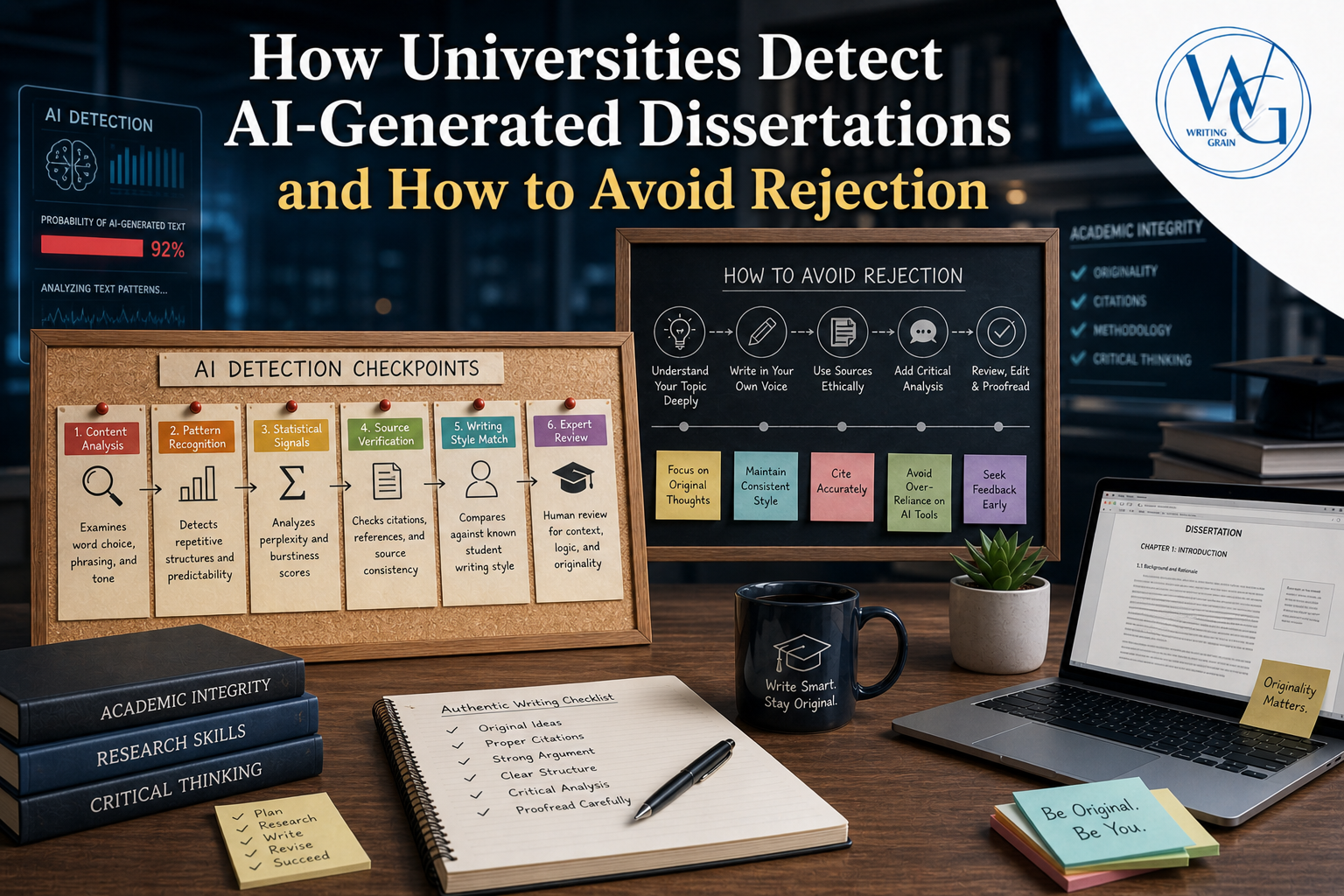
Learn how universities detect AI-generated dissertations and what you can do to avoid rejection. Discover how Writing Gram provides human-written, plagiarism-free, Turnitin-ready dissertations that meet doctoral standards and help you submit successfully.
The increasing use of generative AI tools in academic writing has raised concerns in higher education about originality, authorship, and academic integrity, prompting universities to revise assessment standards to ensure the legitimacy of submitted academic work.
In this context, a key question many students now ask is can universities detect AI writing, especially as detection systems become more advanced and integrated into submission workflows. The development of the AI detection dissertation screening process reflects a broader shift in how academic work is assessed, with institutions increasingly relying on a combination of automated tools and human evaluation to identify inconsistencies in writing style, structure, and critical depth.
As a result, students are increasingly exposed to risks such as assignment rejection, academic misconduct investigations, or mandatory revisions if the submitted work appears artificially generated or does not reflect their own writing style. This has made it essential to understand how detection systems operate and how to produce original, well-structured dissertations.
Writing Gram supports students by providing carefully developed, human-written, Turnitin-ready dissertations that are plagiarism-free and free from any AI-generated content, ensuring that submitted work meets institutional expectations while maintaining clarity, coherence, and scholarly integrity.
👉 Place your order today with Writing Gram to receive a fully original, plagiarism-free, Turnitin-ready dissertation that meets academic standards and helps you avoid rejection, unnecessary revisions, and submission delays.
Why Universities Are Actively Screening for AI-Generated Dissertations
Universities are placing greater emphasis on academic integrity as generative AI becomes more widely accessible, resulting in closer scrutiny of student submissions, especially dissertations. A major concern is academic integrity, where institutions aim to ensure that submitted work genuinely reflects a student’s own understanding, reasoning, and research effort. According to guidance from the University of Texas at Dallas, students are expected to uphold honesty and integrity in all academic work, including dissertations, and universities reserve the right to regulate or assess the use of generative AI within assessments to preserve these standards. This shift reflects a broader institutional effort to protect the credibility of academic qualifications in an environment where AI-generated content is becoming increasingly difficult to distinguish from human writing.
Another key reason universities are screening dissertations for AI-generated content is to verify originality and confirm authorship. Academic institutions must be confident that a dissertation represents independent thought rather than machine-generated text, especially in high-stakes qualifications such as master’s and doctoral degrees. The University of North America Student AI Policy notes that many universities now explicitly classify submitting AI-generated work as one’s own as a breach of academic conduct, reinforcing the expectation that students demonstrate their own intellectual contribution in their research outputs. This has made originality a core evaluation criterion, not just in terms of plagiarism, but also in terms of authorship authenticity.
Finally, institutional policies are rapidly evolving as universities respond to the widespread use of AI tools in education. Across the education sector, policies are being updated to define acceptable and unacceptable uses of generative AI, often requiring disclosure, limiting usage, or prohibiting it entirely in formal assessments, depending on the institution. For example, the University of Southern California notes that universities are increasingly providing clear expectations on AI use and encouraging instructors to define boundaries within course guidelines to maintain fairness and consistency in assessment. This evolving policy landscape means that work previously considered acceptable may now be flagged under stricter rules, increasing the likelihood of detection and review during dissertation submissions.
Concerns around plagiarism AI detection in PhD work have become more prominent, as doctoral-level writing is expected to demonstrate the highest level of independent research and critical thinking. As universities refine their detection systems and policies, students are now expected to navigate not only traditional plagiarism checks but also advanced AI screening mechanisms that assess writing style, consistency, and authorship authenticity.
Dissertation assistance writing services like Writing Gram employ expert writers who do not use AI tools, and all work is carefully reviewed to ensure it contains no unintended AI-generated content.
How Universities Detect AI Writing in Dissertations
Universities are increasingly using advanced software to assess the originality and authorship of student submissions, with tools designed to detect both plagiarism and potential AI-generated content. One of the most widely used platforms is Turnitin, which has expanded its capabilities to include AI writing indicators alongside traditional similarity checking. In many institutions, Turnitin’s AI detection tools are now integrated into submission workflows, where student work is analyzed for patterns such as unusually consistent sentence structure, overly uniform organization, and limited variation in critical reasoning. These systems do not simply flag copied text but also assess writing characteristics that may suggest non-human authorship, making them a central part of modern academic evaluation.
Beyond Turnitin, universities also use a wide range of academic AI writing detection tools that function as supplementary systems to support academic integrity reviews. These tools apply linguistic and probabilistic models to evaluate whether a dissertation aligns with expected human writing patterns, often comparing submissions against large datasets of academic work. While no system is perfect, the combination of multiple detection methods increases the likelihood of identifying inconsistencies that may require further review by faculty members. As a result, students are expected to ensure that their dissertations reflect genuine analytical thinking, coherent argument development, and a consistent academic tone throughout, rather than relying on automated text generation that may be flagged during institutional review.
As a result, students are expected to ensure that their dissertations demonstrate clear analytical thinking, coherent argument development, and a consistent academic tone throughout, rather than relying on automated text generation that may be flagged during institutional review.
Dissertation assistance writing services like Writing Gram employ expert writers who do not use AI tools, and all work is carefully reviewed to ensure it contains no unintended AI-generated content.
👉Just upload your instructions and requirements and let our professional dissertation writers handle the rest. We will develop a fully original, non-AI dissertation designed to pass rigorous Turnitin checks while delivering high-quality work that strengthens your chances of approval.
How Universities Detect AI Writing in Dissertations
AI Detection Software and Tools
Universities are increasingly relying on academic AI writing detection tools to assess whether a dissertation reflects genuine student authorship.
These systems are often integrated into existing plagiarism detection platforms and are designed to identify patterns associated with machine-generated writing, such as uniform sentence structures, repetitive phrasing, and unusually consistent tone. One widely used system is Turnitin, which now includes AI writing indicators alongside its traditional similarity reports. In a typical Turnitin AI detection dissertation review process, submissions are analyzed not only for copied content but also for linguistic signals that may suggest automated text generation. According to the University of California, Berkeley’s academic integrity guidance, instructors are encouraged to combine technological tools with academic judgment when evaluating originality and authorship in student work, reinforcing that detection relies on both automated systems and human evaluation rather than algorithms alone.
Writing Style and Consistency Analysis
Beyond software-based tools, universities also carefully evaluate writing style and internal consistency throughout a dissertation. One of the most common indicators of concern is a sudden shift in tone, vocabulary complexity, or argument structure, which may suggest that different sections were produced using inconsistent writing sources or automated assistance.
Academic reviewers also look for a consistent personal academic voice, as genuine research typically reflects a developing line of reasoning shaped by the student’s own analytical thinking. Overly generic phrasing or text that lacks subject-specific depth can also raise questions during assessment. In this context, concerns around whether universities can detect AI writing are closely tied to how well a student maintains coherence, originality, and intellectual continuity across chapters.
Supervisor Review and Oral Defense (Viva)
Another key method universities use to verify dissertation authenticity is the supervisory and oral defense process. During these interactions, students are expected to explain and defend their research choices, methodology, and conclusions in real time. A common red flag arises when there is a noticeable mismatch between the written dissertation and the student’s ability to clearly articulate its arguments during the oral defense. If a student cannot confidently explain key concepts or justify their reasoning, it may raise concerns about authorship and understanding. This step remains critical because it allows examiners to assess whether the work reflects genuine academic engagement or AI-generated content.
Metadata and Draft History Checks
Universities may also review document development patterns through metadata and draft history analysis, particularly when submissions are made electronically. Tools such as Google Docs or Microsoft Word often retain version histories that show how a dissertation evolved over time. A lack of progressive drafting, such as large sections appearing suddenly without intermediate revisions, can appear inconsistent with normal academic writing behavior. Examiners may use this information to assess whether the work demonstrates a structured research process, including planning, drafting, and revision stages, which are essential components of legitimate dissertation development.
Limitations of AI Detection Tools (What Students Often Misunderstand)
AI detection systems used in academic settings are often seen as definitive proof of authorship, but in reality, they have important limitations that students do not always fully understand. While tools such as Turnitin’s AI writing indicators are widely used in the evaluation process, they do not provide absolute certainty about whether a dissertation was written by a human or generated with AI. Instead, they rely on pattern recognition and statistical models that estimate the likelihood of machine-generated text, which means the results should be interpreted as indicators rather than final judgments. This distinction is especially important in the context of an AI detection dissertation, where students may mistakenly assume that a flagged result automatically leads to rejection.
One of the key limitations is the possibility of false positives, where genuinely human-written work is incorrectly identified as AI-generated due to factors such as consistent writing style, formal academic tone, or simplified sentence structures. Similarly, detection systems are inherently probabilistic, meaning they operate on likelihood rather than certainty, which introduces a margin of error in their assessments. As a result, human academic judgment remains central to the evaluation process, with instructors and examiners reviewing flagged content in context rather than relying solely on automated outputs. This balance between technology and human review ensures that decisions about academic integrity are not made purely by algorithms, but through a more comprehensive assessment of writing quality, intent, and authorship.
Risks of Submitting AI-Generated Dissertations
Submitting an AI-generated dissertation can lead to serious academic consequences, particularly as universities continue to strengthen their academic integrity policies.
One of the primary risks is the possibility of an academic misconduct investigation, where the institution reviews the submission to determine whether the work meets the required standards of originality and authorship. In such cases, students may be asked to explain their research process, demonstrate understanding of their arguments, and justify how the dissertation was developed. If the work is found to rely excessively on automated generation without proper disclosure or academic engagement, it may be treated as a violation of institutional guidelines.
Another significant risk is rejection or forced revisions, where examiners require substantial changes before a dissertation can be accepted for grading or final submission. This often occurs when sections of the work lack depth, consistency, or clear academic reasoning, which can raise concerns about whether the student has fully engaged with the research process. In more severe cases, these issues can result in delayed graduation, as students may need additional time to rewrite or resubmit their dissertations to meet the required academic standards. Ultimately, universities prioritize independent scholarly contribution, and any submission that fails to demonstrate this clearly may face additional scrutiny.
Practical Strategies to Ensure Dissertation Originality and Academic Compliance
Maintaining academic integrity while producing a strong dissertation requires a deliberate focus on originality and structured thinking. Universities assess not only the final submission but also the depth of reasoning, coherence of arguments, and evidence of independent research. To reduce the risk of rejection, students must ensure that their work reflects genuine intellectual effort rather than relying on automated text generation, which can weaken analytical depth and raise concerns during review processes.
Build a Clear and Original Research Direction
A strong dissertation begins with a well-defined research question and a logically developed argument shaped through independent thinking. Instead of depending on pre-generated content, students should develop ideas through reading, critical analysis, and engagement with credible academic sources. This approach ensures that the dissertation demonstrates genuine intellectual contribution and avoids overly generic or surface-level discussion that may raise concerns during academic evaluation.
Maintain a Consistent Academic Writing Style
Consistency in tone, structure, and academic expression is essential throughout the dissertation. A common issue identified in assessed work is uneven writing quality or sudden shifts in language complexity, which can disrupt the coherence of the argument. A well-written dissertation should maintain a steady academic voice from introduction to conclusion, with ideas progressing logically and clearly without unexplained stylistic changes or vague generalizations.
Use AI Responsibly as a Support Tool Only
If AI tools are used during the writing process, they should function strictly as support mechanisms rather than content generators. They may be useful for refining clarity, editing and proof-reading, organizing ideas, or assisting with early-stage brainstorming, but the core analysis, argument development, and writing must be done by the student. Over-reliance on automated generation increases the risk of detection during institutional review and may lead to concerns about authenticity, which can ultimately affect assessment outcomes.
Work With Human Academic Support
Maintaining originality in dissertation writing often requires professional academic support that focuses on clarity, argument development, and effective integration of research rather than just generating content. Students are increasingly advised to understand how to avoid AI detection in thesis work, which primarily means ensuring that their writing reflects genuine understanding, a consistent academic voice, and properly developed arguments supported by credible sources. The goal is not to “beat” detection systems, but to produce work that naturally meets academic standards of authorship and critical thinking.
In many cases, students benefit from guided academic assistance that helps improve structure, refine arguments, and strengthen overall coherence without compromising originality. This is where services like Writing Gram play a role by providing human-written academic support that focuses on dissertation planning, editing, and refinement. The emphasis is on producing work that aligns with university expectations for clarity, depth, and integrity, ensuring that the final submission is both credible and plagiarism-free.
👉 Place your dissertation order now and receive an original, professionally structured, plagiarism-free, and non-AI dissertation that meets the required academic standards and helps you submit with confidence while avoiding unnecessary rejection or revision delays.
Ethical Dissertation Writing in the Age of AI
The rise of generative AI has changed how students approach academic writing, while also making ethical writing practices more important than ever. While AI tools can assist with idea generation or improving clarity, they should not replace the core process of research, analysis, and critical thinking that defines a dissertation. Universities expect students to demonstrate independent intellectual effort, and over-reliance on automated content generation can weaken both academic quality and authorship credibility.
Academic integrity remains the foundation of dissertation writing, particularly as institutions strengthen their evaluation methods to ensure that submitted work genuinely reflects student understanding. This includes maintaining originality in arguments, properly engaging with scholarly sources, and ensuring that the writing process reflects genuine learning rather than automated production. Upholding these standards is essential not only for passing academic review but also for building trust in one’s scholarly abilities. Failing to follow your institution’s academic integrity guidelines on the use of AI tools can result in your dissertation failing.
Academic credibility is determined by the ability to consistently produce original, well-reasoned work that demonstrates independent thinking. Students who prioritize ethical writing practices are better positioned to succeed beyond graduation, as the skills developed through authentic dissertation writing translate directly into professional and research environments. As AI continues to evolve, the value of genuine academic effort becomes even more significant in distinguishing credible scholarship from automated output.
Secure Your Dissertation with Trusted Human Academic Support
As universities continue to strengthen their review processes, AI detection dissertation methods are becoming increasingly sophisticated, making shortcuts riskier for students aiming to graduate without delays or complications.
Detection is no longer limited to basic software checks; it now combines writing analysis, institutional policies, and expert review by instructors, all aimed at ensuring that submitted work reflects genuine intellectual effort. In this environment, relying on automated content generation can introduce inconsistencies, weaken argument quality, and raise unnecessary concerns during evaluation, ultimately affecting the outcome of your submission.
Choosing the right support approach is therefore essential. Instead of risking rejection, revisions, or academic scrutiny, students benefit more from structured, human-led assistance that prioritizes originality, clarity, and academic integrity.
Writing Gram provides professionally developed, human-written dissertations that are carefully structured, plagiarism-free, and aligned with university standards, ensuring that your work reflects authentic research and critical thinking.
👉 Place your dissertation order with Writing Gram today to receive an original, Turnitin-ready dissertation that meets academic expectations and allows you to submit with confidence while avoiding unnecessary risks and delays.