What Makes a Dissertation Writer Qualified to Handle Doctoral Research?
By Writing Gram • Jun 27, 2026
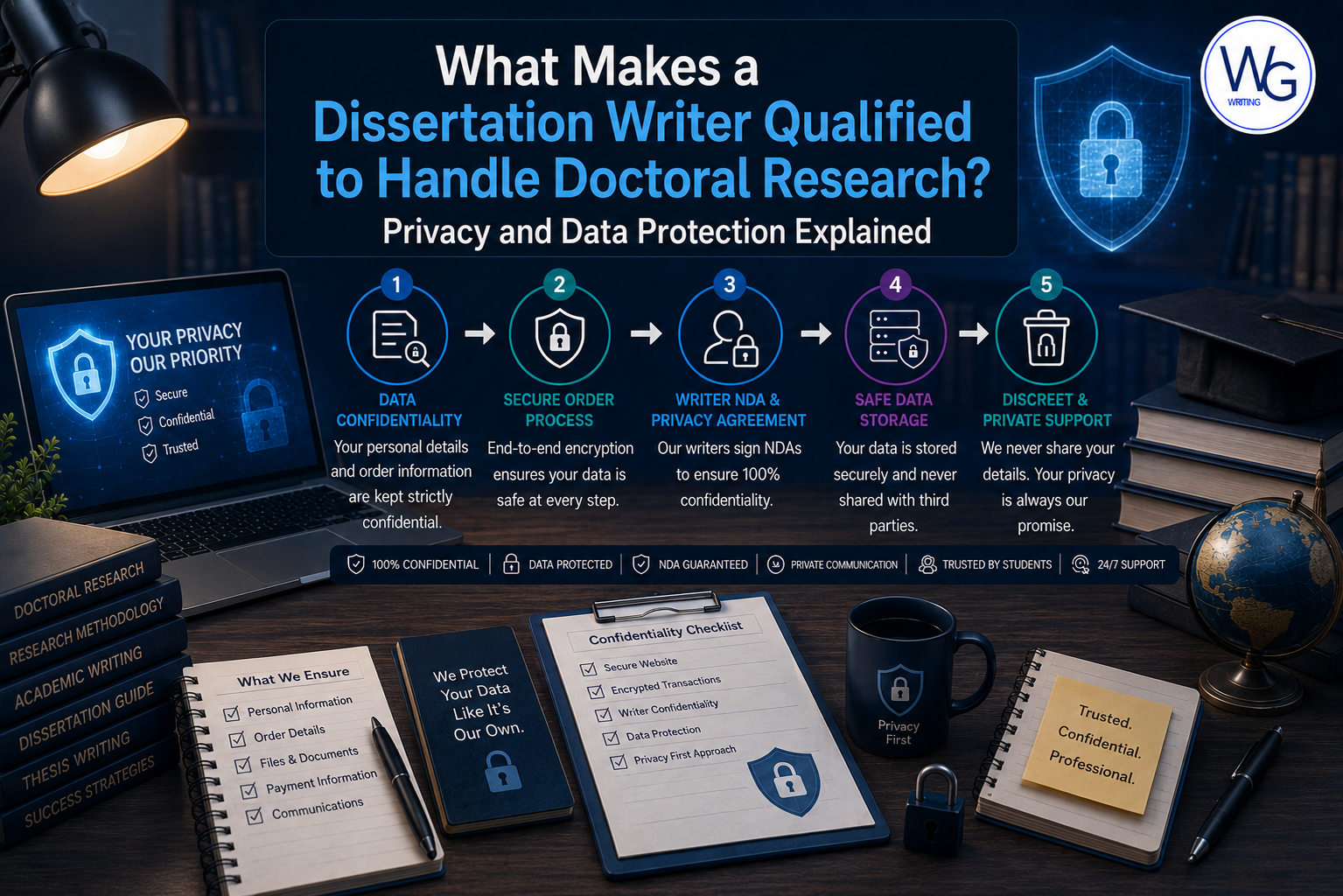
Discover what makes a qualified dissertation writer. Learn the credentials, research expertise, and skills that matter before hiring dissertation help.
Why Qualifications Matter When Handling Doctoral Research
Doctoral research demands a level of academic expertise that extends far beyond undergraduate and master's coursework. A dissertation is expected to demonstrate independent thinking, rigorous research, critical analysis, and a meaningful contribution to existing knowledge within a specific field. Because of these expectations, selecting a qualified dissertation writer is one of the most important decisions a doctoral student can make when seeking professional academic support.
Unlike shorter academic assignments, a doctoral dissertation requires months of planning, extensive scholarly research, careful evaluation of evidence, and the ability to present complex ideas through well-structured academic writing. Every chapter must build logically upon the previous one while maintaining consistency in argument, methodology, and academic style. Even minor weaknesses in research design, literature analysis, or data interpretation can affect the overall quality of the dissertation.
A writer's qualifications directly influence whether they can meet these demanding academic standards. An experienced professional dissertation writer understands how doctoral research differs from other forms of academic writing and recognizes the importance of producing work that is accurate, logically organized, thoroughly researched, and aligned with university requirements. Their expertise helps ensure that each section of the dissertation supports a coherent research objective while maintaining academic integrity throughout the project.
Doctoral research also requires specialized knowledge that goes beyond writing ability alone. A writer should understand advanced research methodologies, evaluate scholarly literature critically, develop evidence-based arguments, and communicate complex concepts with clarity. These skills enable them to support research projects across various disciplines while adapting to the specific expectations of each field.
Not every academic writer possesses the expertise required to handle doctoral-level work. While many writers may have experience completing essays, coursework, or master's assignments, doctoral research presents a different level of complexity. A lack of advanced research experience or subject-specific knowledge can result in weak literature reviews, poorly justified methodologies, inconsistent arguments, or conclusions that fail to address the research objectives.
When evaluating a dissertation writing service, consider whether its writers demonstrate qualifications such as:
Advanced academic education relevant to the subject area.
Experience supporting doctoral-level research projects.
Strong knowledge of qualitative, quantitative, or mixed research methods.
The ability to analyze and synthesize scholarly literature.
Familiarity with university dissertation structures and academic standards.
Excellent critical thinking, analytical writing, and academic editing skills.
Commitment to producing original, well-documented academic work.
Choosing a writer with these qualifications can improve the overall organization, clarity, and scholarly quality of your dissertation while reducing the risk of avoidable research and writing mistakes. More importantly, working with someone who understands the expectations of doctoral research provides valuable support throughout one of the most demanding academic projects a student will undertake.
🚀 Work With Qualified Dissertation Writers Who Understand Doctoral Research
At Writing Gram, our professional dissertation writers have the research expertise, academic writing skills, and subject knowledge needed to support complex doctoral projects. Whether you need assistance with a research proposal, literature review, methodology chapter, data analysis, editing, or a complete dissertation, we provide original, carefully structured support tailored to your research objectives and university requirements.
📚🎓 Place your order today and work with qualified dissertation writers who can strengthen your research, improve the quality of your dissertation, and help you submit well-organized doctoral work that meets the high academic standards expected at the PhD level. ✅
What Is a Qualified Dissertation Writer?
A qualified dissertation writer is an academic professional with advanced subject knowledge, strong research expertise, and the ability to produce doctoral-level writing that meets university standards. They understand research methodologies, scholarly writing conventions, and the critical analysis required to support original, well-structured dissertations.
A qualified dissertation writer does far more than write academic content. They possess the knowledge and analytical skills needed to support complex doctoral research while maintaining the academic standards expected of PhD-level work. Their role involves helping students develop logical arguments, evaluate scholarly evidence, organize research effectively, and communicate ideas with clarity and precision.
Doctoral research demands a high level of academic writing proficiency alongside the ability to engage critically with existing literature. Recent peer-reviewed research in Sage Journals has highlighted that successful doctoral writing depends on advanced reading, critical evaluation, discipline-specific knowledge, and the ability to communicate research according to doctoral expectations, emphasizing that these competencies are essential for producing high-quality dissertations.
A professional dissertation writer should demonstrate several core qualifications that distinguish them from general academic writers, including:
Advanced academic education that provides a thorough understanding of research principles and scholarly communication.
Research expertise in locating, evaluating, and synthesizing credible academic sources to build evidence-based arguments.
Subject-specific knowledge that enables accurate use of disciplinary concepts, terminology, and research methods.
Strong academic writing skills for producing clear, coherent, and logically organized doctoral-level content.
Knowledge of doctoral dissertation standards, including chapter organization, research methodology, citation styles, ethical academic practices, and university formatting requirements.
Critical thinking and analytical ability to interpret findings, identify research gaps, and develop original academic arguments supported by scholarly evidence.
These qualifications allow a doctoral research writing expert to contribute meaningfully throughout the dissertation process. Whether supporting a literature review, refining a methodology chapter, improving data interpretation, or strengthening academic arguments, a qualified writer understands how every component of a dissertation contributes to a coherent and academically rigorous research project.
It is equally important to recognize that academic writer qualifications extend beyond formal education. Experience working with doctoral dissertations, familiarity with university assessment criteria, attention to detail, and the ability to maintain consistency across multiple chapters are all characteristics of a writer who is prepared to handle the demands of doctoral research.
Choosing a writer with the appropriate dissertation writer credentials helps ensure that your dissertation is supported by someone who understands both the intellectual demands of doctoral study and the scholarly expectations required for successful academic research.
Why Qualifications Matter When Handling Doctoral Research
Doctoral research is one of the most demanding forms of academic work. Unlike undergraduate or master's assignments, a dissertation requires students to investigate a research problem independently, evaluate existing scholarship critically, apply appropriate research methods, and produce findings that contribute new knowledge to their field. These expectations make the qualifications of a professional dissertation writer especially important when seeking academic support.
Recent research published in the peer-reviewed article Evaluation Practices of Doctoral Examination Committees: Boundary-Work Under Pressure on doctoral assessment highlights that universities evaluate dissertations against rigorous standards, including originality, independent research capability, critical analysis, credibility of the methodology, and a meaningful contribution to knowledge. These expectations are consistently reflected in doctoral examination practices across institutions, demonstrating why advanced expertise is essential when supporting PhD-level research.
A qualified dissertation writer understands that doctoral research is not simply about producing well-written content. It requires the ability to guide complex research while ensuring that every chapter aligns with the study's objectives, research questions, methodology, and academic standards.
The Complexity of Doctoral Research
Doctoral dissertations involve multiple interconnected components that must work together to produce a coherent and credible research project. A writer supporting doctoral research should understand how to:
Develop a clear and researchable problem statement.
Conduct comprehensive literature reviews using scholarly sources.
Identify research gaps that justify the study.
Select appropriate qualitative, quantitative, or mixed-method research designs.
Interpret findings accurately without overstating conclusions.
Present evidence logically throughout the dissertation.
Managing these elements requires both advanced research knowledge and extensive experience with doctoral-level academic writing.
Higher Expectations for Critical Analysis
Universities expect doctoral candidates to move beyond summarizing existing research. Instead, dissertations should demonstrate the ability to examine competing viewpoints, evaluate the strengths and limitations of previous studies, identify patterns in the literature, and develop well-supported academic arguments.
A doctoral research writing expert should therefore be capable of:
Comparing and evaluating scholarly evidence objectively.
Identifying inconsistencies or limitations within existing research.
Connecting theoretical concepts with empirical findings.
Building logical arguments supported by credible academic literature.
Maintaining analytical depth throughout every dissertation chapter.
These skills help ensure that the dissertation demonstrates independent scholarly thinking rather than simply describing published research.
Independent Research Is a Core Doctoral Requirement
One of the defining characteristics of a PhD dissertation is independent research. Universities expect candidates to make informed research decisions, justify their methodological choices, and interpret findings using sound academic reasoning.
A qualified writer understands how to support this process by helping students:
Refine research objectives.
Develop defensible research questions.
Justify methodological decisions.
Organize evidence systematically.
Present research findings clearly and objectively.
This level of support requires strong research expertise rather than general academic writing experience.
Every Dissertation Should Contribute New Knowledge
A doctoral dissertation is expected to extend existing scholarship in some meaningful way. While this does not always require a groundbreaking discovery, the research should provide new insights, examine existing problems from a different perspective, test theories in new contexts, or address previously unexplored questions.
A writer with strong dissertation writer credentials recognizes the importance of ensuring that the study's contribution is clearly explained and consistently supported throughout the dissertation. This requires careful alignment between the literature review, methodology, findings, discussion, and conclusion.
Meeting University and Departmental Standards
Each university establishes academic requirements that dissertations must satisfy before approval. These standards often cover:
Dissertation structure and chapter organization.
Research ethics and academic integrity.
Methodological justification.
Citation and referencing requirements.
Formatting guidelines.
Scholarly writing style.
Originality and proper source attribution.
A professional dissertation writer who understands these expectations is better equipped to produce work that aligns with institutional requirements while maintaining academic quality from the introduction through the final conclusion.
Hence, the qualifications of a dissertation writer directly influence the quality, credibility, and organization of doctoral research. Advanced academic knowledge, research expertise, subject specialization, and a thorough understanding of doctoral standards enable qualified writers to provide meaningful support for one of the most challenging academic projects a student will complete.
Essential Qualifications Every Professional Dissertation Writer Should Have
Choosing a professional dissertation writer involves more than reviewing years of experience or reading testimonials. Doctoral research requires specialized knowledge, advanced research capabilities, and the ability to meet doctoral academic standards. The most qualified dissertation writers possess a combination of academic credentials, research expertise, writing proficiency, and a thorough understanding of dissertation requirements.
Research published in the Frontiers in Education journal emphasizes that doctoral writing is a complex academic practice requiring advanced disciplinary knowledge, critical thinking, research competence, and the ability to communicate scholarly arguments effectively. These competencies are widely recognized as essential for producing high-quality doctoral research
Advanced Academic Education
One of the first indicators of a qualified dissertation writer is their academic background. While not every dissertation writer must hold a PhD, they should possess advanced education that equips them to understand complex theories, research methods, and scholarly writing conventions.
A writer with a master's or doctoral-level education is generally better prepared to:
Interpret advanced academic literature.
Understand discipline-specific concepts and terminology.
Evaluate complex research questions.
Apply appropriate theoretical frameworks.
Produce writing that reflects doctoral-level academic expectations.
Advanced education also helps writers recognize the depth of analysis required in doctoral research, allowing them to provide more meaningful academic support than writers with limited research experience.
Strong Research Skills
Effective dissertation writing depends on rigorous research rather than opinion or unsupported claims. A doctoral research writing expert should be capable of locating, evaluating, and integrating scholarly evidence to support well-developed academic arguments.
Strong research skills include the ability to:
Conduct comprehensive literature reviews using credible academic databases.
Identify gaps or unresolved questions within existing research.
Evaluate the reliability, relevance, and quality of scholarly sources.
Compare differing perspectives presented in academic literature.
Synthesize findings from multiple studies into a coherent discussion.
Select evidence that directly supports the research objectives.
These skills strengthen the academic foundation of a dissertation while ensuring that arguments are supported by relevant and credible scholarship.
Advanced Academic Writing Skills
Doctoral dissertations require substantially more than grammatically correct writing. Every chapter should demonstrate logical reasoning, analytical depth, and clear scholarly communication.
Essential academic writer qualifications include the ability to:
Write in a formal academic style appropriate for doctoral research.
Organize ideas into logically connected sections and chapters.
Develop evidence-based arguments supported by scholarly sources.
Critically analyze research instead of simply summarizing published work.
Explain complex concepts with precision and clarity.
Maintain consistency in tone, terminology, and structure throughout the dissertation.
These writing skills enable readers, supervisors, and examiners to follow the research process and evaluate the study with confidence.
Knowledge of Dissertation Requirements
Even experienced academic writers may struggle with doctoral projects if they lack familiarity with dissertation-specific requirements. A professional dissertation writer should understand the purpose and expectations of every component of a dissertation while ensuring compliance with university guidelines.
Key areas of knowledge include:
The structure and objectives of each dissertation chapter.
Qualitative, quantitative, and mixed-method research methodologies.
Common citation and referencing styles, including APA, MLA, Harvard, and Chicago.
University formatting and submission requirements.
Ethical academic writing practices, including proper citation, originality, and responsible use of scholarly sources.
This knowledge enables writers to produce well-organized dissertations that align with institutional expectations while maintaining academic integrity throughout the research process.
When these qualifications are combined, they form the foundation of a writer who can support doctoral research responsibly and effectively. Rather than focusing solely on writing ability, students should evaluate whether a writer possesses the education, research expertise, analytical skills, and understanding of doctoral standards needed to contribute to a high-quality dissertation.
Work With Qualified Dissertation Writers for Reliable Doctoral Research Support
🎓 At Writing Gram, our qualified dissertation writers combine advanced academic knowledge, strong research expertise, and subject-specific experience to provide professional support for complex doctoral research. Whether you need help with a single chapter or your entire dissertation, our writers deliver original, well-structured work that aligns with your research objectives and university requirements.
🚀 Place your order today and work with a qualified dissertation writer who can strengthen your literature review, refine your research methodology, improve the clarity of your academic arguments, and help you produce a well-organized, original dissertation that meets doctoral-level academic standards. 📚✅
Why Subject Expertise Is Essential for Doctoral Research
Subject expertise is one of the defining characteristics of a qualified dissertation writer. While strong writing and research skills are essential, they are not enough on their own to support doctoral-level work. Every academic discipline has its own theories, research standards, terminology, methodologies, and expectations. A writer who understands these discipline-specific requirements is better equipped to provide meaningful support throughout the dissertation process.
Recent peer-reviewed research published in the Higher Education journal highlights that doctoral writing is a discipline-specific practice shaped by the conventions, knowledge, and research practices of individual academic fields. This reinforces the importance of subject expertise when producing high-quality doctoral research
Discipline-Specific Research Expectations
Every academic discipline expects doctoral candidates to demonstrate knowledge and research practices that are unique to that field. For example, dissertations in engineering often emphasize experimental design and technical analysis, while studies in education or psychology may require qualitative research, thematic analysis, or mixed-method approaches.
A doctoral research writing expert understands these differences and can adapt their approach to meet discipline-specific expectations by:
Applying relevant theoretical frameworks.
Using research methods commonly accepted within the field.
Following disciplinary writing conventions.
Presenting evidence in ways that align with scholarly expectations.
Developing arguments that reflect current academic discussions within the subject area.
This expertise helps ensure that the dissertation is academically appropriate for the discipline rather than relying on a generic writing approach.
Understanding Technical Terminology
Doctoral dissertations often involve specialized concepts and technical language that require more than a basic understanding of the subject. Misusing terminology or applying concepts incorrectly can weaken academic arguments and reduce the credibility of the research.
A professional dissertation writer with subject expertise can:
Use technical terms accurately and consistently.
Explain complex concepts clearly without changing their intended meaning.
Distinguish between closely related theories and concepts.
Maintain discipline-specific academic language throughout the dissertation.
Accurate terminology demonstrates scholarly competence and helps ensure that the dissertation communicates research effectively to supervisors and examiners.
Selecting Appropriate Research Methods
Research methodology is one of the most important components of any dissertation. The methods selected should align with the research objectives, research questions, available data, and disciplinary standards.
A writer with strong dissertation writing credentials understands how different fields apply research methodologies and can support students by:
Identifying suitable qualitative, quantitative, or mixed-method approaches.
Explaining why a particular research design fits the study.
Aligning data collection methods with research objectives.
Supporting appropriate data analysis techniques.
Ensuring methodological consistency throughout the dissertation.
This subject-specific knowledge strengthens the overall quality and credibility of the research.
Interpreting Academic Literature Accurately
A literature review should do more than summarize previous studies. It should critically evaluate existing scholarship, identify patterns and inconsistencies, and explain how previous research informs the current study.
A qualified dissertation writer with expertise in the relevant discipline can:
Evaluate the quality and relevance of scholarly sources.
Compare differing viewpoints within the literature.
Identify significant research gaps.
Connect previous findings to the dissertation's research objectives.
Differentiate between descriptive and critical writing.
Synthesize evidence into coherent, evidence-based discussions.
Accurate interpretation of academic literature helps establish a strong scholarly foundation for the dissertation and supports well-reasoned academic arguments.
Why General Academic Writing Experience Is Not Always Enough
Many academic writers have experience producing essays, coursework, or master's assignments across multiple subjects. However, doctoral research requires a deeper level of subject knowledge and analytical expertise than general academic writing alone can provide.
General writing experience may not prepare a writer to:
Address complex discipline-specific research questions.
Apply specialized theoretical frameworks correctly.
Evaluate advanced scholarly debates within a field.
Select research methods that align with disciplinary standards.
Produce the depth of critical analysis expected in a doctoral dissertation.
For this reason, students should look beyond general writing experience when evaluating academic writer qualifications. Choosing a writer with subject-specific expertise increases the likelihood that the dissertation will demonstrate accurate scholarship, sound methodology, logical analysis, and academic depth while meeting the expectations of doctoral-level research.
Dissertation Writer Credentials to Look For
Evaluating a writer's credentials is one of the most effective ways to determine whether they are prepared to support doctoral research. While qualifications and subject expertise provide a strong foundation, credentials offer tangible evidence of a writer's ability to handle the demands of a dissertation. They demonstrate practical experience, familiarity with scholarly standards, and the professional competencies needed to assist with complex academic projects.
Research in the Journal of Advanced Nursing notes that doctoral writing support is most effective when it is grounded in disciplinary expertise, established scholarly practices, and professional research competencies rather than writing ability alone.
When assessing a qualified dissertation writer, consider whether they possess the following credentials.
Experience Supporting Doctoral Dissertations
Experience with doctoral dissertations exposes writers to the academic expectations, challenges, and workflows associated with PhD research. Writers who have supported multiple dissertation projects are more likely to recognize common issues before they become significant problems.
Look for evidence that the writer has experience with:
Literature reviews.
Research methodology chapters.
Results and discussion chapters.
Subject Specialization
A writer's credentials should demonstrate expertise within the discipline relevant to your research. Subject specialization helps ensure that academic discussions, terminology, and scholarly sources are appropriate for the field rather than relying on generalized academic knowledge.
Examples include specialization in:
Academic Research Experience
Research experience is an important credential because doctoral dissertations depend on systematic investigation rather than descriptive writing. Writers who have participated in academic research are often better prepared to work with scholarly evidence and research design.
Useful indicators include experience with:
Scholarly literature searches.
Evidence synthesis.
Research design.
Data collection planning.
Data interpretation.
Scholarly publication or research collaboration.
Familiarity With University Dissertation Standards
Universities establish detailed requirements for dissertation structure, formatting, ethics, and assessment. Writers who understand these academic standards can better support projects intended for doctoral evaluation.
Relevant experience may include familiarity with:
Institutional dissertation guidelines.
Graduate school formatting requirements.
Dissertation examination expectations.
Research ethics and responsible scholarship.
Academic integrity policies.
Citation Style Expertise
Accurate referencing is essential in doctoral research because it acknowledges previous scholarship, strengthens academic credibility, and reduces the risk of citation errors.
A professional dissertation writer should demonstrate proficiency in widely used citation styles, including:
APA.
MLA.
Harvard.
Chicago.
IEEE.
Vancouver.
The ability to apply citation styles consistently across lengthy dissertations is an important indicator of professional competence.
Knowledge of Qualitative and Quantitative Research
Many doctoral studies rely on specialized research methodologies. Writers should understand the principles behind different research approaches so they can appropriately support projects.
Look for experience with:
Qualitative research.
Quantitative research.
Mixed-method research.
Case studies.
Surveys.
Interviews.
Experimental research.
Statistical and thematic analysis.
Commitment to Originality
Originality is a fundamental expectation of doctoral research. Writers should demonstrate clear processes for producing customized academic work while properly acknowledging published scholarship.
Indicators of this commitment include:
Independently written content tailored to the student's research topic.
Appropriate citation of all referenced sources.
Careful paraphrasing supported by scholarly evidence.
Adherence to university policies on academic integrity.
Thorough review of content before submission.
Confidential Handling of Academic Materials
Doctoral research often contains unpublished ideas, research data, participant information, and other sensitive materials. Professional credentials should, therefore, include a commitment to protecting client information throughout the dissertation process.
Good confidentiality practices include:
Secure handling of dissertation documents.
Protection of personal and research information.
Restricted access to project files.
Private communication throughout the project.
Responsible management of academic materials.
Reviewing these credentials provides a practical way to evaluate whether a dissertation writer has the professional background needed to support doctoral research. Rather than relying solely on marketing claims, students should assess credentials that demonstrate experience, research competence, ethical academic practices, and familiarity with the standards expected in doctoral education.
Skills That Distinguish a Doctoral Research Writing Expert
Academic qualifications and research experience establish a strong foundation, but they do not fully determine whether someone can effectively support doctoral research. The most capable doctoral research writing experts possess a combination of practical skills that enable them to navigate complex research challenges, refine scholarly arguments, and maintain the quality expected of a doctoral dissertation.
A study published in the Cureus journal found that successful doctoral writing relies on advanced cognitive, analytical, and revision skills that allow researchers to construct persuasive academic arguments and respond effectively to scholarly review throughout the writing process.
A dissertation writer should have the following skills:
Critical Thinking
Critical thinking enables a writer to move beyond describing information and instead examine the strengths, limitations, and implications of scholarly evidence. This skill is essential when developing arguments that are logical, balanced, and supported by credible research.
A writer with strong critical thinking skills can:
Examine competing viewpoints objectively.
Identify weaknesses in existing arguments.
Distinguish between evidence and opinion.
Draw well-supported academic conclusions.
Analytical Reasoning
Doctoral dissertations require careful analysis rather than simple reporting of research findings. Analytical reasoning allows a writer to identify meaningful relationships between concepts, theories, and evidence while ensuring that every argument contributes to the overall research objective.
This skill helps a writer:
Connect findings across multiple studies.
Recognize trends and recurring patterns.
Explain relationships between variables or concepts.
Develop coherent and persuasive academic arguments.
Problem-Solving
Research projects often encounter unexpected challenges, including limited literature, conflicting findings, methodological constraints, or gaps in available evidence. A skilled dissertation writer approaches these issues systematically rather than allowing them to weaken the study.
Effective problem-solving may involve:
Refining research questions when necessary.
Identifying alternative scholarly evidence.
Recommending appropriate methodological adjustments.
Improving the organization of complex discussions.
Resolving inconsistencies within the dissertation.
Evidence Evaluation
Not all academic sources contribute equally to doctoral research. One of the defining skills of a professional dissertation writer is the ability to evaluate evidence critically before incorporating it into the dissertation.
This includes assessing:
The credibility of scholarly sources.
The relevance of evidence to the research objectives.
The quality of research methods used in published studies.
The reliability of research findings.
Whether evidence supports or challenges existing theories.
Careful evidence evaluation strengthens the academic credibility of the dissertation and helps ensure that conclusions are supported by high-quality scholarship.
Academic Editing
Doctoral dissertations often undergo multiple rounds of revision before submission. Academic editing involves much more than correcting grammar or spelling. It focuses on improving the clarity, structure, consistency, and scholarly quality of the dissertation while preserving the intended meaning.
Professional academic editing may include:
Improving logical flow between sections.
Strengthening paragraph organization.
Eliminating repetition.
Enhancing clarity and precision.
Correcting inconsistencies in terminology and formatting.
Verifying accurate citation and referencing.
Data Interpretation
Collecting data is only one stage of doctoral research. The ability to interpret findings accurately is equally important because it determines how the results contribute to answering the research questions.
A writer with strong data interpretation skills can:
Explain the significance of research findings.
Relate results to previous scholarly literature.
Identify meaningful patterns and relationships.
Recognize findings that require further discussion.
Avoid conclusions that extend beyond the available evidence.
Attention to Detail
Doctoral dissertations contain hundreds of interconnected elements, including citations, tables, figures, headings, appendices, and references. Small inconsistencies can reduce the overall quality of an otherwise strong dissertation.
Attention to detail helps ensure:
Consistent formatting throughout the dissertation.
Accurate citations and reference lists.
Correct numbering of tables and figures.
Consistent terminology across chapters.
Compliance with university submission requirements.
Time Management
Doctoral research is completed over an extended period and involves numerous deadlines for proposals, chapter submissions, revisions, and final submission. Effective time management allows work to progress efficiently while maintaining academic quality.
Strong time management supports:
Timely completion of research tasks.
Organized revision schedules.
Efficient chapter development.
Balanced workloads during lengthy dissertation projects.
Adequate time for proofreading and final review.
Incorporating Supervisor Feedback
Supervisor feedback is an essential part of the doctoral research process. A skilled dissertation writer understands how to interpret academic feedback and apply revisions without disrupting the overall consistency of the dissertation.
This involves the ability to:
Understand the purpose of reviewer comments.
Revise arguments while maintaining logical consistency.
Clarify sections that require additional explanation.
Strengthen evidence where requested.
Align revisions with the research objectives and overall direction of the dissertation.
Together, these skills distinguish a qualified dissertation writer from someone who possesses only general writing experience. They enable a writer to support the intellectual demands of doctoral research, improve the quality of scholarly communication, and contribute to the development of a well-structured dissertation that meets doctoral-level expectations.
Questions to Ask Before Hiring a Professional Dissertation Writer
Choosing a professional dissertation writer should involve more than comparing prices or turnaround times. Asking the right questions helps you evaluate a writer's expertise, professionalism, and ability to support doctoral research. The following checklist can help you make an informed decision before placing an order.
Checklist: Questions to Ask Before Hiring a Dissertation Writer
☐ What academic qualifications do you have?
Ask about the writer's educational background and whether they have advanced qualifications relevant to your subject area. A writer with postgraduate education is generally better equipped to understand doctoral-level research expectations.
☐ Have you worked on dissertations in my subject area?
Subject-specific experience is important because every discipline has unique research methods, terminology, and academic standards. Request examples of the types of dissertations or research topics the writer has previously supported.
☐ What research methods are you familiar with?
Determine whether the writer has experience with the research methodology your dissertation requires, such as qualitative, quantitative, mixed-method, case study, experimental, or survey research.
☐ How do you ensure originality?
A professional writer should explain how they produce customized content, cite scholarly sources appropriately, and maintain academic integrity throughout the writing process.
☐ Which citation styles can you use?
Confirm that the writer is proficient in the citation style required by your university, whether it is APA, MLA, Harvard, Chicago, IEEE, Vancouver, or another recognized academic format.
☐ Do you provide revisions?
Doctoral projects often require updates based on supervisor feedback. Ask whether revisions are available and how they are handled if changes are requested after the initial draft is delivered.
☐ How do you protect client confidentiality?
Your dissertation may contain unpublished research, personal information, or sensitive data. Ask how your documents, communications, and project files are stored and protected throughout the writing process.
☐ How do you verify the quality of completed work?
Find out whether the dissertation is reviewed for clarity, logical organization, citation accuracy, formatting consistency, and overall academic quality before delivery.
☐ Can you support individual dissertation chapters instead of the entire project?
Some students only need assistance with specific sections, such as the literature review, methodology, data analysis, or discussion chapter. Confirm whether the service offers flexible support based on your individual needs.
☐ How will you communicate throughout the project?
Clear communication helps ensure that instructions are followed accurately and that questions or revision requests can be addressed promptly during the dissertation process.
Taking the time to ask these questions allows you to assess a writer's qualifications, experience, and professionalism before making a decision. A reputable dissertation writing service should answer each question clearly and transparently, giving you greater confidence that your doctoral research will receive appropriate academic support.
Why Students Choose WritingGram for Professional Dissertation Support
Selecting the right dissertation writing service is about finding academic support that matches the complexity of your doctoral research. At Writing Gram, we understand that every dissertation presents unique challenges, from developing a research proposal to refining the final chapter. For this reason, we provide flexible, subject-specific dissertation assistance designed to support students at every stage of the research process.
Support for Individual Chapters or Complete Dissertations
Not every student requires help with an entire dissertation. Some need guidance with a specific chapter, while others benefit from comprehensive support throughout the project. Writing Gram offers assistance that adapts to your academic requirements.
Our dissertation services include support for:
Research proposals.
Literature reviews.
Research methodology chapters.
Data analysis and interpretation.
Results and discussion chapters.
Conclusions and recommendations.
Complete dissertation writing.
Dissertation editing and proofreading.
This flexibility allows you to receive professional assistance exactly where it is needed without paying for services you do not require.
Subject-Specific Academic Assistance
Doctoral research varies significantly across disciplines. Writing Gram matches students with dissertation writers who have academic backgrounds relevant to their fields of study. This subject-specific approach helps ensure that research terminology, scholarly sources, theoretical frameworks, and academic conventions align with the expectations of your discipline.
Our writers support dissertations across a wide range of academic fields, including:
Business and management.
Nursing and healthcare.
Education.
Psychology.
Computer science.
Engineering.
Law.
Social sciences.
Humanities.
Original, Customized Dissertation Support
Every dissertation should reflect the student's research objectives, university requirements, and area of study. Writing Gram provides customized academic assistance tailored to the specific scope of each project rather than relying on generic or recycled content.
Each project is developed according to:
Your dissertation topic.
Research objectives.
Supervisor instructions.
University guidelines.
Required citation style.
Preferred formatting requirements.
This personalized approach helps ensure that every dissertation receives the attention it deserves.
Confidential Handling of Dissertation Materials
We recognize that doctoral research often contains unpublished ideas, research findings, and sensitive academic information. Writing Gram handles dissertation materials with confidentiality throughout the writing and review process, allowing students to share project details securely while working with our academic team.
Professional Editing and Proofreading
Even well-researched dissertations can benefit from careful editing before submission. Writing Gram provides professional editing and proofreading services that focus on improving the overall quality of your dissertation.
Our editing services include:
Improving clarity and readability.
Strengthening logical flow.
Correcting grammar and punctuation.
Verifying citation consistency.
Reviewing formatting requirements.
Eliminating typographical errors.
The result is a dissertation that is well-structured, organized, and ready for academic review.
Flexible Dissertation Support Based on Your Needs
Every doctoral journey is different. Some students seek occasional guidance, while others require ongoing academic assistance throughout the dissertation process. WritingGram provides flexible support that adapts to your individual requirements, timeline, and research progress.
Whether you need help refining a single chapter, editing a completed draft, or developing a complete dissertation, our services are designed to provide practical academic support that aligns with your project goals and university expectations.
Frequently Asked Questions
What qualifications should a dissertation writer have?
A qualified dissertation writer should possess advanced academic education, strong research capabilities, subject-specific knowledge, and extensive experience with doctoral-level writing. They should also understand university dissertation requirements, research methodologies, academic citation styles, and scholarly writing conventions. These qualifications help ensure that the dissertation is well-organized, evidence-based, and aligned with doctoral academic standards.
Can a professional dissertation writer help with doctoral research?
Yes. A professional dissertation writer can provide academic support throughout different stages of the doctoral research process. Depending on your needs, they may assist with refining research questions, conducting literature reviews, developing research methodologies, organizing dissertation chapters, editing academic writing, improving clarity, and ensuring that the dissertation follows your university's formatting and citation requirements. The level of assistance should always be tailored to your specific research project.
Why are dissertation writer credentials important?
Dissertation writer credentials provide evidence that a writer has the academic background and practical experience required to support doctoral research. They indicate whether the writer has worked on dissertations, understands scholarly research practices, and possesses the skills needed to produce high-quality academic writing. Evaluating a writer's credentials can help you choose someone who is better prepared to meet the expectations of doctoral-level work.
What makes doctoral research different from other academic writing?
Doctoral research differs from undergraduate and master's assignments because it requires students to investigate a research problem in greater depth and contribute original insights to their academic discipline. A dissertation involves advanced critical analysis, systematic research, methodological justification, and the integration of scholarly evidence to answer complex research questions. Universities also expect doctoral dissertations to demonstrate independent thinking, logical reasoning, and a clear contribution to existing knowledge.
How can I determine whether a dissertation writer is qualified?
You can evaluate a dissertation writer by reviewing their academic qualifications, subject specialization, research experience, familiarity with doctoral dissertations, and ability to explain their approach to academic writing. It is also helpful to ask about their experience with your discipline, research methodologies, citation styles, revision process, and confidentiality practices. Choosing a writer based on demonstrated expertise rather than marketing claims can help you find someone capable of supporting doctoral-level research effectively.
Making an Informed Choice When Hiring a Dissertation Writer
Selecting a qualified dissertation writer is an important decision that can influence the quality and organization of your doctoral research. Throughout this guide, we have explored the qualifications, credentials, subject expertise, and professional skills that distinguish experienced dissertation writers from general academic writers. These factors provide a practical framework for evaluating whether a writer is equipped to support the demands of doctoral-level research.
Rather than focusing solely on cost or turnaround time, evaluate whether a writer has the academic background, discipline-specific knowledge, and research experience necessary for your field of study. A writer who understands doctoral research standards is better positioned to produce well-structured academic content, communicate complex ideas clearly, and support each stage of the dissertation process while adhering to your university's requirements.
Before making your decision, take time to review a writer's qualifications, ask relevant questions about their experience, and assess whether their expertise aligns with your research objectives. Choosing a professional dissertation writer based on demonstrated knowledge and proven academic competence can help you secure reliable dissertation support that contributes to a stronger, more organized doctoral research project.
Get Expert Dissertation Support from Qualified Academic Writers
Choosing the right dissertation writer can make a significant difference in the quality of your doctoral research. At Writing Gram, we match students with qualified dissertation writers who possess advanced academic knowledge, subject-specific expertise, and the research skills needed to support complex doctoral projects. Whether you require assistance with a single chapter or a complete dissertation, our writers provide customized academic support tailored to your research objectives, university requirements, and chosen citation style.
We are committed to delivering original, well-structured dissertation assistance while maintaining strict confidentiality throughout every stage of your project. Our flexible approach allows you to receive professional support exactly where you need it, whether that involves developing a stronger literature review, refining your methodology, improving academic writing, or polishing your dissertation before submission.
🚀 Place your order today and work with a qualified dissertation writer who can strengthen your research, improve the clarity of your academic arguments, develop a well-organized dissertation that aligns with your university's requirements, and save valuable time while you focus on completing your doctoral degree with confidence. 📚🎓✅