How to Improve Dissertation Quality Before Submission: Final Checklist for PhD Students
By Writing Gram • May 12, 2026
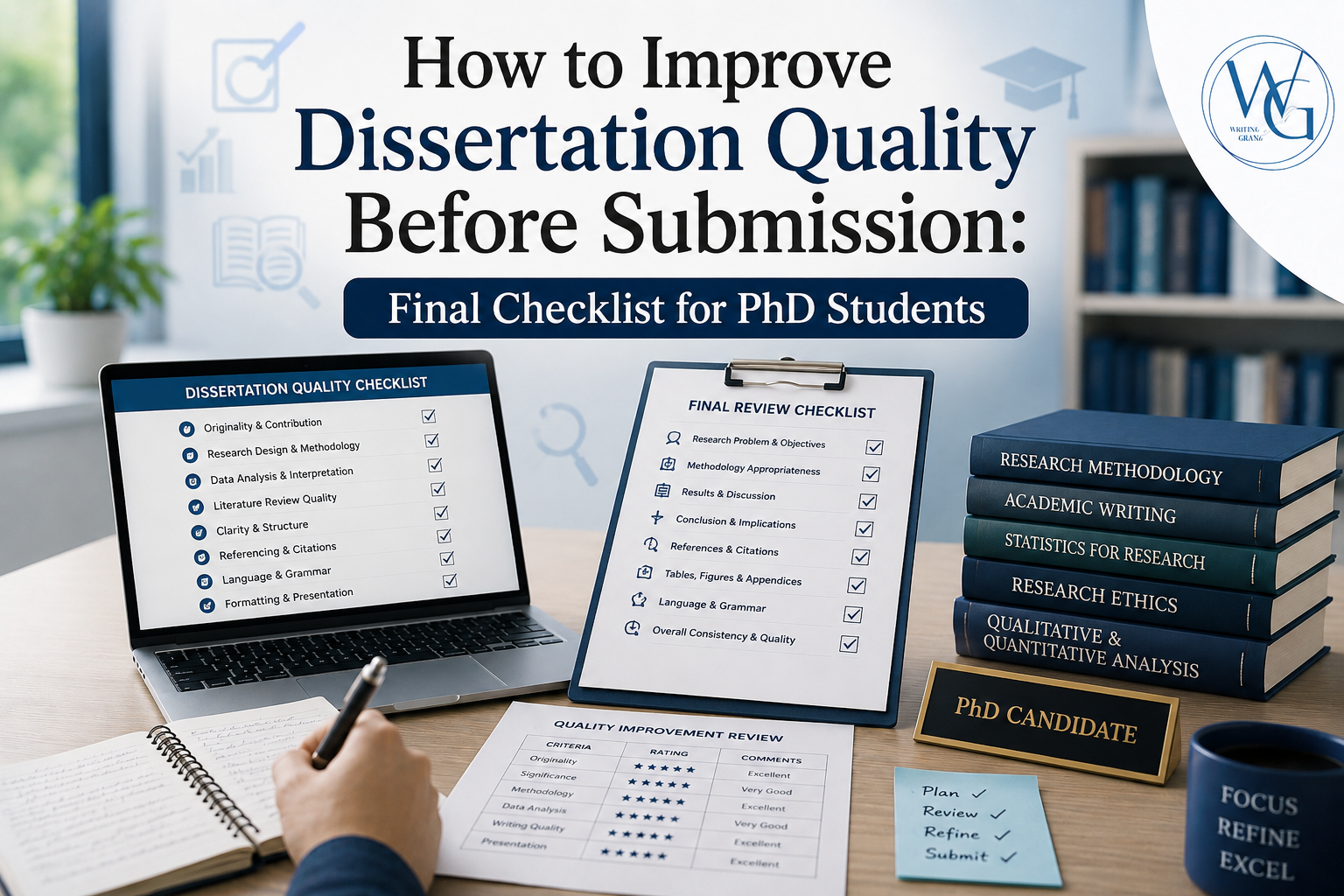
PhD dissertation final checklist to improve dissertation quality before submission. Avoid mistakes, meet USA requirements, and get expert help today.
Before submitting a dissertation, PhD students should carefully review the formatting, citations, argument clarity, grammar, originality, and university submission requirements. A strong dissertation can still lose marks because of inconsistent formatting, weak proofreading, unclear arguments, or citation mistakes that affect its credibility. Using a detailed dissertation final checklist helps students identify these issues early and submit their work with greater confidence.
The final review stage is important because doctoral committees expect dissertations to meet both research and technical standards. Many universities in the United States have strict requirements for margins, citation styles, page numbering, reference formatting, and submission documents. Even minor errors can delay approval or require revisions before final acceptance. Students who understand how to improve dissertation quality before submission are more likely to present a polished and professional dissertation that meets graduate school expectations.
If you want expert assistance before submitting your dissertation, Writing Gram provides professional dissertation writing and editing services tailored to your academic requirements. Our team delivers custom, non-AI, and plagiarism-free dissertations that are carefully reviewed for quality, formatting, originality, and clarity.
👉Place your order today and get reliable dissertation support designed to help you submit with confidence.
Dissertation Final Checklist: What Every PhD Student Should Review
Using a detailed dissertation final checklist before submission can help PhD students identify technical and academic issues that may affect approval of their dissertation. Many universities temporarily reject dissertations because of formatting errors, missing citations, or poor document organization, rather than weak research. Reviewing every section carefully helps ensure that the dissertation meets graduate school standards and presents the research professionally.
Title Page Accuracy
Review the title page carefully to ensure the dissertation title, student name, department, university name, degree program, and submission date match your university’s official formatting requirements. Even small errors on the title page can create delays during the submission process.Table of Contents Updates
Make sure all chapter titles, subheadings, appendices, and page numbers in the table of contents are accurate and updated automatically. A table of contents with incorrect page numbers creates a poor impression and suggests weak document organization.Chapter Numbering Consistency
Check that chapter numbers, section headings, and subsection formatting remain consistent throughout the dissertation. Inconsistent numbering can confuse readers and reduce the professional presentation of the document.Citation Style Consistency
Ensure that APA, MLA, Chicago, or any required citation style is used consistently across in-text citations and the reference list. Universities often flag dissertations for inconsistent citation formatting, missing publication details, or incorrect referencing styles.Research Objectives Alignment
Review the introduction, literature review, methodology, findings, and conclusion to confirm that every chapter supports the main research objectives. The conclusion should directly answer the research questions presented earlier in the dissertation.Grammar and Spelling Review
Carefully proofread the dissertation for grammar mistakes, spelling errors, punctuation problems, and awkward sentence structures. Reading the document aloud can help identify unclear wording and repetitive phrases that may reduce the overall quality of the writing.Data and Statistics Verification
Double-check calculations, statistical interpretations, graphs, tables, and numerical data for accuracy. Incorrect statistics or inconsistent data presentation can weaken the credibility of the entire dissertation.Figure and Table Labeling
Ensure that all tables, charts, graphs, and figures are labeled correctly and referenced within the text. Every figure should have a clear title and follow the university’s formatting guidelines.Plagiarism Review
Run a plagiarism check before submission to confirm that all borrowed ideas, quotations, and paraphrased information are cited correctly. Proper citation practices help maintain academic integrity and reduce the risk of problems such as plagiarism detection issues, missing references, and formatting inconsistencies during the submission and review process.Reference List Completeness
Verify that every source cited in the dissertation appears in the reference list and that no uncited sources are included. Missing references are one of the most common issues that occur when students are submitting their dissertations.
According to Arizona State University’s official formatting checklist, graduate schools review dissertations for consistency in formatting, page numbering, references, tables, figures, and overall structure before approval, highlighting the importance of carefully checking these technical details before submission.
How to Improve Dissertation Quality Before Submission
Improving a dissertation before submission is not only about correcting grammar but also about refining clarity, strengthening arguments, and ensuring consistent academic writing throughout the document. Understanding how to improve dissertation quality at this stage helps PhD students present research that is coherent, credible, and aligned with institutional expectations. A well-polished dissertation demonstrates strong scholarly thinking and significantly reduces the risk of revision requests during evaluation.
Strengthen Argument Clarity
A strong dissertation must maintain a clear and consistent argument from the introduction to the conclusion. Every chapter should contribute directly to answering the research questions without unnecessary deviation.
Ensure every chapter supports the research question
Each section of the dissertation should clearly connect back to the main research problem. If a paragraph or section does not contribute to answering the research question, it should be revised or removed to maintain focus.Remove repetitive explanations
Repetition often weakens academic writing by making arguments appear unclear or underdeveloped. Reviewing the dissertation for repeated ideas ensures that each section adds new analytical value rather than restating earlier points.Improve transitions between sections
Smooth transitions between chapters and paragraphs improve readability and help the examiner follow the progression of ideas. Each section should logically lead into the next, creating a cohesive academic narrative.
Improve Academic Tone
Academic tone plays a critical role in how a dissertation is evaluated. A formal, precise, and objective writing style enhances credibility and aligns with doctoral-level expectations.
Remove informal language
Expressions that are conversational or casual should be replaced with formal academic wording. This ensures the dissertation maintains a professional scholarly voice throughout.Use discipline-specific terminology naturally
Subject-specific terms should be used accurately and appropriately without forcing complex vocabulary. Effective academic writing shows understanding through clear, precise language rather than overly complex wording.Avoid overly complex sentences
Long and complicated sentence structures can reduce clarity. Clear and well-structured sentences improve readability and make arguments easier to evaluate.
Verify Evidence and Sources
Strong academic research depends on accurate, credible, and properly cited evidence. This step is essential for ensuring reliability and academic integrity.
Ensure recent and credible sources
Academic work should rely on peer-reviewed journals, scholarly books, and reputable publications. Using outdated or unreliable sources can weaken the dissertation’s credibility.Cross-check quotations and citations
Every quotation and paraphrased idea must match the original source accurately. Citation errors are one of the most common issues flagged during dissertation review.Confirm statistical interpretations
Any data analysis, charts, or statistical findings must be reviewed carefully to ensure accuracy. Misinterpreted data can significantly affect the validity of research conclusions.
Guidelines from the University of Michigan Rackham Graduate School emphasize the importance of accuracy in formatting, citations, and source verification when preparing theses and dissertations for submission, underscoring the need for a careful final review before submission.
Final Dissertation Editing Checklist for Better Academic Quality
At the final stage of doctoral writing, careful editing is what separates a strong dissertation from one that receives unnecessary revision requests. A final dissertation editing checklist helps PhD students identify hidden issues in clarity, formatting, and academic tone that are often missed during earlier drafts. This stage is essential for ensuring the dissertation is polished, consistent, and ready for submission.
According to Purdue University Graduate School writing guidelines, dissertations must meet strict standards for formatting consistency, document structure, and clarity before final approval, highlighting why thorough editing is essential in the submission process. Their official guidance on thesis and dissertation preparation emphasizes careful review of formatting and structural accuracy. You can follow the following strategies to ensure your dissertation meets doctoral-level standards:
Read the dissertation aloud
Reading aloud is one of the most effective editing techniques because it helps detect awkward sentence structures, repetitive phrasing, and unclear transitions. When spoken, errors that seem invisible during silent reading become much easier to identify.Check sentence flow and readability
Ensure that each paragraph flows logically into the next. Poor sentence flow can make even strong research difficult to follow. Focus on clarity, coherence, and smooth transitions between ideas.Remove passive voice where unnecessary
While passive voice is common in academic writing, excessive use can make arguments weak or indirect. Replace unnecessary passive constructions with active voice to strengthen clarity and academic authority.Verify page numbering and formatting consistency
Check that page numbers are continuous and match the table of contents. Inconsistent formatting, spacing, or numbering can create a negative impression during formal evaluation.Ensure headings match formatting rules
All chapter titles, subheadings, and section labels must follow university formatting guidelines. Consistency in headings improves readability and demonstrates attention to detail.Double-check appendices and supporting documents
Appendices should be complete, correctly labeled, and referenced in the main text. Missing or incorrectly referenced appendices are a common issue during submissions.Review supervisor comments carefully
Before submission, ensure all the supervisor feedback has been addressed. Ignoring even minor suggestions can affect approval during final review.
Final clarity checks, such as reading aloud, refining flow, and verifying formatting, help ensure your dissertation meets academic expectations and reduces the likelihood of revision delays.
Writing Gram provides professional dissertation support designed to ensure your work fully meets the final dissertation editing checklist and all the submission requirements. Our team helps you refine structure, clarity, formatting, and originality so your dissertation is ready for submission and of high quality.
👉Place your order now by uploading your requirements and get a custom, plagiarism-free, non-AI dissertation tailored to your academic needs.
What to Check Before Submitting Dissertation Documents
Before submitting a dissertation, it is essential to carefully review all final submission documents to avoid technical errors that could delay approval. Even strong research can be rejected due to missing files, incorrect formatting, or incomplete administrative requirements. A review of submission materials ensures everything aligns with university expectations and reduces last-minute complications.
Below is a practical checklist of what PhD students should verify before final submission:
PDF conversion quality
Ensure the final dissertation is properly converted into PDF format without formatting errors such as shifted margins, broken tables, or missing images. Universities typically require a clean, locked PDF version that preserves original formatting exactly as intended.File naming requirements
Check that all files follow the university’s official naming convention. Incorrect file names can lead to submission system errors or administrative delays during review.Signature pages
Confirm that all required signature pages are completed, signed, and correctly placed in the document. Missing signatures from supervisors or committee members can invalidate a submission.Ethical approval documents
Include all necessary ethical clearance or institutional review board (IRB) approvals where applicable. These documents confirm that the research followed approved academic and ethical standards.Turnitin/plagiarism report
Most universities require a plagiarism report to verify originality. Ensure that similarity scores are within acceptable limits and that proper citations are included for all referenced work.Submission portal requirements
Different universities use different online submission systems with specific upload formats, file size limits, and document structures. Always double-check these technical requirements before uploading.Backup copies
Keep multiple backup copies of your dissertation in secure storage (cloud and external drive). This ensures you can recover your work in case of upload failure or file corruption.Required declaration forms
Many institutions require authorship declarations, copyright agreements, or submission confirmations. Missing these forms can delay the review process.
The Graduate School at Stanford University outlines detailed submission guidelines that cover proper formatting, required documentation, and final file checks before acceptance, showing how rigorous submission standards are across U.S. universities.
Understanding Dissertation Submission Requirements in the USA
Dissertation submission requirements in the USA vary significantly depending on the university, but they all follow strict academic standards designed to ensure consistency, readability, and long-term preservation of scholarly work. PhD students are expected to carefully follow institutional guidelines because even minor formatting errors can delay approval or require resubmission. Understanding these requirements early helps students avoid last-minute corrections and ensures a smooth submission process.
Formatting guidelines differ by university
Each American university has its own dissertation formatting rules covering structure, headings, citation style, and document organization. For example, institutions such as Harvard University require students to follow detailed formatting instructions provided by their graduate school to maintain consistency across all submitted theses. This means students must not rely on general formatting rules but instead follow their specific institution’s handbook.Margin and font requirements
Most universities require standardized margins (commonly 1 inch on all sides) and approved fonts such as Times New Roman or Arial. These rules ensure that dissertations are professionally presented and suitable for archiving or printing. Even small deviations in spacing or font size can result in formatting revisions.Electronic submission systems
Many U.S. universities now require dissertations to be submitted through digital platforms such as ProQuest or internal graduate school portals. These systems often have strict upload requirements, including file type (usually PDF), size limits, and embedded font rules. Students must ensure that their final file is fully compatible before submission.Copyright permissions
If a dissertation includes copyrighted material such as images, charts, or large text excerpts, students may need formal permission from the original copyright holders. Universities require confirmation that all third-party content is legally used to avoid intellectual property issues.Embargo requests
Some students choose to place their dissertation under embargo, meaning it will not be publicly accessible for a set period. This is common when research involves sensitive data, patent applications, or future publication plans. Universities typically require a formal request and justification for embargo approval.Graduate school deadlines
Submission deadlines are strictly enforced by graduate schools, and missing them can delay graduation. Institutions like Purdue University emphasize that students must submit all final documents, including formatting approvals and administrative forms, before the official deadline to be considered for degree conferral in that term.
For detailed formatting and submission expectations, graduate schools such as Harvard University and Purdue University provide official dissertation submission guidelines that students are required to follow closely, reinforcing how standardized and strict the process is across U.S. doctoral programs.
Common Dissertation Submission Mistakes PhD Students Should Avoid
Even well-researched dissertations can face delays or revisions if certain avoidable mistakes are overlooked during the final submission stage. Understanding these issues in advance is a key part of improving academic quality and ensuring a smooth approval process. Careful attention to detail at this stage helps PhD students present a polished and professional final document.
Last-minute proofreading
Rushing through proofreading is one of the most common mistakes. Errors in grammar, punctuation, or formatting are often missed when students review their work under pressure. A final slow, careful read-through is essential to catch issues that automated tools may not detect.Incorrect citations
Citation errors, such as missing references, incorrect formatting styles, or mismatched in-text citations, can seriously affect academic credibility. Every source used in the dissertation must be properly cited and included in the reference list to maintain integrity.Ignoring formatting manuals
Each university provides specific formatting guidelines covering margins, headings, font styles, spacing, and document structure. Ignoring these instructions can lead to unnecessary revision requests, even if the research itself is strong.Submitting without supervisor review
Submitting a dissertation without final supervisor feedback is a major risk. Supervisors often identify structural or content issues that students may overlook, making their review an essential final quality check.Weak conclusions
A weak or vague conclusion can reduce the impact of an otherwise strong dissertation. The conclusion should clearly summarize findings, address research questions, and highlight the significance of the study.Inconsistent terminology
Using different terms to refer to the same concept throughout the dissertation can confuse readers and weaken academic clarity. Consistency in terminology ensures a more professional and coherent presentation.Missing references
Every in-text citation must match a corresponding entry in the reference list, and every reference list entry must be cited within the text. Missing or incomplete references are one of the most frequently flagged issues during submission reviews and can delay approval.
Get Expert Dissertation Support Before You Submit: Avoid Costly Revisions
Before submitting your final draft, it is important to understand that even strong research can lose marks if clarity, formatting, or citation issues are overlooked. A careful final review using a dissertation final checklist helps ensure your work is polished, consistent, and aligned with academic expectations. This final stage is not just about correcting errors but also about strengthening the overall quality and credibility of your PhD research.
Taking time to refine your dissertation at this stage significantly improves the overall strength and clarity of your work. Strong editing ensures your arguments are clear, your structure is consistent, and your formatting meets institutional standards. It also reduces the risk of revision requests, which can delay graduation and create unnecessary stress. Many students underestimate how strict submission evaluation can be, which is why final proofreading and structural refinement are essential before handing in your work. A proper PhD dissertation submission checklist ensures that nothing is missed before you submit your work.
Turn Your Dissertation into a Submission-Ready Document with Professional Help
If you want to avoid last-minute errors and ensure your dissertation meets academic expectations, professional support can make a significant difference. Writing Gram provides expert dissertation assistance designed to improve clarity, structure, formatting, and overall academic quality while ensuring originality and accuracy.
Our service includes plagiarism-free writing, custom academic support tailored to your requirements, detailed proofreading, formatting correction, and PhD-level editing to align your dissertation with university standards. We also provide support for dissertations with strict deadlines so you can complete your work with confidence and avoid unnecessary revisions.
🎓 Place your order today by uploading your requirements and get a fully customized, non-AI, plagiarism-free dissertation that meets your submission guidelines and instructions.