The Difference Between Descriptive and Critical Writing in a Dissertation
By Writing Gram • Jun 3, 2026
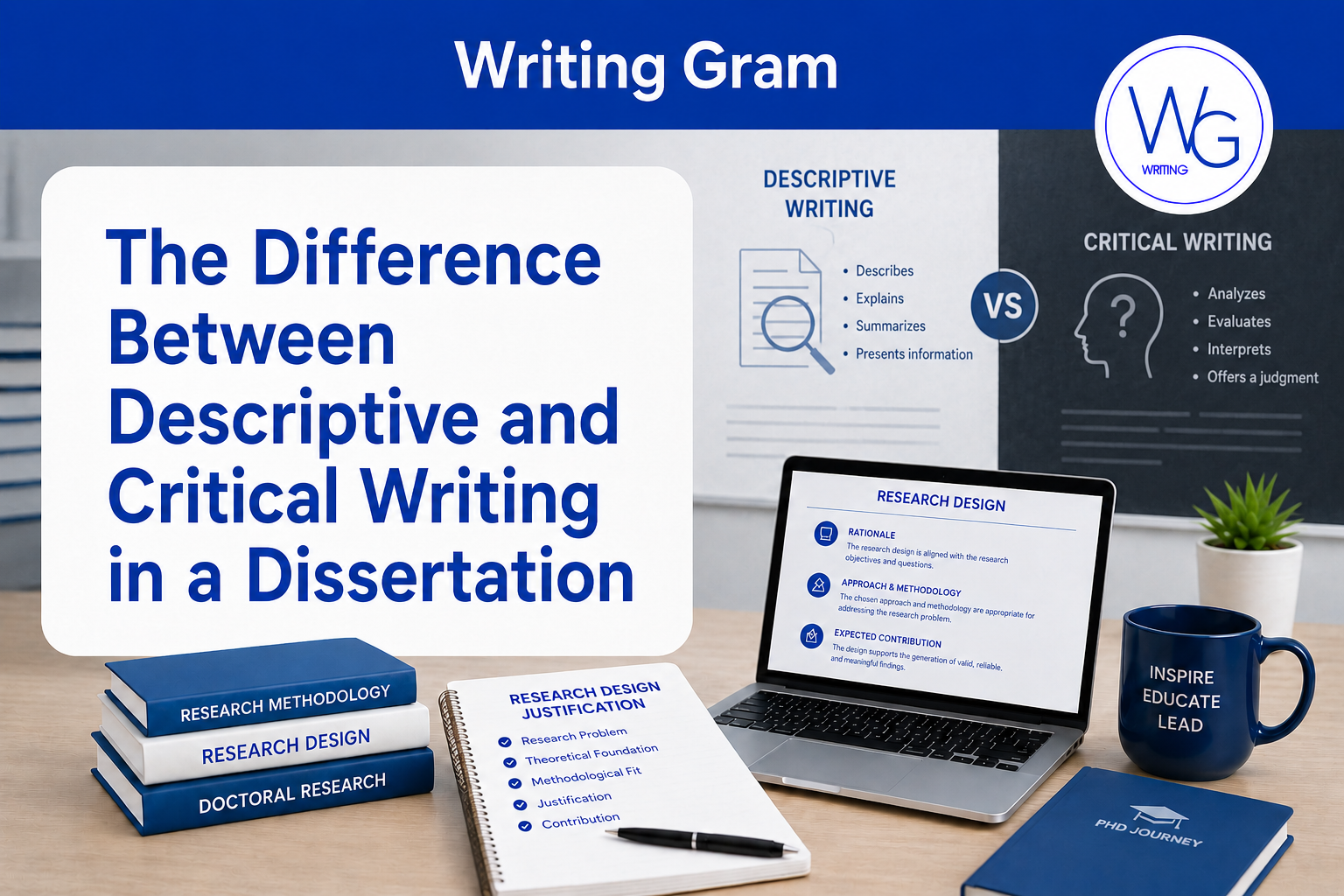
Learn the difference between descriptive and critical writing in a dissertation with clear examples and guidance, and get expert dissertation help to improve analysis, strengthen arguments, and enhance academic quality for higher grades.
Many dissertation students struggle to distinguish between describing information and critically analyzing it. While descriptive writing demonstrates knowledge of a topic, it often falls short of the deeper evaluation, interpretation, and argument development that examiners expect at the postgraduate and doctoral levels. As a result, dissertations that rely heavily on description may appear informative but often fail to demonstrate the critical analysis, independent evaluation, and original insight that examiners expect at the doctoral level.
Understanding the distinction between a descriptive vs critical writing dissertation approach is essential for producing a high-quality dissertation that demonstrates analytical depth, independent thinking, and the critical engagement required to achieve strong academic results. Dissertations are not simply summaries of existing studies or reports of findings; they require students to assess evidence, identify strengths and weaknesses in the literature, justify methodological decisions, and develop convincing arguments supported by scholarly sources. This level of analysis reflects the critical thinking skills expected in advanced academic research.
This guide explains the key differences between descriptive and critical writing, why the distinction matters, and practical ways to strengthen your dissertation.
If you need help with dissertation writing, Writing Gram can help transform descriptive sections into insightful critical analysis, strengthen arguments, improve evidence evaluation, and ensure your work meets examiner expectations.
🎓Place your order now to benefit from expert dissertation support, deeper academic analysis, stronger critical engagement with sources, improved argument development, and a dissertation that demonstrates the level of intellectual depth required for higher grades.
What Is Descriptive Writing in a Dissertation?
Descriptive Writing Explained
Descriptive writing is a form of academic writing that focuses on explaining facts, reporting information, summarizing research, or outlining what theories, authors, and data say. In a dissertation, descriptive writing answers questions such as what happened, what a study found, what a theory proposes, or what methodology was used. Its primary purpose is to provide readers with the background information needed to understand the research topic.
According to the University of Colorado Boulder, descriptive writing explains a topic by outlining what happened or summarising what an author has said, while analytical and critical writing goes further by interpreting the information, evaluating its importance, and explaining its broader significance.
Descriptive writing plays an important role in maintaining coherence in dissertation chapters. For example, it is commonly used when introducing key theories in the literature review, explaining research methods in the methodology chapter, or presenting findings in the results section. Without a clear description, readers may struggle to understand the context of the research.
However, one of the most common challenges in the descriptive vs critical writing dissertation debate is that many students rely too heavily on description instead of developing deeper analysis and evaluation. They summarize sources accurately but stop short of evaluating their strengths, weaknesses, relevance, or implications. This distinction is central to understanding academic analysis vs description at postgraduate and doctoral levels.
Consider the following example of overly descriptive writing:
"Smith (2022) found that remote work increased employee productivity by 15%. Johnson (2023) reported similar findings in technology companies."
While this sentence reports information accurately, it does not explain why the findings matter, whether the studies are reliable, how they compare with conflicting evidence, or what they mean for the research problem being investigated. As a result, the writing informs the reader but does not contribute substantial academic analysis.
What Is Critical Writing in a Dissertation?
Understanding Critical Writing
Critical writing in a dissertation goes beyond simply reporting what other researchers have said. It involves evaluating, interpreting, and engaging with academic evidence in a way that builds an argument rather than just presenting information. Instead of only describing findings, critical writing asks deeper questions such as why the evidence matters, how strong it is, and what conclusions can reasonably be drawn from it.
In doctoral and master’s level research, this approach is essential because examiners expect students to demonstrate analytical academic writing, not just summaries of sources. Critical writing shows that you can think independently, compare different viewpoints, and justify your position using evidence.
A useful explanation of this distinction is provided by the University of Washington Writing Center, which highlights the difference between simply reporting ideas and engaging with them through analysis and evaluation in academic work.
Critical writing in a dissertation includes:
Evaluating sources: Assessing whether studies are reliable, relevant, or limited in scope
Comparing perspectives: Identifying agreements, contradictions, or gaps between authors
Interpreting findings: Explaining what results actually mean in relation to your research question
Building an argument: Using evidence to support a clear academic position rather than listing information
Questioning assumptions: Identifying weaknesses, bias, or missing considerations in existing literature
Thus, descriptive writing states what a study found, while critical writing explains why it matters and how it contributes to broader academic debates. For example, instead of saying that multiple studies found a similar result, a critical approach would examine whether those studies used comparable methods, whether their samples were reliable, and whether their conclusions can be generalized.
In a dissertation, this level of engagement is what transforms writing from basic reporting into meaningful academic analysis.
Key Differences Between Descriptive and Critical Writing
Descriptive vs Critical Writing in Dissertations
Understanding the difference between descriptive and critical writing is essential for producing a strong dissertation because each serves a distinct academic purpose and is assessed differently at the postgraduate level.
While descriptive writing provides the foundation of knowledge, critical writing demonstrates analysis, evaluation, and independent thinking.
A helpful distinction is provided by the University of California, Berkeley Writing Center, which explains that academic writing should go beyond summarizing information to include analysis and evaluation to develop a clear argument.
In a dissertation, the differences can be understood as follows:
Purpose
Descriptive writing: Presents facts, summaries, and background information
Critical writing: Evaluates evidence and builds an argument based on interpretation
Depth of engagement
Descriptive writing: Stays at a surface level by reporting what is known
Critical writing: Goes deeper by explaining meaning, relevance, and implications
Language style
Descriptive writing: Uses reporting language such as “states,” “shows,” or “found”
Critical writing: Uses analytical language such as “suggests,” “implies,” “indicates limitations,” or “supports the argument that”
Role in the dissertation
Descriptive writing: Provides context in the literature review, methodology, and findings sections
Critical writing: Forms the core of the discussion, analysis, and argument development
Both forms of writing are necessary, but they are not equally weighted. A dissertation that relies heavily on description may appear informative but lacks the intellectual depth required at the doctoral level. In contrast, strong critical engagement demonstrates academic analysis vs description by showing how evidence is interpreted and applied directly to the research question, rather than simply being reported.
If you need help with dissertation, understanding this balance is often the turning point between average and high-quality academic work. Many students struggle with knowing when to shift from description to evaluation, which is where structured support becomes valuable. Professional dissertation assistance can help refine argument structure, improve analytical depth, and ensure that each section meets academic expectations.
🎓With Writing Gram, descriptive sections are used where clarity is needed, while critical writing is strengthened where argumentation is required. This structured approach ensures your dissertation is not just informative but analytically strong, well-structured, and aligned with examiner expectations. Place your order now to benefit from improved argument development, clearer academic structure, stronger critical engagement with sources, and a fully refined dissertation that demonstrates clear analytical depth throughout your dissertation.
Why Critical Writing Matters in a Dissertation
The Importance of Critical Writing in Dissertation Writing
Critical writing is a core requirement in dissertation work because it demonstrates a student’s ability to go beyond description and engage with research at an analytical level. At the undergraduate level, students are often rewarded for accurately explaining theories and summarizing research. However, at the master’s and doctoral levels, expectations shift significantly toward evaluation, interpretation, and argument development. This is where critical thinking dissertation writing becomes essential.
The University of North Carolina at Chapel Hill Writing Center highlights that dissertations should not only report information but also analyze it by questioning evidence, considering alternative perspectives, and explaining significance within a broader academic context. This expectation exists because dissertations are not simply knowledge-based reports; they are designed to show independent intellectual engagement with a topic. Without critical analysis, a dissertation may appear descriptive and lack academic depth, even if it contains accurate information.
Critical writing in your dissertation allows:
Stronger argument development: Critical writing allows students to build a clear position supported by evidence rather than listing sources
Higher-level evaluation: It shows the ability to assess strengths, weaknesses, and limitations in existing research
Engagement with academic debate: It connects different viewpoints rather than presenting isolated studies
Progression toward doctoral-level writing style: At the PhD level, originality and interpretation become more important than summary or repetition of existing literature
When critical analysis is missing, dissertations often become overly descriptive, which weakens the overall argument and reduces academic impact. Examiners typically expect evidence that the student can interpret data, justify methodological and analytical decisions, and place findings within broader scholarly discussions.
Hence, critical writing is not an optional skill but a defining feature of high-quality academic research.
How to Move From Descriptive to Critical Writing
Improving Your Academic Writing Style
Moving from descriptive writing to critical writing is one of the most important skills in dissertation writing. It requires changing how you engage with sources—from simply reporting what authors say to actively evaluating and interpreting their meaning within your research context. This shift is central to producing strong analytical academic writing that meets postgraduate expectations.
A useful reference point is the Harvard University Writing Center, which highlights that effective dissertation writing goes beyond summarizing ideas to include analysis, questioning, and building arguments based on evidence.
To make this transition effectively, students should apply the following techniques:
Ask deeper questions: Instead of only stating findings, ask why does this matter for my research question?
Compare sources actively: Identify where authors agree, disagree, or use different methods and explain why that matters
Challenge assumptions: Consider whether a study’s conclusions are fully supported or whether limitations affect reliability
Use evidence strategically: Do not just report information—use it to build, support, or question an argument
A clear way to understand this shift is through rewriting. For example:
Descriptive: “Several studies show that remote work increases productivity.”
Critical: “While several studies suggest remote work increases productivity, differences in sample size and industry context raise questions about how widely these findings can be applied.”
The second sentence is stronger because it does more than state a general finding. It adds a limitation and a condition, showing that the result is not automatically universal. Instead of simply saying “studies show productivity increases,” it explains that the evidence may not apply in all situations because factors like sample size and industry type differ between studies. This is what makes the writing critical rather than purely descriptive, as it evaluates the reliability and scope of the evidence instead of simply repeating it.
Need Help With Your Dissertation? Final Thoughts on Descriptive vs Critical Writing
Descriptive and critical writing serve different but complementary roles in a dissertation. Descriptive writing provides the foundation by explaining key theories, summarizing research, and presenting background information clearly. Without it, the reader would lack context and understanding of the topic being studied.
However, critical writing is what gives a dissertation its real scholarly depth and persuasive power. It goes beyond reporting information and focuses on interpreting evidence, evaluating arguments, and explaining why findings matter in relation to the research question. This is what examiners look for when assessing higher-level work, especially at master’s and PhD levels.
In simple terms:
Descriptive writing = foundation and context
Critical writing = analysis, argument, and academic value
Important tip: A strong dissertation balances both but prioritizes critical engagement where arguments are developed and conclusions are justified. This balance is often what separates average work from high-scoring dissertations.
For many students, the challenge is not understanding the difference but applying it consistently across chapters. It can be difficult to know when to stop describing and start evaluating, especially when working with complex academic sources.
If you need help with dissertation, this is where professional dissertation writing help becomes valuable. Writing Gram focuses on helping students:
Shift from descriptive summaries to strong critical analysis
Strengthen argument development across chapters
Improve evaluation of academic sources and research findings
Apply analytical thinking consistently throughout the dissertation
Ensure writing aligns with examiner expectations for doctoral work
Through our professional PhD writing service, each section is refined to ensure that descriptive content is used appropriately for context, while critical writing drives the academic argument forward.
With this structured approach, your dissertation becomes clearer, more analytical, and more aligned with what examiners expect in high-quality academic research.
🎓Place your order now to receive professional support that improves critical engagement, strengthens academic argumentation, enhances clarity across chapters, and delivers a fully refined dissertation ready for submission.