Dissertation Analysis Help for Statistical Results That Do Not Answer Your Research Questions Clearly
By Writing Gram • Sep 12, 2026
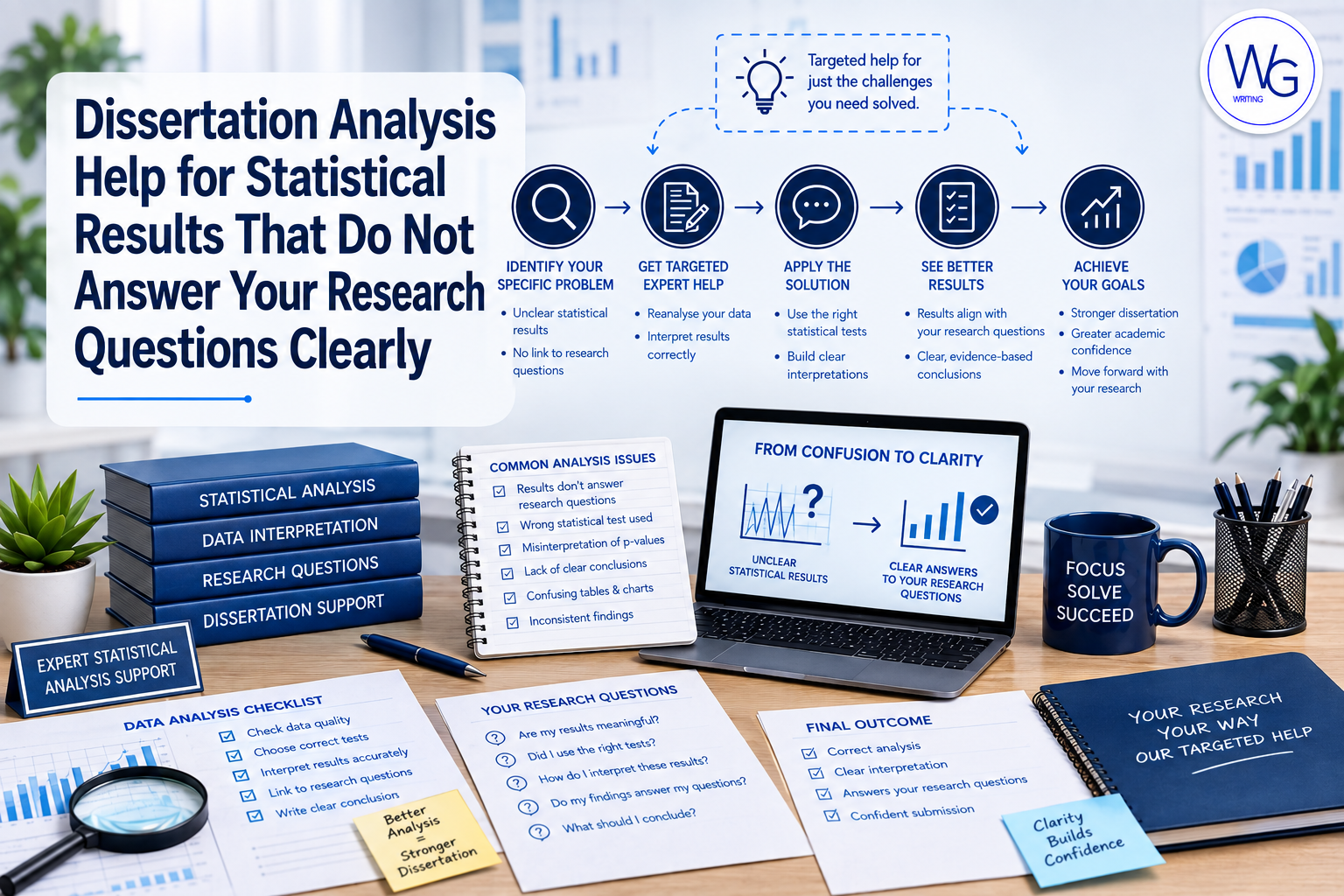
Get dissertation analysis help interpreting statistical results, connecting findings to research questions, avoiding overinterpretation, and strengthening your results chapter.
Your Statistical Results Are Complete, But Your Research Questions Are Still Unanswered
You may have finished the statistical analysis, generated your SPSS, R, Stata, or other statistical output, and still be unsure how to explain what the findings mean for your dissertation. The problem is no longer simply running a statistical test; you need to connect the output to your research questions and explain what the results actually show.You also need to distinguish meaningful findings from results that do not answer your research questions, understand what the statistical evidence means for your study, avoid making claims that go beyond what the data supports, and turn the results into a clear interpretation that you can use in your dissertation.
This distinction matters because statistical output gives you the results of your analysis, but you still need to explain how those results answer your research questions. Statistical Analysis Guidance from Harvard University notes that researchers can overlook important information contained in statistical results and that interpretation should make the findings more informative in relation to the research questions.
Writing Gram can work with the statistical results you already have, help you identify which findings answer each research question, explain what those findings mean for your study, and turn your analysis into clear results and discussion sections that show exactly what you found, how the findings relate to your research questions, and what conclusions your evidence supports.
📊Get Dissertation Analysis Help to Turn Your Statistical Results Into Clear Findings and Conclusion
Writing Gram provides dissertation analysis help for researchers who have already completed their statistical analysis but need help interpreting their results, explaining how the findings answer their research questions, and writing clear results and discussion sections for their dissertations.
Place your order now to get help interpreting your existing statistical output, identify which results answer each research question, explain your findings clearly in your results and discussion chapters, reduce the time you spend trying to interpret statistical tables on your own, and save time by avoiding redoing analysis you have already completed.
Why Statistical Results Can Be Correct but Still Fail to Answer the Research Question
A statistical test can be performed correctly while the explanation of its results remains unclear. The real challenge is turning the output into a clear explanation of what you found, how the findings answer your research questions, which results need to be discussed in detail, and what conclusions you can draw from the evidence.
For example, imagine your research question asks whether job satisfaction is related to employee performance. Your analysis may show a statistically significant positive relationship between the two variables. Reporting that result alone does not fully explain the finding. You still need to state what the relationship means for your research question, explain the direction and strength of the relationship, and make clear what the result allows you to conclude about the study.
The same problem occurs when researchers report numbers without explaining their meaning. A p-value, regression coefficient, odds ratio, confidence interval, correlation coefficient, or F statistic provides statistical evidence, but the reader still needs to understand what that evidence indicates about the research question.
Stanford University specifically warns against allowing statistical-program output to replace the study question when presenting results. Statistical analysis is a means of addressing the research question, not the final point of the explanation. This means the dissertation still needs to explain what the findings mean and how they answer the question the study set out to investigate.
Another problem arises when the researcher makes a stronger claim than the statistical analysis supports. A statistically significant association does not automatically establish that one variable caused another. Similarly, a nonsignificant result does not automatically mean that a variable has no relationship with the outcome under every possible condition.
When several predictors produce different results, the task becomes even harder. Some may be statistically significant, others may not be, and some may point in unexpected directions. The researcher then has to determine how the individual statistical findings answer the research question and what those findings contribute to the study’s overall contribution.
How to Interpret Dissertation Statistical Results Against Each Research Question
Start with the exact research question, rather than beginning with the statistical output. Ask what the question is actually asking the study to establish. This gives you a basis for deciding which parts of the output matter.
Next, identify the variables connected to that question. Depending on the research design, these may include an outcome variable, predictor variables, grouping variables, control variables, or variables being compared.
Then identify the statistical evidence that directly addresses the question. Not every table generated by SPSS, R, Stata, or another program deserves equal attention. Some output may be useful for checking the analysis but may not belong in the main explanation of the finding.
Interpret the direction and size of the result as well. A coefficient, difference, correlation, odds ratio, or estimated effect tells you more than whether a p-value crossed a particular threshold. The practical meaning of the estimate should be explained in terms of the variables used in the study.
The University of Michigan Guide on how to read a journal article explains that the results section reports what was found through analysis, while the discussion explains what those results mean and connects them back to the research questions. That distinction can help prevent a dissertation from simply repeating statistical output without explaining its meaning.
Finally, state what the evidence does and does not establish. If the analysis shows an association, describe it as an association unless the research design supports a stronger causal claim. If the evidence is uncertain, explain the uncertainty. Then formulate a direct answer to the research question based on the evidence available.
This approach turns dissertation research question analysis from a list of statistical outputs into a clear explanation of what the study actually found.
What to Do When the Results Do Not Clearly Support Your Research Questions
Not every dissertation produces the result the researcher expected. You may find that a statistical test is nonsignificant, an estimated effect is smaller than anticipated, only some predictors are significant, or a relationship runs in an unexpected direction. This can be especially important in an article-based or publication-based dissertation, where each study may need to stand on its own as a research paper while also contributing to the dissertation as a whole. Unexpected statistical findings therefore need to be interpreted carefully so that each article accurately explains what the analysis found, what those findings mean for the research question, and how they contribute to the overall dissertation.
A wide confidence interval can also make the estimate less precise. The sample size, study design, measurement approach, or available variables may place limits on what the analysis can establish. In other cases, the statistical method may not fully match the research question, or the question may be broader than the evidence collected. These limitations can become more important in dissertations that include multiple studies or research phases, where each study may use different samples, measures, variables, or statistical methods. The researcher then needs to consider what each phase can establish on its own and how the findings from the different phases can be used together to address the broader research question.
The answer is not to force the results to support the original expectation. Instead, explain exactly what the evidence supports and where the evidence stops.
Columbia University advises researchers to consider whether their statistical methods were suitable for the data and whether the analysis actually answered the questions they initially intended to address. It also emphasizes interpreting the major findings rather than simply presenting statistical output.
A nonsignificant result does not mean that the study has failed. It can still provide an important answer when the research question asks whether there is evidence of a particular relationship or difference. The key is to explain what the result shows, how it answers the research question, and what limitations need to be considered when interpreting the finding.
How Dissertation Analysis Assistance Can Help When the Output Is Already Complete
Dissertation analysis assistance can be useful when the statistical work has already been completed but the results chapter still does not clearly explain what the findings mean.
Instead of simply rerunning statistical tests, the work can begin with your existing research questions, methodology, dataset information, statistical output, tables, and draft results. This makes it possible to examine the relationship between the questions you asked and the evidence produced by the analysis.
The assistance can help you:
Review each research question alongside the relevant statistical output.
Identify which findings directly answer each question.
Separate important results from output that is not central to the research questions.
Explain coefficients, relationships, differences, estimates, and statistical significance in clear language.
Identify interpretations that go beyond what the analysis can support.
Connect statistical tables and figures to the written explanation.
Check whether the results chapter accurately reflects the analysis that was performed.
Identify findings that require clarification or additional analysis.
Explain unexpected or mixed findings without forcing them to match the original hypothesis.
Create a clearer connection between the results chapter and the discussion chapter.
Interpret results when you are completing a PhD while working full time. Dissertation analysis assistance can help you work through your existing statistical output, identify the findings that matter for each research question, and turn those findings into clear explanations without requiring you to spend additional hours trying to interpret every table and test on your own.
Connect quantitative and qualitative results when your dissertation uses both types of evidence. Assistance can help you explain what the statistical findings show alongside themes, interview findings, or other qualitative evidence, identify where the two types of results support or differ from each other, and show how the combined evidence answers your research questions.
Duke University emphasizes using model output to address research questions and focusing on the variables and findings that help answer those questions rather than simply listing every statistical result.
For doctoral researchers, PhD dissertation help can be useful when the statistical analysis is already complete but the results chapter still needs to turn the findings into clear explanations that answer the research questions and support the dissertation’s conclusions.
🎓 Get Dissertation Results Interpretation Help Before You Rewrite Your Chapter
Writing Gram offers dissertation help services that can help you interpret your existing statistical output, connect the findings to each research question, identify conclusions that go beyond what the evidence supports, and turn unclear or disconnected results into a clear results chapter.
Place your order now to save time interpreting complex output, make better use of the analysis you have already completed, reduce unnecessary rewriting, explain your findings more clearly, and create a stronger foundation for your discussion and conclusion.
Frequently Asked Questions About Dissertation Analysis Help and Statistical Results
Can statistical results fail to answer a dissertation research question?
Yes. A statistical test can be performed correctly while the resulting findings do not fully address the wording or scope of a dissertation research question. This can happen when the analysis examines only part of the question, the variables do not fully represent what the question asks, or the findings are interpreted beyond what the statistical evidence supports.
How do I interpret statistical results in relation to my research questions?
Start with each research question and identify the statistical analysis that was designed to address it. Then examine the relevant estimates, relationships, differences, significance levels, confidence intervals, and other evidence before explaining what the findings show. The final interpretation should directly answer the research question without adding claims that the analysis cannot support.
What if my statistical results are not significant?
A nonsignificant result does not mean that your dissertation failed. It means that the analysis did not provide sufficient statistical evidence for the effect, difference, or relationship being tested. You should explain the finding accurately and consider factors such as the study design, sample, measurement, and precision of the estimate when discussing what the result means.
Can dissertation analysis help interpret existing SPSS results?
Yes. Dissertation analysis help can focus on your existing SPSS output rather than requiring you to start the statistical analysis again. This can include identifying the results relevant to each research question, explaining statistical findings, checking whether your interpretation matches the output, and identifying conclusions that go beyond the evidence.
What should I do if only some of my research questions are answered by statistical analysis?
First, identify which questions are directly addressed by the completed analysis and which ones are not. You can then determine whether additional analysis is actually needed or whether the existing findings can answer the question with a narrower interpretation. This helps you avoid adding statistical procedures simply because the results chapter feels incomplete while ensuring that your conclusions remain supported by the evidence. It also strengthens the credibility of the research by showing that each research question is addressed using the appropriate evidence and that the dissertation does not make claims that the analysis cannot support.
How do I know which statistical results belong in my dissertation results chapter?
Include the findings that directly contribute to answering your research questions and meeting your study objectives. Supporting statistics may also be necessary to show how the main result was obtained and justify the interpretation you give it, but not every piece of software output needs to appear in the chapter. Each result you include should have a clear purpose in supporting your research questions, study objectives, or research justification. Tables and figures should also have a clear purpose in helping the reader understand why the finding matters and how it supports the conclusions of the study.
Can I interpret my statistical results without changing the analysis?
Often, yes. If the statistical analysis was appropriate and the required output is already available, the main problem may be interpretation rather than additional testing. Reviewing the existing results against the research questions can reveal whether the dissertation needs clearer explanation rather than a completely new analysis.
What if my statistical findings contradict my hypothesis?
You should report the findings you obtained rather than changing the interpretation to make them agree with the hypothesis. A result that does not support the hypothesis can still answer the research question and may become an important part of the discussion. The important part is to explain what the evidence shows, why the result may have occurred, and what it means for the research question.
Can dissertation results interpretation help identify overinterpretation?
Yes. Dissertation results interpretation help can involve checking whether statements in the results chapter accurately reflect the statistical evidence. This includes identifying causal claims that are not supported by the research design, treating associations as proof of causation, overstating nonsignificant findings, or making broader claims than the measured variables allow.
Can PhD dissertation help improve a results chapter after statistical analysis is finished?
Yes. PhD dissertation help can be useful after the statistical analysis is complete when the challenge is explaining the findings clearly. Assistance can focus on connecting the existing analysis to the research questions, improving the explanation of statistical results, organizing the results narrative, and identifying areas that need clarification before the discussion chapter is written.
What should I provide for dissertation analysis assistance?
You should provide your research questions, hypotheses where applicable, methodology, dataset information, statistical output, relevant tables or figures, and any draft results you have already written. Providing these materials allows the analysis to be reviewed in the context of your study and makes it easier to determine how each statistical finding relates to the research question it was intended to answer. You can also use our dissertation analysis checklist to know exactly what to send and ensure that your materials meet your dissertation requirements and instructions.
Questions to Ask Before Buying Dissertation Results Interpretation Help
Before hiring dissertation results interpretation help, make sure the service addresses the actual problem you are facing. If your statistical analysis is already complete, ask whether the service can work with your existing output instead of simply repeating the analysis. You can also use our step-by-step process to understand what happens after you hire dissertation analysis help and what you can expect throughout the process.
It is also important to ask whether the findings will be connected directly to each research question and whether the interpretation will explain what the evidence supports and what it does not support. A legitimate dissertation results analysis service should also be able to identify overinterpretation, unclear explanations, and gaps between your statistical output and the written results. You can use our guide to identify the red flags that can help you avoid low-quality services and fake online dissertation writers.
You should also check whether the dissertation writing service can take your existing methodology, research questions, hypotheses, and dissertation requirements into account. Dissertation analysis assistance should help you understand how to interpret your statistical results, explain why that interpretation is supported by the evidence, and present it clearly in your dissertation instead of simply rewriting your existing text.
Get Dissertation Analysis Help to Clearly Explain Your Results and Answer Your Research Questions
If you have completed your statistical analysis but still struggle to explain what the results mean for your research questions, Writing Gram can help you interpret the statistical output you already have, identify the findings that matter, and explain them clearly in your dissertation. Our dissertation analysis help assists you interpret the relevant findings, connect them directly to your research questions, identify claims that go beyond the evidence, and turn confusing statistical tables into clear explanations for your results chapter.
Dissertation analysis assistance can save you time by helping you work with the analysis you have already completed instead of repeating unnecessary statistical procedures. It helps you understand your results, determine which findings matter for each research question, explain the evidence clearly, and turn your statistical output into stronger results, discussion, and conclusion sections.
📊 Place Your Order Now to get dissertation analysis help that saves you time interpreting difficult statistical output, shows you which findings matter for your research questions, helps you explain what your evidence actually supports, reduces unnecessary rewriting, and gives you clear results, discussion, and conclusion sections that accurately reflect your research.