How to Tell If a Dissertation Writing Service Understands Your Research Topic Before You Order
By Writing Gram • Jul 2, 2026
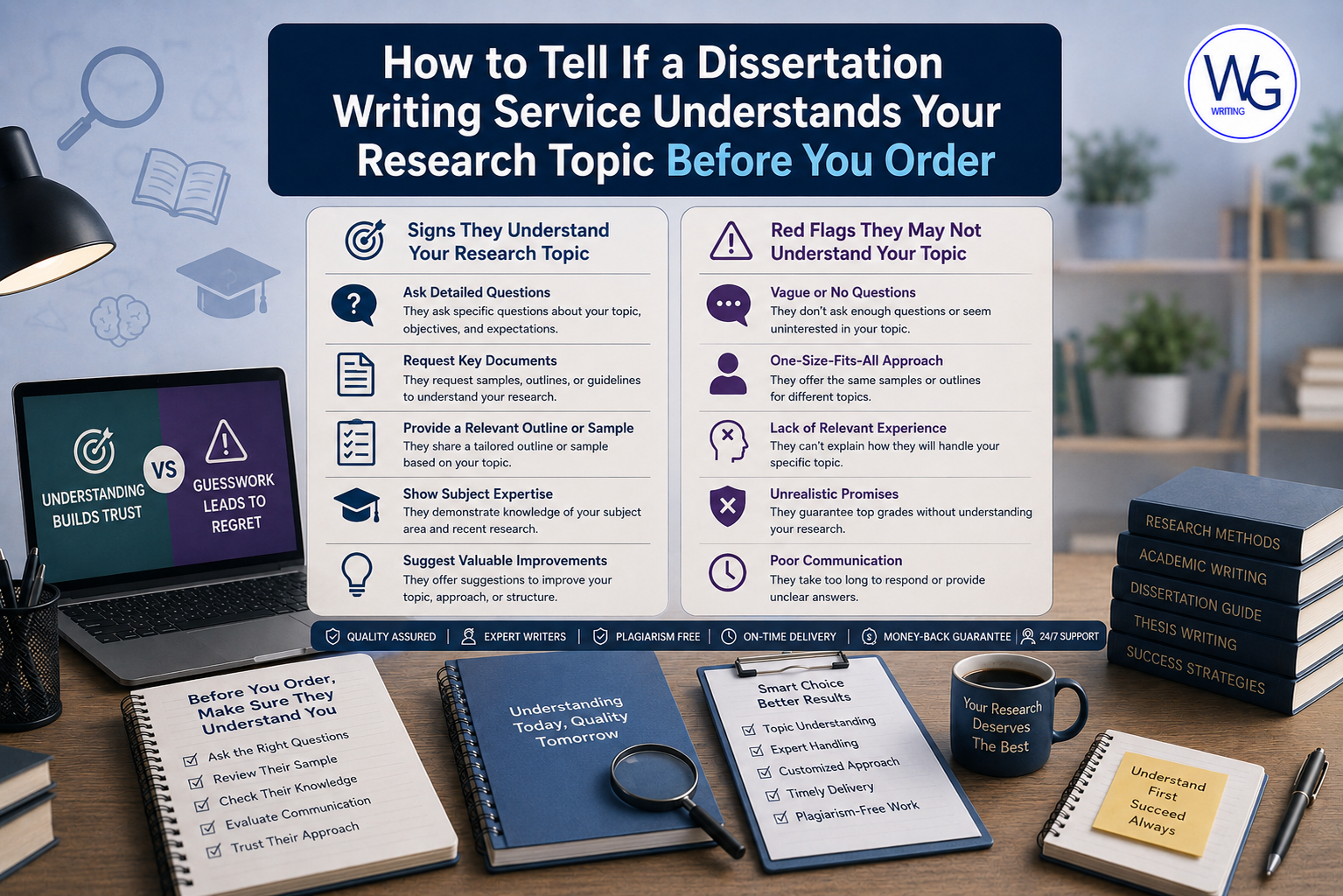
Learn how to verify a dissertation writing service understands your research topic before you order. Choose the right expert with confidence.
Choosing a dissertation writing service is an important decision, especially when your research addresses a specialized subject or a complex academic question. While many services offer dissertation assistance, not every dissertation writer has the academic background or subject knowledge required to understand every research area. A writer who is experienced in business management, for example, may not have the expertise needed to work on a doctoral dissertation in nursing, mechanical engineering, public health, or data science. Subject-specific knowledge plays a significant role in understanding the terminology, theoretical foundations, research methods, and scholarly expectations that shape a high-quality dissertation.
Before placing an order, it is worth determining whether the service can assign a writer whose qualifications align with your research topic rather than simply assigning the next available writer. An appropriate match helps ensure that important concepts are interpreted correctly, discipline-specific terminology is used accurately, and the research remains consistent with the academic standards expected within your field of study. This becomes even more important for dissertations that involve specialized methodologies, technical analyses, regulatory frameworks, or emerging areas of research where general writing experience alone may not be sufficient.
Evaluating subject expertise before ordering also helps reduce unnecessary revisions later in the writing process. When a dissertation writer understands your research objectives, supervisor instructions, and the academic conventions of your discipline from the beginning, communication becomes more efficient, and project expectations are easier to meet. Instead of spending valuable time correcting misunderstandings or explaining fundamental concepts, you can focus on refining your research and preparing for a successful dissertation submission.
The following sections explain how to evaluate whether a dissertation writing service genuinely understands your research topic before you commit to an order. By knowing what to look for and which questions to ask, you can make a more informed decision and choose dissertation support that is better aligned with your academic goals.
🎓 Work With a Dissertation Writer Who Understands Your Research Topic
Finding the right dissertation writer should involve more than comparing prices or turnaround times. At Writing Gram, we carefully evaluate every project to match it with a writer whose academic background and subject knowledge align with your research requirements.
✅ Place Your Order Now and Receive:
📚 Assignment to a writer with relevant subject expertise
🎯 Careful review of your dissertation topic and project requirements
📝 Support tailored to your research objectives and academic discipline
🔄 Revision assistance based on your original project instructions
🔒 Confidential, professional, and reliable dissertation support from start to finish
🚀 Place your order with Writing Gram today and get matched with a qualified dissertation writer who understands your research topic and academic goals from the very beginning.
Why Subject Expertise Matters More Than General Dissertation Writing Experience
Many dissertation writing services advertise experienced writers, but experience alone does not guarantee that a writer is the right fit for your research topic. A dissertation in finance, for example, requires a different knowledge base than one in clinical psychology or software engineering. While an experienced academic writer may understand dissertation structure and scholarly writing conventions, they also need a solid understanding of your discipline to interpret research accurately and work effectively with subject-specific literature.
This distinction becomes even more important at the doctoral level because dissertations are expected to make an original contribution within a specific field of study. That requires familiarity with the language, debates, research methods, and academic expectations that define the discipline.
Dissertation Writing Experience vs. Subject Expertise
A qualified dissertation writer should possess both general dissertation writing skills and relevant subject knowledge.
General dissertation writing experience includes:
Understanding dissertation structure and chapter organization
Following university formatting and citation requirements
Maintaining academic writing standards
Organizing evidence into a logical argument
Responding effectively to revision requests
Subject expertise includes:
Understanding discipline-specific theories and concepts
Recognizing current research trends within the field
Using technical terminology accurately
Selecting appropriate research methods
Interpreting scholarly literature within the proper academic context
A writer who combines these two strengths is better positioned to support a dissertation that reflects both sound academic writing and a clear understanding of the research subject.
Why Doctoral Research Requires Discipline-Specific Knowledge
Doctoral research goes beyond summarizing existing information. It requires evaluating evidence, identifying research gaps, and developing arguments that contribute to ongoing scholarly discussions. These expectations differ across academic disciplines.
For example:
Nursing dissertations often involve evidence-based practice, patient outcomes, healthcare policies, and clinical research standards.
Engineering research may require an understanding of technical models, mathematical analysis, simulations, or system design.
Psychology dissertations frequently depend on established psychological theories, validated measurement instruments, ethical research procedures, and statistical interpretation.
Business research may examine organizational strategy, leadership, finance, marketing, or operations using different analytical frameworks.
Computer Science dissertations often involve software development, algorithms, artificial intelligence, cybersecurity, or data architecture, each with its own technical vocabulary and research practices.
Although every dissertation follows a similar overall structure, the way evidence is gathered, analyzed, and presented varies significantly between these disciplines. Assigning a writer with relevant subject expertise helps ensure that your project reflects those differences accurately.
How Subject Expertise Influences Dissertation Quality
Subject knowledge affects far more than the accuracy of technical terminology. It shapes how each stage of the dissertation is approached.
Literature review quality
A writer with expertise in your field can distinguish foundational studies from less influential publications, recognize recurring themes in the literature, and explain how previous research relates to your research question. This leads to a literature review that is more focused and academically meaningful.
Methodology selection
Research methods should align with both the research objectives and disciplinary expectations. A writer familiar with your subject can better understand why certain qualitative, quantitative, or mixed-method approaches are commonly used within that field and how they support the research design.
Academic terminology
Every discipline develops its own vocabulary. Accurate use of technical language improves clarity and demonstrates familiarity with the field, reducing the likelihood of confusing or inconsistent terminology throughout the dissertation.
Critical analysis
Doctoral research requires more than describing previous studies. It involves comparing perspectives, evaluating evidence, identifying limitations, and explaining how your research contributes to existing knowledge. Subject expertise allows a writer to engage with these discussions in a way that is relevant to your discipline.
Research consistency
When the writer understands your subject, the research question, literature review, methodology, analysis, and conclusions are more likely to remain aligned throughout the dissertation. This consistency helps create a manuscript that presents a clear and coherent academic argument.
Recent research published in the Perspectives on Medical Education journal also highlights that high-quality scholarly work depends on selecting research methods that fit the research question and disciplinary context rather than relying on generalized approaches. This reinforces why subject expertise is an important consideration when choosing dissertation support, particularly for doctoral research that requires specialized knowledge
For students comparing dissertation writing services, evaluating subject expertise before placing an order is a practical way to reduce risk. Rather than assuming every writer can support every discipline, verify how the service matches writers to research topics, what qualifications the assigned writer has, and whether they have experience working on dissertations within your academic field. Taking these steps before making a purchase can help you choose dissertation support that is better aligned with your research objectives and doctoral requirements.
Signs That a Dissertation Writing Service Truly Understands Your Research Topic
Choosing academic support for a dissertation should involve more than comparing prices, turnaround times, or customer reviews. A high-quality service demonstrates that it understands the academic requirements of your research before any work begins. Subject knowledge is reflected in the questions asked, the information requested, and the way the service evaluates whether it has the appropriate expertise for your project.
1. The Service Evaluates Your Research Before Accepting the Project
A knowledgeable provider does not rely solely on your dissertation title. Instead, it reviews information that helps determine whether the project matches available expertise, such as:
Your research proposal or prospectus
Research objectives or questions
Dissertation guidelines from your institution
Preferred research methodology
Supervisor instructions
Required citation style
This preliminary review helps identify the academic requirements of the project rather than making assumptions based only on the subject area.
2. It Understands the Language of Your Discipline
Every academic discipline has its own terminology, concepts, and scholarly conventions. A service with genuine subject knowledge should demonstrate familiarity with the language commonly used within your field instead of relying on broad or generic explanations.
For example, research in public health, finance, computer science, education, and engineering each uses different concepts, research approaches, and technical vocabulary. Demonstrating an understanding of those differences indicates that the service recognizes the expectations of discipline-specific research.
3. It Asks Questions About Your Research Objectives
Instead of guaranteeing a delivery date before evaluating your dissertation requirements, a knowledgeable dissertation writing service focuses on understanding your research.
Examples of useful questions include:
What are your primary research objectives?
Which methodology are you planning to use?
Are there institutional requirements that must be followed?
Have you received feedback from your supervisor?
These discussions help determine whether the requested support aligns with your academic goals.
4. It Recognizes That Research Methods Should Match the Research Question
Research methodology is not interchangeable across every dissertation. Appropriate methods depend on the research objectives, available evidence, and disciplinary expectations.
Recent peer-reviewed research published in the Research in Social & Administrative Pharmacy journal emphasizes that effective knowledge synthesis requires selecting methodologies that align with the research purpose instead of applying a one-size-fits-all approach. The same principle applies when evaluating academic support for dissertation projects because understanding methodological differences is an important aspect of subject expertise.
5. It Can Explain Its Area of Expertise Clearly
A service should be able to describe the disciplines and research areas in which it provides support without making unrealistic claims.
Clear explanations inspire more confidence than statements suggesting expertise in every academic subject. Doctoral research is highly specialized, and acknowledging the importance of disciplinary knowledge reflects a more thoughtful and transparent approach.
6. It Requests Supporting Materials Early
Providing relevant documents before work begins allows the service to understand your project more accurately.
Common examples include:
Approved topic
Department guidelines
Reviewing these materials before any support is provided helps ensure that advice is based on the specific requirements of the dissertation rather than generic assumptions.
7. It Provides Consistent and Accurate Academic Communication
Subject expertise is often reflected in communication. Responses should be relevant to your discipline, avoid unnecessary jargon, and demonstrate an understanding of the research process. Clear communication reduces misunderstandings and allows expectations to be discussed before work begins.
Key Takeaways
Before choosing academic support for your dissertation, consider whether the service:
Reviews your project before accepting it.
Understands terminology within your academic discipline.
Asks detailed questions about your research objectives.
Demonstrates familiarity with appropriate research methods.
Clearly explains the areas in which it has expertise.
Reviews supporting documents before providing assistance.
Communicates accurately about your research requirements.
Evaluating these factors can help you make a more informed decision about whether a service has the knowledge needed to understand your dissertation topic and provide support that aligns with your academic requirements.
🎓 Get Professional Academic Support for Your Dissertation
Evaluating expertise before choosing academic support can save time, improve communication, and help ensure your dissertation aligns with your university's expectations. At Writing Gram, we provide professional dissertation support designed to help you strengthen your research while maintaining your original work and academic integrity.
✅ Place Your Order Now and Receive:
📚 Support tailored to your academic discipline and research requirements
📝 Professional editing, proofreading, formatting, and citation assistance
🎯 Constructive feedback to improve clarity, organization, and academic presentation
🔍 Careful review of your dissertation against your university guidelines
🔄 Revision support based on your original instructions
🔒 Confidential, reliable, and timely assistance throughout your dissertation journey
🚀 Place Your Order Now and receive professional academic support that helps you present your research with greater clarity, consistency, and confidence.
Questions to Ask Before Choosing Academic Support for Your Dissertation
Selecting academic support for your dissertation is an important decision. Whether you need editing, proofreading, formatting, rewriting, or research guidance, asking the right questions before committing to a service can help you determine whether it has the expertise, transparency, and professionalism needed to support your work effectively.
1. What experience do you have with dissertations in my academic discipline?
Different academic fields have unique research conventions, terminology, and expectations. Ask whether the service has experience supporting dissertations in your discipline and what types of projects it has worked on. A provider should be able to explain its areas of expertise honestly rather than claiming to specialize in every subject.
2. What qualifications do your academic specialists have?
Understanding who will be reviewing your work is just as important as understanding the services offered. Consider asking:
What academic qualifications do your specialists hold?
Do they have experience with graduate or doctoral research?
Are they familiar with the citation style required by my institution?
Have they worked with dissertations similar to mine?
These questions help you evaluate whether the service has the background needed to provide meaningful academic support.
3. How do you determine whether you are the right fit for my project?
A professional academic support provider should review your dissertation requirements before agreeing to assist.
You may want to ask:
Do you review my dissertation proposal or draft first?
How do you evaluate the scope of my project?
Will you identify any limitations before work begins?
This process demonstrates transparency and helps establish realistic expectations from the outset.
4. Can I share my university guidelines and supervisor feedback?
Institutional requirements often differ between universities. A reliable academic support service should encourage you to provide:
Dissertation guidelines
Assessment rubrics
Supervisor comments
Department formatting requirements
Citation and referencing instructions
Reviewing these materials allows the support provided to align more closely with your institution's expectations.
5. How do you communicate throughout the project?
Clear communication contributes to a smoother experience.
Ask questions such as:
How will progress updates be provided?
Who will answer my questions?
What is the expected response time?
Can I clarify instructions if my research develops?
Open communication helps reduce misunderstandings and ensures that feedback remains focused on your stated objectives.
6. How are revisions and feedback handled?
Academic projects often evolve after discussions with supervisors or committee members.
Before choosing a service, ask:
How are revision requests managed?
What types of revisions are included?
How quickly are revisions completed?
How should additional supervisor feedback be submitted?
Understanding the revision process in advance can help you plan more effectively during the dissertation review process.
7. How do you protect confidentiality and academic integrity?
Because dissertations contain original research, confidentiality is essential.
Consider asking whether the service:
Protects personal information
Maintains secure handling of documents
Explains its confidentiality practices clearly
Supports students in maintaining academic integrity
A confidential dissertation writing service should be willing to explain these practices before any work begins.
Why These Questions Matter
Asking thoughtful questions before choosing academic support allows you to compare providers based on expertise, communication, transparency, and professionalism rather than relying solely on pricing or marketing claims. It also helps you identify a service that understands your academic requirements and can provide support that aligns with your university's standards and your own research goals.
Red Flags That May Indicate Limited Subject Knowledge
Not every dissertation writing service has the expertise needed for specialized dissertation projects. While marketing claims can sound impressive, certain warning signs may suggest that a provider lacks the subject knowledge required to support complex doctoral research effectively. Identifying these red flags before committing to a service can help you make a more informed decision and avoid unnecessary revisions later in the dissertation process.
1. Claiming Expertise in Every Academic Discipline
Red flag
“We have experts in every subject imaginable.”
Doctoral research is highly specialized. A provider that claims equal expertise across medicine, engineering, law, psychology, finance, computer science, nursing, and dozens of other fields may be overstating its capabilities.
Why it matters:
Different disciplines use different research methods.
Academic terminology varies significantly by field.
Discipline-specific theories and frameworks require specialized knowledge.
Supervisor expectations often differ between departments.
Why it matters
A more credible service acknowledges its strongest subject areas instead of presenting itself as universally specialized.
2. Providing Vague Answers About Qualifications
Red flag
“Our team is highly qualified.”
That statement sounds reassuring, but it provides very little useful information.
Why it matters:
A knowledgeable academic support provider should be able to explain:
What qualifications do its specialists hold?
Whether they have experience with graduate or doctoral research.
Which disciplines do they commonly support?
How subject expertise is evaluated.
Transparency about qualifications helps students assess whether the service is genuinely equipped to support their research area.
3. Focusing Only on Turnaround Time
Red flag
“We can finish your dissertation in a few days.”
Speed may be important, but dissertations are complex research projects that require careful review, organization, and academic accuracy.
Why it matters:
Literature reviews require a thorough evaluation of sources.
Methodology sections must align with research objectives.
Formatting and citation checks take time.
Quality assurance is difficult to guarantee under unrealistic timelines.
Why it matters
A service that discusses research quality, clarity, and academic requirements—not just speed—often demonstrates a more thoughtful approach.
4. Not Asking for Your Proposal or Guidelines
Red flag
Accepting the project without reviewing your materials.
Every university has its own dissertation requirements.
Why it matters:
Before providing support, a knowledgeable service should typically request:
Your dissertation proposal or draft.
Department guidelines.
Assessment rubric.
Supervisor feedback.
Citation and formatting requirements.
Failing to review these materials may indicate that the service is relying on generic assumptions rather than understanding your specific project.
5. Ignoring Academic Specialization When Assigning Support
Red flag
“Any available specialist can handle your dissertation.”
Research projects vary widely in complexity and subject matter.
Why it matters:
Effective academic support should consider:
Discipline.
Research methodology.
Technical terminology.
Institutional expectations.
Matching support based on academic specialization helps reduce misunderstandings and improve the relevance of feedback.
6. Unable to Explain How Specialist Matching Works
Red flag
The provider cannot tell what happens after you hire its dissertation writers.
Students should understand how their project will be evaluated and who will be involved in providing support.
Why it matters:
A credible service should be able to explain:
How projects are reviewed.
How subject expertise is considered.
What type of academic support is provided?
How communication and revisions are handled.
Clear processes are often a sign of a more organized and professional service.
Quick Checklist Before You Choose a Service
✔️ Does the service explain its subject expertise clearly?
✔️ Does it ask for your proposal and university guidelines?
✔️ Does it discuss research quality, not just speed?
✔️ Does it explain how specialists are matched to projects?
✔️ Is communication transparent and specific?
Final Thought
These red flags do not automatically mean a service is unreliable, but they are useful indicators to investigate further. The more specialized your dissertation topic is, the more important it becomes to verify that the academic support you choose understands the research methods, terminology, and expectations of your discipline before any work begins.
How Professional Dissertation Writing Support Is Matched to Specialized Research Projects
Not all dissertation projects require the same type of academic support. A dissertation in nursing, for example, may require careful review of evidence-based practice and reporting standards, while an engineering dissertation may benefit from support focused on technical writing, data presentation, or formatting complex figures. Because doctoral research differs significantly across disciplines, reputable academic support providers should evaluate the needs of each project before determining whether they can provide appropriate assistance.
Subject-Based Expertise
A responsible dissertation writing service begins by identifying the academic discipline and scope of the dissertation. This helps ensure that any editing, proofreading, formatting, or research consultation is performed by someone who is familiar with the terminology, scholarly conventions, and citation practices commonly used within that field.
Subject-specific familiarity can improve:
Consistency in academic terminology.
Clarity of technical explanations.
Accurate application of discipline-specific citation styles.
Overall readability of the dissertation.
Reviewing Academic Requirements
Before providing support, experienced providers typically review the documents that define the project's expectations. These may include:
Dissertation proposal or prospectus.
University dissertation handbook.
Assessment rubric.
Department formatting requirements.
Supervisor feedback.
Institutional referencing guidelines.
Reviewing these materials allows recommendations to be tailored to the student's actual academic requirements rather than relying on generic advice.
Considering Methodological Requirements
Different research methods require different types of academic support. Qualitative, quantitative, and mixed-methods studies each present unique challenges in organization, reporting, and presentation. Understanding the methodological approach allows academic support to focus on improving clarity, consistency, and adherence to accepted reporting practices without altering the student's original research.
Taking Supervisor Feedback Into Account
Supervisor comments often identify areas that require improvement before submission. An effective dissertation academic support service should review this feedback carefully so that editing or consultation addresses the student's documented concerns while preserving the student's own ideas and academic voice.
Examples include:
Improving organization.
Clarifying academic language.
Correcting formatting inconsistencies.
Strengthening citation accuracy.
Improving transitions between chapters.
Verifying Expertise and Transparency
Students should also evaluate whether a dissertation support provider is transparent about its expertise. Useful questions include:
Which academic disciplines do you regularly support?
What types of academic support do you provide?
How do you determine whether a project matches your expertise?
What materials do you review before beginning work?
Clear, specific answers demonstrate professionalism and help students make informed decisions when selecting academic support.
By evaluating subject knowledge, reviewing project requirements, considering methodology, and incorporating supervisor feedback, academic support providers can deliver guidance that is more closely aligned with a student's research objectives while respecting academic integrity and institutional expectations.
Why Early Topic Evaluation Leads to Better Dissertation Support
Evaluating a dissertation topic before academic support begins is more than an administrative step. It establishes the foundation for effective collaboration. By reviewing the research topic, objectives, methodology, and university requirements early in the process, both the student and the academic support provider can determine whether the requested assistance aligns with the project's needs. This initial evaluation helps ensure that the guidance provided is relevant, focused, and consistent with the expectations of doctoral-level research.
Fewer Misunderstandings Throughout the Project
Many dissertation challenges arise because important project details are discussed too late. Reviewing the topic and supporting documents at the beginning allows both parties to clarify expectations before substantive feedback is provided.
An early evaluation can help identify:
The purpose and scope of the research.
Key research questions or hypotheses.
Required dissertation structure.
University-specific formatting requirements.
Supervisor expectations and feedback.
Clarifying these elements from the outset helps reduce confusion and creates a more efficient review process.
Better Communication
Effective dissertation writing support depends on clear communication. When the dissertation writing service understands the dissertation topic and research goals early, discussions become more specific and productive. Instead of spending time explaining basic concepts repeatedly, conversations can focus on improving clarity, organization, academic writing, and presentation.
Students also benefit because they know what type of support is being provided and how recommendations relate to their research objectives.
More Relevant Academic Guidance
General advice is rarely sufficient for doctoral research. Early topic evaluation enables feedback that reflects the discipline, research methodology, and institutional expectations associated with the dissertation.
For example, recommendations may focus on:
Strengthening the organization of the literature review.
Improving the clarity of methodological descriptions.
Enhancing the logical flow between chapters.
Refining academic language while preserving the student's original meaning.
Ensuring consistent application of citation and formatting requirements.
Because the guidance is informed by the specific project, it is often more useful than broad recommendations that could apply to any dissertation.
Improved Consistency Across Chapters
A dissertation should present a coherent academic argument from the introduction to the conclusion. When academic support begins with a clear understanding of the research topic, reviewers are better positioned to identify inconsistencies in terminology, organization, and presentation across different chapters.
This may include checking that:
Research objectives remain consistent throughout the dissertation.
Key concepts are defined and used consistently.
Chapter transitions support the overall argument.
Tables, figures, and references follow a consistent format.
Conclusions reflect the evidence presented in earlier chapters.
Greater consistency contributes to a clearer and more professional final manuscript.
Reduced Revision Requests
Supervisor feedback is a normal part of the dissertation process, but early evaluation can help reduce revisions caused by avoidable issues such as inconsistent formatting, unclear organization, or failure to follow institutional requirements.
By identifying potential concerns before extensive review takes place, students can address many presentation-related issues earlier in the process, allowing later revisions to focus on substantive academic feedback.
Better Alignment With Project Objectives
Every dissertation is designed to answer a specific research question or address a defined research problem. Early topic evaluation helps ensure that academic support remains aligned with those objectives instead of introducing suggestions that are unrelated to the purpose of the study.
Benefits for Both Students and Academic Support Providers
Early topic evaluation creates a stronger working relationship by establishing realistic expectations before academic support begins.
For students, it helps:
Receive guidance that is relevant to their research.
Improve communication throughout the review process.
Reduce unnecessary revisions.
Maintain consistency across the dissertation.
For academic support providers, it helps:
Understand the project's scope and requirements.
Identify the most appropriate type of support to provide.
Deliver more focused and constructive feedback.
Maintain clear communication throughout the engagement.
Taking time to evaluate a dissertation topic before dissertation academic support begins helps create a more organized, transparent, and productive process. By establishing a shared understanding of the research objectives, methodology, and institutional expectations from the beginning, students are better positioned to receive meaningful guidance that strengthens the quality and presentation of their original research.
🎓 Choose Dissertation Support That Understands Your Research
Selecting dissertation support should involve more than just comparing prices, discounts, or turnaround times. The quality of the support you receive depends on whether the provider understands your academic discipline, research objectives, and your university's expectations. Taking time to evaluate subject expertise before placing an order can help you choose a service that offers meaningful guidance throughout your dissertation journey.
Before making your decision, look for a provider that:
✅ Takes time to review your research topic and project requirements.
✅ Understands the terminology and conventions used in your academic discipline.
✅ Encourages you to share your dissertation proposal, supervisor feedback, and university guidelines.
✅ Provides transparent information about its areas of expertise and academic support services.
✅ Communicates clearly about the review process, timelines, and available revisions.
✅ Focuses on improving the quality, clarity, organization, formatting, and presentation of your original work.
Choosing the right academic support early in the dissertation process can help reduce unnecessary revisions, improve communication, and ensure that the feedback you receive is relevant to your research goals. Whether you need assistance with editing, proofreading, formatting, citation review, or strengthening the overall presentation of your dissertation, working with a knowledgeable academic support team can make the review process more efficient and less stressful.
🚀 Get Professional Dissertation Support From WritingGram
If you're looking for reliable academic support tailored to your research, Writing Gram is ready to help. Our team provides professional dissertation editing, proofreading, formatting, citation review, and research guidance designed to strengthen the quality and presentation of your original work while respecting academic integrity.
🌟 Place Your Order Now and Receive:
📚 Discipline-specific academic support tailored to your dissertation.
📝 Professional editing and proofreading for improved clarity and consistency.
📖 Accurate formatting and citation review based on your university's requirements.
🎯 Constructive feedback that helps strengthen the presentation of your original research.
🔒 Confidential, dependable, and timely academic support throughout your dissertation journey.
🚀 Place Your Order Today and let Writing Gram help you strengthen your dissertation with expert academic support, clearer writing, and a polished final manuscript that is ready for supervisor review.