Dissertation Help Before a Committee Review What to Check First
By Writing Gram • Aug 29, 2026
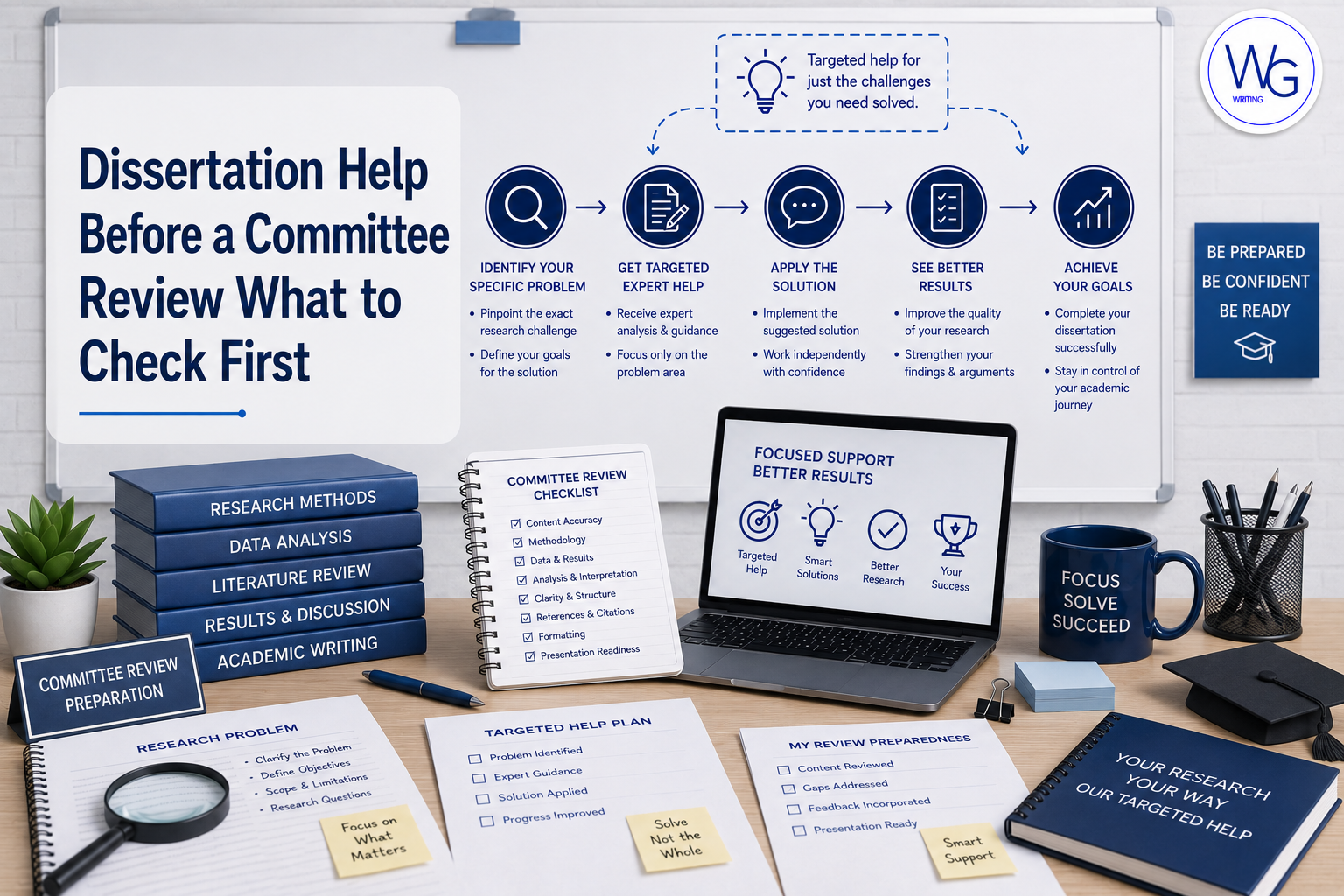
Need dissertation help before a committee review? Learn what to check first, from research alignment and analysis to chapter consistency and likely committee feedback.
Your Dissertation Should Be Reviewed Before the Committee Does
A dissertation committee review is a high-stakes point in the research process because the committee is not simply looking for spelling mistakes or polished sentences. Depending on the stage of the doctorate and the requirements of the program, faculty may examine the research problem, research questions, methodology, findings, interpretation, and the significance of the work. For example, Stanford University explains that doctoral oral examinations may involve reviewing a dissertation proposal, examining the strategy behind the research, or evaluating a dissertation and the candidate's understanding of the research.
That makes preparation before a review different from preparing a dissertation for final submission. You do not necessarily need to spend your remaining time changing every sentence or correcting minor formatting details. The more important task is to identify problems that could make your research difficult for committee members to follow, raise questions about how your study was conducted, or lead to requests for substantial revisions.
Start by looking at the relationships between the major parts of your dissertation. Does the research problem still lead logically to your research questions? Does your methodology address those questions? Do your findings answer what you set out to investigate? Do your conclusions reflect what your analysis actually established?
If you have revised your dissertation repeatedly, an independent review may also reveal problems that are difficult to notice when you have been working on the same document for months. PhD dissertation help is particularly useful when you need a professional review of your dissertation as a complete research project, with expert support to identify weaknesses, strengthen your arguments, improve consistency across chapters, and ensure the final document is clearly developed and ready for submission.
Get Your Dissertation Checked Before You Send It to the Committee
Writing Gram provides targeted dissertation writing assistance to help researchers review the areas most likely to affect their upcoming committee review.
👉 Place your order now to have your dissertation examined for cross-chapter inconsistencies, unclear analysis, unresolved revisions, and weaknesses that could lead to avoidable committee questions before you submit it for review.
What Should You Check First Before a Dissertation Committee Review?
Before a committee review, check the parts of the dissertation most likely to affect how the committee understands and evaluates your research. Start with the relationship between the research problem, questions, objectives, methodology, analysis, and conclusions. Then check whether your evidence supports your interpretations, whether important claims remain consistent across chapters, and whether previous committee feedback has been fully addressed.
A professional dissertation review should examine the work in the following order:
Research alignment — confirm that the problem, questions, objectives, methodology, analysis, and conclusions still correspond.
Analysis and interpretation — verify that the findings are represented accurately and that interpretations remain supported by the evidence.
Previous committee feedback — check that requested changes have been completed and that revisions have not created new problems elsewhere.
Cross-chapter consistency — compare terminology, participant or sample information, variables, findings, tables, figures, and conclusions.
Presentation and language — address clarity, grammar, formatting, citations, and other surface-level issues after the more consequential areas have been checked.
This order matters because a perfectly proofread dissertation can still have serious problems if its research questions, analysis, and conclusions are not properly aligned.
Check Whether Your Research Decisions Still Align
Before the committee reviews your dissertation, read beyond individual chapters and trace the research from its starting point to its conclusions. Your problem statement should establish the issue your study addresses, while your research questions should specify what the study seeks to answer. Your objectives should support those questions rather than introduce a different purpose.
The methodology deserves the same check. Ask whether the research design, participants or data sources, instruments, procedures, and analytical approach actually address the questions you established earlier. If a research question is introduced in Chapter 1 but is not adequately addressed in the analysis, a committee member may question why it was included and whether the dissertation has fully answered its stated research questions.
Your conclusions should also be carefully compared with your research questions, findings, and analysis to ensure that they accurately reflect what your study established. They should answer the research questions using the findings presented in the dissertation rather than introducing claims that were not established through the study.
Dissertation writing assistance can help you evaluate whether your conclusions are fully supported by your research questions, findings, and analysis, rather than focusing only on how clearly they are written.
A chapter-by-chapter edit might improve individual sections while missing a relationship problem between them. A broader review instead follows the logic of the dissertation from the research problem through the final conclusions.
For example, The University of Massachusetts Amherst describes a dissertation prospectus as including research questions, a theoretical framework, a literature review, the significance of the project, and the research procedures to be used.These elements are closely connected, so a change to one research decision may affect what needs to appear elsewhere in the dissertation.
Check Your Analysis and Interpretation Before the Committee Does
Your analysis deserves close attention because the committee may question not only what you found but also how you reached the conclusions you present.
Begin by comparing your written interpretation with the actual results. If a table shows one pattern but the surrounding discussion describes another, correct the discrepancy before the committee encounters it. Check whether figures, tables, statistical results, themes, quotations, or other evidence are represented accurately throughout the chapter.
Then examine the difference between what the data show and what you infer from those findings. An interpretation that extends beyond the evidence may invite questions about how the conclusion was reached. Similarly, an important finding that receives little explanation may leave committee members wondering why it matters to your research questions.
The discussion chapter deserves another comparison with the results chapter. Your discussion should interpret the findings rather than simply repeat them, while your conclusions should remain connected to what the study established. If recommendations extend beyond the evidence, identify the findings that support each recommendation and explain the connection between the evidence and the proposed action.
The University of California, Berkeley explains that dissertation committees guide doctoral research and judge the merits of the dissertation, with the final oral examination addressing the relationship between the dissertation and the candidate’s field of study. That makes it worth checking whether your dissertation not only reports results but also explains their significance within the research area. Professional dissertation writing assistance can also help you anticipate questions that may arise during a dissertation defense or viva voce, particularly questions about how your findings support your conclusions and contribution to the field.
If you are struggling to determine whether an interpretation is sufficiently supported, PhD dissertation help focused on analysis and discussion provides a practical second review before the committee sees the document. The purpose of professional review should be to identify unclear reasoning, unsupported claims, inconsistencies, or explanations that require strengthening—not to alter your findings or manufacture conclusions.
Check Whether Earlier Committee Feedback Has Been Fully Addressed
If your dissertation has already been reviewed by your advisor or committee, do not rely on memory when preparing for another review. Create a working list of the comments you received and identify exactly where each issue was addressed.
For every major comment, ask:
Where did I make the requested change?
Does the revised passage actually resolve the concern?
Did I explain the change sufficiently?
Did changing this section require changes elsewhere?
Does the revised chapter still agree with the rest of the dissertation?
Are there comments that I addressed partially but left unresolved?
The last two questions are particularly important. A revision that fixes one chapter may create a contradiction in another. For example, changing a research objective might require corresponding changes to the methodology, analysis, discussion, and conclusion. Updating a sample description might also require changes to tables, participant counts, and the narrative describing the study.
This is why doctoral committee feedback preparation should involve more than checking whether individual comments have been crossed off a list. You need to determine whether the changes made in response to earlier feedback have been carried through the dissertation.
The committee's expectations also vary by program and review stage, so your own department's instructions should remain the primary reference. For instance, The Ohio State University describes a dissertation proposal review in which committee members examine the rationale for the dissertation topic and the research plans before deciding whether the proposal is sufficiently developed. The example reinforces an important point: preparing for committee scrutiny requires attention to the reasoning behind the research, not merely its presentation.
Check for Cross-Chapter Inconsistencies
One of the most useful final checks before a committee review is to compare information across chapters rather than reading each chapter separately.
Look specifically at:
Research questions and objectives
Definitions of key concepts
Participant or sample descriptions
Variables, constructs, or themes
Research design and procedures
Analytical techniques
Findings reported in different chapters
Tables and figures
Terminology
Limitations
Conclusions and recommendations
A dissertation may appear polished when each chapter is reviewed independently but reveal inconsistencies when the document is considered as one research project. A participant number might differ between the methodology and results. A research question might appear in the introduction but remain insufficiently addressed in the discussion. A term might have one definition in the literature review and another in the analysis. A conclusion might claim a contribution that the findings never directly established.
These issues deserve attention before proofreading because they affect whether committee members can see a clear and consistent connection between the study’s research questions, analysis, and conclusion. A professional dissertation review can help if you are stuck on your dissertation by identifying inconsistencies, unresolved revisions, and gaps in the connection between your research questions, analysis, findings, and conclusions.After months of writing and revision, researchers can become so familiar with their intended argument that they may overlook inconsistencies between what they intended to establish and what the dissertation actually communicates.. A professional reviewer can approach the dissertation from the perspective of someone encountering the research for the first time, making it easier to identify unclear arguments, missing connections, and inconsistencies that the author may overlook.
If your committee review is approaching, a professional review should help you focus on changes that strengthen the dissertation rather than introduce unnecessary revisions.The goal is to identify the specific areas where clarification, revision, additional explanation, or stronger connections between chapters would make the document easier to evaluate.
Order Dissertation Review Assistance Before Your Committee Review
Writing Gram helps researchers prepare dissertations for committee review by examining the connections between chapters, reviewing analysis and interpretation, checking previous feedback, and identifying inconsistencies before the document reaches the committee.
👉 Place your order now to have your dissertation reviewed for research alignment, unresolved revisions, cross-chapter inconsistencies, and weaknesses that could attract committee questions, so you can submit a dissertation in which your analysis and conclusions accurately address your stated research questions and reflect your findings.
Check the Chapters Most Likely to Draw Committee Questions
You do not need to review every chapter with the same level of attention immediately before a committee review. Start with the sections that determine whether committee members can follow the logic of the study and evaluate the evidence supporting its conclusions.
Introduction and Problem Statement
Check whether the introduction clearly establishes the problem your dissertation investigates, why the problem warrants investigation, and what the study is designed to examine. The problem statement should lead naturally into the research questions rather than identify a problem that the study’s analysis and findings do not address.
Research Questions and Objectives
Compare every research question with the objectives, methodology, analysis, and conclusions. If a question appears in the introduction but is not answered in the findings or discussion, that gap should be resolved before the review. Similarly, if the dissertation presents findings that do not correspond to any stated research question or objective, determine why they appear in the study.
Methodology
Review the methodology against the actual research you conducted. Check whether the research design, participants or data sources, instruments, procedures, and research methods described in the chapter correspond with what you report in the results. Changes made during the research process should also be reflected accurately rather than leaving an outdated description in the methodology chapter.
The University of Washington requires a dissertation proposal to explain the research problem, rationale, research questions, and methods and demonstrate how these elements align to establish a clear direction for the proposed study.
Results and Findings
Check whether the findings answer the research questions and whether the numbers, themes, quotations, tables, or other evidence presented in the chapter correspond with the underlying analysis. Pay particular attention to discrepancies between tables and the accompanying narrative.
Discussion and Conclusions
Compare the discussion with the actual findings. Each major interpretation should be traceable to evidence presented in the results. Then examine whether the conclusions answer the research questions and whether the stated implications and recommendations follow from what the study established.
The University of Oregon requires doctoral students to provide the committee with a full dissertation draft before the formal defense, giving the committee an opportunity to review the completed research before the examination.
This chapter-by-chapter priority helps you spend your limited preparation time on the parts most likely to generate substantive questions rather than spending hours correcting sentences while a research question remains unanswered or a finding conflicts with the methodology.
When Should You Get Professional Dissertation Help Before the Review?
Professional PhD dissertation help can be useful when the upcoming committee review requires more than a final spelling and grammar check. The timing matters: if the dissertation is already substantially written, targeted review and revision assistance may be more appropriate than paying for a complete dissertation from scratch.
Consider professional assistance when your committee review is approaching and:
You have revised several chapters in response to previous committee comments and need to check whether those changes remain consistent throughout the dissertation.
You are unsure whether each research question is answered clearly in the findings and conclusions.
Your methodology has changed during the research process and you need to compare the current research procedures with what the dissertation says you did.
You have difficulty determining whether your interpretation goes beyond what your results demonstrate.
Your tables, figures, statistical results, themes, or narrative explanations contain discrepancies that you have struggled to resolve.
You have received extensive feedback and need to determine whether every requested change has actually been incorporated.
You have spent so much time with the dissertation that inconsistencies between chapters are difficult for you to notice.
You need a professional independent reviewer to examine the dissertation before it reaches the committee.
You also do not necessarily need the same level of support for every part of the dissertation. A completed methodology chapter may require only a consistency check, while the discussion may require more substantial revision because several interpretations are unclear or insufficiently connected to the findings.
The University of Rochester advises doctoral students preparing for a defense to meet with their advisory committee to confirm that the work is ready to defend. For a dissertation that is already substantially complete, professional assistance can focus on reviewing existing chapters, resolving inconsistencies, and addressing issues that may arise during the defense rather than rewriting completed sections.
What Can Dissertation Writing Assistance Cover Before a Committee Review?
Dissertation writing assistance can cover different types of work depending on what remains unresolved in your dissertation. Before ordering support, identify whether you need someone to examine the entire document, particular chapters, or specific problems.
Dissertation writing assistance provides the following services before a committee review”
Cross-Chapter Review
A cross-chapter review compares information that appears in different parts of the dissertation. This can include research questions, sample descriptions, terminology, variables, themes, findings, tables, figures, and conclusions.
Chapter Revision
If a committee comment requires substantial changes to a particular chapter, professional assistance can help reorganize the affected section, clarify its explanation, and connect the revision to information presented elsewhere in the dissertation.
Methodology Review
Methodology assistance can focus on whether the description of your research design, participants, data sources, procedures, instruments, and analysis accurately reflects the study you conducted.
Data Analysis Assistance
If the problem concerns the analysis itself, support can focus on interpreting the results, checking calculations or analytical procedures where appropriate, organizing findings, and connecting the reported results to the research questions.
Discussion and Interpretation Review
Professional assistance can examine whether your discussion accurately interprets the findings, distinguishes evidence from inference, and explains why the findings matter to the research questions.
Committee Feedback Revisions
If you already have comments from your advisor or committee, assistance can focus on incorporating those comments into the dissertation and checking whether a revision in one chapter requires corresponding changes elsewhere.
Language and Presentation
Once substantive concerns have been checked, assistance can address sentence clarity, grammar, transitions, terminology, citations, and formatting so that these issues do not distract from the content being reviewed.
The Columbia University Graduate School of Arts and Sciences states that doctoral dissertations undergo formal examination in which candidates discuss and defend their dissertations with respect to their sources, findings, interpretations, and conclusions. This makes it particularly useful to distinguish between surface-level editing and assistance that examines the findings, interpretations, and conclusions themselves.
What Not to Spend Time Perfecting Before a Committee Review
Preparing for a committee review does not mean rewriting every sentence simply because it could be phrased differently. If your time is limited, correcting a minor wording preference should not take priority over a research question that has not been answered or a conclusion that does not follow from the findings.
You can usually postpone low-impact changes when more substantive work remains. These may include:
Replacing words with stylistic alternatives that do not change the meaning.
Rewriting sentences that are already clear simply to make them sound different.
Making cosmetic formatting changes that do not affect how the committee reads the research.
Reorganizing paragraphs when their current order already communicates the argument clearly.
Changing terminology that is already defined and used consistently.
Reworking sections that have no connection to the committee's previous concerns.
Instead, use your remaining preparation time to examine questions such as:
Can a committee member identify which research question each major finding answers?
Can the methodology chapter be reconciled with what was actually done?
Can each major interpretation in the discussion be traced to specific findings?
Can the conclusions be supported by evidence presented earlier in the dissertation?
Can you show where each significant piece of previous committee feedback was addressed?
These checks are more consequential than making a dissertation sound slightly more polished. A committee member is more likely to question an unexplained difference between the methodology and results than a sentence that could have been worded more elegantly.
Dissertation Review Preparation Checklist
Before submitting your dissertation to the committee, review the document against the following questions:
Research and Structure
Does the problem statement describe the same research problem investigated in the later chapters?
Does each research question have corresponding findings?
Do the objectives correspond to the research questions?
Does the methodology describe the research that was actually conducted?
Do the conclusions answer the research questions?
Evidence and Analysis
Do the reported findings match the underlying analysis?
Do tables and figures agree with the accompanying text?
Are statistical results, themes, quotations, or other evidence reported consistently?
Can each major interpretation in the discussion be traced to specific findings?
Do recommendations identify the findings that support the proposed action?
Are claims in the conclusion supported by evidence presented in the dissertation?
Committee Feedback
Have previous committee comments been addressed individually?
Can you identify where each requested revision appears in the dissertation?
Did a revision in one chapter require corresponding changes elsewhere?
Are any previous committee concerns still unresolved?
Cross-Chapter Consistency
Are participant or sample numbers identical wherever they appear?
Are key terms defined and used consistently?
Are variables, constructs, themes, or categories described consistently?
Do the methodology, findings, discussion, and conclusion describe the same study?
Are the limitations consistent with the methods and findings?
Do the recommendations follow from the findings and conclusions?
Final Presentation
Are headings and chapter organization consistent?
Are citations and references complete and consistent?
Are tables and figures numbered and discussed correctly?
Have grammar and sentence-level problems been corrected after the substantive review is complete?
This checklist gives you a practical order for dissertation review preparation: first verify what the study investigates and how it was conducted, then verify what the evidence shows and how it is interpreted, and only afterward spend substantial time on presentation-level corrections.
Get Your Dissertation Checked Before the Committee Review
A committee review is easier to prepare for when you know exactly which parts of the dissertation require attention. Rather than treating every sentence as equally important, prioritize the research questions, methodology, findings, interpretation, conclusions, previous committee revisions, and connections between chapters.
If you have completed most of the dissertation but are unsure whether it is ready for an upcoming review, Writing Gram provides targeted dissertation writing assistance based on the sections and problems you need checked.
👉Place your order now to have your dissertation reviewed for cross-chapter inconsistencies, unsupported interpretations, unanswered research questions, unresolved committee feedback, and discrepancies between your methodology, findings, and conclusions before the committee reviews it.