Dissertation Analysis Help for Mediation and Moderation Results
By Writing Gram • Sep 18, 2026
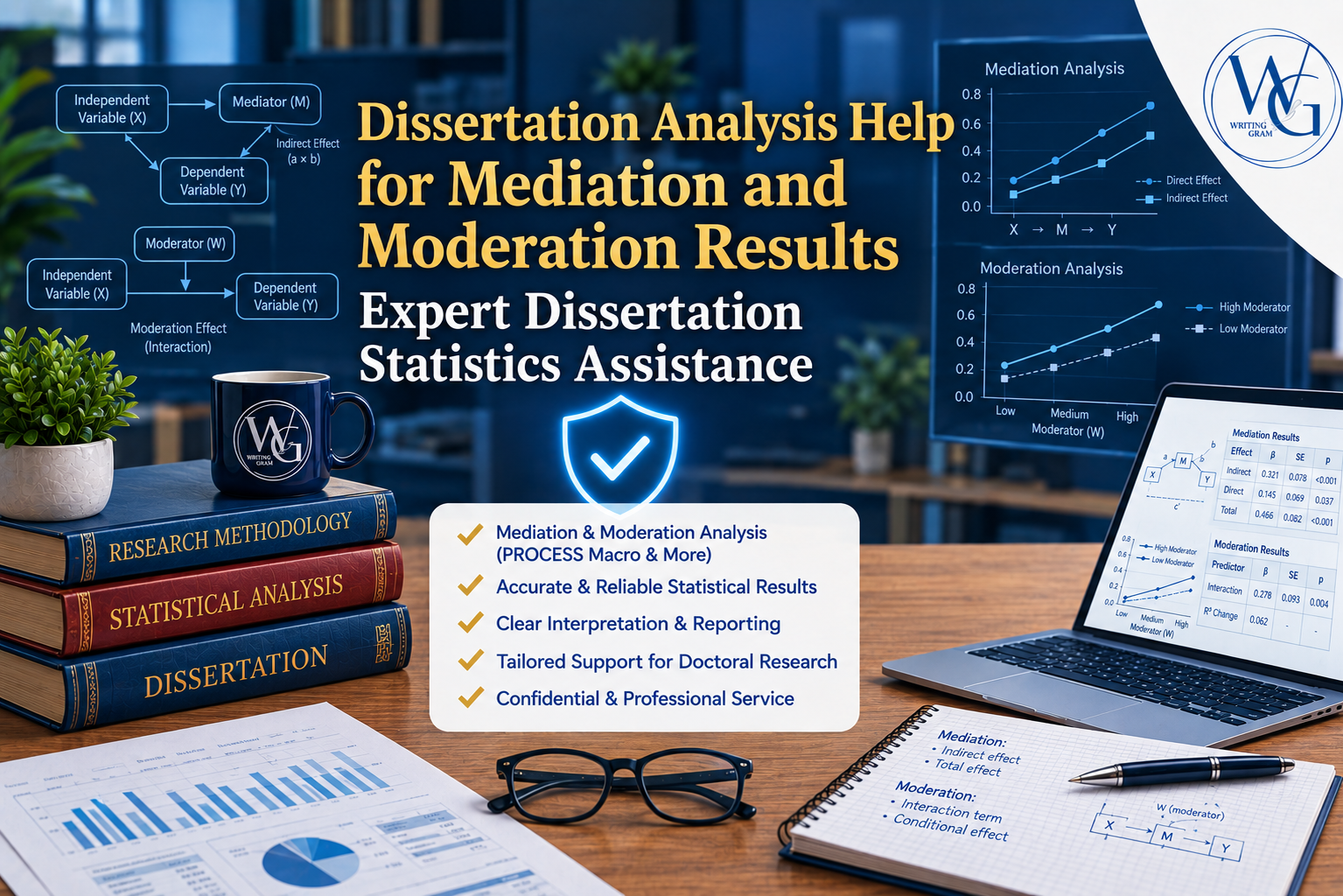
Get dissertation analysis help interpreting mediation and moderation results, explaining statistical findings, and presenting them clearly in your dissertation.
Students who already have mediation or moderation output may need help understanding what the results actually show, connecting the findings to their research questions and hypotheses, and presenting the analysis clearly in a dissertation. Dissertation analysis help can assist with interpreting existing statistical output, explaining significant or unexpected findings, and turning complex results into accurate, dissertation-ready writing without changing the underlying results.
What Mediation and Moderation Results Mean in a Dissertation
Mediation and moderation analyses answer different research questions, so interpreting their results requires more than simply determining whether a p-value is statistically significant. A mediation analysis examines whether an effect or association operates through an intermediate variable, while moderation examines whether the relationship between two variables changes according to the level or category of another variable.
Mediation results
In a mediation analysis, the researcher is generally interested in whether a proposed mediator helps explain the relationship between a predictor and an outcome. The results may include a direct effect, indirect effect, and total effect. For a dissertation, the important task is to explain what those results mean in relation to the proposed model rather than simply reproducing the statistical table.
For example, a student may have a significant indirect effect but be unsure how to explain it in the Results or Discussion chapter. The interpretation needs to identify the pathway being examined, report the relevant statistical evidence, and explain how the finding relates to the research question.
Research guidance from Stanford University Graduate School highlights the importance of focusing on the evidence for indirect effects when interpreting mediation rather than treating the significance of the overall predictor-outcome relationship as the sole basis for a mediation conclusion.
Moderation results
Moderation asks a different question. Instead of asking whether a relationship operates through another variable, it asks whether the relationship changes depending on a moderator.
The interaction effect is therefore central to the interpretation. For example, a dissertation might examine whether the relationship between leadership style and employee performance differs according to organizational tenure. The moderation result needs to explain whether the relationship varies across the moderator and, where appropriate, describe the direction and nature of that difference.
Penn State University Eberly College of Science explains that interaction effects occur when the relationship represented by a regression model cannot be treated as simply additive. This is why a moderation result should not be interpreted by looking only at the individual coefficients without considering the interaction.
For a doctoral student, the challenge is often not obtaining the output. It is understanding how to move from the output to a clear explanation that answers the research question and fits the dissertation's theoretical framework.
📊 Get Dissertation Analysis Help for Your Mediation and Moderation Results
Writing Gram dissertation analysis help can help you interpret your existing mediation or moderation results, explain what the statistical output means, connect the findings to your research questions and hypotheses, and turn the results into clearer dissertation writing.
👉 Place your order now to get help working through your existing results, explaining difficult or unexpected findings, and presenting your analysis clearly before submission.
When You Need Dissertation Mediation Analysis Help
You may need dissertation mediation analysis help when the statistical analysis has already been completed but the results are difficult to interpret or present.
This is particularly common when the output contains several statistical results that need to be interpreted together to answer the research question. A mediation model may provide estimates for the direct, indirect, and total effects, together with standard errors, significance values, or confidence intervals. Knowing which figures matter for the research question and how they should be discussed can be more difficult than generating the output itself. This can be especially important in publication-based or article-based dissertations, where mediation findings may need to be interpreted clearly within an individual research article while also fitting the broader research objectives of the dissertation. Therefore, the researcher needs to understand what each effect means and identify which results directly address the research question before presenting them in the dissertation or research article.
For example, you may need help with:
Understanding what the indirect effect represents
Explaining the relationship between the direct and indirect effects
Interpreting confidence intervals reported for an indirect effect
Determining how the finding relates to a mediation hypothesis
Explaining an unsupported mediation hypothesis
Discussing an unexpected mediation finding
Turning statistical output into a clear Results chapter
Checking whether your written interpretation accurately reflects your reported results
The University of Virginia explains that mediation can be represented through relationships involving the predictor, mediator, and outcome and demonstrates how direct, total, and mediation effects can be distinguished when interpreting results.
The important point is that dissertation mediation analysis help does not necessarily mean starting the statistical analysis again. If you already have your output, you may instead need help interpreting what you have, identifying which results answer your research questions, and explaining those findings accurately.
That distinction makes this type of support particularly useful for doctoral students who are working on a Results or Discussion chapter and are unsure how to move from statistical tables to written interpretation. It can also be valuable for ABD students and doctoral students working full time who may have completed their analysis but need focused support to interpret the findings and turn them into clear dissertation chapters.
When You Need Dissertation Moderation Analysis Help
Dissertation moderation analysis help can be useful when your analysis includes an interaction effect but you are uncertain about what the interaction means or how to explain it in your dissertation. This can be especially relevant when a dissertation includes multiple studies or research phases, where interaction effects may need to be interpreted separately for each study or phase while still being connected to the overall research objectives.
A moderation result should not be reduced to a sentence such as "the interaction was significant." The reader needs to understand what relationship was being moderated, which variable served as the moderator, and what the interaction indicates about the relationship being examined.
This can involve several interpretive questions:
Does the interaction provide evidence that the relationship changes across levels of the moderator?
In which direction does the relationship change?
What does the interaction mean for the original hypothesis?
Should the relationship be described separately at particular moderator values?
How should an unexpected interaction be presented?
How can the finding be connected to the research question without overstating it?
For example, when two continuous variables interact, the interpretation may require examining the slope of one variable at different values of the moderator.
University of California, Los Angeles Office of Advanced Research Computing, Statistical Methods and Data Analytics provides examples showing that interaction coefficients can be understood through differences between conditional or simple effects. This is particularly relevant when a dissertation needs to explain what an interaction means rather than merely report its coefficient.
A student therefore may have perfectly usable moderation output but still need assistance turning that output into a coherent dissertation. The goal is to make the statistical interpretation understandable while keeping it consistent with the analysis that was actually conducted.
Interpreting Mediation Results in a Dissertation
Once the mediation analysis has been completed, the dissertation needs to explain the findings in a way that connects the statistical evidence with the research question. The interpretation process involves more than reporting the numbers, so it helps to work through each part of the mediation results and explain how the findings should be understood in the context of the study. The following sections explain how to examine the indirect effect, interpret its confidence interval, connect the findings to the research question, and discuss unexpected results.
Interpreting Mediation Results in a Dissertation
Once the mediation analysis has been completed, the dissertation needs to explain the findings in a way that connects the statistical evidence with the research question. The interpretation process involves more than reporting the numbers, so it helps to work through each part of the mediation results and explain how the findings should be understood in the context of the study. The following sections explain how to examine the indirect effect, interpret its confidence interval, connect the findings to the research question, and discuss unexpected results.
i. Check the indirect effect
The indirect effect is central to interpreting a mediation model because it represents the extent to which the relationship between a predictor and an outcome operates through the proposed mediator. Rather than simply stating that mediation occurred, the dissertation should identify the indirect effect reported by the analysis and explain what that effect represents in the context of the study. In a PROCESS analysis, for example, the indirect effect is calculated from the pathway from the predictor to the mediator and the pathway from the mediator to the outcome.
The University of California, Los Angeles Office of Advanced Research Computing, Statistical Methods and Data Analytics provides an example of how mediation output reports direct, indirect, and total effects.
For example, suppose a doctoral dissertation examines whether employee motivation mediates the relationship between transformational leadership and organizational performance. The analysis might produce an indirect effect of 0.23. The researcher should not simply write that transformational leadership had a mediated effect on organizational performance. Instead, the Results chapter could explain that the indirect effect indicates that the relationship between transformational leadership and organizational performance operated partly through employee motivation. The researcher would then report the actual estimate and relevant statistical information from the analysis.
This distinction is important because the indirect effect addresses the proposed pathway itself. A dissertation may therefore have statistically significant relationships between individual variables while still requiring a separate interpretation of whether the proposed indirect pathway received support.
ii. Examine the confidence interval
The confidence interval provides additional information about the uncertainty surrounding the estimated indirect effect. When bootstrapping is used, the confidence interval for the indirect effect is particularly important because the sampling distribution of an indirect effect does not generally follow a normal distribution. Bootstrapped confidence intervals are commonly used for indirect effects in PROCESS because of this issue.
For example, imagine a dissertation examining whether workplace stress affects employee turnover intention through burnout. Suppose the estimated indirect effect is 0.18 and the 95% bootstrap confidence interval is [0.09, 0.30]. Because the interval does not include zero, the researcher can report that the indirect effect was statistically supported. The interpretation should then explain that the findings are consistent with the proposed pathway in which higher workplace stress is associated with greater burnout, which in turn is associated with higher turnover intention.
The important point is to use the confidence interval produced by the actual analysis rather than replacing it with a general statement about statistical significance. Dissertation research often includes several coefficients and significance values, but the confidence interval for the indirect effect provides specific information about the evidence for the proposed mediation pathway. Research on confidence intervals for indirect effects also highlights why methods that account for the non-normal distribution of indirect effects are important when interpreting mediation results.
iii. Connect the finding to the research question
After identifying the indirect effect and examining its confidence interval, the dissertation should explain what the result means for the research question. This is where statistical output becomes substantive interpretation. The researcher should connect the mediation result to the variables and relationship being investigated rather than leaving the reader to determine its meaning from a statistical table.
For example, consider a dissertation asking whether social media use is associated with academic performance through anxiety among university students. If the analysis indicates a statistically supported indirect effect through anxiety, the Results chapter could explain that the findings provide evidence consistent with anxiety serving as an intervening variable in the relationship between social media use and academic performance. The researcher can then relate this finding directly to the research question by explaining that the proposed pathway received statistical support. A university research project has similarly examined relationships among social media use, anxiety, and academic performance, illustrating how these variables can be investigated within a research context.
The interpretation should remain within the boundaries of the study. For example, if the research design is correlational or cross-sectional, the researcher should avoid turning a statistically supported indirect association into a stronger causal claim than the design permits. The goal is to explain what the statistical evidence shows about the proposed relationship and how that evidence addresses the research question.
iv. Explain unexpected findings
Not every mediation analysis produces the result the researcher expected. An indirect effect may be unsupported, smaller than expected, or different from the direction proposed in the hypothesis. When this happens, the dissertation should report the finding as it appears in the analysis rather than changing the interpretation to make the hypothesis appear supported.
For example, suppose a dissertation examines whether job stress affects employee job satisfaction through burnout and the analysis produces an indirect effect whose confidence interval includes zero. The researcher should not describe burnout as a mediator simply because the theoretical framework predicted that it would be. Instead, the Results chapter could state that the analysis did not provide statistical support for the proposed indirect effect. The Discussion chapter could then consider possible explanations, such as the way burnout was measured, characteristics of the sample, the study design, or findings from previous research.
Unexpected findings can also occur in healthcare research. A nursing PhD dissertation might examine whether workload is associated with employee turnover intention through job burnout, but the proposed indirect pathway may not receive statistical support. In that situation, the researcher can discuss whether other factors in the study may help explain turnover intention, while clearly distinguishing those possible explanations from what the mediation analysis actually demonstrated. Published doctoral research provides examples of mediation analyses in healthcare and workplace settings where proposed mediation effects were not supported for every relationship examined.
The distinction between the statistical finding and the possible explanation is important. The analysis determines whether the proposed indirect effect received statistical support; the Discussion chapter then provides a reasoned interpretation of why the result may have occurred in light of the study's theory, measures, sample, design, and existing literature.
Interpreting Moderation Results in a Dissertation
Interpreting moderation results requires attention to the interaction because the central question is whether the relationship between the predictor and outcome changes according to the moderator. To interpret the result clearly, the dissertation should first establish whether the interaction effect is supported, then explain the direction of the relationship, connect the finding to the hypothesis, and address any unexpected results. The sections below explain how to approach each of these aspects when interpreting and writing about moderation results in a dissertation.
a. Identify the Interaction Effect
The interaction term provides the key evidence for whether the proposed moderation relationship is present in the model. Its interpretation should be tied to the variables and hypothesis in the dissertation rather than treated as an isolated statistical value.
For example, suppose a dissertation examines whether organizational support moderates the relationship between transformational leadership and employee job performance. The researcher may find a statistically significant interaction between transformational leadership and organizational support. This would indicate that the relationship between transformational leadership and employee job performance changes depending on the level of organizational support.
The interaction coefficient should therefore not be interpreted on its own. The researcher should examine the statistical significance of the interaction and then consider the conditional effects or simple slopes to understand how the relationship changes at different levels of the moderator. A significant main effect for transformational leadership would not, by itself, demonstrate that organizational support moderates the relationship. The evidence for moderation comes from the interaction between the predictor and moderator.
b. Explain the Direction of the Relationship
If the interaction indicates that the relationship changes across levels of the moderator, the dissertation should explain the direction and substantive meaning of that change.
For example, imagine a study examining whether financial literacy predicts personal financial management and whether income level moderates this relationship. Suppose the results show that the positive relationship between financial literacy and personal financial management is stronger among participants with higher income levels than among participants with lower income levels.
The researcher should explain this difference rather than simply report that the interaction term was statistically significant. The interpretation could state that the relationship between financial literacy and personal financial management becomes stronger as income level increases. If the analysis includes simple slopes or conditional effects, those results can be used to show how the relationship differs across the relevant income levels.
This approach helps the reader understand what the interaction means for the relationship between the variables. The dissertation should describe the direction shown by the statistical results without claiming effects that were not supported by the analysis.
c. Connect the Interaction to the Hypothesis
The interpretation should return to the original hypothesis. If the hypothesis predicted that a particular variable would strengthen, weaken, or otherwise alter a relationship, the reported moderation result should be explained in those terms while remaining faithful to the actual statistical evidence.
For example, suppose a dissertation examines whether technological support moderates the relationship between remote work and employee productivity. The hypothesis may predict that the positive relationship between remote work and productivity will be stronger when employees have greater access to technological support.
If the interaction is statistically significant and the conditional effects show that the relationship is stronger at higher levels of technological support, the researcher can explain that the finding supports the proposed moderation hypothesis. If the interaction is not statistically significant, the researcher should instead state that the predicted moderation relationship was not supported.
Harvard T.H. Chan School of Public Health tools and tutorials provides methodological resources on interaction, including tutorials addressing how interaction effects can be interpreted and analyzed.
d. Present Unexpected Moderation Findings
An unexpected moderation result should be presented as a finding rather than adjusted to fit the original prediction. If the interaction is not supported, the dissertation can report that outcome and explain its implications for the research question.
For example, suppose a study examines whether social media marketing influences customer purchase intention and proposes that age moderates this relationship. The researcher may expect the relationship to be stronger among younger consumers, but the interaction analysis may show that age does not significantly change the relationship.
In this case, the dissertation should report that the proposed moderation effect was not supported rather than implying that age influenced the relationship. The discussion can then consider possible explanations, such as differences in how participants use social media or whether other characteristics may be more relevant to purchase intention.
Similarly, if the interaction is supported but operates in an unexpected direction, the interpretation should describe what the data show and then consider possible explanations separately.
Clear dissertation writing therefore separates the statistical finding from the interpretation of that finding. This makes it easier for the reader to see what the analysis demonstrated, how it relates to the hypothesis, and what conclusions can reasonably be drawn from the study.
📊 Get Professional Moderation Analysis Help for Your Dissertation
Writing Gram dissertation help can help you interpret your existing moderation results, explain interaction effects, connect the findings to your research questions and hypotheses, and turn your statistical output into well-explained Results and Discussion sections for your dissertation.
👉 Place your order now to get help interpreting your existing results, explaining unexpected or difficult findings, and presenting your moderation analysis clearly so you can continue working toward your dissertation submission.
Turning Mediation and Moderation Output Into Dissertation Writing
Having statistical output is not the same as having a completed dissertation analysis section. A student may have SPSS tables, PROCESS output, regression coefficients, indirect-effect estimates, interaction terms, confidence intervals, graphs, or other statistical results and still be unsure how to turn those figures into a clear explanation.
A strong mediation analysis dissertation section should do more than reproduce the values from the statistical output. It should identify the result that addresses the research question, report the relevant statistical evidence, and explain what the finding means within the study.
The same applies to a moderation analysis dissertation. An interaction coefficient may appear straightforward in the output, but the dissertation still needs to explain what relationship is being moderated and how the interaction relates to the hypothesis. The University of Michigan's doctoral-level statistical methods course specifically includes simple mediation and moderation alongside correlation and regression, reflecting the need to understand how these analyses fit together when interpreting dissertation results.
The following sections explain how to carry out each of these steps when turning mediation and moderation output into a clear explanation of your dissertation findings.
a. Report what the analysis found
The first task is to accurately report the relevant statistical findings. This may involve presenting an indirect effect for mediation or an interaction effect for moderation, together with the statistical information required by the methodology used in the study.
The Results section should make it possible for the reader to identify what the analysis actually found without having to reconstruct the conclusion from several tables.
For example, suppose a DNP capstone project examines whether workplace violence affects patient safety among nursing interns through professional burnout. If the mediation analysis shows a significant indirect effect through professional burnout, the Results section should report the indirect effect and its confidence interval and clearly state that the analysis provided statistical evidence for an indirect relationship through burnout.
b. Explain what the result means
Reporting a coefficient or significance value does not automatically explain its meaning. The interpretation should translate the statistical result into a statement about the variables examined in the study.
For mediation, this may involve explaining whether the proposed pathway through the mediator received statistical support. For moderation, it may involve explaining whether and how the relationship between the predictor and outcome changes according to the moderator.
For example, suppose a DBA dissertation examines whether workload is associated with employee well-being through burnout. If the indirect effect is significant, the researcher could explain that higher workload is associated with lower well-being partly through its relationship with burnout. Therefore, the interpretation tells the reader what role burnout plays in the relationship instead of simply stating that the indirect effect was statistically significant.
c. Connect the result to the research question or hypothesis
The final step is connecting the finding back to the research question or hypothesis that led to the analysis.
This is particularly important when the statistical output contains several effects. The dissertation should make clear which result addresses the hypothesis, whether the expected relationship was supported, and what the finding means within the context of the study.
For example, suppose a dissertation investigates whether emotional labor is related to job burnout differently depending on perceived organizational support. If the interaction between emotional labor and perceived organizational support is significant, the researcher should connect that finding directly to the hypothesis by explaining whether the relationship between emotional labor and burnout changes at different levels of organizational support.
Separating the reporting, interpretation, and connection to the research question or hypothesis helps the dissertation explain what the analysis found, what the results mean, and how the findings relate to the study.
How Dissertation Analysis Help Can Improve Your Results and Discussion Chapters
Students who have already completed their mediation or moderation analysis may need help interpreting their existing results and presenting those findings clearly in their dissertation. This can be especially useful when the statistical output is complete but the student is unsure how to explain the findings, identify the results that answer the research questions, or write the Results and Discussion chapters.
This type of dissertation analysis help can focus on the actual output from the student's study and the requirements of the dissertation. The sections below explain how this support can help with reviewing mediation and moderation results, interpreting significant and non-significant findings, connecting results to research questions and hypotheses, explaining the study’s overall contribution, and presenting the findings clearly in the Results and Discussion chapters.
Dissertation analysis help can improve these chapters in the following ways:
I. Improving the Presentation of Mediation Results
Students may have completed their mediation analysis but still be unsure which results to report and how to explain the direct effect, indirect effect, total effect, or confidence interval in their dissertation. Dissertation analysis help can review the existing mediation output and identify the findings that need to appear in the Results chapter.
It can also help turn those statistical findings into written explanations that show what the mediation analysis found and what the result means for the relationship between the variables. This makes the Results chapter more complete and gives the Discussion chapter a clear statistical finding to interpret.
II. Improving the Presentation of Moderation Results
Moderation results can be difficult to explain when the statistical output contains an interaction term, regression coefficients, and other model information. Dissertation analysis help can review the existing output and help the student identify the interaction effect that needs to be reported.
The written explanation can then show whether the relationship between the predictor and outcome changes according to the moderator and explain what that finding means within the study. This helps the Results chapter report the moderation finding clearly and gives the Discussion chapter a specific result to examine.
III. Improving the Interpretation of Significant and Non-Significant Findings
The Results and Discussion chapters need to explain significant and non-significant findings accurately. Dissertation analysis help can help the student determine what a significant result actually demonstrates and how a non-significant result should be reported without claiming that the expected relationship was established.
The Discussion chapter can then examine why the findings may have occurred and how they relate to the study's theoretical and conceptual frameworks and previous research. This creates a clear distinction between the statistical finding reported in the Results chapter and the interpretation of that finding in relation to the theories and concepts used in the study.
IV. Improving the Connection Between Findings and Research Questions
A dissertation should make it clear how the statistical findings answer the research questions and relate to the hypotheses. Dissertation analysis help can help the student connect each mediation or moderation result to the specific research question or hypothesis it was intended to address.
This can improve the Results chapter by making the purpose of each reported finding clear and improve the Discussion chapter by showing how the findings answer the questions the study set out to investigate.
V. Improving the Explanation of the Study's Overall Contribution
Individual statistical findings need to be brought together to explain what the completed study contributes to the research problem. Dissertation analysis help can help the student identify how the mediation and moderation findings collectively add to what was already known about the topic.
This can strengthen the Discussion chapter by connecting the study's findings to the research gap identified in the literature, showing what the study reveals about the relationships examined, and explaining what the completed research adds to the field.
VI. Improving the Writing of the Results Chapter
Students may have detailed statistical output but struggle to turn it into well-organized Results-section paragraphs. Dissertation analysis help can help determine which statistics need to be reported, how the findings should be presented, and how the written explanation should correspond to the tables and figures.
This helps the Results chapter present the analysis in a logical and coherent way, making it easier for the reader to understand what the statistical analysis found.
VII. Improving the Discussion of Unexpected Findings
Unexpected mediation or moderation findings can leave students unsure how to write the Discussion chapter. Dissertation analysis help can help the student explain what the analysis actually found and then examine possible reasons why the result differed from the original expectation.
This can improve the Discussion chapter by connecting unexpected findings to the study's framework and relevant literature while keeping the explanation consistent with the actual statistical results.
VIII. Improving the Accuracy of the Results and Discussion
The interpretation written in the dissertation needs to match the statistical output. Dissertation analysis help includes comparing the existing statistical results with the written Results and Discussion chapters to identify interpretations that do not accurately reflect the reported findings.
This can help correct inaccurate statements, clarify conclusions that extend beyond the statistical evidence, and ensure that the Results and Discussion chapters consistently reflect the mediation and moderation analyses that were actually performed.
🎓 Get Dissertation Analysis Help for Your Mediation or Moderation Results
Writing Gram can help you interpret your existing mediation or moderation results, explain what the statistical output means, connect the findings to your research questions and hypotheses, explain the study's overall contribution, and incorporate those findings into your dissertation.
👉 Place your order now to get help interpreting your existing mediation or moderation results, explaining significant, non-significant, unexpected, or difficult findings, connecting your results to your research questions and hypotheses, and strengthening your dissertation before submission.