How Professional Dissertation Support Protects Research Quality From Start to Finish
By Writing Gram • Jul 11, 2026
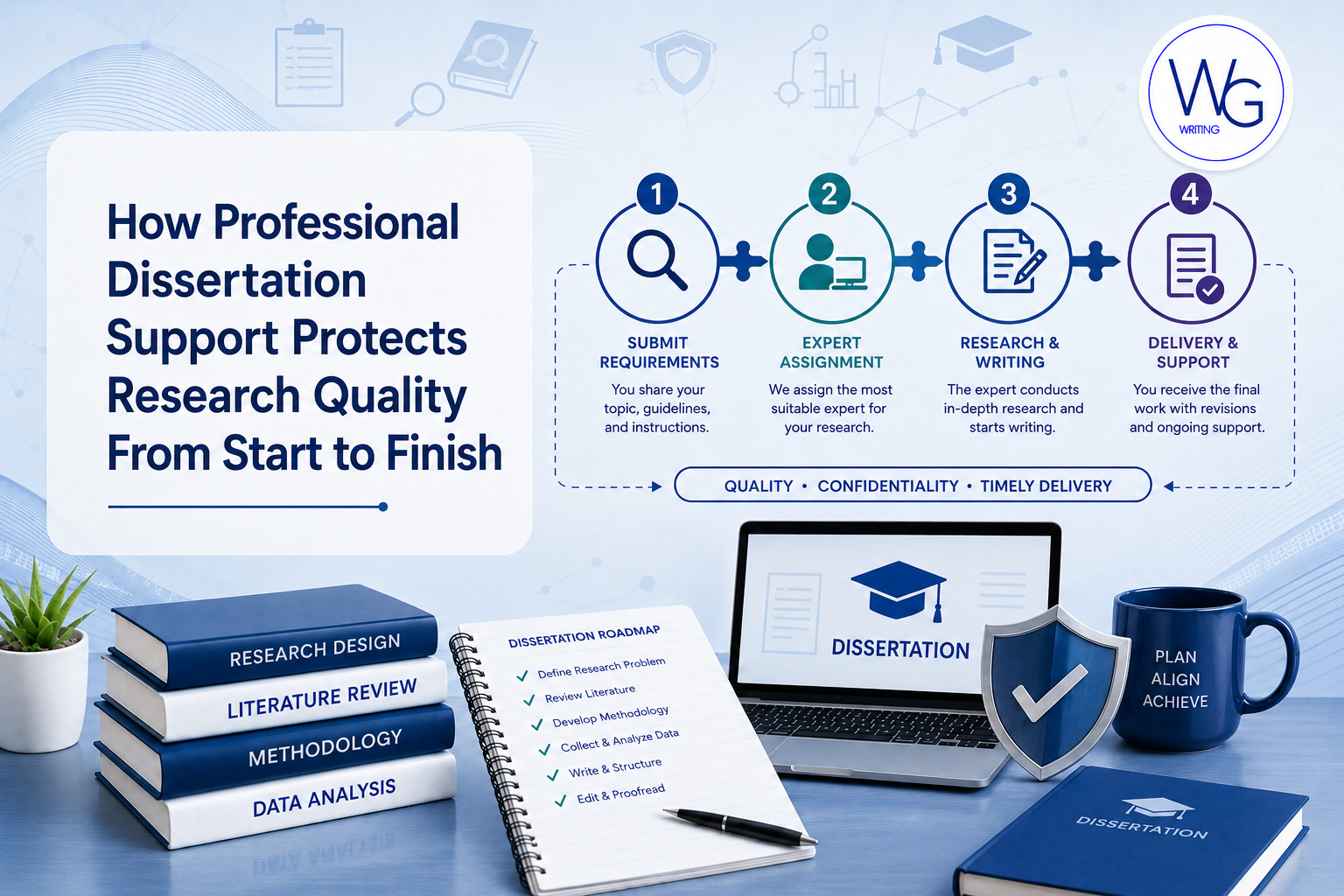
Discover how professional dissertation support maintains research quality through planning, methodology, analysis, revisions, and final preparation with expert guidance.
Dissertation research quality is built throughout the entire research process, not created during the final proofreading stage. A strong dissertation depends on the decisions made throughout the entire research process, from selecting a research problem to developing the methodology, analyzing findings, and preparing the final submission. Each stage influences the credibility, clarity, and academic value of the completed study.
Many researchers focus on improving quality only when they are close to submission and discover issues such as unclear research objectives, weak connections between chapters, inconsistent arguments, or limitations in their methodology. However, these challenges often develop much earlier during the dissertation lifecycle. Addressing them at the final stage can require extensive revisions and may affect the overall strength of the research.
Maintaining dissertation quality requires a structured approach that evaluates how each research component contributes to the final outcome. This involves ensuring that research questions align with the study objectives, selected methods effectively address the research problem, data analysis supports the findings, and conclusions accurately reflect the evidence presented. A dissertation with strong individual chapters can still lose quality if these elements are disconnected.
Professional dissertation support helps researchers manage quality throughout the research journey rather than focusing only on correcting problems at the end. Effective dissertation assistance examines the development of the dissertation as a complete research project by identifying areas that require improvement, strengthening academic communication, and helping researchers maintain consistency across different stages of their work.
For doctoral researchers, this approach provides greater confidence because quality control becomes part of the research process instead of a final review activity. Whether a researcher needs assistance refining a research topic, improving methodological decisions, strengthening analysis, or preparing the dissertation for evaluation, continuous quality management helps create a more coherent and academically prepared submission.
📚 Strengthen Your Dissertation Quality With Professional Research Support
A dissertation requires more than completing chapters; it requires maintaining quality from the first research decision to final submission. Writing Gram provides professional dissertation assistance designed to help researchers improve their research structure, strengthen academic communication, and prepare a high-quality dissertation with confidence.
✅ Expert dissertation and thesis assistance tailored to your research needs
✅ Support with research development, methodology, analysis, and revisions
✅ Confidential assistance with transparent pricing and no hidden charges
✅ Unlimited revisions when your original instructions remain unchanged
🚀 Take control of your dissertation quality and move closer to successful completion. Place your order now and benefit from professional guidance that helps you develop a stronger, well-structured, and submission-ready dissertation.
What Is Dissertation Research Quality and Why Does It Matter?
Dissertation research quality refers to the overall strength, reliability, and academic value of a research project. It is determined by how effectively a dissertation addresses its research problem, applies appropriate methods, analyzes evidence, and communicates meaningful conclusions. High-quality research is not measured only by the amount of information included but by how well each component of the study connects to create a logical and credible argument.
Universities evaluate dissertation quality by examining whether the research demonstrates a clear purpose, appropriate methodology, effective use of evidence, and a meaningful contribution to existing knowledge. For example, the University of Maryland Graduate School explains that doctoral dissertations are expected to demonstrate original research and contribute knowledge within a specific academic field.
Several factors determine dissertation research quality, including:
Clear research objectives: Strong dissertations begin with clearly defined aims that guide the entire research process. Unclear objectives can make it difficult to select suitable methods or develop focused findings.
Appropriate methodology selection: The research approach must match the research questions and objectives. A well-designed methodology strengthens the credibility of the study by ensuring that data collection and analysis address the intended problem.
Strong connection between research questions and findings: Quality research maintains alignment between what the researcher investigates and what the dissertation ultimately demonstrates. Findings should directly respond to the research questions rather than introduce unrelated observations.
Accurate interpretation of evidence: Research quality depends on how effectively evidence is analyzed and explained. Strong dissertations move beyond presenting results by showing what those results mean within the context of the research topic.
Logical academic structure: Each chapter should contribute to the overall research argument. Literature reviews, methodologies, findings, and discussions need to connect clearly so that readers can understand the development of the study.
Consistent scholarly communication: Academic quality also depends on how effectively ideas, evidence, and conclusions are presented. Clear communication allows examiners to understand the significance of the research contribution.
A dissertation can contain extensive research material and still have quality issues if its arguments, methods, and conclusions are not properly connected. Research quality is developed through continuous decisions made throughout the dissertation process rather than through a final review before submission. This is why researchers benefit from maintaining quality at every stage instead of waiting until problems become difficult to resolve.
How Professional Dissertation Support Maintains Quality During Dissertation Planning
The planning stage creates the foundation for dissertation research quality. Decisions made at this stage influence every later chapter, including the methodology, literature review, analysis, and final conclusions. When research objectives are unclear or the research design does not match the intended outcomes, researchers may experience difficulties that affect the entire dissertation.
Professional dissertation support helps researchers establish a stronger quality foundation by reviewing and improving important early-stage decisions. This includes refining research objectives, strengthening research questions, developing realistic research plans, and ensuring that the selected approach supports the intended research outcomes.
A well-planned dissertation requires alignment between the research problem, objectives, questions, methodology, and expected findings. For example, a research question that requires detailed exploration may need a different approach from a question focused on measuring relationships between variables. Selecting an unsuitable approach at the beginning can create challenges during data collection and analysis.
Professional assistance during dissertation planning can also help researchers identify potential weaknesses before they become major issues. Early quality management allows researchers to address gaps in their research direction, improve the structure of their study, and reduce the need for extensive corrections later in the dissertation process.
Rather than treating dissertation quality as something assessed only after completion, effective planning makes quality management part of the research journey from the beginning. This approach helps researchers develop a more organized, focused, and doctoral-level dissertation.
📚 Build a Strong Dissertation Foundation With Expert Research Support
Starting your dissertation with the right structure can prevent costly revisions and strengthen your chances of producing a high-quality research project. Writing Gram provides professional dissertation assistance to help researchers refine their research direction, improve methodology decisions, strengthen academic structure, and maintain quality throughout the dissertation lifecycle.
✅ Research-focused dissertation and thesis assistance
✅ Support with research planning, methodology, analysis, and revisions
✅ Confidential service with transparent pricing and no hidden charges
✅ Unlimited revisions when your original requirements remain unchanged
🚀 Do not wait until dissertation problems affect your submission timeline. Get professional guidance that helps you build a stronger research foundation and complete your dissertation with greater confidence. Place your order now and benefit from expert assistance, improved research quality, and a clearer path toward a submission-ready dissertation.
Maintaining Dissertation Quality Through Methodology Development
Methodology is one of the most important factors influencing dissertation research quality because it determines whether a study can effectively answer its research questions. A well-developed methodology provides a clear framework for collecting, analyzing, and interpreting data, while a weak methodological approach can create limitations that affect the reliability and usefulness of the findings.
A strong dissertation methodology should demonstrate that the selected research approach is appropriate for the research problem and aligned with the study objectives. According to Boston University Libraries, a dissertation should present a clear research design and explain the methods used to investigate the research problem.
Maintaining methodology quality requires careful evaluation of several areas throughout the research process:
Selecting the appropriate research approach: The chosen methodology should reflect the purpose of the study. Qualitative, quantitative, or mixed-method approaches each provide different ways of examining research problems, and selecting the wrong approach can weaken the connection between the research objectives and outcomes.
Aligning methods with research objectives: Every methodological decision should support what the researcher intends to investigate. Data collection methods, participant selection strategies, and analytical techniques should directly contribute to answering the research questions.
Developing effective data collection strategies: High-quality research depends on collecting relevant and reliable information. Researchers need to consider whether their data sources, instruments, or procedures are suitable for generating meaningful evidence.
Recognizing and addressing methodological limitations: Every research design has limitations. Identifying these limitations and explaining how they affect the study demonstrates careful research planning and improves the credibility of the dissertation.
Professional dissertation support can help researchers evaluate methodological decisions before weaknesses affect later stages of their work. By reviewing the connection between the research problem, objectives, methods, and expected outcomes, expert assistance helps researchers identify areas that may require refinement before submission.
Methodology development is not simply a chapter requirement; it is a quality management process that influences the strength of the entire dissertation. When the research design is carefully planned and consistently applied, researchers can produce findings that more effectively address their research questions and demonstrate the value of their study.
Protecting Research Quality During Data Analysis and Findings Development
Data analysis and findings development are critical stages where dissertation research quality can either be strengthened or weakened. Collecting data is only one part of the research process; the quality of a dissertation depends on how effectively the researcher organizes, examines, and explains that information in relation to the original research objectives.
Many research quality issues occur when findings are presented without a clear connection to the research questions. A dissertation may contain detailed results, but those results must be interpreted within the context of the research problem and supported by appropriate analytical reasoning. Strong findings chapters explain not only what the data shows but also why those results matter.
Maintaining quality during analysis involves several important considerations:
Organizing the analytical process: A structured approach helps researchers examine data systematically and ensures that important patterns, relationships, or themes are identified appropriately.
Interpreting results accurately: Research findings should reflect what the evidence demonstrates rather than assumptions or unsupported claims. Accurate interpretation strengthens the credibility of the dissertation.
Connecting findings with existing research: A strong dissertation explains how new findings relate to previous studies. This connection helps demonstrate the significance of the research and places the study within a broader academic discussion.
Avoiding unsupported conclusions: Conclusions should be based on the evidence collected during the research process. Overstating findings or making claims beyond the available data can reduce research quality.
Professional dissertation support during analysis and findings development helps researchers strengthen the connection between evidence, interpretation, and conclusions. This assistance focuses on improving the clarity and academic strength of the research narrative rather than simply organizing information.
The difference between presenting information and developing meaningful research interpretations is essential. A dissertation that only reports data provides limited academic value, while a dissertation that explains the significance of findings demonstrates stronger research communication and a clearer contribution to knowledge.
Maintaining quality during data analysis also helps ensure that the final discussion chapter accurately reflects the research outcomes. When findings, interpretations, and conclusions are aligned, the dissertation becomes a more coherent and convincing representation of the researcher’s work.
How Dissertation Quality Management Continues During Writing and Chapter Development
Dissertation quality management is an ongoing process that continues throughout the writing stage. It involves regularly evaluating whether each chapter contributes to the overall purpose of the research and whether the dissertation remains consistent from the introduction to the final conclusions. Quality management during writing is not limited to correcting grammar or improving presentation; it focuses on maintaining the strength and connection of the entire research project.
According to Graduate School at Arizona State University, doctoral dissertations should demonstrate a clear research purpose, logical organization, and a meaningful contribution to the academic field. These expectations highlight why researchers need to maintain quality throughout the development of every dissertation chapter rather than reviewing quality only at the end.
During dissertation writing, quality management requires monitoring several important areas:
Argument consistency across chapters: Each section of the dissertation should support the central research argument. Changes in one chapter should not create contradictions with earlier discussions or later conclusions.
Strong connections between chapters: A dissertation should develop logically from the literature review to the methodology, findings, and discussion chapters. Each chapter should build on previous sections while moving the research toward its final contribution.
Alignment between research questions and written content: The dissertation should consistently address the original research questions. Literature discussions, methodological choices, findings, and conclusions should all connect directly to what the study aims to investigate.
Clear use of evidence: Academic arguments should be supported by relevant evidence rather than unsupported statements. Researchers need to ensure that sources, data, and interpretations are used effectively throughout the dissertation.
Academic clarity and communication: Complex research ideas must be presented in a way that allows examiners and academic readers to understand the purpose, process, and significance of the study.
Professional dissertation support can help researchers identify weaknesses that may appear as different chapters develop. For example, a literature review may introduce concepts that are not fully addressed in the methodology, or findings may not completely answer the research questions established in the introduction. Identifying these connections early helps prevent structural problems that can affect the final quality of the dissertation.
Maintaining dissertation quality during writing also requires regular evaluation of how the research develops over time. A dissertation is not a collection of separate chapters; it is a connected research document where each section contributes to the overall academic contribution. Continuous quality management ensures that the final work remains focused, coherent, and aligned with the original research purpose.
The Dissertation Quality Assurance Process Before Submission
The dissertation quality assurance process is the final stage of evaluating whether a research project is prepared for academic assessment. However, quality assurance involves much more than proofreading sentences or correcting formatting issues. It examines whether the dissertation functions as a complete research study and whether all major components work together effectively.
Many researchers confuse dissertation editing with quality assurance. Editing focuses mainly on improving language, grammar, readability, and presentation. Dissertation quality assurance evaluates deeper research elements, including whether the study has a clear purpose, appropriate methods, meaningful findings, and logical conclusions.
A comprehensive dissertation quality assurance process typically reviews the following areas:
Research objective alignment: The review examines whether the dissertation consistently addresses the research objectives and whether the final conclusions respond to the original research purpose.
Methodological consistency: The methodology should match the research questions and remain consistent with the way data is collected, analyzed, and interpreted.
Findings interpretation: Quality assurance evaluates whether findings are accurately explained and whether the discussion demonstrates the significance of the results.
Literature integration: The dissertation should effectively connect previous research with the current study and demonstrate how the research contributes to existing knowledge.
Academic presentation: The final document should follow institutional expectations for structure, formatting, referencing, and professional academic communication.
Compliance with submission requirements: Researchers should confirm that the dissertation meets university guidelines, required documentation standards, and submission procedures.
Professional dissertation support during quality assurance helps researchers evaluate their work from a complete research perspective. Instead of focusing only on surface-level corrections, this approach identifies areas where the dissertation may need stronger connections, clearer explanations, or improved organization before evaluation.
A strong quality assurance process provides a final opportunity to confirm that the dissertation represents the researcher’s intended contribution effectively. By reviewing the entire dissertation rather than examining chapters separately, researchers can identify issues that may influence examiner perceptions and improve the overall readiness of the dissertation.
Why Professional Dissertation Support Should Focus on Research Development, Not Only Corrections
Professional dissertation support provides the greatest value when it focuses on improving research development rather than only correcting existing problems. Many researchers seek dissertation assistance after encountering challenges near submission, but quality issues often develop much earlier during research planning, writing, and analysis.
A correction-focused approach is mainly reactive. It addresses problems after they have already affected dissertation quality, such as unclear arguments, weak chapter connections, inconsistent methodology, or poorly developed explanations. While corrections can improve presentation, they may not resolve deeper research issues that require earlier attention.
A research development approach is proactive because it focuses on identifying and improving potential weaknesses before they affect the final dissertation. This involves evaluating research decisions, strengthening academic structure, improving connections between chapters, and ensuring that findings and conclusions accurately represent the study.
Professional dissertation support that emphasizes development can assist researchers throughout multiple stages, including:
Refining research ideas before they become difficult to manage.
Improving the relationship between research questions, methodology, and findings.
Strengthening academic arguments across dissertation chapters.
Identifying areas where additional explanation or evidence may be needed.
Preparing the dissertation for final review with greater confidence.
Choosing assistance that supports the entire dissertation lifecycle allows researchers to approach quality as a continuous process rather than a final correction exercise. The goal is not simply to produce a document with fewer errors but to develop a research project that is logically structured, academically sound, and clearly communicates its contribution.
How to Choose Professional Dissertation Support That Protects Research Quality
Choosing professional dissertation support requires more than comparing prices or looking for quick assistance with writing tasks. Researchers need to evaluate whether the service they select can help maintain research quality throughout the dissertation lifecycle. The right assistance should focus on strengthening the development of the research project, improving academic communication, and ensuring that each stage of the dissertation remains connected to the overall research purpose.
Before choosing dissertation assistance services, researchers should consider several important factors. These factors are:
Research Expertise
Dissertation research involves complex decisions related to research design, methodology, data analysis, academic structure, and disciplinary expectations. Professional dissertation assistance should be provided by individuals who understand doctoral-level research processes and can work effectively within different academic fields.
Relevant expertise allows researchers to receive guidance that is aligned with their research objectives rather than generic suggestions. For example, assistance with a qualitative dissertation requires a different approach from support involving quantitative analysis or mixed-method research. Understanding these differences helps ensure that recommendations strengthen the actual research project.
Transparent Process
A reliable dissertation support process should provide clear communication and defined stages of assistance. Researchers should understand how their dissertation will be reviewed, what areas will be addressed, and how progress will be managed throughout the project.
Transparency helps researchers remain involved in important decisions while receiving professional guidance. Clear timelines, regular updates, and straightforward communication reduce uncertainty and allow researchers to track improvements made during each stage of the dissertation process.
Comprehensive Dissertation Assistance
Research quality depends on more than language accuracy. While editing and proofreading can improve presentation, maintaining dissertation quality requires attention to research structure, methodology, analysis, and argument development.
Researchers should look for dissertation assistance that can address different aspects of the research process, including:
Improving research structure and chapter organization.
Strengthening connections between research questions, methods, and findings.
Reviewing analytical approaches and interpretation of results.
Refining academic arguments and explanations.
Preparing the dissertation for final evaluation.
Comprehensive assistance helps identify issues before they affect the final submission and ensures that quality management remains part of the entire dissertation journey.
Confidentiality and Reliability
Dissertation research often includes original ideas, unpublished findings, and sensitive academic information. Researchers should select assistance that handles dissertation materials professionally and maintains confidentiality throughout the process.
Reliability also involves meeting agreed timelines, providing consistent communication, and delivering assistance that follows the researcher’s requirements. A professional approach helps researchers manage their dissertation progress with greater confidence while protecting the integrity of their work.
Frequently Asked Questions About Dissertation Research Quality Support
Can Professional Dissertation Support Improve Research Quality?
Professional dissertation support can improve research quality by helping researchers identify weaknesses, strengthen connections between different research components, and improve the overall development of their dissertation. Effective assistance focuses on areas such as research structure, methodology alignment, findings interpretation, and academic communication.
Rather than replacing the researcher’s contribution, professional guidance helps ensure that the dissertation clearly presents the researcher’s ideas and demonstrates the significance of the study. This approach allows researchers to address potential quality issues earlier and develop a stronger final submission.
Is Dissertation Quality Management Only Needed Before Submission?
No. Dissertation quality management should begin during the early planning stages and continue throughout the entire research process. Quality decisions made during topic selection, research design, methodology development, analysis, and writing influence the strength of the final dissertation.
Waiting until submission preparation to evaluate quality can make it harder to correct major issues. Continuous quality management allows researchers to identify problems earlier and maintain consistency as the dissertation develops.
What Is the Difference Between Dissertation Editing and Dissertation Quality Assurance?
Dissertation editing and dissertation quality assurance address different areas of improvement. Editing mainly focuses on language, grammar, formatting, and readability to ensure that the dissertation is professionally presented.
Dissertation quality assurance examines whether the research project is logically developed and academically prepared. It evaluates areas such as research question alignment, methodology consistency, findings interpretation, chapter connections, and overall research communication.
A dissertation can be grammatically correct while still requiring improvements in its research structure or argument development. Quality assurance addresses these deeper aspects of dissertation preparation.
When Should I Seek Professional Dissertation Support?
Researchers can seek professional dissertation support at any stage of their project, depending on their specific needs. Early assistance can help establish a stronger research foundation, while support during later stages can help improve analysis, structure, and final preparation.
Seeking guidance before quality issues become significant can reduce the need for extensive revisions and help researchers maintain consistency throughout the dissertation process.
📚 Protect Your Dissertation Quality With Professional Research-Focused Assistance
Your dissertation represents years of research, planning, and academic effort. Maintaining quality throughout the process requires more than final corrections; it requires structured assistance that helps strengthen your research direction, methodology, analysis, and overall dissertation development.
Writing Gram provides professional dissertation and thesis assistance designed to help researchers improve research quality at every stage. Our services include research-focused guidance, dissertation development support, data analysis assistance, editing and proofreading when required, confidential handling of academic materials, transparent pricing, and unlimited revisions when original instructions remain unchanged.
🚀 Strengthen your dissertation with expert assistance that helps you improve structure, maintain research quality, and prepare a stronger submission. Place your order now and take the next step toward completing a high-quality, submission-ready dissertation with professional guidance throughout your research journey.