Dissertation Assistance for Students Returning to a Research Project After a Long Break
By Writing Gram • Aug 30, 2026
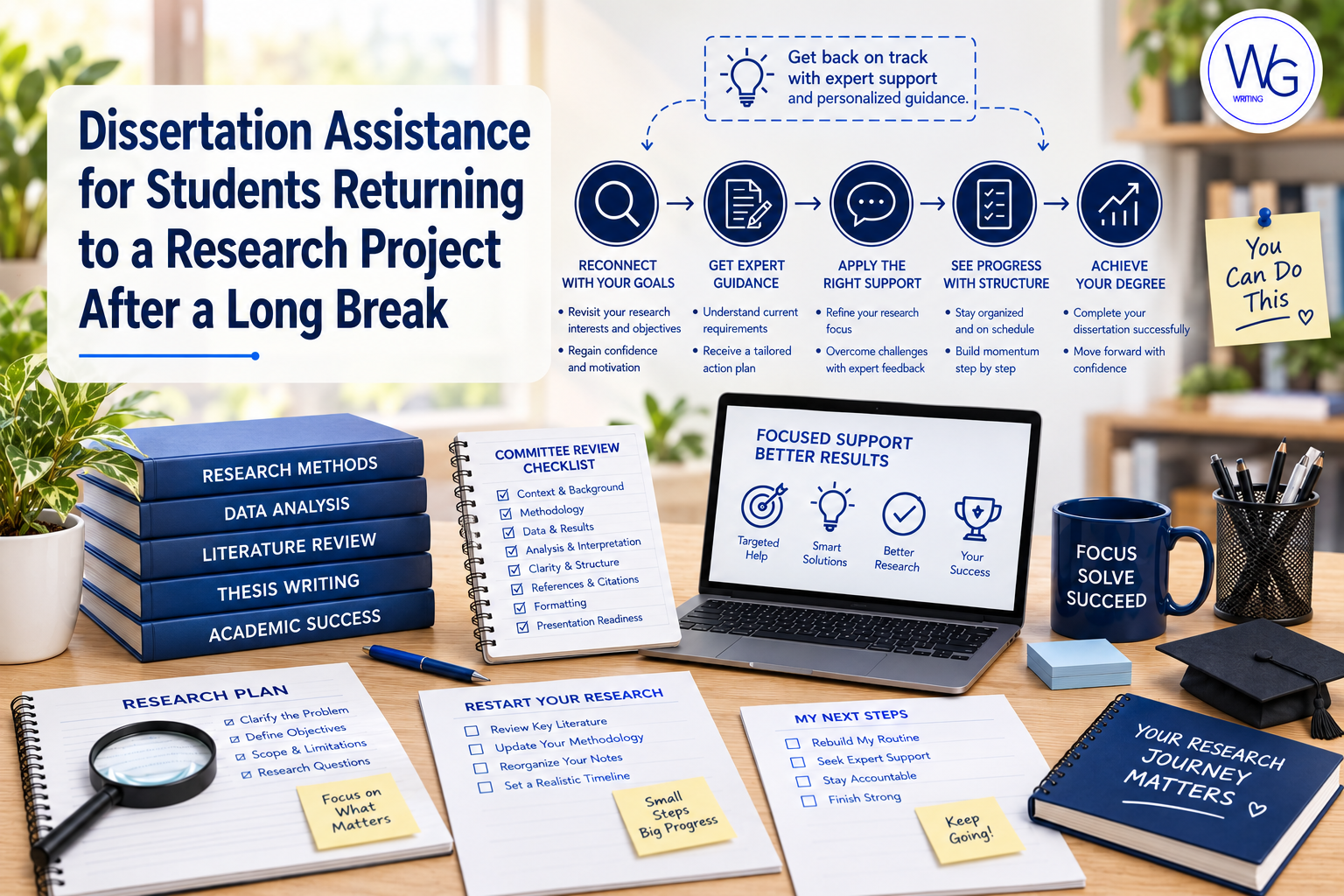
Need dissertation assistance after a long break? Get help reviewing your existing research, updating outdated sections, resolving gaps, and restarting your dissertation with a clear plan.
Returning to a Dissertation Is Different From Starting One
Returning to a dissertation after months or years away is not the same as beginning a research project from scratch. You may already have a proposal, literature review, methodology chapter, data analysis, supervisor comments, and several completed chapters sitting on your computer. The difficulty is determining what still works, what needs updating, and where the next piece of writing should begin.
A long break may have resulted from employment, family responsibilities, funding problems, a leave of absence, or other commitments. When you return, immediately rewriting everything is rarely the best first step. Stanford University’s thesis guidance emphasizes keeping doctoral work current and making clear, precise connections between the different parts of a thesis. That makes a review of your existing material particularly useful when the project has been left untouched for an extended period.
Get Professional Dissertation Help to Help You Kickstart Your Dissertation After a Long Research Break
Writing Gram professional dissertation help service can review the dissertation work you already have and identify the sections that need revision, updating, completion, or further development.
👉 Place your order now to determine where your project stands, preserve usable work, identify the remaining chapters, revisions, and research tasks, and reduce the stress of deciding what to keep, what to revise, and what to complete next.
What Needs to Be Checked Before You Restart the Dissertation
The first step when you restart a dissertation after a break is to establish exactly what you have. Open the most recent version of every chapter rather than relying on memory, then compare those files with your proposal, research questions, methodology, notes, data, and supervisor feedback.
Review the Last Completed Version
Look for unfinished paragraphs, incomplete chapters, comments that were never addressed, inconsistent terminology, missing references, placeholder text, and sections that stop abruptly. You may discover that a chapter you remembered as “almost finished” actually contains several unresolved issues.
Check Whether the Research Still Matches the Original Plan
Place your research questions alongside the methodology and the work you completed. Does the analysis still answer the questions? Does the methodology chapter describe what you actually did? Did the project change before you took the break? Are there research decisions that were made but never properly explained?
Cornell University’s dissertation guidelines show how the dissertation brings together elements such as the research text, references, appendices, and other components. For a returning student, checking those relationships can reveal where an old draft no longer reflects the project as it currently stands.
Identify Material That May Be Outdated
A long interruption can affect more than the date on your draft. New studies may have changed the literature surrounding your topic. Policy, industry conditions, theoretical debates, or methodological references may also have developed while you were away.
That does not mean every old paragraph needs to be replaced. The goal is to identify which material has actually become outdated and which remains useful.
When a Dissertation Needs Updating Instead of Starting Over
One of the biggest mistakes when returning to doctoral research is assuming that a long break has made the entire dissertation unusable. Your existing work may contain substantial material that still belongs in the finished project.
Completed sections can often remain useful when they still address the research problem, use appropriate sources, and fit the direction of the study. Your original research questions may still be suitable. Previously completed analysis, tables, notes, references, and drafts may also save considerable time.
Other sections may require more substantial revision. A literature review may need newer studies. A methodology chapter may need correction if the research was conducted differently from the original plan. A chapter may need restructuring if its argument no longer connects clearly with the research questions. Findings or interpretations may require clarification if the earlier draft did not explain how the results answer the research questions or support the conclusions.
MIT’s thesis-writing guidance recommends planning the research and writing process around identifiable tasks rather than treating the thesis as one enormous assignment. This approach is especially useful after a long interruption because it allows you to determine which completed sections can be retained, which sections need revision, and which outstanding tasks must be addressed before committee review.
This is where dissertation writing help can be more useful than starting again: the work can begin with the material you already produced and focus on what actually needs to change.
How to Restart a Dissertation Without Losing Weeks Relearning the Project
If you need to restart a dissertation after a break, resist the temptation to open Chapter One and simply start reading from the first page. That can consume weeks without telling you what needs to happen next.
Instead, rebuild your understanding of the project in a deliberate order.
Gather the latest files. Collect the newest dissertation draft, proposal, research instruments, data, analysis, notes, references, and supervisor feedback.
Reconstruct the research plan. Put the research questions, objectives, methodology, and completed work side by side.
Separate finished work from unfinished work. Mark chapters and sections as complete, incomplete, outdated, or uncertain.
Review unresolved feedback. Identify comments from your supervisor or committee that were never addressed before the break.
Check the chapter-to-question connection. Determine whether each major section contributes to answering the research questions.
Choose the next few tasks. Do not make “finish my dissertation” the immediate assignment. Identify three to five concrete pieces of work that can move the project forward.
Resume with the most useful section. The best starting point may be an unfinished methodology section, a literature review update, a results chapter, or another section that reconnects you with the research.
Cornell University Graduate School notes that dissertation writing develops through discrete chapters, sections, and even paragraphs, and recommends leaving work at a point that makes it easier to resume. For someone returning after a long absence, breaking the project back into identifiable pieces can make the difference between productive re-entry and repeatedly rereading the entire dissertation without progressing.
When Dissertation Assistance Makes Sense After an Interruption
Dissertation assistance is particularly valuable for partially completed dissertations, helping you assess the research material, chapters, and analysis you already have and determine what needs to be revised, developed, or completed. You may remember your topic and main argument while struggling to reconstruct why particular decisions were made, which supervisor feedback still matters, or how unfinished chapters were supposed to connect.
You may benefit from professional assistance if you have:
Several partially completed chapters but no clear order for finishing them
Older literature that needs to be checked against more recent research
Supervisor or committee feedback that was never fully addressed
A methodology chapter that may no longer describe the research accurately
Findings that were completed but never developed into a coherent discussion
Scattered notes and drafts that need to be organized into the existing dissertation
Uncertainty about whether previous analysis still answers the research questions
Limited time to return to the project because you are working or managing other responsibilities
The assistance required will depend on what is actually missing. You may need a review of existing chapters, dissertation editing and rewriting, literature review updating, methodology and research design assistance, data analysis assistance, development of findings and discussion, or dissertation writing help for sections that were never completed.
UC Berkeley’s dissertation filing guidance makes it clear that the dissertation is a presentation of the research conducted and that the faculty committee oversees its intellectual content. Therefore, professional assistance should not replace your research decisions or committee's role. Instead, it can help you work through the existing material, improve unfinished writing, organize revisions, and prepare sections for your continued academic review.
When you have been away from your dissertation for a long time, the most important question is not “How do I write a dissertation again?” It is “What do I already have, what has changed, and what specifically needs to happen for this project to move forward?”
Restart Your Existing Dissertation With the Professional Help You Need
Writing Gram professional dissertation help service can work with the dissertation material you already have, helping you identify unfinished sections, update older material, address unresolved feedback, and develop the remaining work.
👉 Place your order now to get dissertation assistance with the research you have already completed, determine what needs to be updated or finished, and avoid spending time rewriting sections that remain relevant to your research questions and findings.
What to Give a Dissertation Assistance Team Before Work Begins
Before seeking dissertation assistance after a long break, gather the materials that show where your research stopped and what your university expects you to complete. Start with the latest dissertation draft, then add your research proposal, research questions, methodology materials, existing data or analysis, supervisor or committee feedback, and any university formatting or submission requirements. Also explain briefly when the project was paused, what caused the interruption, and what deadline you are now working towards. You can use our checklist to help you determine the material that you should provide when hiring professional dissertation writers.
These materials give the person assisting with the dissertation enough context to distinguish between unfinished work, sections that need updating, and material that can be developed without unnecessary rewriting. For example, University of Massachusetts Amherst’s dissertation guidelines explain that a dissertation prospectus can include the research questions, theoretical framework, literature review, research procedures, working bibliography, and schedule for the dissertation work. Having your original prospectus or research plan available makes it much easier to determine how your existing chapters relate to the research questions, methodology, and planned structure of the dissertation.
Returning to Doctoral Research Does Not Mean Starting From Scratch
Returning to doctoral research after a long break does not automatically mean discarding everything you completed before the interruption. Your literature review, methodology, analysis, findings, references, and chapter drafts may contain substantial work that remains useful. What matters first is determining whether each part still fits your research questions and the research you actually conducted.
Some sections may need newer sources, additional explanation, restructuring, or completion. Others may require little more than careful revision. This distinction matters because dissertation support after interruption or disruption should help you identify the work that genuinely needs attention rather than encouraging you to rewrite material simply because it is old.
The goal is to reconnect with the research you already completed, identify the specific changes required, and establish where writing should resume. That approach can save considerable time compared with rereading and rewriting the entire dissertation without first determining what has actually changed.
Get Dissertation Assistance to Restart Your Existing Research
Writing Gram dissertation assistance can help you work through the dissertation material you already have, identify unfinished sections, review material that may need updating, and develop the remaining work around your research questions and findings.
👉 Place your order now to have your existing dissertation work assessed, identify which chapters and sections need revision or completion, preserve material that still supports your research questions and findings, and reduce the stress of figuring out where to restart.