Why Subject-Specific Dissertation Assistance Produces Stronger Research Than Generic Academic Support
By Writing Gram • Aug 15, 2026
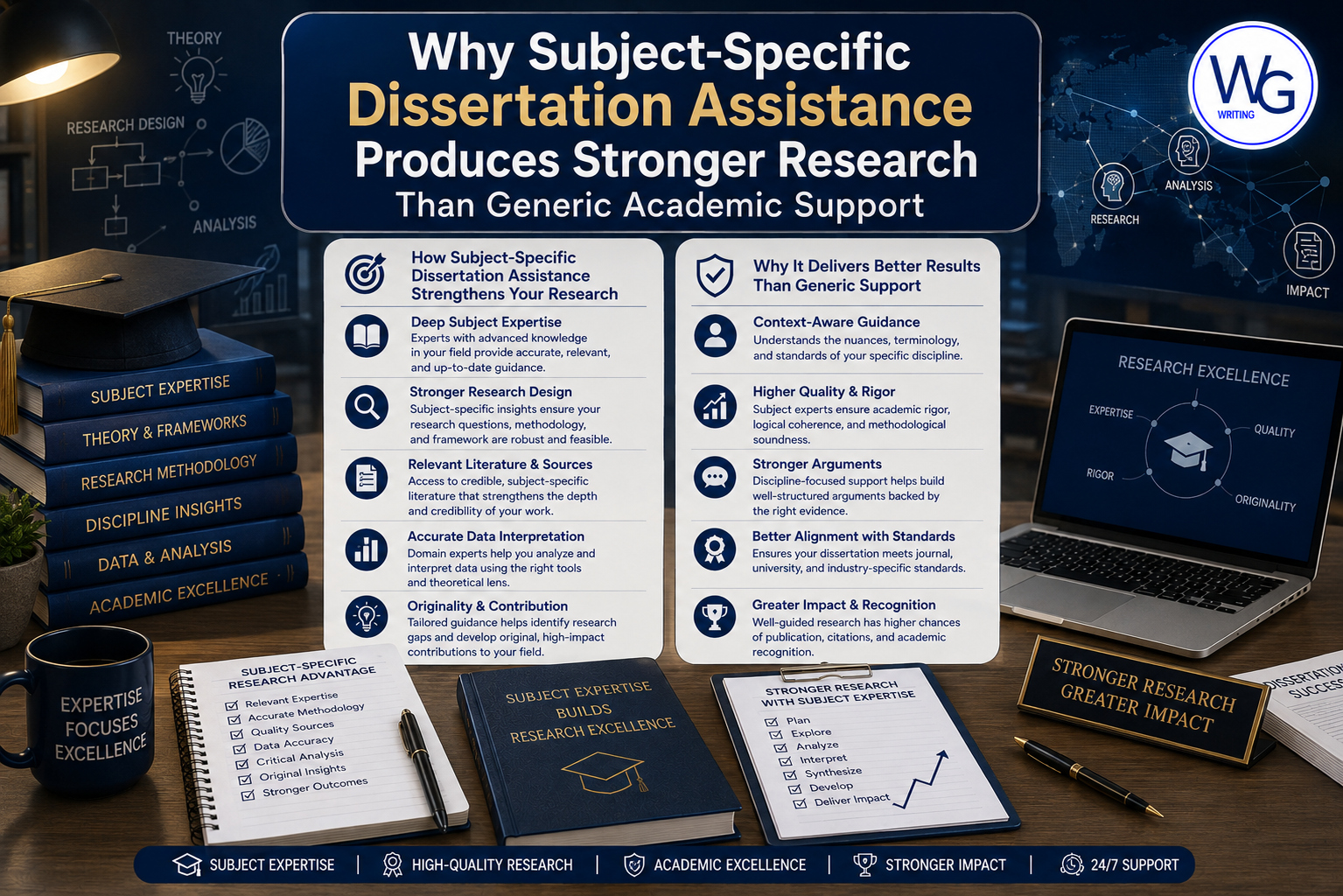
Get dissertation assistance tailored to your subject to strengthen research questions, evidence, analysis, and conclusions with personalized support.
Why Subject Knowledge Changes Dissertation Research Outcomes
A dissertation is more than a sequence of chapters to complete; the subject shapes how the research problem is understood, which evidence is relevant, how findings are interpreted, and what conclusions the study can reasonably support. This distinction matters because using the same broad research process can produce very different outcomes across disciplines. A source that is highly useful in psychology may have little value in engineering. A statistical result that answers a question in economics may require a completely different interpretation in nursing. Even terms that appear straightforward can carry discipline-specific meanings that affect how a research question is framed and how evidence is evaluated.
For example, Stanford Graduate School of Education describes a doctoral dissertation as an original contribution to knowledge within a discipline or interdisciplinary field, emphasizing that a suitable research problem must be researchable and go beyond merely describing a topic to support meaningful analysis. That distinction shows why dissertation subject knowledge matters from the beginning: the field influences not only what a student researches, but also what counts as a worthwhile research problem and how it should be investigated.
Generic academic support can improve organization, grammar, formatting, or general readability. Those improvements can be useful, but they do not necessarily resolve whether the research question fits the field, whether the selected evidence actually answers it, or whether the conclusions are justified by the findings. Discipline specific dissertation support addresses those research-level connections, helping the dissertation function as one coherent investigation rather than a collection of individually polished sections.
Get Dissertation Assistance Tailored to Your Subject
Your dissertation needs support that understands how your specific subject shapes the research question, evidence, analysis, and conclusions. Writing Gram provides dissertation assistance tailored to your discipline and research requirements, helping you develop work that reflects the concepts, evidence, and research expectations of your field.
Place your order now and get support that strengthens your research argument, improves the connection between your evidence and conclusions, and helps you produce a dissertation built around your specific field.
How Discipline Knowledge Strengthens the Research Question
Why does subject knowledge matter when developing a dissertation research question?
Subject knowledge matters because a research question must do more than sound interesting. It needs to address a meaningful problem within the field, use concepts appropriately, remain answerable through available evidence, and provide a clear foundation for the analysis and conclusions.
A broad question can easily become unmanageable when the researcher has not established what the subject considers significant. For example, a question about employee motivation could lead toward very different research depending on whether the dissertation belongs to organizational psychology, human resource management, economics, or sociology. The underlying topic may be similar, but the relevant theories, variables, evidence, and interpretation can differ substantially.
Therefore, subject-specific dissertation assistance can help examine whether the question:
Addresses a problem that matters within the chosen discipline.
Uses key concepts consistently with their meaning in the field.
Can be answered using realistic sources, data, or other evidence.
Has a research scope appropriate for the level and purpose of the dissertation.
Creates a logical connection between the research problem, questions, evidence, analysis, and conclusions.
The University of Massachusetts Amherst similarly notes that research prospectuses vary by field and commonly require students to define research problems and questions, understand relevant literature, establish a research plan, anticipate research challenges, and identify anticipated contributions. For students considering dissertation writing services, the research question is more than an isolated sentence; it shapes the research, evidence, analysis, and conclusions that follow.
A well-formed research question also keeps the study focused by limiting unnecessary research. When the question is too broad, students may collect sources that never contribute to the final argument. When the research question is too narrow or poorly framed, they may struggle to find enough evidence to answer it. Knowledge of the dissertation subject helps identify these problems before they affect the literature review, data collection, analysis, and discussion.
Why Subject-Specific Support Leads to More Relevant Evidence
A dissertation does not become stronger simply because it contains more sources. The important issue is whether those sources help answer the research question and establish the argument the study needs to make.
A review informed by the requirements of your field can assess why a source belongs in the study and whether it meaningfully supports the research, not simply whether it is credible or recent.
. For example, relevant evidence may need to answer several different questions:
Does the source address the same concept used in the research question?
Does it provide evidence for the specific relationship, phenomenon, or problem being investigated?
Is its theoretical framework appropriate for the study?
Does it establish an important position in the existing literature?
Does it support, challenge, or complicate the argument being developed?
Can its findings reasonably be applied to the population, setting, or conditions examined?
This distinction is especially important in literature-heavy dissertations. A student can spend weeks collecting peer-reviewed studies yet still have a literature review that does not establish a clear foundation for the research.The problem is not necessarily a shortage of evidence but poor alignment between the evidence and the question.
Subject-specific support can also identify misleading similarities between sources. Two studies may investigate apparently similar issues while using different definitions, populations, theoretical assumptions, or measures. Treating their findings as directly comparable can distort the argument.
That is why dissertation subject knowledge has a direct effect on evidence selection. It helps distinguish between information that can be cited and evidence that actually moves the research forward.
How Dissertation Subject Knowledge Improves Analysis and Interpretation
Collecting evidence is only one stage of doctoral research. The most demanding task is explaining what that evidence means in the context of the discipline.
The interpretation of a finding depends partly on the concepts, theories, standards, and debates surrounding it. A statistical association, for instance, does not carry the same research meaning simply because the numerical result is clear. Its significance depends on what was measured, why those variables matter, how the result compares with previous research, and what conclusions the study is entitled to draw.
Consider how disciplinary context changes interpretation:
Psychology: Findings may need to be interpreted in relation to psychological constructs, measurement approaches, theoretical explanations, and prior empirical findings.
Nursing: Results may need to be connected to patient outcomes, clinical practice, care settings, or existing evidence about interventions.
Business: Findings may need to explain organizational behavior, managerial consequences, market conditions, or strategic implications.
Engineering: Experimental results may need to be evaluated against technical models, performance requirements, design assumptions, or established engineering principles.
The point is not that one discipline has better research practices than another. It is that the same type of evidence can answer different questions depending on the field in which it is used.
This is also why simply reporting findings is insufficient. The discussion needs to explain their meaning. The Harvard Kenneth C. Griffin Graduate School of Arts and Sciences dissertation writing guidance distinguishes reporting results from discussing what those results mean, while its doctoral research guidance emphasizes formulating questions, identifying appropriate evidence and methods within the discipline, assessing outcomes, and explaining the significance and limits of findings.
Specialized dissertation assistance can be particularly useful when a student understands the numerical, textual, experimental, or observational results but struggles to explain their significance within the subject. The goal is not to force a stronger conclusion. It is to make the interpretation consistent with the evidence and the research question.
Stronger Connections Between Findings and Conclusions
A dissertation's argument should not jump directly from findings to conclusions. The discussion must establish what the findings mean, how they relate to previous research, whether they answer the research questions, and where their implications begin and end.
This is where discipline-specific support can expose weaknesses that a general proofreading review may leave untouched.
For example, a detailed review may identify that:
A finding does not actually answer one of the stated research questions.
A result contradicts an important study that the discussion has overlooked.
An interpretation is stronger than the evidence permits.
A surprising result requires a plausible explanation rather than a simple restatement.
A limitation changes how broadly a conclusion can be applied.
A proposed implication is not sufficiently connected to the study's actual findings.
The conclusion introduces a claim that was never established in the analysis.
These are research problems, not merely writing problems.
A strong discussion should show the reader how the evidence supports the argument without turning a limited result into an unsupported generalization. The final conclusions should then reflect what the study actually established.
For students considering dissertation writing services, this is one of the strongest reasons to choose support that understands the subject and its research requirements rather than treating every dissertation as the same. When these elements remain connected, the dissertation presents a clear and consistent line of research from the initial question to the final conclusion. Better formatting cannot compensate for gaps or inconsistencies in that underlying research.
Additional sources cannot automatically fix a research question that does not fit the problem. More sophisticated language cannot compensate for an interpretation that ignores the disciplinary context.
🎓 Strengthen Your Dissertation With Subject-Focused Support
Writing Gram provides dissertation writing services tailored to your subject, research requirements, and the specific areas of your dissertation that need attention. Get support that helps strengthen your research question, connect relevant evidence to your analysis, clarify the interpretation of your findings, and ensure your conclusions remain grounded in your study.
Place your order today and get focused dissertation support built around your subject and the research needs of your study.
What Generic Academic Support Can Miss
Generic academic support can be useful for improving presentation, organization, and general readability, but those improvements do not necessarily resolve problems within the research itself. A paragraph can be grammatically clear while using a concept incorrectly for the discipline. A literature review can contain credible sources while failing to establish the evidence needed for the research question. A discussion chapter can follow an acceptable structure while drawing conclusions that extend beyond what the findings demonstrate.
The limitation is not that general support is ineffective. Rather, many research problems depend on the specific requirements and expectations of the discipline.
A review that focuses primarily on whether a dissertation is logically organized may not ask whether the selected theory is appropriate for the subject. A general assessment of sources may identify additional references without determining whether they actually contribute to the research argument. Similarly, a structural review may confirm that the dissertation contains an introduction, literature review, methodology, results, discussion, and conclusion without examining whether those sections are connected by one coherent research purpose.
This distinction becomes particularly important when the problem is hidden beneath apparently polished writing. A student may have:
A research question that is too broad for the available evidence.
Literature that describes the topic without establishing the specific problem under investigation.
Sources that are relevant to the general subject but not to the precise research question.
Findings that are accurately reported but insufficiently interpreted.
Conclusions that answer a different question from the one posed at the beginning.
Concepts that change meaning between the literature review and analysis.
Recommendations that are not supported by the study's actual findings.
The issue is not simply whether individual sections are well written. It is whether each section serves its intended purpose within the discipline and contributes to the overall argument in the dissertation
The University of South Alabama's doctoral dissertation guidance shows how closely the different parts of a dissertation are connected: students are expected to organize and synthesize relevant literature to refine the primary research question and hypotheses, then develop an approach that adequately addresses that research question. This is why reviewing a dissertation section by section is not always enough. A research question, the literature used to develop it, and the approach used to answer it need to remain connected throughout the study.
That is the gap subject-specific dissertation support is intended to address. Instead of treating the dissertation as a generic academic document, it considers how the subject affects the meaning and use of the research.
When Is Subject-Specific Dissertation Assistance Worth Getting?
Subject specific dissertation assistance becomes particularly valuable when the difficulty involves the substance of the research rather than simply its presentation. One way to identify this need is to consider whether you can clearly explain how each major research decision supports your research question. When those connections are unclear, the dissertation may need support with the research itself, not just with its presentation.
Support may be valuable when the challenge involves the research itself rather than simply the way it is written.:
Your research question has changed substantially and earlier chapters no longer align with it.
Your literature review has become extensive but you are uncertain which studies actually belong in the argument.
You have collected substantial evidence but are unsure which findings directly answer your research questions.
Your findings are clear but their significance within the discipline is difficult to explain.
Your discussion chapter repeats results instead of interpreting what they mean.
Supervisor feedback identifies weaknesses in the argument, evidence, interpretation, or conclusions rather than sentence-level errors.
You are uncertain whether a concept, theory, or source is being used appropriately within your field.
Several chapters were developed at different stages and now need to work together as one study.
You are approaching submission and need to identify research weaknesses that could lead to substantive revisions.
This does not mean every dissertation problem requires outside assistance. Students remain responsible for their research, judgments, evidence, and final academic work. The value of discipline specific dissertation support is that it can provide an informed examination of the research so that the student can better understand where the argument is weak, where evidence is insufficient, and where conclusions need to be reconsidered.
Duke University describes a dissertation as significant and original research conducted under supervision in the student's major field, with the final work expected to present the research, findings, conclusions, and significance of the project. That makes the field itself relevant to how the dissertation is developed and evaluated.
For a student deciding whether to purchase dissertation assistance, the question is therefore not simply asking "Can someone improve my dissertation?" It is "Can the support address the research problem I am actually facing in my subject?"
That distinction can prevent students from paying for dissertation assistance that improves the appearance of a dissertation without addressing the reason it is struggling.
How to Evaluate the Value of Subject-Specific Dissertation Support
If you are considering dissertation writing services but have not yet decided whether specialized support is worth purchasing, evaluate what the service can actually contribute to your research.
Start by asking whether the assistance can address your specific discipline and research area, rather than treating your dissertation as if it follows the same requirements as every other field.
Then consider whether the service can help with questions such as:
Does the support address my research question and evidence, or only grammar and formatting?
Can it identify whether the literature I have selected actually supports my research problem?
Can it examine the connection between my research question, findings, discussion, and conclusions?
Can it identify claims that extend beyond what my evidence supports?
Can it work from my university’s dissertation requirements and research instructions?
Can I obtain assistance with the specific chapter, section, or research problem where I need it?
Will my research materials, instructions, and personal information be handled confidentially?
These questions help distinguish substantive dissertation assistance from services that primarily improve presentation.
MIT's research guidance similarly emphasizes that a research question should emerge logically from an existing line of inquiry or an identifiable gap, while the proposed approach should explain how the question will be addressed. This reinforces why the value of support should be judged by whether it helps maintain the relationship between the question, evidence, research approach, and eventual contribution.
The answers can also help you determine what type of assistance you actually need. If your research is strong but the writing is difficult to follow, editing may be sufficient. If your sources are plentiful but poorly connected to your research question, a literature review assessment may be more useful. If your findings are complete but the discussion does not explain their significance, support focused on analysis and interpretation may be appropriate. If problems appear across several chapters, a broader dissertation review may be justified.
The objective should always be to obtain the right type of support for the research problem, rather than purchasing the broadest service available.
🎓 Strengthen Your Dissertation With Subject-Focused Support
Writing Gram provides dissertation assistance tailored to your subject, research requirements, and the specific areas of your dissertation that need attention. Get support that helps strengthen your research question, connect relevant evidence to your analysis, clarify the interpretation of your findings, and ensure your conclusions remain grounded in your study.
Place your order today and get focused dissertation support built around your subject and the research needs of your study.