Bayesian Analysis Help for PhD Dissertations
By Writing Gram • Oct 22, 2026
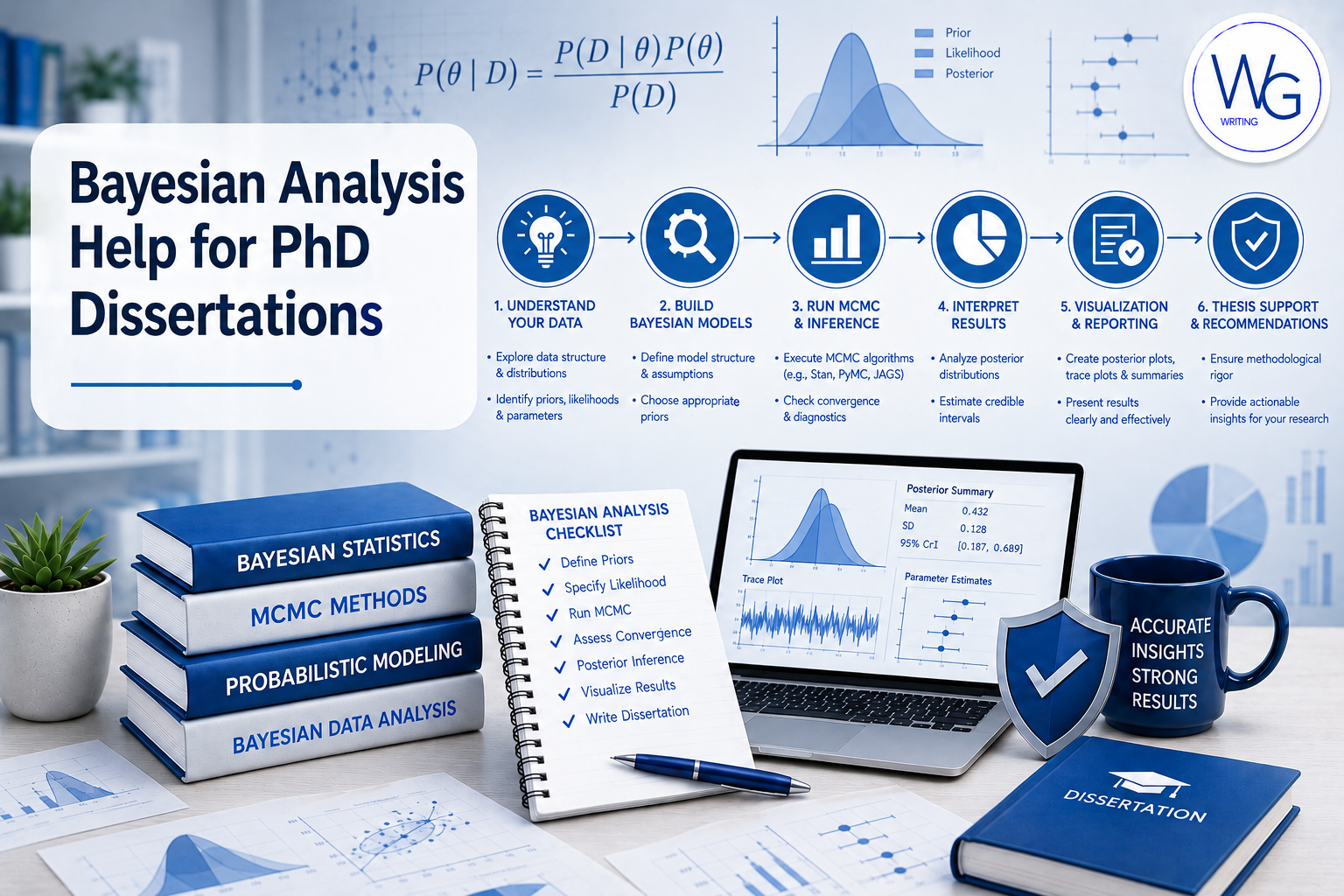
Get Bayesian analysis help for your PhD dissertation. Review models, interpret posterior estimates, and report results with Writing Gram.
Bayesian Model Checking Before Reporting Dissertation Results
A Bayesian model can produce posterior estimates even when its assumptions or computational performance require further investigation. Before reporting your findings, consider which checks are appropriate for the model and estimation method.
These may include:
Convergence diagnostics: For Markov chain Monte Carlo (MCMC) estimation, assess whether the chains have adequately explored the target posterior distribution.
Effective sample size: Examine whether the simulation draws provide sufficient information to estimate posterior quantities with reasonable precision.
Sampling diagnostics: Investigate divergences, poor mixing, or other computational warnings where applicable.
Posterior predictive checks: Compare observed data with replicated data generated from the fitted model to investigate whether the model reproduces important features of the data.
These checks address different questions. Good MCMC convergence does not automatically establish that a model fits the data adequately, and a satisfactory predictive check does not prove that every assumption is correct.
The Columbia University Bayesian Workflow research discusses posterior predictive checking, cross-validation, and evaluating fitted models. These approaches can help researchers identify limitations that should be investigated before interpreting and reporting their results.
Bayesian Statistical Analysis Help for PhD Dissertations
Bayesian analysis help for a dissertation can include reviewing model specifications and prior distributions, interpreting posterior estimates and credible intervals, assessing model diagnostics, and reporting findings accurately. The right assistance depends on your research questions, statistical model, software, and existing results. Whether you need help understanding Bayesian output or explaining your findings in a PhD dissertation, identifying the specific problem helps establish the support your analysis requires.
Get Bayesian Analysis Help for Your PhD Dissertation
Writing Gram can help you review your Bayesian model, interpret posterior distributions and credible intervals, assess relevant diagnostics, and present your dissertation findings accurately. If you are struggling to explain your estimates or need help turning statistical output into meaningful results, we can focus on the specific tasks you need addressed.
👉Place your order now to receive personalized guidance on choosing appropriate Bayesian methods, interpreting posterior estimates and credible intervals, checking model diagnostics, and explaining your findings clearly in your dissertation with human support tailored to your research questions, existing analysis, and university requirements.
What Makes Bayesian Dissertation Analysis Difficult?
Bayesian dissertation analysis can be challenging because researchers must account for prior assumptions, evaluate statistical models, and interpret uncertainty in the context of their research questions. Common challenges include:
Choosing and justifying prior distributions: Prior distributions represent assumptions or existing information about model parameters before the observed data are incorporated. Researchers need to explain why their chosen priors are reasonable for the study and consider whether alternative plausible priors could change the conclusions.
Understanding posterior distributions: The posterior distribution combines the prior distribution with the likelihood of the observed data to represent uncertainty about model parameters after considering the evidence. Interpreting this distribution requires understanding how the data have updated prior beliefs and what the resulting estimates indicate about the research problem.
Evaluating model reliability: Researchers must assess whether their chosen model and estimation procedure produce trustworthy results. For Markov chain Monte Carlo (MCMC) methods, this can involve checking convergence, effective sample sizes, trace plots, and sampling behavior. Depending on the model, researchers may also need to examine model fit, predictive performance, and sensitivity to prior choices.
Interpreting credible intervals: A Bayesian credible interval summarizes uncertainty about a parameter based on its posterior distribution. For example, a 95% credible interval contains 95% of the posterior probability for the parameter within the specified interval. Its interpretation differs from that of a frequentist 95% confidence interval, which is defined through the long-run behavior of the interval estimation procedure.
Connecting statistical results to research questions: Posterior estimates, credible intervals, and other model outputs need to be interpreted in relation to the study's objectives. Researchers must distinguish the strength of the evidence from certainty, acknowledge relevant limitations, and avoid conclusions that extend beyond what the model and data support.
The University of California, Los Angeles (UCLA), Statistical Methods and Data Analytics group offers support in applied statistics, statistical modeling, data analysis, and statistical computing. Its resources include statistical guidance, examples, and training materials that can help researchers understand analytical methods and interpret statistical output. Although these general resources are not exclusively focused on Bayesian analysis, they illustrate the importance of sound statistical reasoning and appropriate analytical techniques in research.
What Bayesian Analysis Assistance Can Include
Writing Gram offers human support with Bayesian dissertation analysis, whether you need help interpreting existing statistical output, reviewing your model, or conducting additional analysis. The scope of assistance depends on your research questions, data, analytical requirements, and the work already completed.
Model specification and prior selection: Review whether your Bayesian model is appropriate for your research questions, outcome variables, data structure, and assumptions. Assess whether the selected prior distributions are reasonably justified and whether sensitivity analysis is needed to determine how alternative plausible priors affect the results.
Posterior estimates and uncertainty: Interpret posterior means, medians, credible intervals, and other relevant summaries. Understand what these estimates suggest about model parameters, how uncertain the estimates are, and how they relate to your dissertation hypotheses or research questions.
Convergence diagnostics and model checking: Review appropriate diagnostic results for the estimation method used. For models fitted with Markov chain Monte Carlo (MCMC), this may include trace plots, convergence statistics, effective sample sizes, and sampling behavior. Depending on the model, assistance may also include posterior predictive checks to assess whether the model can reproduce important features of the observed data.
Bayesian multilevel modeling: If your dissertation examines nested or grouped data, such as students within schools, patients within hospitals, or repeated observations within individuals, assistance may include specifying hierarchical models, interpreting group-level and individual-level effects, and understanding partial pooling. Depending on the research question, this may also involve reviewing random intercepts, random slopes, and between-group variation.
Model comparison and interpretation: Compare competing Bayesian models using appropriate methods for the model and research objective. Where suitable, this may involve predictive comparison criteria or posterior model probabilities. Interpret estimated effects in context and explain what the results support without overstating the evidence.
Tables, figures, and results reporting: Present posterior summaries, credible intervals, group-level estimates, and relevant diagnostic results in clear tables and figures. Organize the findings into a coherent dissertation results section, explaining the statistical evidence, its relevance to the research questions, and any limitations that affect interpretation.
The Pennsylvania State University Department of Statistics highlights how advances in computing and statistical algorithms have made it possible to fit hierarchical Bayesian models to complex data. The department also describes applications of Bayesian methods in fields such as neuroscience, public health, ecology, and statistical genetics. These examples illustrate how Bayesian analysis can address complex research questions while accounting for uncertainty in statistical estimates.
The assistance you need depends on the stage of your data analysis. Reviewing existing output may be sufficient if your model has already been fitted and you need help interpreting the findings. If you require data preparation, model specification, new model fitting, diagnostic checks, or additional computational work, these requirements should be established before the work begins so the scope of assistance can be agreed upon.
How to Interpret Posterior Estimates and Credible Intervals
In Bayesian analysis, the posterior distribution represents uncertainty about a model parameter after combining the prior distribution with the likelihood of the observed data under the specified model. Researchers can summarize this distribution using measures such as the posterior mean or median, alongside a credible interval that describes the uncertainty surrounding the estimate.
When interpreting posterior estimates, consider the direction and magnitude of the estimated effect, the uncertainty around it, and its relevance to the dissertation's research questions. For example, if a Bayesian regression estimates a positive association between two variables, explain the estimated size of the association, the credible interval, and whether the results support a meaningful relationship in the context of the study. A positive association alone does not establish causation.
A 95% Bayesian credible interval contains 95% of the posterior probability for the parameter within the specified interval, assuming the model and prior choices. Its interpretation differs from that of a frequentist 95% confidence interval, which refers to the long-run coverage of the interval estimation procedure under its assumptions. Researchers should also avoid treating a credible interval as proof that an effect is important or that a hypothesis is definitively true.
The Duke University Bayesian Statistics course introduces Bayesian inference and applies it to practical statistical problems, including Bayesian regression, comparisons of means and proportions, credible regions, model averaging, and prediction using R. These topics help researchers understand how to develop Bayesian models, interpret posterior estimates and uncertainty, and draw conclusions that address their research questions.
Bayesian Model Checking Before Reporting Dissertation Results
A Bayesian model can produce posterior estimates even when its assumptions or computational performance require further investigation. Before reporting your findings, consider which checks are appropriate for your model and estimation method.
These may include:
Convergence diagnostics: For Markov chain Monte Carlo (MCMC) estimation, assess whether the chains have adequately explored the target posterior distribution.
Effective sample size: Examine whether the simulation draws provide sufficient information to estimate posterior quantities with reasonable precision.
Sampling diagnostics: Investigate divergences, poor mixing, or other computational warnings where applicable.
Posterior predictive checks: Compare observed data with replicated data generated from the fitted model to investigate whether the model reproduces important features of the data.
These checks address different questions. Good MCMC convergence does not automatically establish that a model fits the data adequately, and a satisfactory predictive check does not prove that every assumption is correct.
The Columbia University Bayesian Workflow research paper discusses posterior predictive checking, cross-validation, model comparison, and evaluating fitted models. These techniques help researchers assess how well a model captures relevant features of the data, examine its predictive performance, and identify limitations that may require further investigation before interpreting and reporting their findings.
How to Present Bayesian Dissertation Results Accurately
Your Bayesian dissertation results should explain what your model estimates, how much uncertainty surrounds those estimates, and what the findings mean for your research questions. Clear reporting helps readers understand the evidence without overstating what the analysis can establish.
A well-organized results section should include the following, where relevant to your model and research objectives:
Model estimates and research questions: Identify the parameters, relationships, or group-level effects being investigated and explain how they relate to your research questions or hypotheses.
Posterior estimates and credible intervals: Report appropriate summaries, such as posterior means or medians, alongside credible intervals. Explain the direction and magnitude of the estimates and the uncertainty surrounding them.
Model diagnostics and checks: Report relevant evidence that the model was fitted adequately. For MCMC estimation, this may include convergence diagnostics and effective sample sizes. Depending on the analysis, posterior predictive checks may also help assess whether the model reproduces important features of the observed data.
Interpretation of findings: Explain what the estimates suggest in the context of your study. Where applicable, distinguish statistical uncertainty from practical or substantive importance.
Limitations and implications: Acknowledge relevant assumptions, data limitations, sensitivity to prior choices, or other issues that could affect interpretation. Explain what conclusions the evidence supports and where caution is warranted.
For example, suppose a Bayesian regression examining the relationship between student engagement and academic performance produces a positive posterior coefficient. You should report the estimated coefficient and its credible interval, explain what the coefficient means in the model's measurement units, and discuss its relevance to your research question. A positive estimate alone does not establish that student engagement causes better academic performance; that conclusion depends on the research design, assumptions, and supporting evidence.
The University of Michigan's introduction to Bayesian statistics using Stata explains the relationship between likelihood functions, prior distributions, and posterior distributions, and introduces Markov chain Monte Carlo (MCMC) estimation using the Metropolis–Hastings algorithm. These concepts help researchers understand how Bayesian models are fitted and how to interpret the resulting estimates in light of the model and its assumptions.
When to Seek Dissertation Bayesian Statistics Assistance
Bayesian analysis can involve challenging decisions about model specification, prior distributions, estimation, and interpretation. If you are unsure how to proceed or need help understanding your statistical results, getting support with the specific problem can help you determine the next steps in your analysis.
Consider seeking dissertation Bayesian statistics assistance if you need help with any of the following:
Choosing or reviewing prior distributions: You are unsure which priors are appropriate for your model or how to justify your choices.
Interpreting posterior results: You need help understanding posterior estimates, credible intervals, or the implications of your findings for your research questions.
Investigating model warnings: Your estimation procedure raises convergence or sampling concerns, or your model checks suggest that further investigation is needed.
Reviewing model specification: You want to assess whether your model structure and assumptions are appropriate for your data and research objectives.
Responding to supervisor feedback: You need to revise your analysis, explain your statistical decisions, or improve the presentation of your results.
To help establish the scope of assistance your dissertation requires, prepare the following materials where available:
Your research questions and hypotheses.
Your methodology and current model specification.
Your dataset or a description of its structure, along with the statistical software you are using.
Existing model output, diagnostic results, and any unresolved warnings.
Relevant dissertation guidelines and supervisor feedback.
The University of Washington's STAT 544 Bayesian Statistical Methods course covers topics including the foundations of Bayesian inference, prior distributions, conjugate families, posterior distributions, and the mathematical properties of Bayesian methods. These topics illustrate the statistical concepts that may need to be understood when developing and interpreting a Bayesian analysis.
The right level of assistance depends on what you have already completed. If you have fitted your model, you may need help interpreting your results or reviewing diagnostics. If you have not yet selected a suitable model or completed the estimation, you may need broader support with model specification, computation, and evaluation. Sharing your existing work and identifying the main difficulty will help establish the appropriate scope of assistance.
Get Dissertation Bayesian Statistics Assistance From Writing Gram
Writing Gram provides human support with Bayesian dissertation analysis, from reviewing model diagnostics and interpreting posterior estimates to explaining credible intervals and presenting your findings clearly. Whether you need help resolving a specific analytical problem or reporting your results accurately, we can tailor the assistance to your research questions, existing analysis, and dissertation requirements.
👉 Place your order today to get expert human help interpreting your Bayesian results, addressing model diagnostics, and presenting your dissertation findings clearly and accurately.
Frequently Asked Questions About Bayesian Dissertation Help
What does Bayesian dissertation analysis help include?
Our Bayesian dissertation analysis assistance can include reviewing model specifications and prior distributions, interpreting posterior estimates and credible intervals, assessing relevant model diagnostics, comparing models where appropriate, and presenting findings clearly in your dissertation. We tailor the scope to your research questions, existing analysis, and required deliverables.
Can you help me choose the right Bayesian model for my dissertation?
We can help review whether your proposed Bayesian model fits your research questions, outcome variables, data structure, and assumptions. Depending on your study, this may involve Bayesian regression, hierarchical or multilevel modeling, or another suitable model. The appropriate choice depends on your research objectives and the characteristics of your data.
How do I interpret posterior estimates and credible intervals?
A posterior estimate summarizes a model parameter using its posterior distribution, while a credible interval describes uncertainty about that parameter. For example, a 95% credible interval contains 95% of the posterior probability within the specified interval, given the model, prior choices, and observed data. Our assistance can help you interpret the direction and magnitude of estimates, explain uncertainty, and connect your findings to your dissertation research questions.
Can you review my Bayesian model and prior distributions?
Yes. Our Bayesian analysis assistance can include reviewing your model structure and assessing whether your prior distributions are reasonably justified by the research context, existing knowledge, and available data. Where appropriate, we can also examine prior sensitivity to determine whether alternative plausible priors materially affect your conclusions.
How can I tell whether my Bayesian model is reliable?
No single diagnostic establishes that every Bayesian model is reliable. Depending on the estimation method and model, relevant checks may include convergence diagnostics, effective sample sizes, trace plots, posterior predictive checks, and sensitivity analyses. We can help review the available diagnostics, identify potential concerns, and explain what additional checks may be appropriate.
Can you help me interpret existing Bayesian statistical output?
Yes. You do not necessarily need a complete new analysis to request assistance. If you already have model output, we can help interpret posterior means or medians, credible intervals, regression coefficients, and other relevant results. We can also help you understand diagnostic findings and explain what your results do and do not establish.
Can you help with Bayesian multilevel modeling for a dissertation?
Yes. Where Bayesian multilevel modeling is appropriate for your research, our assistance can include reviewing hierarchical model specifications, interpreting group-level and individual-level effects, and explaining partial pooling and between-group variation. For example, a dissertation examining students nested within schools may require a model that accounts for differences between schools as well as variation among students. The model structure should reflect your research questions and data.
What software can be used for Bayesian dissertation analysis?
Bayesian analysis can be performed using software such as R with Stan, Stan directly through supported interfaces, JAGS, and Stata, depending on the model and available functionality. The most suitable tool depends on the statistical method, model complexity, and your research requirements. When requesting our assistance, tell us which software you use and share your existing code or output where available.
Can you help me write my Bayesian dissertation results section?
Yes. We can help organize your findings into a clear results section, report appropriate posterior estimates and credible intervals, explain relevant diagnostic results, and connect the findings to your research questions. We also help ensure that interpretations acknowledge uncertainty and limitations rather than making unsupported causal or substantive claims.
What should I provide when ordering Bayesian dissertation analysis help?
To help us establish the appropriate scope of work, provide your research questions, methodology, dissertation guidelines, and any available model specifications, statistical output, or diagnostic results. If you need a new analysis, include your dataset or explain its structure and identify your software and intended deliverables. If you only need help interpreting existing results, specify the output or statistical questions you want addressed.
How do I get started with Writing Gram's Bayesian analysis service?
Place your order through Writing Gram and provide your dissertation requirements, the stage you have reached in your analysis, and the specific assistance you need. We can use this information to establish whether your project requires model review, interpretation of existing output, additional statistical analysis, or help reporting your findings.
Get Bayesian Dissertation Analysis Help Today
We can help you interpret posterior distributions, assess model diagnostics, understand credible intervals, and report your Bayesian findings clearly in relation to your research questions.
👉 Order Bayesian Dissertation Analysis Help now to get help interpreting your results, checking your model diagnostics, and presenting clear, accurate findings in your dissertation.