Dissertation Analysis Help for Cleaning and Preparing Data Before Statistical Analysis
By Writing Gram • Oct 4, 2026
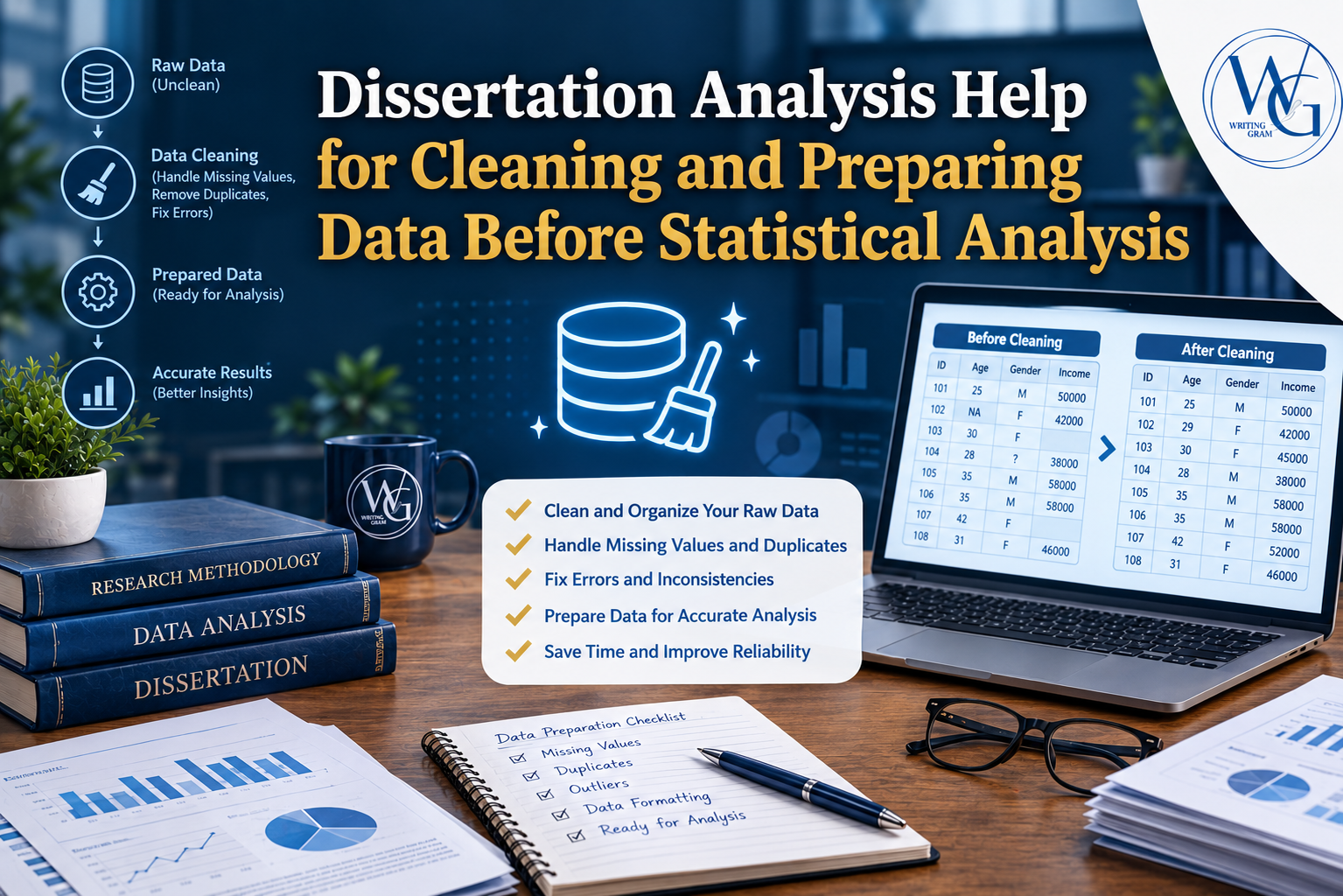
Need dissertation analysis help? Get your raw data cleaned, coded, organized, and prepared for statistical analysis so you can work with an accurate, analysis-ready dataset.
If your dissertation dataset contains missing values, duplicate records, inconsistent coding, invalid entries, or poorly organized variables, it may need to be cleaned before statistical analysis begins. At this stage, dissertation analysis help includes reviewing the raw dataset, correcting or standardizing data issues, documenting necessary changes, and preparing a clean, organized file that is ready for the next stage of analysis.
What Is Dissertation Data Cleaning and Preparation?
Dissertation data cleaning is the process of checking collected data for problems that could interfere with its proper use in statistical analysis. The work can include reviewing missing values, duplicate records, inconsistent categories, invalid values, variable formats, labels, and the overall structure of the dataset.
The goal is to move from a raw dataset to an analysis-ready dataset without changing the underlying research evidence simply to produce a preferred result.
For example, a survey dataset might contain responses coded as “Male,” “male,” “M,” and “1.” If those values are intended to represent the same category, they need to be handled consistently according to the study's coding scheme. Similarly, a questionnaire score should be checked against the valid range for the instrument rather than assuming every number in the column is correct.
Harvard Medical School recommends practices such as using appropriate study IDs, keeping variables and observations properly organized, validating ranges, standardizing data, checking missing information, and documenting datasets before analysis.
The distinction is important: data cleaning prepares the information for analysis; statistical analysis uses the prepared information to examine the research questions.
What Problems Should You Look for in Raw Dissertation Data?
Raw dissertation data can contain problems that are easy to miss, especially when you are working under a tight deadline. Data cleaning should therefore involve systematic checks rather than simply opening the spreadsheet and looking for obvious mistakes. The following are the common problems that you should look for when cleaning raw data in your dissertation:
Missing values
A blank cell does not necessarily mean the same thing as a value such as 999, -99, N/A, or NA. These codes may have been used to represent missing information, although some may represent legitimate values for a particular variable. Before deciding how missing observations should be handled, you should establish what the codes mean and how missing data were recorded.
Duplicate records
A dataset may contain the same participant or observation more than once. However, not every repeated-looking record is necessarily an error. Repeated measurements may be legitimate when a study includes multiple observations for the same participant. Duplicate checking therefore needs to consider the study design and identification variables.
Inconsistent coding
Coding may vary because of capitalization, spelling, abbreviations, or different numeric representations. For example:
Male / male / M
Female / female / F
Yes / YES / Y
No / NO / N
Before changing inconsistent codes, check what each code means and make sure the new coding matches the research instrument. The intended coding scheme and research instrument should determine how categories are represented.
Invalid or impossible values
Examples can include an age outside the permitted range, a questionnaire score outside the instrument's possible range, an impossible date, or a value accidentally entered into the wrong variable.
Variable names and labels
A clean dataset should make it possible to identify what each variable represents. Ambiguous names, missing labels, inconsistent formats, or multiple concepts stored in one field can make later analysis unnecessarily difficult.
Cornell University identifies inconsistent data problems such as alternative spellings or capitalization, unexpected text in otherwise numeric data, and mismatched keys between tables.
Need Help Cleaning Your Dissertation Dataset?
Writing Gram helps you clean, organize, and check your dissertation dataset so it is ready for statistical analysis. Send us your existing dataset and requirements, and we’ll handle the data preparation and cleaning for you.
Our support includes checking inconsistent coding, reviewing missing and invalid entries, organizing variables, checking data formats and ranges, and documenting the cleaning steps. The goal is to give you a clean, well-organized dataset that is ready for the next stage of your dissertation—not to change the data to produce a particular result.
Not sure whether your dissertation dataset is clean and ready for analysis? 👉 Place your order now for professional dissertation dataset cleaning and preparation. Save hours of manual checking, catch data problems before they affect your results, and get a clean, properly organized dataset ready for statistical analysis—so you can spend less time fixing data issues and more time working on your dissertation.
How Do You Prepare Data for Dissertation Analysis?
Preparing data for dissertation analysis involves more than deleting empty cells. A sound preparation process preserves the original information while creating a separate working version that can be checked and documented.
The following steps show how to prepare your dataset before you begin statistical analysis:
1. Preserve the original dataset
Keep an untouched copy of the raw data before making any cleaning changes. This gives you a reference point if you need to verify an entry or explain how the final dataset was produced.
2. Review the dataset structure
Check the rows, columns, participant or observation identifiers, variable names, data types, and formats. The structure should match how the data were collected and the unit of analysis used in the study.
3. Identify missing values
Determine how missing information is represented and distinguish genuinely missing observations from legitimate responses. Do not automatically delete records or replace missing values without considering the research design and the reasons for the missing data.
4. Standardize coding
Review categorical and other coded variables for inconsistent representations. Coding should remain consistent with the questionnaire, codebook, research protocol, or other documentation for the study.
5. Check ranges and validity
Look for values outside the legitimate range for each variable and investigate whether they result from data-entry errors, valid exceptions, or incorrect coding. For example, a questionnaire score should fall within the range permitted by the instrument.
6. Check duplicates and unusual records
Look for repeated records, identifiers, and unusual patterns, but verify them against the study design before removing anything. Multiple observations for the same participant may be intentional in longitudinal, repeated-measures, or other study designs.
7. Document the changes
Record important cleaning decisions so you can explain what was checked, changed, retained, or removed. A data dictionary, README file, cleaning log, or similar documentation helps make the final dataset easier to understand and allows the cleaning process to be reproduced.
University of Michigan demonstrates why researchers need to check how missing values are represented, since missing information may appear as NA, empty strings, 999, -1, or other codes.
Frequently Asked Questions About Dissertation Data Cleaning
What is dissertation data cleaning?
Dissertation data cleaning is the process of reviewing a research dataset for missing, duplicate, inconsistent, invalid, or incorrectly formatted information and addressing those issues according to the study design, research instrument, and available documentation before statistical analysis.
How do I clean dissertation data before analysis?
Start by preserving the original raw dataset. Then review its structure, identify missing-value codes, check variable formats and ranges, investigate duplicate or unusual records, standardize appropriate coding, and document important cleaning decisions. The result should be a separate working dataset prepared for analysis.
What is dissertation data preparation?
Dissertation data preparation is the process of organizing and checking collected data so it is suitable for the planned analysis. It may include data cleaning, coding, formatting, variable organization, missing-data review, validation, and documentation.
Can someone help clean my dissertation data?
Yes. We clean dissertation datasets for students and researchers who need help preparing their research data for analysis. We review the dataset for issues such as inconsistent coding, missing-value problems, invalid entries, duplicate records, and formatting inconsistencies, based on the information and requirements provided for the study. This saves you hours of manual checking and helps ensure your dataset is properly organized and ready for the next stage of your research.
What does your dissertation data cleaning service include?
Our dissertation data cleaning service includes reviewing the dataset structure, checking variable names and formats, identifying inconsistent coding, reviewing missing and invalid entries, checking appropriate ranges, investigating possible duplicate records, and documenting important cleaning decisions. The exact work depends on the dataset and the requirements of your study.
Will you change my dissertation data to produce better results?
No. We do not alter valid research data to produce a preferred result. Data cleaning focuses on identifying and addressing genuine data-quality issues according to the study documentation and appropriate data-handling procedures. Cleaning decisions should be based on the data and study requirements, not on whether they improve or weaken a particular hypothesis.
Do I need to provide my research requirements with my dataset?
Yes. Your questionnaire, codebook, data dictionary, research requirements, or other relevant documentation helps us determine how variables should be coded and how potential data problems should be handled. Providing this information also reduces the risk of making assumptions about what particular values or categories mean.
Will you document the data-cleaning changes?
Yes. We document the important changes made during the data-cleaning process so you have a clear record of what was checked, corrected, or left unchanged. This may include a cleaning log, notes explaining coding decisions, and other relevant details about how your dataset was prepared for analysis.
Should I delete missing values from my dissertation dataset?
Not always. Missing data should not be deleted automatically because the right approach depends on why the data are missing, how much data are missing, and how you plan to analyze the dataset. Deleting every row with a missing value could remove useful information and affect your results.
Should duplicate dissertation records always be removed?
No. First determine whether the records are genuinely duplicated. A participant may legitimately appear more than once in studies involving repeated measurements, multiple visits, or longitudinal data. Duplicate removal should therefore be based on the study structure and identification information rather than appearance alone.
What is the difference between data cleaning and statistical analysis?
Data cleaning prepares and checks the dataset for analysis. Statistical analysis uses the prepared data to examine research questions and produce statistical findings. They are related stages of a research project, but they are not the same task.
Can data cleaning change my dissertation results?
Yes. Cleaning may affect subsequent results when it identifies genuine data-entry errors, resolves coding inconsistencies, or applies an appropriate approach to problematic records. This is why cleaning decisions should follow the study documentation and be recorded transparently rather than being made to obtain a preferred statistical outcome.
Do you provide statistical analysis as well as data cleaning?
Yes. We provide both dissertation data cleaning and statistical analysis. You can order data cleaning separately if your dataset only needs to be prepared for analysis, or request both services if you need help taking your cleaned dataset through the statistical analysis stage. Statistical analysis is based on your research questions, hypotheses, study design, and the appropriate statistical methods for your data.
What types of dissertation datasets do you clean?
We work with datasets used in dissertation research, including datasets containing survey responses, questionnaire data, experimental observations, and other structured research data. The appropriate cleaning process depends on the variables, study design, data-collection method, and analysis you plan to perform.
What do I need to send for dissertation data cleaning?
Send your dataset along with your research requirements and deadline. If available, also provide your questionnaire, codebook, data dictionary, variable descriptions, study objectives, or other documentation that explains how the data were collected and coded. Information about your study's objectives and intended contribution also helps us understand what your data are intended to examine and prepare the dataset appropriately for the planned analysis.
How do I get started with your dissertation data cleaning service?
Send us your dataset, requirements, and deadline through our order page. We’ll review the information you provide and use it to determine the data-cleaning work required for your dissertation.
How does dissertation formatting relate to data cleaning?
Dissertation formatting and data cleaning are separate tasks, but both help prepare your dissertation for the stages that follow data collection. Data cleaning focuses on the dataset itself, such as correcting data-entry errors, checking coding, reviewing missing values, and documenting changes. Dissertation formatting focuses on presenting the research document according to your university's requirements. Cleaning the dataset does not replace formatting your dissertation or changing how your final document is presented.
Should I calculate effect size and practical significance after cleaning my dissertation data?
Yes. Effect size and practical significance are generally considered during the analysis and interpretation stages after the dataset has been appropriately cleaned. Effect size describes the magnitude of an observed relationship or difference, while practical significance considers whether that magnitude is meaningful in the context of the research question or field. Cleaning the data first helps ensure that the calculations are based on data that have been properly checked and prepared. The appropriate effect size measure depends on the statistical test and study design.
Does data cleaning matter when converting a dissertation into a journal article?
Yes. A journal article should be based on accurate and appropriately prepared research data. Data cleaning should therefore be completed before the results are reported in the article. When converting a dissertation into a journal article, the cleaned dataset and documented analysis provide the basis for presenting the key findings, statistical results, and relevant effect sizes accurately. The article may present fewer variables or findings than the full dissertation, but it should remain consistent with the underlying research and analysis.
Why Does Data Cleaning Matter Before Statistical Analysis?
Statistical software can process numbers and categories without knowing whether those values were entered, coded, or structured correctly. A program may therefore calculate results from a dataset containing duplicate records, inconsistent categories, invalid values, or incorrectly represented missing information.
That does not mean every unusual value should be deleted. It means potential problems need to be identified and investigated before analysis so that decisions about the data are based on the research design and available evidence.
Research from the University of California, Berkeley describes missing, duplicate, incorrect, and inconsistent values as forms of dirty data that can create challenges for accurate analytics.
What Can Dissertation Data Cleaning Help Include?
If you already have your dissertation data but are unsure whether it is ready for statistical analysis, professional dissertation data cleaning help can address the preparation stage before statistical testing.
Depending on your dataset and requirements, support can include:
Reviewing the raw dataset
Checking missing and invalid entries
Identifying potential duplicate records
Reviewing variable names and labels
Checking data types, formats, and ranges
Standardizing appropriate coding
Organizing variables and observations
Reviewing the dataset against available documentation
Recording important cleaning decisions
Preparing a separate analysis-ready version of the dataset
Data cleaning is not necessarily about using a particular software package. The same underlying principles apply whether your eventual analysis is performed in SPSS, R, Stata, SAS, Python, Excel, or another appropriate tool.
Columbia University provides resources on cleaning messy datasets, including checking for duplicate records, missing values, inconsistent spelling, and other quality problems before working with the data.
Is Your Dissertation Dataset Ready for Analysis?
You may benefit from dissertation data analysis help at the preparation stage if:
Your dataset contains hundreds or thousands of records.
You have inconsistent responses or coding.
You are unsure what different missing-value codes mean.
Your survey platform exported the data in a difficult format.
You inherited an existing dataset and do not know how it was organized.
You have made several manual changes and no longer have a clear record of what changed.
You need to prepare the dataset before meeting a statistical-analysis deadline.
You want another person to review the dataset for obvious data-quality issues before analysis.
If your dataset is already clean but you need help choosing statistical tests, interpreting statistical output, or explaining your findings, you may need dissertation analysis help instead. Data cleaning prepares your dataset for analysis, while data analysis uses the cleaned dataset to answer your research questions.
What Should an Analysis-Ready Dissertation Dataset Look Like?
An analysis-ready dataset should have a structure and coding system that are understandable and appropriate for the intended analysis. Variables should be clearly identified, observations should be organized consistently, missing information should be appropriately represented, and values should be checked against legitimate ranges and the study documentation.
The cleaned dataset should also be distinguishable from the original raw data, with important preparation decisions documented so they can be reviewed later.
Research at Stanford University demonstrates that missing values can present substantive analytical challenges and may require deliberate methods rather than simply being ignored.
Get Dissertation Data Cleaning Help From Writing Gram
Writing Gram helps students and researchers clean, organize, and prepare their dissertation datasets for statistical analysis. We review inconsistent coding, missing or invalid entries, duplicate records, variable organization, data formats, and other data-quality issues based on your study requirements.
Save hours of manual checking, catch data problems before they affect your analysis, and get a clean, organized dataset with important cleaning decisions documented. We handle your research data with confidentiality and secure data handling throughout the cleaning process.
👉 Place your order now and send us your dataset, dissertation requirements, and deadline to get your dissertation data cleaned, organized, and prepared for analysis.