Dissertation Analysis Help for Missing Data and Incomplete Research Datasets
By Writing Gram • Oct 8, 2026
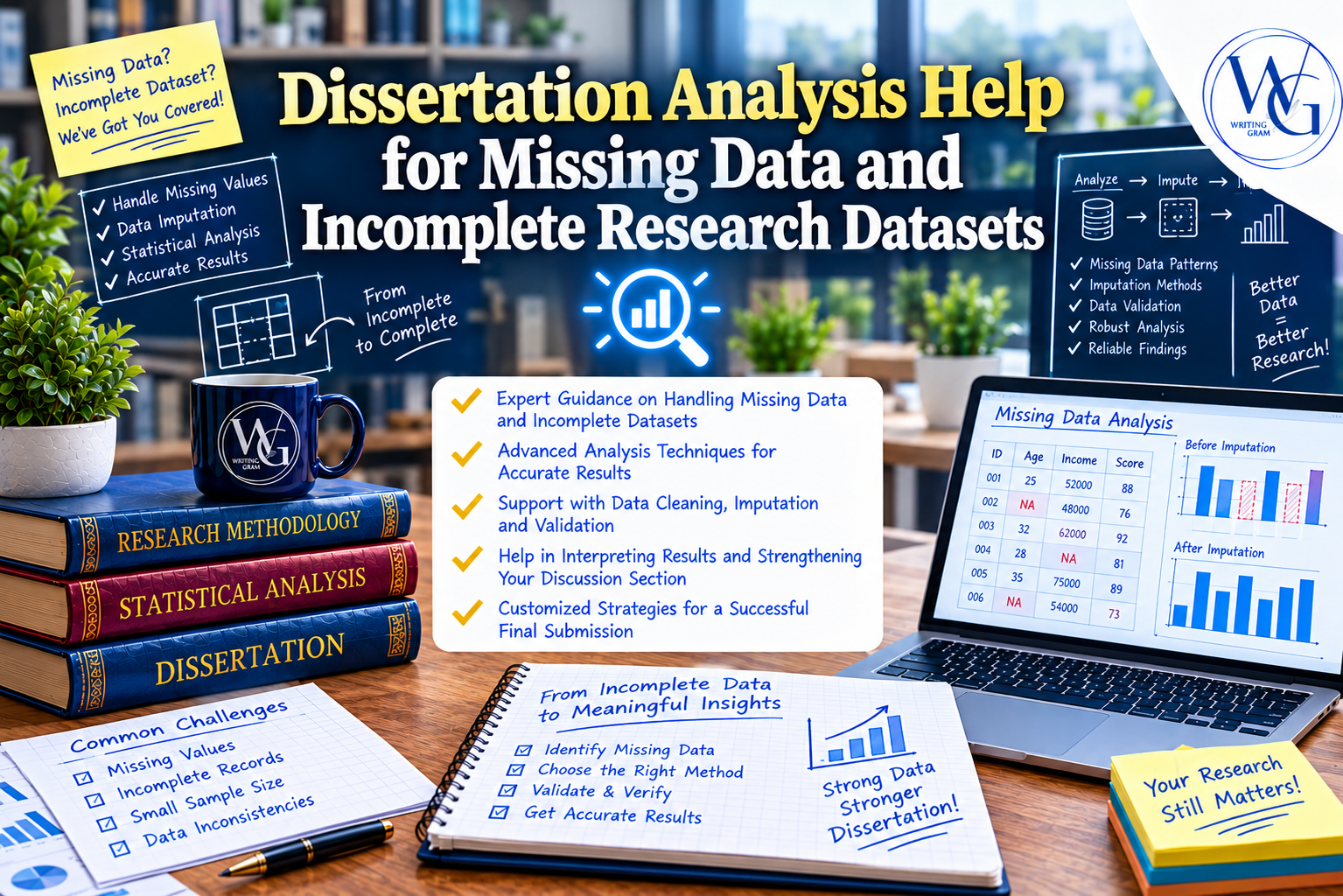
Need dissertation analysis help with missing data? Get expert help assessing incomplete datasets, choosing appropriate analysis methods, and preparing defensible results for your dissertation.
Can You Still Analyze a Dissertation Dataset With Missing Data?
Yes, a dissertation can often still be analyzed when some data are missing. The appropriate approach depends on what is missing, how much is missing, why it is missing, and which variables are affected. You may be able to analyze the available data, use an appropriate missing-data method, modify the planned analysis, or report the limitation rather than simply filling gaps with guessed values.
Need Help Figuring Out What to Do With Your Incomplete Dissertation Data?
Writing Gram can help you make sense of an incomplete dissertation dataset using the data you actually have. We can review where the missing information occurs, explain how it may affect your analysis, and help you decide what to do with the missing data so you can move forward with an analysis that fits your dissertation.
You do not have to spend hours trying to figure out whether your incomplete dataset can still be used or how to deal with missing data.
👉 Place your order now and get help reviewing your missing data, choosing an appropriate approach, and preparing your analysis so you can clearly explain and report your dissertation results.
What Counts as Missing or Incomplete Data in a Dissertation?
An incomplete dissertation dataset does not necessarily mean that your research has failed or that you have to start collecting your data again. Missing information can occur in several ways, and the type of missingness matters when deciding how the analysis should proceed.
For example, you may have:
Participants who answered some survey questions but left others blank
Missing values in otherwise usable participant records
Questionnaires that were only partially completed
Participants who dropped out before completing a later stage of the study
Variables that were not collected for part of the sample
Gaps in a secondary dataset you planned to analyze
Entire observations that are unavailable
Values that are present but cannot be used because of data-quality problems
Missing references or source information needed to support claims, findings, or other parts of the dissertation
Missing tables or figures needed to present your results, findings, or analyzed data clearly.
How Missing Data Can Affect Your Dissertation Analysis
Finding missing information in your dissertation dataset can be worrying, especially when you have already finished collecting your data and are unsure whether you can still complete your analysis. The good news is that not every missing response creates a serious problem. Columbia University explains that researchers may have partially completed cases, missing groups of variables, or entire observations or variables that are unavailable. The effect on your analysis depends on what is missing, how much is missing, and where it occurs.
If missing data is not properly assessed, it can create problems such as:
You may struggle to complete the analysis you planned: If an important variable has too many missing values, you may not have enough usable information for the statistical test or analysis you intended to perform.
Your findings may be less reliable: If important information is missing from a substantial part of your sample, it can affect the results you obtain and make it harder to draw accurate conclusions from your study.
You may have difficulty explaining your findings: When important information is missing, it can make your results harder to interpret and explain in your Results and Discussion chapters.
Your methodology may be questioned: Your dissertation needs to explain how missing data was identified and dealt with. If this is not clearly addressed, you may have difficulty justifying your analytical decisions to your supervisor or examiners.
You may face delays getting your dissertation finished: Uncertainty about whether your dataset is usable, which cases to include, or how to proceed with the analysis can leave you stuck when you need to complete your Results and Discussion chapters.
Your final dissertation may be weaker: If missing data is ignored or handled inappropriately, it can affect the credibility of your analysis and the conclusions you present in your dissertation, which may ultimately affect how your work is assessed.
So, seeing blank cells in your dataset does not automatically mean that you need to collect your data again. What matters is what is missing, how much is missing, where it occurs, and how it affects the analysis you need to complete your dissertation.
Reasons Why Data in Your Dissertation May Be Missing
If you find missing information in your dissertation dataset, one of the first things to consider is why it is missing. A few unanswered questions may not cause a major problem, but understanding why information is missing can help you determine how it may affect your results and what you should do with the missing values.
Researchers commonly describe missing data in three ways: Missing Completely at Random (MCAR), Missing at Random (MAR), and Missing Not at Random (MNAR). Understanding the difference can help you make a more informed decision about how to proceed with your analysis.
Missing Completely at Random (MCAR)
MCAR means that the missing information has no clear connection to the participants, the other information in your dataset, or the values that are missing.
For example, imagine that a technical problem caused some survey responses to be lost. If the problem happened randomly and was not related to who the participants were or how they would have answered the questions, the missing data may be considered MCAR.
MCAR is a strong assumption. Simply not knowing why some information is missing does not mean that your data are MCAR. You need to consider the available information about your dataset before making that assumption.
Missing at Random (MAR)
MAR means that whether information is missing may be related to other information you already have about the participants. Once those known factors are taken into account, the missing value itself is assumed not to be the reason the information is missing.
For example, suppose participants from one particular age group were more likely to leave a survey question unanswered. If your dataset includes each participant’s age, you can see that the missing responses are related to information you already have. This can help you understand the pattern of missing data when deciding how to analyze it.
Missing Not at Random (MNAR)
MNAR means that the reason information is missing may be connected to the value that was not reported. In other words, the people who did not provide an answer may be different from those who did, and that difference may be related to the missing information itself.
For example, imagine a survey asking participants about a sensitive personal issue. Participants with particularly high or low scores may be less willing to answer the question. If the people who leave the question blank are more likely to have certain scores, simply treating their missing responses like the responses you do have could affect your results.
The UCLA Office of Advanced Research Computing, Statistical Methods and Data Analytics explains that MCAR, MAR, and MNAR describe different ways missing data can occur. The appropriate approach depends on factors such as why information is missing, how much is missing, where it occurs, the structure of your dataset, and the analysis you plan to perform.
You may not be able to know with certainty which type of missingness applies to your dataset. In many studies, the exact reason cannot be confirmed because the missing information is unavailable. What matters is considering the evidence you do have, understanding the assumptions behind the approach you choose, and clearly explaining how you addressed the missing data in your dissertation.
Should You Delete Cases With Missing Values?
Not automatically.
When you find missing values in your dissertation dataset, it can be tempting to remove every participant with incomplete information and continue with the remaining data. However, deleting incomplete cases is not always the best choice for your analysis.
Complete-case analysis, also called listwise deletion, removes a participant from a particular analysis if they are missing information required for that analysis. This can leave you with fewer participants, which may make your results less precise. If the participants you remove differ in an important way from those who remain, deleting them can also affect your results and the conclusions you draw from your study.
Another option is available-case analysis, also called pairwise deletion. Here, each calculation uses the participants who have the information needed for that particular calculation. This can allow you to keep more of your available data, but different parts of your analysis may then be based on different groups of participants.
Depending on your dataset and planned analysis, other approaches may also be appropriate. These can include imputation, where missing values are estimated using available information, or statistical methods designed to work with incomplete data without simply removing every participant with a missing value.
The Pennsylvania State University Department of Statistics explains that different approaches can be used to deal with missing observations, including excluding incomplete observations or using an appropriate imputation strategy. The right choice depends on the nature of the missing data, the analysis you are performing, and the assumptions behind the method.
For your dissertation, the important point is that you should not delete participants simply because your statistical software gives you that option. Before removing incomplete cases, you need to consider how many participants you would lose, how that could affect your analysis, and whether the remaining data can still support the conclusions you want to make.
What Can You Do With an Incomplete Dissertation Dataset?
Finding missing information in your dataset does not automatically mean that you need to collect your data again. Depending on what is missing, how much is missing, and the analysis you need to perform, there may be several ways to continue with your dissertation.
Analyze the Data You Still Have
In some cases, you may be able to carry out your planned analysis using the information that is available.
This does not mean simply ignoring the missing data. You first need to look at how much information is missing, which variables are affected, and how leaving out incomplete cases could affect your results.
If you still have enough useful information to answer your research question and the requirements of your planned analysis are met, working with the available data may be an appropriate option.
Use a Missing-Data Method
Depending on your dataset, you may be able to use a statistical method specifically designed to deal with missing information.
One example is multiple imputation. Instead of replacing each missing value with one guessed number, multiple imputation uses the information available in your dataset to create several plausible versions of the missing values. These datasets are then analyzed and the results are combined while taking the uncertainty around the missing information into account.
Other methods may also be appropriate, including likelihood-based approaches for certain types of analyses. The goal is not to choose the most complicated method. The method needs to fit your dataset, research design, missing-data situation, and planned analysis.
Adjust Your Planned Analysis
Sometimes reviewing the missing data shows that the analysis you originally planned is no longer the best fit for your dataset.
For example, if an important variable is missing for a large number of participants, you may need to consider a different analytical approach, limit part of the analysis, or be more careful about the conclusions you draw from the available data.
This does not mean changing your analysis simply to get a significant result. Any change should be based on the data you have and explained clearly in your dissertation.
The University of Michigan provides guidance on statistical analysis with missing data, including complete-case analysis, imputation, likelihood-based methods, and approaches that account for the data and missing-data mechanism.
Explain How You Handled the Missing Data
Whatever approach you use, the missing information should be clearly addressed in your dissertation. Your methodology should explain what was missing and how you dealt with it. Your results should make clear how much data was available for the analyses you performed, particularly if this differs from your original sample.
You should also discuss any important limitations that remain because of the missing data.
An incomplete dataset does not automatically mean you have to start your research again or that you cannot finish your dissertation. What matters is understanding what information is missing, choosing an approach that works for your study, and clearly explaining how you handled the missing data and how it affected your analysis and conclusions.
Is Multiple Imputation Always the Answer?
No.
Before deciding whether multiple imputation is right for your dissertation, it helps to understand what it actually means.
Multiple imputation is a statistical method for dealing with missing values in a dataset. Instead of simply deleting participants who have missing information or filling each blank with one fixed value, the method uses the information already available in your dataset to estimate several plausible values for the missing information.
These different versions of the dataset are then analyzed separately, and the results are combined. This allows the analysis to account for the fact that the missing values are estimates rather than known values.
For example, imagine that some participants did not report their income, but your dataset contains other information about them that may help predict income. Multiple imputation can use the available information to create plausible values for the missing income data rather than simply removing those participants from the analysis.
However, multiple imputation is not the right solution for every dissertation dataset. Having missing values does not automatically mean that you should use multiple imputation, just as it does not mean that you should automatically delete every participant with incomplete data.
Before using multiple imputation, you need to consider how much information is missing, where it is missing, why it may be missing, which variables are affected, and what type of analysis you need to perform. The imputation method also needs to be appropriate for the variables and statistical model used in your dissertation.
It can also be tempting to use a simple solution, such as replacing every missing value with the average for that variable. However, this can change relationships between variables and make your results appear more certain than they really are. Multiple imputation is designed to address this by using several plausible values and carrying the uncertainty about the missing information through the analysis.
The goal is not to work out exactly what each participant would have reported. That is usually impossible because the original information is missing. The goal is to make the best statistical use of the information you do have while properly accounting for the uncertainty created by the missing data.
The UCLA Office of Advanced Research Computing, Statistical Methods and Data Analytics explains that multiple imputation is one approach to handling missing data, and its suitability depends on factors such as the amount and pattern of missing information, the assumptions being made, and the analysis being performed.
What should you do next? Before choosing multiple imputation, first assess how much data is missing, which variables are affected, and whether there is a pattern to the missing information. You can then determine whether multiple imputation or another approach is suitable for your particular dissertation analysis.
What If a Large Part of Your Dataset Is Missing?
Having a large amount of missing information can be worrying, especially if you have already finished collecting your data and are unsure whether you can still complete your dissertation analysis. However, a large amount of missing data does not necessarily mean that you have to start your research again or cannot complete your analysis.
What matters is what information is missing, how much is missing, where it is missing, and why it may be missing.
For example, missing information could involve:
A substantial number of unanswered survey questions
An important independent or dependent variable
Many participants from your original sample
Participants who dropped out before later measurements were collected
An entire section of a questionnaire
An outcome variable needed for your main analysis
Several variables missing for the same group of participants
The effect of missing data depends on what is missing and how important it is to your analysis. For example, missing data in a less important variable may have little effect on your dissertation, while missing the main outcome for many participants could make it much harder to complete your planned analysis.
The reason the information is missing also matters. The same amount of missing data can have different consequences depending on the pattern of missingness, the variables involved, and the statistical analysis you need to perform.
Harvard University explains that missing data can occur for several reasons, including unanswered survey items, unacceptable responses, or information that was not recorded correctly. Simply allowing statistical software to remove observations with missing values can also create problems if you do not first consider how those missing observations could affect your analysis.
So, instead of asking only “What percentage of my data is missing?”, you should ask:
What information is missing, which participants or variables are affected, why might it be missing, and can I still perform the analysis I need for my dissertation?
Answering these questions gives you a much clearer basis for deciding whether you can continue with the data you have, use a missing-data method, adjust your analysis, or take another approach.
Get Dissertation Analysis Help With Missing Data
Not sure how to handle the missing data in your dissertation? Writing Gram provides dissertation analysis help to review your dataset, assess the missing information, and help determine the best way to proceed with your analysis based on the data you have.
👉 Place your order now to get dissertation analysis help with your incomplete dataset. After you place your order, share your dataset and explain what is missing. We can assess the missing data, determine how it affects your planned analysis, and help you handle the missing information appropriately so you can continue working on your dissertation with the analysis you need.
What Should You Check Before Running Your Dissertation Analysis?
Before you start your dissertation analysis, take a few minutes to check your dataset carefully. This can help you identify missing information early and avoid problems later when you are interpreting your findings or writing your Results chapter.
Which parts of your dataset have missing information?
Check which variables, questions, or sections contain missing values. This helps you see exactly where the gaps are instead of assuming that the entire dataset is affected.How much information is missing?
Count how many values or participant records are incomplete and look at the proportion of missing information. This gives you a better idea of the size of the problem.Where is the missing information concentrated?
Check whether missing values are spread across the dataset or concentrated in particular variables, participants, questions, or stages of data collection.Is there a pattern to the missing data?
Look for patterns that could help explain why information is missing. For example, did participants tend to skip the same questions, or did missing information occur after a particular stage of your study?Why might the information be missing?
Consider possible reasons, such as participants skipping questions, technical problems, participants dropping out, problems during data entry, or information that was not collected as planned.Is the missing information important to your main analysis?
Check whether missing data affects your main outcome, important predictors, or other variables you need for your research questions. Missing information in a key variable may create a bigger problem than missing information in a less important variable.How many participants can you actually use for each analysis?
Your original sample size may not be the same as the number of participants available for every statistical test. Check how many participants have the information required for each analysis you plan to perform.Can you still use your planned analysis?
Consider whether the amount and pattern of missing data affect the statistical method you originally planned to use. You may need to adjust your approach if too much information is missing from an important part of the analysis.Do you need to use a method for handling the missing data?
Depending on your dataset, you may need to consider an approach such as multiple imputation, complete-case analysis, a likelihood-based method, or another suitable method. The right choice depends on your data and the analysis you need to perform.If you collected interviews, do you have enough usable material for your qualitative analysis?
If your dissertation uses interviews, check whether any interviews, recordings, transcripts, or sections of transcripts are missing. If some interview material is incomplete, you should consider how this affects your qualitative coding and analysis before drawing conclusions from the available interviews.How will you explain your approach in your dissertation?
Your dissertation should clearly explain what information was missing, how you handled it, and how the missing data affected your analysis. This allows your reader to understand how you arrived at your findings.
These checks can help you understand what is missing, how it affects your dissertation analysis, and what needs to be done before you proceed with your results. Rather than simply deleting incomplete data or allowing your statistical software to make the decision for you, you can assess the situation and choose an approach that fits your study.
Frequently Asked Questions About Missing Data in Dissertation Analysis
Finding missing information in your dataset can leave you wondering whether you can still complete your dissertation analysis, whether you need to remove participants, or whether you need a method such as multiple imputation.
You do not have to figure it all out on your own. The right way to handle missing data depends on your dataset, research design, and planned analysis. Below, we answer common questions students have when missing or incomplete data starts affecting their dissertation analysis.
Can I Still Finish My Dissertation If My Dataset Is Incomplete?
In most cases, yes. Finding missing information in your dataset does not automatically mean you need to start your research again or collect all of your data again. What you should do next depends on what is missing, how much data is missing, which participants or variables are affected, why the data may be missing, and whether you can still carry out the analysis needed to answer your research questions.
How Much Missing Data Is Too Much for a Dissertation?
There is no single percentage that automatically means your dataset cannot be used.
The effect depends on which variables are affected, how many participants are affected, why the information is missing, and what analysis you need to perform. Missing information in a less important variable may have a smaller effect than missing the main outcome needed for your research question.
Should I Remove Participants Who Have Incomplete Responses?
Not in every case. Removing every participant with a missing value can reduce the number of participants available for your analysis and, depending on why the data are missing, can affect your results.
Complete-case analysis means including only participants who have complete information for all the variables required for a particular analysis and leaving out participants who are missing any of that information. This can be appropriate in some situations, but the decision should be based on your dataset, the amount and pattern of missing data, and the statistical method you plan to use.
Can I Use Mean Imputation for My Dissertation?
Mean imputation means replacing a missing value with the average value for that variable.
Mean imputation can be used in some situations, but it is not suitable for every dataset or analysis. Replacing missing values with the mean can reduce the variation in your data, affect relationships between variables, and make your analysis appear more certain than it really is. Whether it is appropriate depends on your dataset, the amount and pattern of missing data, and the analysis you plan to perform.
Is Multiple Imputation Appropriate for My Dissertation?
Multiple imputation can be appropriate in some situations, particularly when you have a meaningful amount of missing data but still have enough information in your dataset to estimate plausible values for the missing information. It uses information from the available data to create several plausible values for the missing information and carries the uncertainty around those values into the analysis.
It may be useful when simply removing participants with missing values would result in a substantial loss of data or could affect your results. However, it is not suitable for every dataset. You need to consider why the data are missing, which variables are affected, how much information is missing, and the analysis you plan to perform before deciding whether multiple imputation is appropriate.
What If My Supervisor Told Me to “Deal With the Missing Data”?
That usually means you need to make a clear decision about how the missing information will be handled in your analysis.
You may need to assess the missing-data pattern, determine how it affects your planned analysis, choose an appropriate approach, and explain that decision in your methodology and results.
Can Missing Data Affect My Statistical Results?
Yes.
Missing information can reduce the number of observations available for an analysis and increase uncertainty around your results. In some situations, it can also affect the results if the observations with missing information differ systematically from those with complete information.
What If My Statistical Software Automatically Drops Observations?
Some statistical procedures automatically exclude observations with missing values.
Before accepting the output, check how many observations were removed and which variables caused them to be excluded. You should also consider whether using only the remaining observations is appropriate for your analysis.
Do not assume that the sample size shown in your statistical output is automatically the correct sample size for your dissertation.
Why Do Different Statistical Tests Sometimes Have Different Sample Sizes?
Different statistical tests can use different numbers of participants because each test may require different information from your dataset.
For example, you may have 100 participants with complete information for one analysis, but only 80 participants have all the information needed for another analysis. The second analysis would therefore use 80 participants instead of 100.
This is common when some variables have more missing data than others. What matters is understanding why the number of participants changes, which data are missing, and how this affects each analysis, then reporting the relevant sample size clearly in your dissertation.
Should I Consider Effect Size and Practical Significance?
Yes. A statistically significant result does not necessarily mean that the finding has a large or meaningful effect. Effect size helps show how large or strong a difference, relationship, or effect is, while practical significance considers whether that effect is meaningful in the real world or important for your research question.
For example, a study can find a statistically significant difference between two groups, but the actual difference may be very small. Looking at the effect size alongside the statistical significance can give you a better understanding of what your results actually mean.
If missing data has reduced your sample size or affected your analysis, it is also important to consider how this may affect the results and their interpretation. Your dissertation should report the appropriate effect size for your analysis and explain what the findings mean in the context of your research question.
How Can Writing Gram Help With Missing or Incomplete Dissertation Data?
Can Writing Gram Help Me Analyze an Incomplete Dissertation Dataset?
Yes. Writing Gram can help you work through missing-data problems using the information from your actual dissertation.
You can provide your dataset, research questions, methodology, and any analysis you have already completed. We can then examine the problem in context and help you move forward with the appropriate dissertation analysis.
Can Writing Gram Help Me Decide How to Handle Missing Values?
Yes. If you are unsure whether to remove incomplete cases, use an imputation method, adjust your analysis, or take another approach, we can assess the available options based on your dataset and research design.
The goal is to avoid applying the same solution to every missing-data problem.
Can Writing Gram Help If I Have Already Started My Analysis?
Yes. You do not necessarily need to start your analysis from scratch because you discovered missing data.
We can review the work you have already completed, identify where the missing information affects the analysis, and help you address those issues before you continue.
Can Writing Gram Help With SPSS, Stata, R, or Other Statistical Software?
Yes. We can provide dissertation statistical analysis help using the software relevant to your project, including SPSS, Stata, and R.
You can provide your dataset, research questions, methodology, and any analysis you have already completed. We can help clean and prepare your data, check for missing or inconsistent values, select and run the appropriate statistical tests, interpret the output, and present the results in a way that fits your dissertation. If you have already started your analysis, we can also review your existing work and help correct or complete it.
Can Writing Gram Help With My Methodology and Results Chapters?
Yes. Missing data does not only affect statistical analysis. Your dissertation also needs to explain what was missing, how it was handled, and how it affected your results.
We can help you present the relevant methodology, analysis, and findings clearly and consistently throughout your dissertation.
Can Writing Gram Help If I Do Not Know Which Statistical Test to Use?
Yes. If you are unsure which statistical test or analytical method fits your research, we can assess your research questions, hypotheses, variables, study design, and available data to help identify an appropriate approach.
Can Writing Gram Work With the Data I Already Collected?
Yes. You can work with the dataset you already have. Missing information does not need to be treated as though it was collected, and you do not necessarily need to start your study again.
We can help you assess what can be done with the available data and how the analysis should account for the information that is missing.
Can Writing Gram Help With Data Cleaning and Preparation?
Yes. Before analyzing your dissertation data, we can help clean and prepare the dataset so it is ready for analysis. This can include checking for missing values, duplicate records, inconsistent entries, incorrect coding, unusual values, and other data-quality problems that could affect your results.
We can also help organize and prepare your variables and dataset for the statistical analysis you need to perform, based on your research questions and methodology.
Can Writing Gram Help If I Am Worried That My Dataset Is Unusable?
Yes. Before assuming that your dataset cannot be used, it is worth assessing the actual problem.
We can examine the missing information, the remaining observations, the variables affected, and the requirements of your planned analysis to help establish what needs to be addressed.
Can Writing Gram Help Me Explain the Missing-Data Problem to My Supervisor or Committee?
Yes. We can help you clearly document what happened to the data, how the missing information was handled, and what effect it had on your analysis and findings.
This can give you a clear explanation to use in your dissertation and when discussing the analysis with your supervisor or committee.
What Should I Provide for Dissertation Analysis Help With Missing Data?
Depending on your project, useful materials may include:
Your dataset
Research questions or hypotheses
Methodology or study design
Variable information or codebook
Questionnaire or survey
Qualitative coding information, if applicable
Analysis you have already completed
Relevant instructions from your university or supervisor
The more relevant information you provide, the easier it is to assess the missing-data problem within the context of your actual dissertation.
What If I Need Dissertation Analysis Help Urgently?
If your deadline is approaching, provide your dataset and dissertation requirements when you place your order, along with any analysis you have already completed.
Writing Gram can then help you address the missing-data problem and work through the relevant dissertation analysis so you can continue completing your dissertation.
Get Dissertation Analysis Help With Missing Data
Missing data can leave you stuck when you are trying to complete your dissertation analysis, prepare your results chapter, and meet your deadline. You do not have to spend hours trying to work out what to do with incomplete responses, missing variables, or an analysis that is no longer working as planned. Our dissertation analysis help can help you clean and prepare your dataset, address missing data, run the appropriate analysis, and produce the results you need for your dissertation.
Writing Gram helps you assess your actual dataset, clean and prepare the available data, address missing or inconsistent information, carry out the appropriate analysis, and present your results clearly in your dissertation. You can share your dataset, research questions, methodology, and any analysis you have already completed so we can work from the research you actually conducted.
👉 Place your order now for dissertation analysis help and let us work through your incomplete dataset with you. We’ll assess the missing data, complete the appropriate analysis, and prepare the results you need for your dissertation.