Difference Between Dissertation, Thesis, and Research Paper Explained for PhD Students
By Writing Gram • May 8, 2026
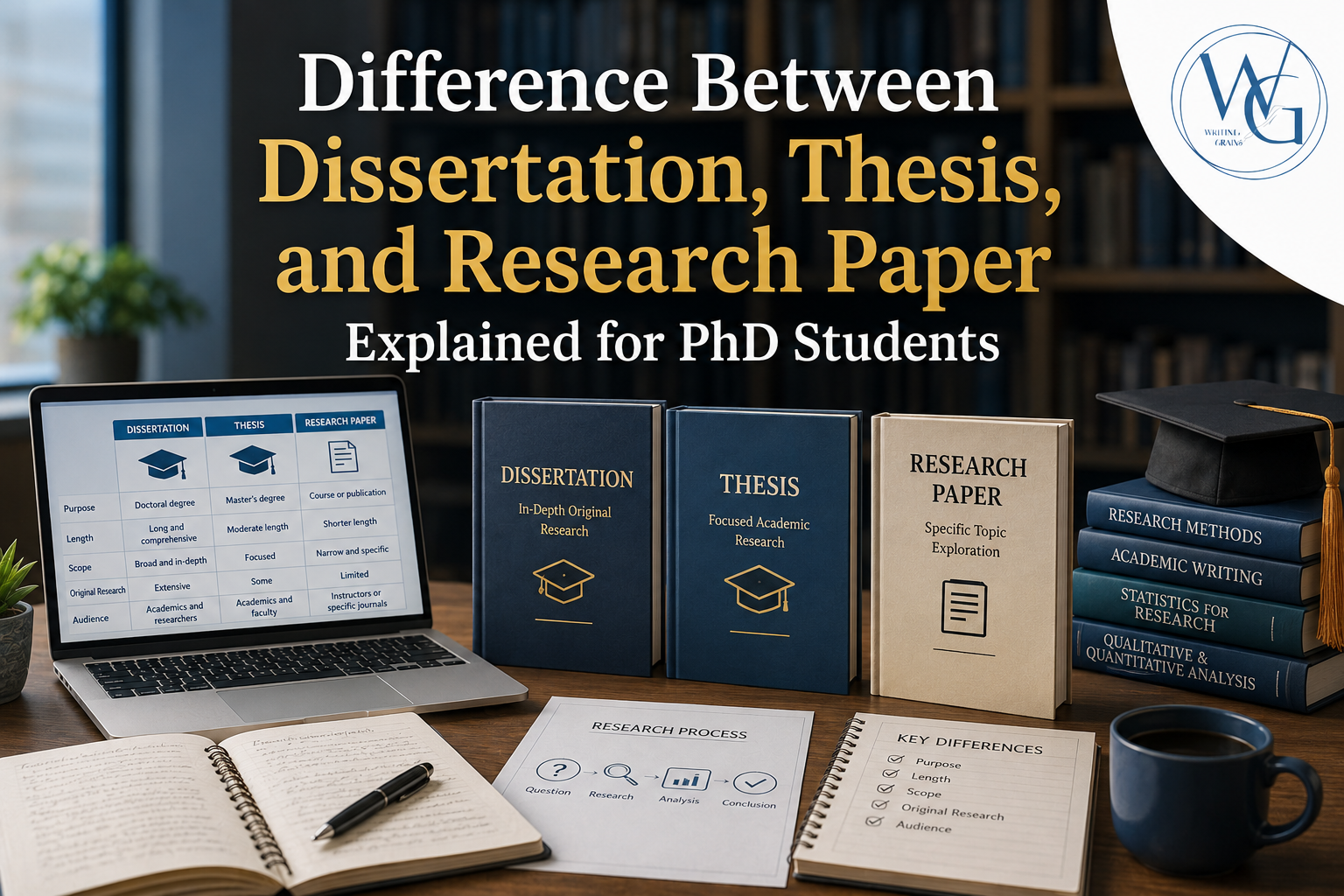
Learn the key differences between dissertations, theses, and research papers, including structure, purpose, and academic level. Understand how each format works in PhD and graduate studies.
Many PhD and graduate students often confuse the terms dissertation, thesis, and research paper because universities around the world use them differently. In some countries, a thesis refers to doctoral research, while in the United States, a dissertation is typically associated with a PhD program and a thesis with a master’s degree. This difference in terminology creates confusion for students trying to understand academic requirements, research expectations, and the type of writing they are expected to complete at different stages of their education.
Understanding the dissertation vs thesis difference is important because each type of academic paper serves a different purpose and comes with different expectations for research depth, originality, structure, and academic contribution. Students who misunderstand these terms may struggle to meet university requirements, prepare for publication standards, or choose the right type of academic support for their projects. Clear knowledge of these academic writing differences also helps students communicate more effectively with supervisors, universities, and academic writing professionals.
This article explains the differences between dissertations, theses, and research papers in a simple and practical way using the American university system as the primary reference point. It explains what dissertations, theses, and research papers are, how they differ from one another, and what PhD students should understand before starting a major academic writing project.
If you need help with a dissertation, thesis, or research paper, Writing Gram provides professional academic writing support tailored to your university standards and research requirements. Our team delivers custom, plagiarism-free, and non-AI academic papers designed to match your specific instructions, research goals, and academic level.
👉Place your order today to get professional and expert help for dissertations, theses, and research papers.
What Is a Dissertation in a PhD Program?
In American universities, a dissertation is a major academic research project completed as part of a PhD program. According to National University, a dissertation is an independent research study that allows doctoral students to investigate a specific problem, analyze evidence, and contribute original knowledge to their field. Unlike shorter academic assignments, a dissertation demonstrates a student’s ability to conduct advanced research, defend arguments, and produce scholarly work that meets doctoral-level standards.
A PhD dissertation is considered one of the highest levels of academic writing because it requires students to move beyond summarizing existing information. Instead, doctoral candidates are expected to identify research gaps, develop research questions, collect and analyze evidence, and present findings that can add value to academic discussions or professional practice. This is one reason many students researching the PhD thesis meaning discover that American universities use the term “dissertation” for doctoral research rather than “thesis.”
Most dissertations follow a structured format that helps organize the research clearly and professionally. Common dissertation sections include:
Literature Review
Examines previous studies related to the research topic
Identifies research gaps and academic debates
Provides the theoretical foundation for the study
Research Methodology
The methodology
Explains the research design and methods used
Describes data collection procedures and sampling techniques
Justifies why specific methods were chosen
Data Collection and Analysis
The data collection and data analysis section
Presents collected research data
Applies qualitative, quantitative, or mixed-method analysis
Interprets patterns, trends, or findings from the research
Findings and Discussion
Explains the meaning and significance of the results
Connects findings to previous academic research
Discusses implications, limitations, and recommendations
Conclusion
Summarizes the overall research contribution
Reinforces the importance of the study
Suggests areas for future research
Many American universities structure dissertations around these core chapters because they help maintain academic clarity and logical progression throughout the research process.
Dissertations are also significantly longer and more detailed than standard academic assignments. Depending on the discipline and university requirements, a doctoral dissertation may range from approximately 100 to over 300 pages. The exact length usually depends on the complexity of the research topic, methodology, and amount of data analyzed.
For example, a PhD student in public health might write a dissertation examining how telemedicine affects healthcare access in rural American communities. This type of project would require extensive literature review, original data collection, statistical analysis, and evidence-based conclusions, which makes a dissertation vs research paper comparison important since research papers are usually shorter and narrower in scope.
What Is a Thesis?
In the American academic system, a thesis is a major research project typically completed at the master’s degree level. It is designed to demonstrate a student’s ability to conduct structured academic research, analyze existing literature, and present findings in a clear and scholarly format. Unlike a dissertation, which is usually required at the doctoral level, a thesis is generally shorter in length and less complex in terms of research depth and originality.
According to the University of Central Florida’s Graduate Studies guidelines, a master’s thesis is an optional or required research component (depending on the program) that allows students to engage in focused academic inquiry under faculty supervision and contribute to their field in a limited but meaningful way.
To clarify key distinctions in the American system:
A thesis is commonly associated with a master’s degree program
A dissertation is associated with a PhD or doctoral program
This difference is important when understanding the dissertation vs thesis difference in U.S. universities
Important tip: In simple terms, a thesis usually involves analyzing existing research or applying established theories to a specific topic, while a dissertation requires producing original research that contributes new knowledge to the field.
It is also important to note that terminology varies globally. In countries such as the United Kingdom, Canada, and Australia, the terms are often reversed—“thesis” may refer to doctoral research, while “dissertation” may refer to master’s-level work. This is one reason many students ask whether is dissertation same as thesis USA when comparing international academic systems.
Because of these differences, confusion is common among international students who switch between education systems or rely on global academic sources. However, in the United States, the distinction remains fairly consistent: theses are master’s-level research projects, while dissertations are PhD-level scholarly works that require a higher level of originality, depth, and academic contribution.
What Is a Research Paper?
A research paper is a structured academic assignment that investigates a specific question, analyzes existing studies, and presents evidence-based arguments. Unlike dissertations or theses, research papers are usually shorter and more focused. They are used across undergraduate, master’s, and even PhD-level coursework to assess a student’s ability to engage with scholarly material and communicate findings clearly.
According to the University of Minnesota Crookston Writing Center, a research paper is an academic assignment that requires students to present knowledge in their own writing by gathering information from multiple sources, analyzing it critically, and demonstrating understanding of a subject through structured argument and evidence-based discussion.
The main goals of a research paper typically include:
Analyzing a specific research question
Breaking down a focused topic into manageable ideas
Identifying key arguments or debates in existing literature
Reviewing existing research
Summarizing and evaluating scholarly sources
Showing how different studies relate to each other
Presenting evidence-based arguments
Using academic sources to support claims
Building logical conclusions based on research findings
Unlike dissertations, research papers do not usually require the student to produce entirely new or original knowledge. Instead, they focus on demonstrating understanding of existing knowledge and the ability to critically analyze information. This is one of the key reasons the dissertation vs research paper distinction is important in academic writing.
Research papers are also significantly narrower in scope. For example, a student might write a research paper analyzing the impact of social media on student learning habits in a single university class, whereas a dissertation could involve a multi-year study examining how social media influences academic performance across different universities, requiring original data collection, advanced methodology, and a significant contribution to existing knowledge in the field.
In academic settings, a research paper might be assigned in a graduate seminar where students are expected to engage deeply with a topic over a few weeks, while a dissertation involves years of independent research at the doctoral level.
This difference is central when making a research paper vs dissertation comparison, especially for students trying to understand expectations at different stages of higher education.
Writing strong research papers, dissertations, and theses requires clarity, structure, and careful academic execution, especially when working with strict university standards. Writing Gram provides professional academic support that helps students develop well-researched, properly structured, and fully customized work for all levels of academic writing.
👉 Upload your instructions today and get expert guidance and support to produce high-quality, professionally written research papers, dissertations, and theses tailored exactly to your requirements.
Main Differences Between a Dissertation, Thesis, and Research Paper
In American higher education, universities generally distinguish these three forms of academic writing based on their level of study, depth of research, and expected contribution to knowledge. Purdue University’s Online Writing Lab explains that academic writing varies in purpose, structure, and complexity depending on the assignment type, audience, and academic level, meaning that expectations differ significantly between undergraduate and graduate-level work.
Understanding these differences helps students approach each task with the correct expectations and methodology. Below is a clear breakdown of how dissertations, theses, and research papers differ across key academic dimensions:
Academic Level
Research paper: Typically assigned at undergraduate or early graduate level to assess understanding of a topic.
Thesis: Commonly completed at the master’s level as a requirement or capstone project.
Dissertation: Completed at the doctoral (PhD) level as the highest form of academic research.
Purpose
Research paper: Demonstrates the ability to analyze existing information and build a structured argument.
Thesis: Shows deeper understanding of a subject through focused academic research.
Dissertation: Contributes new knowledge or original findings to an academic field.
Length and Scope
Research paper: Usually short to moderate in length and focused on a specific question or topic.
Thesis: Longer and more detailed, covering broader analysis within a subject area.
Dissertation: The most extensive, often involving multiple chapters and years of research.
Original Research Requirement
Research paper: May rely heavily on existing sources with limited original input.
Thesis: May include some original analysis but still builds largely on existing research.
Dissertation: Requires significant original research, including data collection and analysis.
Time Required to Complete
Research paper: Usually completed within weeks.
Thesis: Typically takes several months of research and writing.
Dissertation: Often takes multiple years to complete due to depth and complexity.
Complexity and Methodology
Research paper: Basic to moderate analytical structure.
Thesis: More advanced structure with stronger academic reasoning.
Dissertation: Highly complex, involving advanced research methods and academic rigor.
Final Academic Outcome
Research paper: Course grade or publication in some cases.
Thesis: Partial fulfillment of a master’s degree requirement.
Dissertation: Mandatory requirement for earning a PhD degree, often followed by a defense before a committee.
These distinctions are important because they shape how students plan, research, and execute their academic work. Each format serves a different academic purpose, and understanding these differences ensures students meet the expectations of their specific degree programs effectively.
Reasons Why Students Commonly Confuse These Terms
One of the main reasons students struggle with distinguishing between dissertations, theses, and research papers is the difference in academic terminology across regions. In the United States, academic institutions typically use “dissertation” to refer to doctoral-level research and “thesis” for master ’s-level work. However, in the United Kingdom and several other education systems, these terms are often reversed, which creates confusion for international students comparing academic programs across countries.
Another key factor is that universities, professors, and even online academic sources do not always use these terms consistently. Some departments may loosely refer to any major academic project as a “thesis,” while others clearly distinguish the terminology based on the degree level. This inconsistency leads many students to question whether the structure and expectations are different or simply labeled differently across institutions.
This confusion is common among international students and PhD applicants who are trying to understand program requirements in different countries. A student applying to a U.S. university may assume that a dissertation functions the same way as a thesis in their home country, only to realize that the expectations for originality, length, and research depth are significantly different.
This is why many learners often ask, is dissertation same as thesis USA, especially when transitioning between education systems or researching graduate program requirements. In reality, while the terms may overlap globally, the American academic system maintains a clear distinction based on degree level, which helps structure expectations for master’s and doctoral research more consistently.
Our professional dissertation assistance service helps you make informed decisions and ensures your work meets your program’s requirements.
Which Academic Paper Requires the Most Research?
Among the three types of academic writing commonly used in higher education, the most demanding in terms of independent investigation, depth of analysis, and original contribution is the doctoral-level research project. At this level, students are expected to move beyond summarizing existing knowledge and instead produce work that adds new insights to their academic field.
At institutions such as Stanford University, doctoral requirements emphasize that students must complete a substantial piece of original scholarship, often involving years of focused study, extensive data collection, and rigorous analysis under faculty supervision. The final project is evaluated not only on writing quality but also on its academic contribution and methodological strength.
Compared to other academic writing tasks, the differences in scope and expectations become very clear:
Level of independent work
At the doctoral level, students are expected to design and conduct their own research from start to finish with limited guidance.
In other academic projects, research topics and structures are often more guided or partially predefined.
Depth of supervision
Doctoral candidates typically work closely with a supervisor or committee over an extended period, with multiple stages of review.
Less advanced academic work usually involves shorter feedback cycles and fewer formal review stages.
Revisions and evaluation
Doctoral work often goes through multiple rounds of revision, sometimes including formal defense sessions where students must justify their methodology and findings.
In other academic tasks, evaluation is generally limited to written submission and grading without a formal defense.
Scope of research
The doctoral-level project involves a broad, in-depth investigation that may span several years and multiple datasets or case studies.
The other academic assignments tend to focus on narrower topics with limited research scope.
In contrast, research papers and theses are typically more focused and designed to assess understanding of specific concepts or theories rather than producing new knowledge. These papers are usually completed within shorter timeframes and require less complex methodological design.
Overall, the level of expectation increases significantly as students move from coursework-based writing to advanced academic research, with the doctoral project representing the highest standard of scholarly investigation and contribution.
How to Choose the Right Academic Writing Approach
Choosing the right approach for academic writing depends on understanding the expectations of your program, planning your research carefully, and following clear academic procedures from the beginning. Whether you are working on a dissertation, thesis, or research paper, success comes from clarity, organization, and consistent engagement with your academic requirements. The right academic writing approach involves
Planning research early
Strong academic work begins with early planning. Students should:
Identify a clear research topic as early as possible
Narrow the topic to a specific, manageable question
Conduct preliminary reading to understand existing literature
Create a simple timeline for research, writing, and revisions
Early planning helps prevent last-minute pressure and ensures that the research direction remains focused throughout the writing process.
Following university guidelines
Every academic institution has specific formatting, structure, and submission requirements. These guidelines often determine:
Chapter structure and formatting style
Word count expectations
Citation style (APA, MLA, Chicago, etc.)
Submission deadlines and review processes
Ignoring these requirements can lead to unnecessary revisions or even rejection of the final submission, so students should always align their work with official academic instructions.
Managing citations and sources
Proper use of sources is essential in academic writing. Students should:
Use credible and peer-reviewed academic sources
Keep track of references from the beginning of the research process
Avoid over-reliance on a small number of sources
Ensure consistency in citation formatting throughout the document
Good citation practices not only prevent plagiarism but also strengthen the credibility of the work.
Working with supervisors
For advanced academic projects, especially at the master’s and doctoral level, supervisors play a critical role. Effective students:
Maintain regular communication with their supervisors
Share drafts early for feedback
Ask clear questions about structure, methodology, and expectations
Apply feedback carefully in revisions
A strong student-supervisor relationship often improves the quality and direction of the final work significantly.
Revising drafts carefully
Revision is a key part of academic success. First drafts are rarely final, and students should expect multiple rounds of improvement. Effective revision includes:
Checking clarity and logical flow of arguments
Ensuring consistency in structure and formatting
Removing repetition and unnecessary content
Reviewing grammar, tone, and academic style
Careful revision ensures the final document meets academic standards and is presented in a polished, professional manner.
Overall, selecting the right academic writing approach is less about complexity and more about discipline, structure, and consistent improvement throughout the research and writing process.
FAQ
What is the difference between a dissertation, thesis, and research paper?
A dissertation is typically a doctoral-level research project, a thesis is usually completed at the master’s level, and a research paper is a shorter academic assignment focused on analyzing a specific topic using existing sources and evidence.
Is Writing Gram a legal academic writing service?
Yes, Writing Gram operates as a legal academic support service that helps students with structuring, editing, formatting, and guiding dissertations, theses, and research papers in line with academic requirements.
Can Writing Gram help with dissertations and thesis writing?
Yes, Writing Gram provides structured academic assistance for dissertations and theses, helping students develop well-organized, properly researched, and university-compliant academic work.
How is a research paper different from a dissertation?
A research paper is usually shorter and focuses on analyzing existing studies, while a dissertation is a long-form academic project that requires original research, advanced methodology, and a significant academic contribution.
Do dissertations require original research?
Yes, most doctoral dissertations require original research, including data collection, analysis, and interpretation, to contribute new knowledge to the academic field.
Can Writing Gram help with research papers?
Yes, Writing Gram supports students with research paper development by helping them structure arguments, improve clarity, and ensure proper academic formatting and referencing.
Why do students often confuse dissertation, thesis, and research paper terms?
Students often confuse these terms because the meaning of dissertation, thesis, and research paper changes depending on the country and education system. For example, in the United States, a dissertation usually refers to PhD-level research, while a thesis is commonly associated with a master’s degree. In other countries, such as the UK, the terms are used differently, and a research paper may simply refer to a shorter academic assignment at the undergraduate or graduate level. This variation in terminology across universities and academic systems is what leads to frequent misunderstanding among students.
Get Clear Guidance on Dissertations, Theses, and Research Papers with Writing Gram
Understanding the differences between dissertations, theses, and research papers is essential for every student, especially when progressing through different academic levels. While these forms of academic writing share similarities in structure and research expectations, they serve distinct purposes: research papers focus on analyzing existing knowledge, theses demonstrate advanced understanding at the master’s level, and dissertations represent original doctoral-level research contributions. Recognizing these differences helps students approach their work with the right expectations and avoid unnecessary confusion during planning, writing, and submission.
However, many students still struggle to differentiate between these formats, especially when academic terminology varies across institutions and countries. This is where structured academic support becomes valuable. Writing Gram helps students clearly understand what each academic task requires while also providing expert guidance for developing well-structured research papers, theses, and dissertations that meet university standards.
With Writing Gram, students benefit from:
Clear academic structuring tailored to their assignment type
Proper formatting aligned with university requirements
Well-researched and logically organized content
Guidance that helps reduce confusion between different academic writing formats
👉Place your order today and get plagiarism-free, custom, and non-AI academic writing support designed to help you produce high-quality research papers, theses, and dissertations with clarity, confidence, and professional academic standards.