Qualitative Dissertation Analysis Help Coding Interviews and Organizing Themes
By Writing Gram • Oct 5, 2026
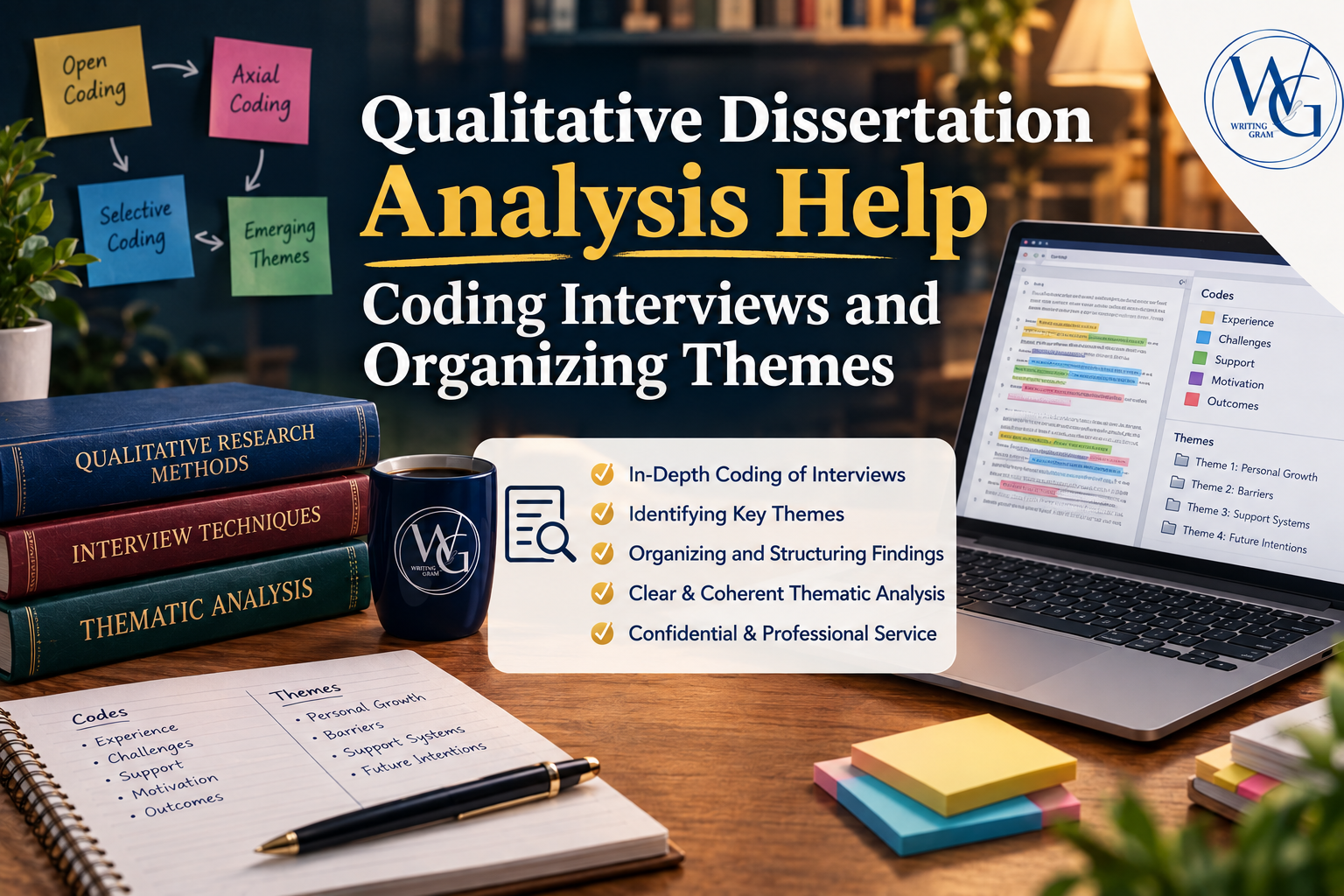
Need qualitative dissertation analysis help? Get expert help coding interview data, organizing themes, and completing your dissertation analysis. Place your order.
What Does Qualitative Dissertation Analysis Help Involve?
Qualitative dissertation analysis help involves working through completed interview transcripts or other collected qualitative data, developing appropriate codes, organizing related codes into categories or themes, and connecting the analysis to your research questions. The goal is to turn a large amount of qualitative data into an organized analysis that accurately reflects the data and provides a solid foundation for your dissertation’s findings section.
What Is Qualitative Dissertation Analysis Help?
If you have already completed your interviews, focus groups, or other qualitative data collection, the next challenge is often figuring out how to analyze all that data. You may have hundreds of pages of transcripts but still be unsure which passages matter, how to label them, or how individual codes should eventually become broader themes.
Qualitative dissertation analysis help focuses on the actual analysis of your collected material. This can include reviewing transcripts, identifying meaningful units of data, developing codes, comparing responses, organizing related codes, and developing themes where your methodology calls for them.
Coding is more than highlighting sentences that appear interesting. It provides a systematic way to organize portions of qualitative data and identify patterns that may not be obvious from reading the transcripts from beginning to end. Loyola Marymount University explains that coding helps researchers organize large amounts of text and identify patterns. It recommends starting with initial coding to identify related data, then using focused coding to refine the codes, combine or adjust categories, and organize them into broader themes.
What Happens When You Have Hundreds of Interview Pages to Analyze?
You may understand what your participants said but still be unsure how to turn hundreds of pages of interview transcripts into a structured dissertation analysis.
You may find yourself:
Reading the same transcripts repeatedly without knowing which passages are relevant to your research questions
Highlighting large sections of text without a consistent coding approach
Creating dozens of codes and then struggling to organize or refine them
Wondering whether some codes overlap and should be combined
Having difficulty identifying patterns that could develop into meaningful themes
Spending hours searching through transcripts for passages that support your analysis
Struggling to connect participants’ responses to your research questions and study objectives
Although the exact process varies by methodology and analytical approach, qualitative data analysis commonly involves several related activities:
Reviewing the research questions, study objectives, and methodological approach.
Becoming familiar with the transcripts and other qualitative data.
Identifying passages or segments of data that are relevant to the study.
Assigning initial codes to relevant segments of data.
Comparing codes and coded data across interviews, participants, or other sources.
Reviewing, combining, separating, or refining codes as the analysis develops.
Grouping related codes into categories or broader concepts and identifying potential themes when appropriate.
Reviewing the developing analysis in relation to the research questions and chosen methodology.
Selecting relevant excerpts or other evidence from the data to illustrate and support the themes and findings.
This is not a universal nine-step formula. The specific process depends on your methodology, research questions, type of qualitative data, and analytical approach. Some approaches may place greater emphasis on coding, while others use different procedures for developing interpretations, categories, or themes.
Get Help With Your Dissertation Qualitative Data
If you have already completed your interviews but are overwhelmed by hundreds of pages of transcripts, Writing Gram can help you organize and analyze the qualitative data you have already collected, so you do not have to work through every transcript on your own. We can help with coding interview data, organizing related codes, developing or refining themes where appropriate, and structuring the analysis around your dissertation requirements. This can save you significant time and give you an organized starting point for writing your findings.
👉 Place your order now and send your transcripts, research questions, methodology requirements, and deadline. We’ll help you organize your qualitative data, develop a consistent coding approach, identify meaningful patterns and themes, and prepare an analysis that supports your dissertation findings.
How Does Coding Interview Data for a Dissertation Work?
Coding interview data involves assigning labels to meaningful segments of a transcript so you can organize related information, compare participants’ responses, and examine patterns in the data.
For example, imagine that several participants discuss difficulty getting timely guidance from their dissertation supervisors. Depending on the data and your research questions, some possible initial codes might include:
Delayed feedback
Limited supervisor availability
Difficulty obtaining guidance
Unanswered questions
Communication delays
As the analysis develops, the researcher may review these codes to determine whether some overlap, should be combined, or represent distinct aspects of the participants’ experiences. Related codes might be grouped into a broader category such as supervisory access. Depending on the research questions and analytical approach, that category could then contribute to a broader theme about barriers to dissertation progress.
The researcher should not force the data into a theme simply because the theme seems appropriate. Codes and themes should be supported by the data and developed in a way that fits the study’s methodology and research questions.
Coding may be inductive, meaning that codes are developed from the data, or deductive, meaning that coding is guided by existing concepts, theory, research questions, or an established framework. Some studies use a combination of inductive and deductive coding. Dartmouth College explains the difference between inductive and deductive coding and encourages researchers to think critically about how their coding decisions shape the findings of their analysis.
How Are Themes Developed From Codes?
A simplified way to think about the progression from qualitative data to themes is
Collected data → codes → categories or patterns → themes → interpretation
This is a simplified model, not a universal sequence that every qualitative study follows. In some approaches, researchers may move back and forth between coding, categorizing, interpreting, and developing themes rather than following a strictly linear process.
A theme is more than a topic that appears in a transcript. In approaches that use thematic analysis, a theme represents a meaningful pattern in the data that is relevant to the research question and captures something important about the phenomenon being studied.
For example, suppose participants repeatedly discuss delayed supervisor responses, difficulty scheduling meetings, and uncertainty about where to obtain guidance. These responses could be assigned different codes and then examined for connections. If the researcher determines that they collectively represent a meaningful pattern related to access to supervisory support, they may contribute to a broader theme about barriers to dissertation progress.
A theme may also contain subthemes when several related but distinct aspects of a broader pattern need to be examined separately.
The exact process for coding, developing categories, and identifying themes depends on the study’s methodology and analytical approach.University of Northern Iowa explains that researchers can organize qualitative data into categories or themes to make sense of the data, using codes to label and group individual pieces of information. The university notes that these codes can help reveal categories and themes and make relevant data easier to retrieve for further analysis.
What Should a Dissertation Coding System Include?
A well-designed coding system clearly explains what each code means and helps you apply the codes consistently throughout your analysis.
For example:
Coding element | What it does | Example |
Code name | Provides a short label for the concept or issue being identified | Delayed feedback |
Definition | Explains what the code represents | Statements about waiting for responses or feedback from a dissertation supervisor |
Inclusion criteria | Describes the type of data that should receive the code | Participant describes waiting an unusually long time for a supervisor's response |
Exclusion criteria | Describes data that should not receive the code | Participant expresses dissatisfaction that is unrelated to delayed feedback |
Example passage | Shows how the code can be applied to the data | A relevant statement from a participant's transcript |
The exact format of a coding system can vary depending on the methodology and analytical approach. However, clearly defining codes can make the analysis easier to manage and help you apply codes consistently as you work through the data. It can also make it easier to review and refine coding decisions as the analysis develops.
A codebook can be particularly useful when a dissertation involves many interviews or when more than one person is coding the data. It provides a documented record of the codes, their definitions, and other coding decisions, which can help maintain consistency and make the analytical process easier to review.
Should You Use NVivo, MAXQDA, ATLAS.ti, Excel, or Word?
Qualitative analysis software can help you organize, retrieve, compare, and manage coded data, but the software does not make the analytical decisions for you.
The appropriate tool depends on factors such as the size of the dataset, methodology, university requirements, researcher's experience, and complexity of the coding system.
For a smaller project, a spreadsheet or carefully structured document may be sufficient. A larger dissertation may benefit from dedicated qualitative analysis software.
The important distinction is that the software manages the data; it does not decide what the data means.
The University of Chicago demonstrates interview transcript analysis, coding, codebook development, thematic analysis, and organization of coded data.
If you are struggling to organize and analyze your interview data, qualitative analysis software can make the process easier by helping you organize your transcripts, manage codes, compare data, and keep your analysis structured.
How Do You Keep Qualitative Dissertation Analysis Connected to the Research Questions?
Your research questions should guide your qualitative analysis throughout the study and help shape your findings.
Before you start coding, review your research questions and study objectives so you know what you are looking for in the data. You may also need to clean and organize your qualitative data by checking transcripts for obvious errors, removing duplicate files, correcting formatting problems, and making sure the files are complete and ready for analysis. Data cleaning should not change the meaning of participants’ responses.
The coding process should not become an exercise in collecting interesting quotations without considering why those passages matter to the study. As codes and themes develop, you should be able to explain how they relate to the research questions, study objectives, methodology, and collected data.
Keeping this connection throughout the analysis also makes it easier to move from analyzing your data to writing your dissertation. Your dissertation formatting should present your findings in a clear and organized way, while your findings chapter should not simply contain a long list of codes or quotations. Instead, you should explain what the patterns in the data mean, how they relate to your research questions, and what evidence from the data supports your findings.
University of Northern Iowa explains that qualitative analysis involves systematically reviewing and organizing data, identifying categories and connections, and developing themes while considering the research questions and the methods used to collect the data.
📝 Let Writing Gram Help You Organize Your Dissertation Analysis
Writing Gram helps you turn your completed interviews into an organized qualitative analysis. We can work with your transcripts, research questions, and dissertation requirements to help structure your coding, categories, themes, and supporting analytical material. You can avoid spending days manually sorting through hundreds of transcript pages and have your analysis organized around the requirements of your actual dissertation.
👉 Place your order now and send your qualitative data, research questions, dissertation requirements, and deadline. We’ll help you organize your transcripts, structure your coding and themes, identify meaningful patterns, and prepare an analysis that supports your dissertation findings while keeping your files and information confidential and secure. Save time and avoid the stress of sorting through hundreds of transcript pages on your own.
What Can Qualitative Dissertation Analysis Help Cover?
Depending on your study, methodology, and dissertation requirements, qualitative dissertation analysis help may include:
Reviewing interview transcripts, focus group transcripts, or other qualitative data you have collected
Cleaning and organizing qualitative data so it is ready for analysis
Identifying relevant units of analysis and meaningful passages
Developing a coding structure that fits your research questions and methodology
Applying codes consistently to relevant passages
Comparing coded responses across participants or data sources
Reviewing overlapping, unclear, or overly broad codes
Refining, combining, or separating codes as the analysis develops
Grouping related codes into categories or broader concepts
Developing or refining themes and subthemes where appropriate
Creating or organizing a codebook with code definitions and examples
Connecting codes, categories, and themes to your research questions
Organizing relevant excerpts from your collected data to support the analysis
Preparing structured analytical material that can support your dissertation findings chapter
The analysis should always be based on your actual collected data. Codes, themes, participant experiences, quotations, and findings should not be invented or altered simply to produce a convenient result.
How Can You Tell If You Need Dissertation Interview Coding Help?
You may benefit from dissertation interview coding help if:
You have completed your interviews but do not know where to begin.
Your transcripts contain hundreds of pages of material.
You have highlighted important passages but cannot organize them.
You have created many tentative codes and do not know what to do with them.
Several codes appear to describe the same underlying idea.
You are unsure whether you have themes or simply topics.
You have identified themes but cannot connect them to your research questions.
Your advisor has asked you to revise your coding or thematic analysis.
You are spending days manually sorting and comparing transcripts.
You need help turning your organized codes into a coherent qualitative analysis.
If these problems sound familiar, the issue may not be collecting more data. You may simply need help organizing and analyzing the qualitative material you already have.
Qualitative Dissertation Analysis FAQs
What is qualitative dissertation analysis?
Qualitative dissertation analysis is the process of examining collected non-numerical data, such as interview transcripts, focus group transcripts, field notes, documents, or other qualitative data, to identify meaningful patterns, categories, themes, relationships, or interpretations relevant to the research questions.
The exact analysis process depends on the research design, methodology, type of data, and analytical approach used in the dissertation.
How do you code interviews for a dissertation?
You generally begin by becoming familiar with the transcripts, identifying relevant units of data, assigning appropriate codes, comparing coded material, reviewing and refining the coding structure, and organizing related codes into categories or themes when appropriate for the methodology.
Coding should remain connected to the research questions and the data rather than simply producing a large list of labels.Qualitative research guidance from the University of Northern Iowa explains that coding helps researchers organize qualitative data into categories, identify connections, and develop themes.
What is qualitative data coding in a dissertation?
Qualitative data coding is the process of giving labels to important parts of your collected qualitative data. These labels help you organize the data, compare similar responses, identify patterns, develop categories, and continue with your analysis.
A single passage can have more than one code if it relates to more than one idea. For example, a PhD participant describing difficulty balancing research demands, teaching responsibilities, and personal commitments could be given codes such as “research workload” and “work-life balance” if both issues are relevant to the study.
What is the difference between coding and thematic analysis?
Coding involves labeling and organizing relevant portions of qualitative data. Thematic analysis is a broader analytical approach that involves examining coded material to identify and develop meaningful patterns or themes.
Coding can therefore be part of a thematic analysis process, although the exact relationship between coding, categories, and themes depends on the methodology and analytical approach.
What is a unit of analysis in qualitative research?
A unit of analysis is the specific piece or level of qualitative data being examined during the analysis. Depending on the study, it could be a word, phrase, sentence, passage, interaction, event, document, or another meaningful segment of data.
The appropriate unit of analysis depends on the research questions, objectives, methodology, and type of qualitative data being analyzed.
How many codes should a qualitative dissertation have?
There is no universal number of codes that a qualitative dissertation should contain. The appropriate number depends on the dataset, research questions, methodology, analytical approach, and level of detail required.
A large number of codes is not automatically better, and a small number is not automatically better. The coding structure should represent the relevant data and support the purpose of the analysis.
Do I need NVivo to analyze qualitative dissertation data?
No. NVivo and other qualitative analysis programs can help researchers manage, organize, retrieve, and compare coded data, but they are not mandatory for every qualitative dissertation.
Depending on the size and complexity of the project, researchers may use dedicated qualitative analysis software, spreadsheets, word processing software, or other appropriate tools.
Can interview transcripts be coded in Word or Excel?
Yes, depending on the size and complexity of the dataset and your university or advisor's requirements. Word or Excel may be practical for some smaller projects, while larger or more complex datasets may benefit from dedicated qualitative analysis software.
The important point is that the tool should support the analytical process rather than determine what the data means.
What is a qualitative dissertation codebook?
A qualitative dissertation codebook is a documented record of the codes used during analysis. It may include code names, definitions, inclusion and exclusion criteria, examples, and other coding instructions.
A codebook can help maintain consistency when applying codes and provide a record of important coding decisions made during the analysis.
What is the difference between a code, category, and theme?
A code is usually a label assigned to a relevant piece of data. Categories can group related codes or concepts. A theme generally represents a broader pattern or meaningful idea developed through the analysis.
Researchers do not always use these terms in exactly the same way, so their precise meaning can depend on the methodology. University of California, San Francisco describes a code as a word or short phrase used to describe and group data with a shared characteristic, while a category can group codes that reflect a broader underlying concept.
Can qualitative dissertation analysis help be based on my existing interviews?
Yes. If you have already completed and transcribed your interviews, our qualitative dissertation analysis help can work from your existing qualitative data.
We base the analysis on the material you provide, your research questions, methodology, and dissertation requirements rather than inventing participant responses or unsupported findings.
Can you help with qualitative data cleaning before analysis?
Yes. Depending on your project, our qualitative dissertation analysis help can include organizing and cleaning your data before coding.
This may involve checking transcripts for obvious errors, removing duplicate files, correcting formatting problems, organizing files, and making sure the data are complete and ready for analysis. Data cleaning should not change the meaning of participants' responses.
Can dissertation analysis help with thematic analysis?
Yes. If thematic analysis is appropriate for your study, we can help organize your transcripts, develop and refine codes, group related codes, review potential themes and subthemes, and connect the analysis to your research questions.
Thematic analysis commonly involves iterative coding and categorizing to identify broader patterns in qualitative data.
Can you help develop themes and subthemes?
Yes, when themes and subthemes are appropriate for your methodology. We can help review the coded data, identify meaningful patterns, organize related concepts, and refine potential themes and subthemes.
Themes should be supported by the collected data and relevant to the research questions. They should not be selected simply because they sound plausible or convenient.
Can you help refine my existing codes?
Yes. If you already have a preliminary coding framework, we can review the codes for overlap, unclear definitions, overly broad categories, and inconsistencies and help organize or refine the coding structure based on your actual data and methodology.
Can you help create a qualitative dissertation codebook?
Yes. We can help organize a codebook based on your study and coding approach. Depending on your requirements, it may include code names, definitions, inclusion and exclusion criteria, and representative examples from your collected data.
Should every interview have the same codes?
Not necessarily. A coding framework can be applied across interviews while still allowing differences between participants to remain visible.
A participant should not receive a code simply because that code was used elsewhere. The underlying passage should support the code.
Can you analyze focus group transcripts?
Yes. Focus group transcripts can be analyzed using appropriate qualitative coding and analytical methods. The analysis should also account for the interaction between participants because focus group data are produced through group discussion rather than isolated individual responses.
Can you compare themes across participants?
Yes. Depending on your methodology and research questions, we can help organize coded data so that responses can be compared across participants, groups, cases, or other relevant units of analysis.
This can help identify similarities, differences, recurring patterns, and important variations within the dataset.
Can you help connect qualitative analysis to my research questions?
Yes. We can organize the analysis around your research questions and dissertation objectives so that the codes, categories, themes, and supporting excerpts remain relevant to what your study is actually investigating.
This connection is important because qualitative analysis is not simply about finding interesting quotations. The analysis should help address the questions and objectives of the study.
Can you help select quotations for my qualitative dissertation?
Yes. We can help identify relevant excerpts from your collected data that illustrate or support the codes, categories, themes, or findings developed during the analysis.
Quotations should come from your actual participant data and should accurately represent the context and meaning of what participants said.
Can you analyze qualitative data without inventing findings?
Yes. Our analysis is based on the qualitative data you provide. We do not need to invent participant responses, quotations, themes, or findings to complete the analysis.
Any codes, themes, patterns, interpretations, and supporting excerpts should be grounded in your actual data and considered in relation to your research questions and methodology.
Can qualitative dissertation analysis help with NVivo?
Yes. If your dissertation requires NVivo or you are already using it, we can help you organize your qualitative analysis around an appropriate coding structure and work with the information you provide.
The exact support available depends on your project, the files you provide, and your university or advisor's requirements.
Can qualitative dissertation analysis help with grounded theory?
Yes, provided grounded theory is the appropriate methodology for your study. The coding and analysis process should follow the requirements of your chosen grounded theory approach rather than simply applying a generic thematic analysis process.
Can qualitative dissertation analysis help with content analysis?
Yes. If content analysis is appropriate for your research design, we can help organize the qualitative data according to your analytical framework, coding approach, categories, and research questions.
Content analysis and thematic analysis can both involve systematic examination and coding of qualitative material, but they are not identical analytical approaches.
Can you help organize hundreds of pages of interview transcripts?
Yes. If you have a large volume of interview transcripts, we can help organize the qualitative data into a manageable coding and analysis structure.
Depending on your methodology, this may include data organization, coding, comparison across participants, category development, theme development, and selection of supporting excerpts.
What should I send for qualitative dissertation analysis help?
You can send the qualitative data you want analyzed, such as interview or focus group transcripts, along with your research questions, methodology requirements, coding instructions if your advisor has provided them, and any relevant university requirements.
Your dissertation deadline is also important because it helps us understand the timeframe for the work.
Is my qualitative dissertation data kept confidential?
Yes. We treat the qualitative data and dissertation materials you provide as confidential and handle them securely. This is especially important when your transcripts contain participant information or other research materials that should not be publicly shared.
You should also remove unnecessary personally identifying information from research files when appropriate and follow your university's research ethics and data handling requirements.
How long does qualitative dissertation analysis take?
The timeframe depends on factors such as the amount of qualitative data, number of interviews or participants, complexity of the coding framework, methodology, scope of the analysis, and your deadline.
Once we review the materials and requirements for your project, the appropriate timeframe can be determined.
How do I get started with qualitative dissertation analysis help?
Getting started is simple. Send us your qualitative data, research questions, methodology requirements, dissertation requirements, and deadline so we can understand what your study requires.
👉 Place your order now and send your transcripts and study requirements. We’ll help you organize your qualitative data, develop and refine your coding structure, identify meaningful patterns and themes, select supporting excerpts, and prepare analytical material that fits your dissertation requirements while keeping your files and information confidential and secure.
Get Help Coding Your Dissertation Interviews
Writing Gram can help you turn completed interview transcripts and other qualitative material into an organized analysis based on your dissertation requirements. You can get help with coding interview data, organizing related codes, developing themes where appropriate, and connecting the analysis to your research questions. This means less time spent trying to make sense of hundreds of transcript pages by yourself and more time available to work on the rest of your dissertation.
Your actual data, research questions, methodology requirements, and deadline can all guide the work, so the analysis stays connected to your study.
👉 Place your order now and let us help you organize your qualitative data, structure your coding, identify meaningful patterns and themes, and prepare supporting material for your dissertation findings. You can save time, avoid the frustration of sorting through hundreds of transcript pages on your own, and have your analysis organized around your actual dissertation requirements.