Dissertation Meta-Analysis Help for PhD Research
By Writing Gram • Oct 15, 2026
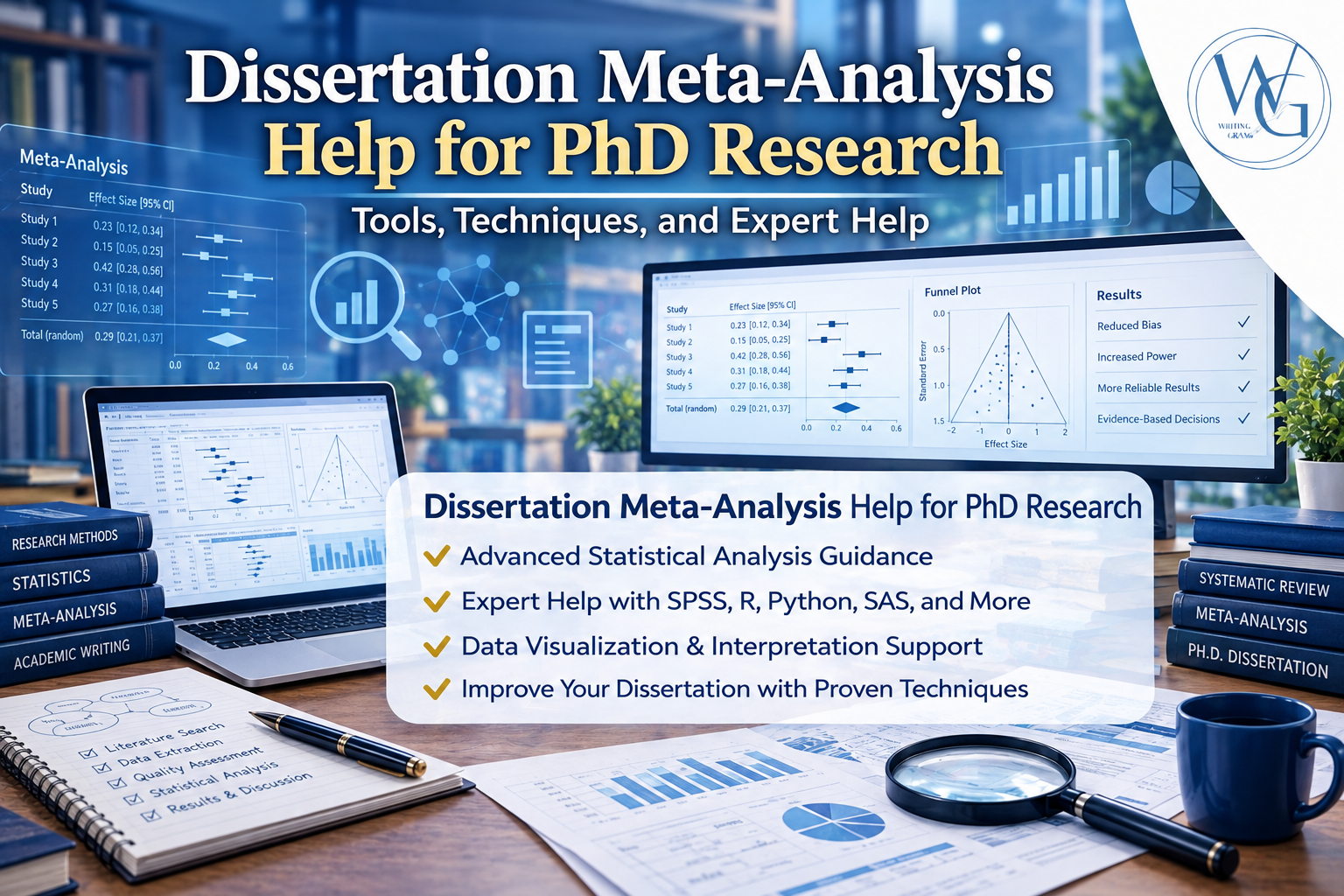
Need dissertation meta-analysis help? Get support with pooled effect sizes, heterogeneity, statistical models, and interpreting results for your PhD research.
Dissertation Meta-Analysis Help for Combining Study Results
Dissertation meta-analysis help supports doctoral researchers who need to combine findings from eligible studies using statistical methods. Assistance can include calculating effect sizes, estimating pooled results, assessing heterogeneity, selecting appropriate statistical models, and interpreting the findings. It is particularly useful when you have collected your studies but need help turning their results into a defensible statistical synthesis for your PhD dissertation.
When Do You Need Dissertation Meta-Analysis Help?
You may need dissertation meta-analysis help when individual studies report different statistics, their findings appear inconsistent, or you are unsure how to calculate comparable effect sizes. You might also be struggling to decide whether a common-effect or random-effects model is appropriate or how to interpret the results produced by your statistical software.
Combining study findings requires more than calculating an average. The studies must provide sufficiently compatible evidence for the proposed synthesis, and differences in their designs, outcomes, and methods must be considered. Without these checks, a pooled estimate may be misleading.
Need Help With Your Dissertation Meta-Analysis?
You have identified the studies for your dissertation, but calculating pooled effect sizes, assessing heterogeneity, and choosing the right statistical model can make the analysis challenging. Writing Gram can help you work through these statistical challenges and interpret your findings for your PhD research.
👉 Place your order now for dissertation meta-analysis help with statistical synthesis, effect-size calculations, heterogeneity assessment, and results interpretation. Get support with the analysis you need to progress with your dissertation.
What Does Statistical Meta-Analysis Assistance Include?
Statistical meta-analysis assistance focuses on combining compatible study results using appropriate quantitative methods. Depending on your research question and project requirements, the work may involve:
Effect-size calculations: Calculating or checking effect sizes and their standard errors or variances using the information reported in eligible studies.
Pooled effect estimates: Combining study-level estimates using an appropriate statistical method and weighting scheme.
Heterogeneity assessment: Examining how much the study results vary beyond what would be expected from sampling error alone.
Statistical model selection: Evaluating whether a common-effect or random-effects model suits the research question and available evidence.
Results presentation: Preparing or interpreting forest plots, pooled estimates, confidence intervals, and relevant statistical outputs.
Research interpretation: Explaining what the findings mean for the dissertation question, including uncertainty and limitations.
The University of Cincinnati's meta-analysis guidance explains the role of meta-analysis in quantitatively synthesizing results across studies. Unlike a narrative summary, a statistical meta-analysis produces a combined estimate when the evidence and methods support one.
How Are Pooled Effect Sizes Calculated?
An effect size expresses the magnitude or direction of a finding in a form suited to the outcome being studied. The appropriate measure depends on the data, study design, and research question. For example, a standardized mean difference such as Hedges' g can compare continuous outcomes measured on different scales, while an odds ratio can summarize the relationship between an exposure or intervention and a binary outcome. Correlation coefficients may be appropriate when studies examine relationships between variables.
Before combining results, the analyst must check that the effect sizes represent sufficiently comparable outcomes and that the required information is available. Depending on the method, calculations may require sample sizes, means and standard deviations, event counts, correlation coefficients, or other reported statistics.
A pooled estimate is generally calculated using a weighting method that accounts for the precision of individual study estimates and, where appropriate, variation between studies. It is not simply the arithmetic average of all reported findings. The University of Southern California's research design guidance provides background on research designs and the importance of matching a research question to an appropriate method.
Heterogeneity Analysis Help: Understanding Differences Between Studies
Heterogeneity describes variation in study results beyond the differences expected from sampling error. Understanding it helps researchers judge how consistently the included studies address the same research question and how cautiously a pooled estimate should be interpreted.
Three commonly reported statistics are:
Cochran's Q: Tests whether the observed variation among study estimates exceeds what would be expected from sampling error, although its power can be limited when few studies are included.
I²: Estimates the proportion of observed variability in effect estimates attributable to heterogeneity rather than sampling error. It does not directly measure the magnitude or practical importance of the differences.
Tau-squared (τ²): Estimates the between-study variance in a random-effects model, expressed on the scale of the effect-size measure being analyzed.
Differences in participants, settings, interventions, outcome measurements, or study methods may help explain heterogeneity. However, these statistics do not identify its cause by themselves. The University of North Dakota's statistical heterogeneity guide provides additional guidance on evaluating variation across studies.
Choosing a Statistical Meta-Analysis Model
A common-effect model assumes that all included studies estimate one underlying effect, with differences in their observed results arising from sampling error. A random-effects model allows the underlying effects to vary across studies and estimates an average across the distribution of effects represented by the included research.
Neither model is automatically correct for every dissertation. Your choice should reflect the research question, the characteristics of the eligible studies, the assumptions you can reasonably defend, and your analysis plan. A random-effects model is not a substitute for investigating important differences between studies, and a heterogeneity statistic alone should not dictate model selection.
The University of Connecticut's Meta-Analysis Lab explanation provides further information about the assumptions underlying fixed-effect and random-effects approaches. Discussing these assumptions in your methods chapter helps readers understand why your chosen model is appropriate.
Interpreting Meta-Analysis Results for a PhD Dissertation
Interpreting meta-analysis results involves more than determining whether a pooled estimate is statistically significant. You need to examine the estimated effect, its confidence interval, the direction and consistency of individual study findings, and the extent of heterogeneity. A forest plot helps you compare individual study estimates with the pooled result and assess the uncertainty surrounding those estimates.
When interpreting your findings, consider the following:
Effect size and confidence interval: Explain the magnitude and direction of the pooled effect and how precisely it has been estimated.
Heterogeneity: Discuss differences between studies and how they affect the interpretation and generalizability of the findings.
Research implications: Explain how the results answer your dissertation research question and identify gaps that warrant further investigation.
Limitations: Acknowledge weaknesses in the available evidence, including potential bias, limited study numbers, and uncertainty in the pooled estimate.
If your dissertation also includes interviews, distinguish the qualitative findings from the statistical meta-analysis. Interview transcripts can provide participants' perspectives, experiences, and explanations that complement quantitative findings when the research design supports integrating the two forms of evidence. However, interview responses should not be treated as additional effect-size data unless the underlying data and methods are appropriate for quantitative synthesis.
Your discussion should also identify opportunities for new research. For example, inconsistent findings may indicate a need for studies involving different populations, settings, interventions, or longer follow-up periods. The University of Washington's evidence synthesis guidance provides relevant guidance on analyzing evidence across studies. Transparent reporting helps readers understand your conclusions, recognize the limitations of the evidence, and see how future research could address unanswered questions.
Get Expert Help Interpreting Your Dissertation Meta-Analysis Results
Choosing a statistical model is only part of the process. You also need to understand what your pooled estimates, confidence intervals, and heterogeneity statistics mean for your research question.
👉 Place your order now for PhD meta-analysis assistance and get help interpreting your statistical outputs and explaining your findings accurately in your dissertation.
Frequently Asked Questions About Dissertation Meta-Analysis Help
Can Writing Gram help calculate pooled effect sizes for my dissertation?
Yes. We provide dissertation meta-analysis assistance that can include calculating or checking effect sizes, estimating their variances, and combining comparable study results using an appropriate statistical method. The calculations depend on your research question, study designs, outcome measures, and the information available from the included studies.
Can you help me interpret heterogeneity and choose an appropriate statistical model?
Yes. We can help you understand heterogeneity statistics, including Cochran's Q, I², and τ², and interpret what they indicate about variation across your studies. We can also help you evaluate common-effect and random-effects models based on your research question, study characteristics, and analysis assumptions. The choice of model should not depend on a heterogeneity statistic alone.
What information should I prepare before ordering dissertation meta-analysis assistance?
To help us understand your requirements, prepare your dissertation research question, analysis plan if available, study-level results, sample sizes, outcome definitions, and any existing statistical outputs. Include effect sizes and their standard errors or variances if you have them. If you have not calculated the effect sizes yet, share the relevant statistics reported in the original studies. Our team can review the information available and identify what is needed for the requested analysis.
Can Writing Gram help if I have collected my studies but have not started the statistical analysis?
Yes. Our dissertation meta-analysis assistance is relevant to researchers who have identified eligible studies but need help with the quantitative synthesis. Depending on your project requirements and the available data, we can assist with effect-size calculations, preparing study-level estimates, assessing heterogeneity, selecting an appropriate model, and interpreting the results.
Can you help with a random-effects meta-analysis?
Yes. We can assist with random-effects meta-analysis when it is appropriate for the research question and available evidence. This may include estimating a pooled effect, assessing between-study variance, interpreting confidence intervals, and explaining how differences in underlying study effects affect the findings. A random-effects model does not automatically resolve differences in study quality or methodological problems.
Can you help me understand forest plots and confidence intervals?
Yes. We can help you interpret forest plots, individual study estimates, pooled effects, and confidence intervals. We can explain how the individual results relate to the overall estimate, what the width of a confidence interval indicates about uncertainty, and how the direction and magnitude of the findings relate to your research question.
Can you help if the studies in my meta-analysis report different types of results?
Yes. We can help assess which results can be converted into compatible effect sizes and which studies may require a different approach. Depending on the outcome and study design, reported means and standard deviations, event counts, odds ratios, or correlation coefficients may provide the information needed for particular calculations. However, not every result can be converted reliably, and studies should not be combined merely because they address a similar topic.
Can Writing Gram help with dissertation systematic review statistics?
Yes. We provide assistance with the statistical components of systematic review projects that include a meta-analysis. This can include calculating effect sizes, pooling compatible results, assessing heterogeneity, evaluating statistical models, and interpreting findings. A systematic review does not necessarily require a meta-analysis; quantitative pooling is appropriate only when the included evidence and methods support it.
Can you help me explain my meta-analysis findings in my dissertation?
Yes. We can help you interpret your statistical outputs and explain the findings in relation to your dissertation research question. This may involve discussing the pooled effect, confidence intervals, heterogeneity, limitations, and implications for future research. The interpretation should reflect the evidence actually obtained and avoid claims that the results cannot support.
What if I already have statistical outputs but do not understand what they mean?
You can request assistance interpreting your existing outputs. Share the relevant results, the analysis method used, your research question, and any difficulties you have encountered. We can help explain the meaning of the reported statistics, identify questions that may need further investigation, and clarify how the findings relate to your research objectives.
Do I need to know how to use statistical software before requesting help?
No. You do not need to be an expert in statistical analysis to explain the assistance you need. Tell us what you are trying to establish, what data or study results you have collected, and where you are encountering difficulties. We can assess your requirements and help you understand the relevant analytical steps and results.
How do I order dissertation meta-analysis assistance from Writing Gram?
Visit our order page and provide your project requirements. Explain whether you need help with effect-size calculations, pooled estimates, heterogeneity analysis, statistical model selection, or interpreting results. Include any relevant study data or existing outputs so your requirements can be understood more clearly.
Get Dissertation Meta-Analysis Help From Writing Gram
Combining findings from multiple studies requires accurate effect-size calculations, an appropriate statistical model, and a clear interpretation of the results. If you are struggling to pool study findings, assess heterogeneity, or explain your statistical outputs, Writing Gram provides dissertation meta-analysis assistance tailored to your research requirements.
Our meta-analysis assistance can include:
Calculated or verified effect sizes and pooled estimates.
Heterogeneity analysis using statistics such as Q, I², and τ², where appropriate.
Statistical model selection and an explanation of the rationale.
Forest plots, confidence intervals, and relevant statistical outputs.
Interpretation of findings, including uncertainty, limitations, and implications for your research question.
You receive the statistical results and explanations covered by your agreed project scope, based on the study data and information you provide.
👉 Place your order now for dissertation meta-analysis help and get the statistical assistance you need to combine study results and interpret your findings for your PhD dissertation.