Dissertation Interview Transcription Services
By Writing Gram • Oct 13, 2026
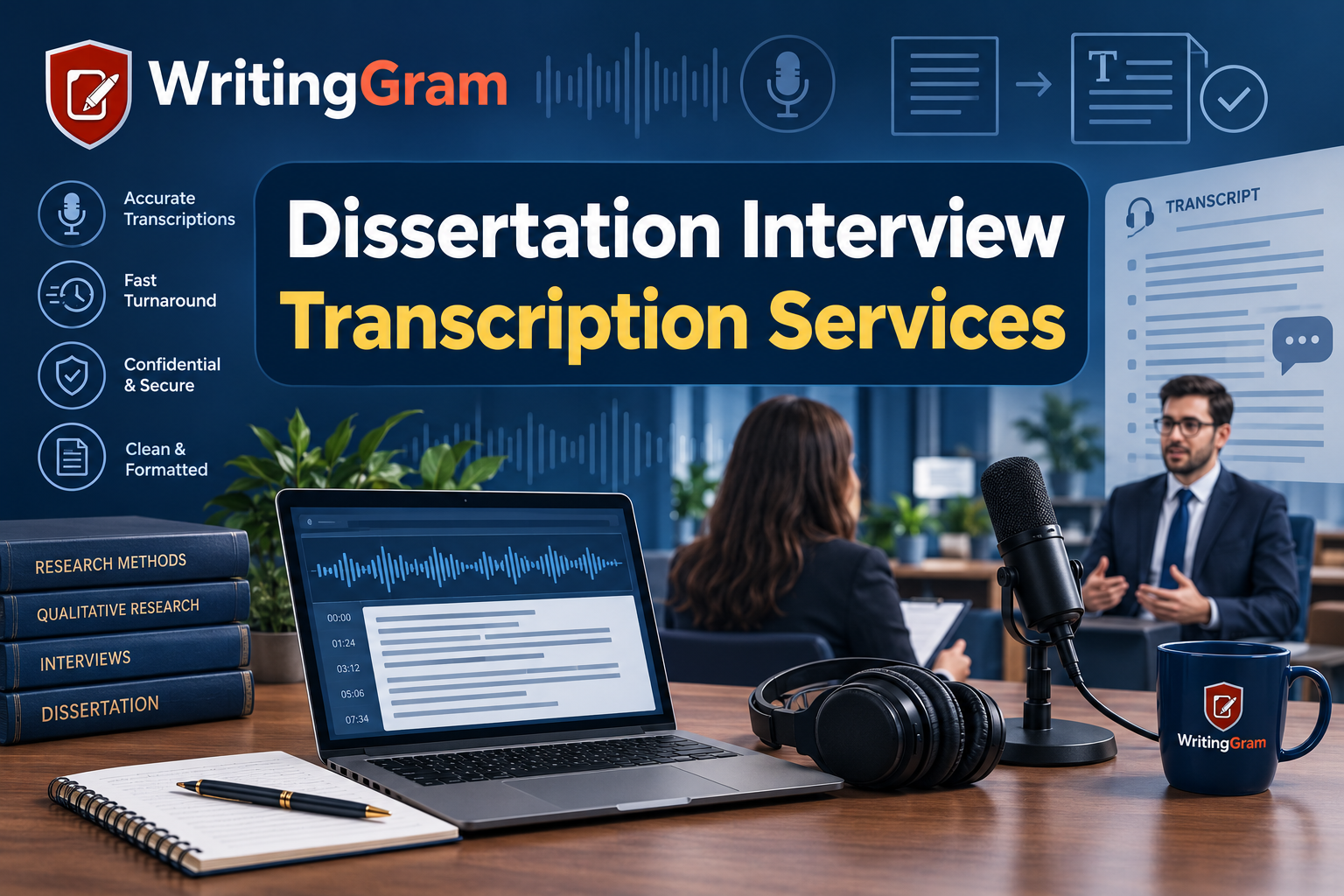
Get accurate dissertation interview transcription services from Writing Gram. Order verbatim PhD interview transcripts with speaker labels and timestamps.
Dissertation interview transcription services help PhD researchers turn recorded interviews into organized written transcripts for their research. Depending on your requirements, transcripts can include verbatim speech, speaker labels, timestamps, and markers for unclear audio. If you have completed your qualitative interviews but need help preparing the recordings for review and analysis, a transcription service can save you time and give you text you can work with.
When Do You Need Dissertation Interview Transcription Services?
Transcribing interviews takes time, especially when your dissertation involves multiple participants or lengthy recordings. You may need to replay sections several times to distinguish speakers, check unfamiliar terms, or confirm exactly what someone said. Even a small number of unclear passages can slow down the process.
Professional transcription support can help you turn those recordings into readable research documents. Once the interviews are transcribed, you can review participants' responses, locate relevant quotations, and prepare your material for your chosen qualitative analysis method.
Turn Your Recorded Interviews Into Dissertation-Ready Transcripts
Writing Gram can help you transcribe your recorded PhD interviews into organized written documents, giving you more time to review your research and work on your dissertation instead of typing out hours of recordings yourself.
👉 Place your order now for dissertation interview transcription services and get your recorded research material prepared for the next stage of your work.
What Is Included in a PhD Interview Transcription Service?
A PhD interview transcription service converts recorded research interviews into written transcripts that you can review, code, and analyze. Depending on your research needs, you can request verbatim or clean verbatim transcription, speaker identification, timestamps, and clear markings for sections that are difficult to hear. Before ordering, consider which options suit your research methodology and university requirements.
PhD interview transcription services typically offer different transcription styles, speaker identification and timestamps, and ways to handle unclear speech, as outlined in the following sections:
1. Verbatim and Clean Verbatim Transcription
The transcription style determines how closely the written transcript follows the original recording.
Full verbatim transcription: Captures spoken words as they occur, including filler words, repetitions, false starts, and other speech features. This format can be useful when analyzing participants' language, pauses, or patterns of speech.
Clean verbatim transcription: Removes selected filler words and disfluencies to improve readability while preserving the speaker's intended meaning. It does not mean rewriting participants' answers or changing their meaning.
Neither format is automatically suitable for every PhD project. Choose the style that aligns with your qualitative research methodology, analytical approach, and institutional requirements.
2. Speaker Labels and Timestamps
Speaker labels and timestamps help you navigate your transcripts and connect written responses to the original recordings.
Speaker labels: Distinguish the interviewer from individual participants, using labels such as Interviewer, Participant 1, and Participant 2.
Timestamps: Mark specific points in the recording so you can locate responses, check quotations, and verify passages during analysis.
Consistent formatting: Organizes questions and responses in a readable structure that supports transcript review and coding.
You can specify whether you need timestamps throughout the transcript or only at selected intervals, depending on your research requirements.
3. Handling Unclear Words and Difficult Audio
Background noise, overlapping speech, unfamiliar terminology, and differences in pronunciation can make some passages difficult to transcribe accurately. A reliable transcription process should distinguish what can be heard clearly from what requires further review.
When a word or passage cannot be understood confidently, it should be marked as unclear or uncertain, with a timestamp where appropriate, rather than completed by guessing. You can then revisit the recording or seek clarification when possible.
George Mason University’s qualitative research transcription guide discusses transcription considerations and the limitations of automated transcription. These issues matter in PhD research because inaccurate wording or undocumented transcription decisions can affect how interview data are interpreted.
Before ordering, consider whether your recordings contain overlapping conversations, technical vocabulary, or sections with poor audio quality. Sharing these details in advance can help establish realistic expectations for transcript accuracy and formatting.
Which Transcript Format Is Right for Your Dissertation?
The best transcript format depends on your research questions, how you plan to analyze your interview data, and any transcription requirements set by your university. Understanding the options can help you request transcripts that suit your project.
Transcript format | Best suited to |
Full verbatim | Research that requires the exact spoken words, including filler words, repetitions, and false starts. |
Clean verbatim | Research that needs readable transcripts with selected disfluencies removed while preserving participants' intended meaning. |
Speaker-labelled transcript | Interviews with multiple speakers where each person's contributions need to be distinguished. |
Timestamped transcript | Research that requires specific passages to be located and checked against the original recording. |
Anonymized transcript | Research where direct identifiers, such as names or contact details, need to be removed or replaced to protect participants' identities. |
You do not necessarily have to choose just one format. These options can be combined to meet your research needs. For example, you could request a full verbatim transcript with speaker labels and timestamps, while replacing participants' names with pseudonyms.
The University of Illinois Urbana-Champaign's qualitative research transcription guide provides guidance on transcription choices and their relationship to qualitative research. The way speech and interactions are represented can affect the material available for analysis, so choose a format that supports your methodology and follow any applicable university requirements.
How Does Dissertation Audio Transcription Work?
Dissertation audio transcription turns your recorded research interviews into written transcripts that you can review, code, and analyze as part of your PhD research. The process involves preparing your recordings, converting speech into text, checking the transcript, and receiving the completed files in your requested format.
1. Submit Your Recordings and Instructions
Start by providing your audio or video recordings and explaining how you need the transcripts prepared. To help ensure the transcripts meet your research requirements, specify:
Transcription style: Full verbatim or clean verbatim, depending on your research methodology.
Speaker identification: Labels for the interviewer and each participant.
Timestamps: Whether you need time markers throughout the transcript or at selected intervals.
Anonymization: Any names or identifying details that need to be removed or replaced with pseudonyms.
File format: Your preferred delivery format, such as Microsoft Word or plain text.
If your recordings contain specialist terminology, strong background noise, or overlapping speech, mention this before the project begins.
2. Convert the Recordings Into Written Transcripts
The audio is transcribed according to your agreed requirements. This involves converting spoken responses into text while preserving the wording and meaning required by your selected transcription style.
Where necessary, speaker labels and timestamps are added to help you identify individual responses and locate passages in the original recording.
3. Review the Transcript for Accuracy and Consistency
A transcript should be checked against the recording to identify potential transcription errors and inconsistencies. Depending on the service, this review may include:
Checking spoken words and speaker identification against the recording.
Correcting spelling, punctuation, and formatting errors without changing participants' intended meaning.
Checking specialist terminology and names where they can be verified.
Flagging words or passages that cannot be understood confidently instead of guessing what was said.
Confirming that agreed anonymization and formatting instructions have been followed.
The extent of the review depends on the service provided. For research purposes, transcripts should be checked carefully because errors or changes in how speech is represented can affect subsequent analysis.
4. Receive Your Completed Transcript Files
Once transcription and the agreed checks are complete, you receive the transcripts in the specified file format. You can then review the text, compare passages with the recordings, and prepare your interview data for coding and analysis.
Before using the transcripts in your dissertation, check that they meet your university's requirements and that participant confidentiality has been maintained.
What Affects Transcription Time and Effort?
The time and effort required to transcribe your interviews depend on several factors:
Recording length: Longer interviews generally require more transcription work.
Audio quality: Background noise, low volume, and overlapping speech can make transcription more difficult.
Number of speakers: Interviews with several participants may require additional speaker identification.
Technical terminology: Subject-specific vocabulary may require extra checking.
Transcription style: Full verbatim transcription may require more detailed representation of speech than clean verbatim transcription.
Additional requirements: Timestamps, anonymization, and specific formatting can add to the work involved.
The University of Denver's guide to obtaining interview transcripts explains how researchers can obtain transcripts from different recording platforms and work with features such as speaker names and timestamps. The steps vary depending on the recording tool, so the process may differ when using automated transcription software or a transcription service.
How Is Confidentiality Handled During Interview Transcription?
Dissertation interviews can contain sensitive information, including participants’ names, workplace details, personal experiences, and opinions they may not want shared publicly. At Writing Gram, we offer confidential academic writing services to help you prepare dissertation materials while reducing the risk of exposing participants’ identities or disclosing sensitive research details. Before submitting interview recordings for transcription, check your university’s ethics requirements and confirm how your files will be accessed, transferred, stored, and removed after the work is complete.
What Should You Consider Before Sharing Interview Recordings?
Before submitting your audio or video files for transcription, check your university’s research ethics requirements, participant consent forms, and data protection procedures. These determine whether you can share recordings with an external service and what safeguards your project requires.
You should also establish the following:
Secure file transfer: Determine how recordings and other research materials will be shared and whether the transfer method meets your institution’s requirements.
Access to your recordings: Confirm who may access your files and whether anyone else will be involved in preparing your transcripts.
Anonymization and pseudonyms: Tell us if participant names must be replaced with pseudonyms or labels such as “Participant 1.” Consider whether workplace names, locations, job titles, or other details could identify participants.
Transcript handling and retention: Clarify how completed transcripts will be delivered, how long recordings and documents will be retained, and whether deletion is available when the work is complete.
Confidentiality requirements: Share any specific instructions from your university or research ethics committee before the transcription work begins.
These precautions are particularly important when your dissertation involves vulnerable participants, sensitive personal experiences, confidential workplace information, or research conducted under strict ethical conditions.
How We Protect Your Dissertation’s Confidentiality
Your dissertation may contain interview recordings, participant details, and personal accounts that should not be shared publicly. At Writing Gram, we offer confidential academic writing services and encourage you to tell us about any privacy requirements that apply to your project before placing an order. This helps us discuss your needs before you share sensitive research materials.
Before submitting your recordings or dissertation files to us, clarify the following:
File transfer: How will you send your recordings and documents, and is the transfer method suitable for your research requirements?
Access to your files: Who will be able to access your materials while the work is being completed?
Participant anonymity: Do names, workplace details, locations, or other identifying information need to be removed or replaced with pseudonyms?
File retention and deletion: How long will your recordings and documents be retained, and can they be deleted once the work is complete?
University requirements: Does your research ethics approval or participant consent allow you to share recordings with an external academic service?
When you contact us, we can discuss your dissertation’s confidentiality requirements and clarify how your files will be handled before you share your research materials. If you require specific safeguards, such as restricted file access, anonymization, secure file transfer, or deletion after completion, please let us know so we can confirm which arrangements are available for your order.
You should also check your university’s research ethics requirements and participant consent forms before sharing recordings. If your study requires approval to share research data with anyone outside your research team, obtain that approval before submitting your files.
As Duke Research & Innovation’s confidentiality guidance explains, protecting sensitive research information involves establishing clear procedures for how data is accessed, used, and protected.
At Writing Gram, we treat your dissertation materials as confidential and take steps to protect your privacy, so you can receive the academic support you need without exposing sensitive research information.
What Should You Provide When Ordering Dissertation Interview Transcription?
Preparing your interview recordings and instructions before placing your order helps us understand your requirements, prepare accurate transcripts, and deliver files in a format you can use for your dissertation research.
To help us get started, please prepare the following information:
Audio or video recordings: Provide the recordings you want transcribed in an accessible file format.
Interview duration and quantity: Tell us how many recordings you have and how long each interview lasts so we can assess the scope of the work.
Speaker information: Indicate how many people speak in each recording and provide speaker names, labels, or pseudonyms if appropriate.
Transcription style: Specify whether you need full verbatim transcription, which captures speech details such as filler words and repetitions, or clean verbatim transcription, which removes selected disfluencies while preserving the intended meaning.
Timestamps and formatting: Tell us whether you need timestamps, speaker labels, and a particular document format, such as Microsoft Word.
Specialist terminology: Include a glossary of technical terms, abbreviations, names, or subject-specific vocabulary when available. This can help reduce transcription errors.
Anonymization instructions: Explain whether participant names or other identifying details must be removed or replaced with pseudonyms.
Deadline: Give us your required delivery date so we can discuss whether the project can be completed within your timeframe.
What Else Should You Tell Us Before Ordering?
Please let us know if your recordings contain background noise, overlapping speech, unfamiliar accents, or sections that are difficult to hear. Sharing these details in advance helps us assess the recordings and discuss how unclear passages should be handled.
If your dissertation involves sensitive participant information, check your university's research ethics requirements and participant consent forms before sharing recordings. Confirm whether sharing the files is permitted and whether specific confidentiality or data-handling procedures apply to your project.
St. Lawrence University's guidance on informed consent explains important considerations when informing research participants about how their data will be used, who may access it, and how confidentiality will be addressed.
Ready to get your dissertation interviews transcribed? Place your order now for accurate, professionally prepared transcripts that help you organize your interview data and prepare it for dissertation analysis. Include your preferred transcription style, formatting requirements, and deadline so we can understand your needs.
Why Choose Writing Gram for Dissertation Interview Transcription?
Turning recorded dissertation interviews into accurate, organized transcripts can save you time and make it easier to prepare your research data for analysis. At Writing Gram, we help you convert your recorded interviews into written transcripts based on your instructions and preferred format.
Our dissertation interview transcription service can accommodate your requirements for:
Verbatim or clean verbatim transcription: Choose whether to retain speech details such as filler words and repetitions or remove selected disfluencies while preserving the intended meaning.
Speaker identification: Use consistent speaker labels to distinguish the interviewer from research participants.
Timestamps: Locate specific responses in your recordings more easily when timestamps are requested.
Unclear passages: Identify sections of difficult audio for review instead of relying on guessed words.
Formatting preferences: Receive transcripts organized according to your specified document format and instructions.
Our goal is to provide transcripts that are easier to review, organize, and use in your dissertation research. You can then work with the transcripts according to your chosen methodology, whether you are preparing interview data for qualitative coding, thematic analysis, or another research approach.
Please note that transcription converts recorded speech into written text. Coding, theme development, and interpretation of findings are separate analytical tasks and are not automatically included in a transcription order.
👉 Place your order now for dissertation interview transcription that follows your specified transcript format and research requirements.
Frequently Asked Questions About Dissertation Interview Transcription
Choosing a dissertation interview transcription service involves more than converting recordings into text. Below, we answer common questions about our service, transcript formats, accuracy, confidentiality, and preparing your interview data for dissertation analysis.
What Is a Dissertation Interview Transcription Service?
A dissertation interview transcription service converts recorded research interviews into written text. Our service helps you turn your audio or video recordings into transcripts that you can review, organize, and use when preparing your dissertation data for analysis.
What Types of Dissertation Interview Transcription Do You Offer?
We can prepare transcripts according to your specified transcription style and formatting requirements. Depending on your needs, you can request:
Full verbatim transcription: Preserves spoken words, including filler words, repetitions, and false starts.
Clean verbatim transcription: Removes selected disfluencies while preserving the intended meaning of participants' responses.
Speaker identification: Distinguishes the interviewer and participants using consistent labels.
Timestamped transcription: Includes timestamps to help you locate specific passages in your recordings.
Anonymized transcripts: Follows your instructions for replacing names or removing identifying details, where agreed as part of the service.
Please specify your preferred transcription style and any additional requirements when placing your order.
Should I Choose Full Verbatim or Clean Verbatim Transcription?
The best choice depends on your research questions, analytical approach, and university requirements.
Choose full verbatim if details such as filler words, repetitions, and false starts are relevant to your analysis. Clean verbatim may be more suitable when you need readable transcripts that preserve participants' intended meaning without every speech disfluency.
If your supervisor or research methodology specifies a transcription style, follow those requirements when ordering.
Can You Transcribe Interviews With Multiple Participants?
Yes, you can specify speaker identification requirements when ordering transcripts of interviews involving multiple participants. Consistent speaker labels help you distinguish responses and identify who said what during the interview. If you know the participants' names or preferred pseudonyms, provide clear instructions about how each speaker should be labeled.
Can You Include Timestamps in My Dissertation Interview Transcripts?
Yes, you can request timestamps if you need to locate particular responses or compare transcript passages with the original recordings. Tell us whether you need timestamps at regular intervals or at specific points, such as when a new speaker begins talking, so we can clarify your formatting requirements.
How Do You Handle Unclear Words or Poor Audio Quality?
Background noise, overlapping speech, unfamiliar terminology, and low recording volume can make some passages difficult to understand. We can follow agreed instructions for identifying uncertain or unintelligible sections instead of presenting guessed words as accurate transcription.
If your recordings have sound-quality problems, let us know before ordering. The extent to which unclear speech can be resolved depends on the recording itself.
What Do I Need to Provide When Ordering Dissertation Transcription?
To help us understand your project and prepare transcripts that meet your requirements, please provide:
Your audio or video recordings in an accessible format.
The number and duration of the interviews.
Speaker information and labeling instructions.
Your preferred transcription style.
Any timestamp, anonymization, or formatting requirements.
A glossary of specialist terminology, if available.
Your required delivery date.
Providing these details in advance helps us assess the scope of your order and clarify any questions before transcription begins.
How Long Does Dissertation Interview Transcription Take?
Turnaround time depends on the total recording duration, audio quality, number of speakers, specialist terminology, and requested formatting. Additional requirements, such as detailed timestamps, may also affect the time needed.
Include your deadline when placing your order so we can assess whether your requested delivery date is feasible.
Do You Offer Confidential Dissertation Interview Transcription?
We offer confidential academic services and recognize that dissertation recordings may contain sensitive participant information. We take confidentiality seriously and can discuss the applicable file-handling arrangements for your order.
Before sharing recordings, check your participant consent forms and university research ethics requirements. If your project requires particular safeguards, such as anonymization, restricted access, or file deletion after completion, confirm the relevant arrangements before submitting your materials.
Does Your Dissertation Transcription Service Include Qualitative Data Analysis?
Transcription and qualitative data analysis are different tasks. Transcription converts recorded speech into written text, while qualitative analysis may involve coding, developing themes, interpreting responses, and connecting findings to your research questions.
Our transcription service should not be assumed to include coding or thematic analysis unless those tasks have been explicitly agreed as part of your order.
Can You Format Transcripts According to My University’s Requirements?
You can provide your university's transcription guidelines or formatting instructions when placing your order. These may specify speaker labels, timestamps, anonymization, spelling conventions, or how pauses and unclear passages should be represented.
We can review your instructions and clarify the formatting requirements for your requested service before the work begins.
What File Format Will I Receive My Transcripts In?
Please specify your preferred output format when placing your order. For example, you may need an editable Microsoft Word document for reviewing and annotating transcripts or a plain-text file for transferring data into compatible qualitative analysis software. Confirm your preferred format before work begins.
How Do I Order Dissertation Interview Transcription?
To get started, prepare your recordings and specify your transcription style, speaker labels, timestamp requirements, formatting preferences, and deadline. Include any relevant confidentiality instructions so the requirements can be clarified before you share sensitive materials.
Order Dissertation Interview Transcription Services
Turn your recorded dissertation interviews into written transcripts you can review, organize, and use in your research. We transcribe your audio or video recordings into text, with speaker labels, timestamps, and your preferred transcription style included according to your order requirements.
👉 Place your order now for dissertation interview transcription and receive written transcripts of your recorded interviews, prepared according to your specified formatting and transcription requirements.